Part 2: The Biker Read Princess Stories — Then the Librarian Told Us Why
His name was Raymond Keller, but everyone on the road called him Brick.
Not because he was mean. Because he was hard to move.
Brick had been riding with the Crosswind Riders for almost twenty years, a working-class club out near Sapulpa where Route 66 bends past old gas stations, tire shops, diners, and fields that look brown most of the year. They were not famous. They did not want to be. They did charity runs, funeral escorts, veteran breakfasts, Christmas toy drives, and the kind of quiet help nobody posts about unless somebody else catches it on camera.
I learned most of this from Ms. Clara after story hour, while Brick was outside tightening a loose strap on his saddlebag.
“He won’t tell you,” she said. “So I will.”
Brick had grown up in a house where books were treated like decorations for people who had time. His father worked oil rigs, drank hard, and believed boys needed tools more than words. His mother signed school forms with an X until a church lady taught her to write her name at thirty-seven.
Brick made it to ninth grade before he quit.
He could read signs. Menus if they had pictures. Labels if he had seen them before. He memorized routes, prices, phone numbers, faces, engine sounds. He was not stupid. That was the part Ms. Clara kept repeating.
“He was never stupid,” she said, sharp enough that I knew somebody had once called him that.
Brick hid it the way men hide old pain. With silence. With jokes. With anger if someone pushed too close. He kept a small notebook in his vest but never wrote in it. He let other brothers read forms. He said he forgot his glasses when menus came. If a sign had too many words, he waited for someone else to react first.
The club knew something was off.
Brotherhood sees what pride tries to bury.
But men like Brick do not accept help just because it is offered. They need help disguised as work.
So his brothers gave him jobs that used what he knew. Road captain. Tool man. Escort lead. He could read traffic better than most men read newspapers. He knew when a rider was tired by the tilt of his helmet. He could hear a loose chain before the rider felt it. He knew which diner waitress needed cash left under the sugar caddy because she would never take a handout.
Then his daughter was born.
Lena.
Tiny thing. Dark hair. Serious eyes. Born when Brick was thirty-nine and already convinced the softest part of his life was behind him.
She changed the sound of his house.
Before Lena, his garage was all metal and radio static. After Lena, there were plastic tea cups on workbenches, tiny socks in tool drawers, alphabet magnets stuck to the beer fridge, and picture books left on his motorcycle seat like parking tickets from God.
At first, Brick pretended story time was her mother’s job.
“Daddy reads engines,” he’d say.
Lena did not care.
She would climb into his lap with a book and slap the cover with one tiny hand.
“Read.”
Brick would cough, shift, and say he was tired.
Then one night, when Lena was four, she opened a pink princess book and pointed to the first word.
“This says once,” she told him.
Brick stared.
She pointed again.
“Once.”
He repeated it.
“Once.”
That was the beginning.
The false ending of Brick’s story happened when Lena was twelve.
By then, he could read.
Not fast. Not smooth. Not like people who had done it since kindergarten. He still moved his lips when the words got long. He still hated paperwork. He still got sweat on his upper lip when someone handed him a form in public. But he could read bedtime books, road signs, birthday cards, and the notes Lena left on the fridge.
She had taught him.
Every night for years, ten minutes at a time.
No shame. No laughing. No school desk. Just a father and daughter at the kitchen table with a pencil, a library card, and a stack of children’s books Ms. Clara kept saving for them.
Lena made rules.
No quitting after one mistake. No saying “I’m dumb.” No throwing the pencil. No skipping the princess books just because Daddy thought dragons were better.
Brick followed them because she was stricter than any club president he had ever known.
When Lena got sick, everything changed fast.
Leukemia.
Even now, Ms. Clara said the word like she hated giving it air.
Brick’s world became hospital parking garages, plastic bracelets, insurance calls, vending machine dinners, and the soft beep of machines beside a bed too small for the size of his fear. The Crosswind Riders showed up in shifts. Preacher sat with him during chemo. Moose fixed the heat in Brick’s house without asking. Their president, a woman named Jo “Hatchet” Marlow, organized rides to cover gas money and never once made Brick say thank you in front of people.
Brotherhood got tested there.
Because Brick wanted to disappear into anger.
He stopped coming to church. Stopped answering calls. Snapped at brothers who offered help. One night, in the hospital parking lot, he told Jo to take the club and go to hell.
Jo stood there under a buzzing light, rain dripping from her helmet, and said, “No.”
Brick stared at her.
She stepped closer.
“You don’t get to fire family because you’re scared.”
He could have yelled. Could have broken. Could have swung at the concrete wall until his knuckles opened. Instead, his shoulders dropped.
“I can’t read the medication sheet,” he said.
That was the first time he said it out loud to anyone but Lena.
Jo took the paper from his shaking hand. She did not make a face. Did not soften her voice too much. Men like Brick can hear pity from across a parking lot.
She only said, “Then we read it together.”
For a while, it looked like Lena might beat it.
There were good scans. Better blood counts. A birthday party in the hospital family room with cupcakes nobody liked and decorations from a dollar store. Brick read her a whole chapter book that night, slow and stubborn, while she lay under a yellow blanket with no hair and a smile too big for her tired face.
At the end, she whispered, “See? You’re not scared of words anymore.”
Brick said, “Still scared of plenty.”
Lena reached for his hand.
“Then read anyway.”
She died six months later.
Brick did not cry at the funeral.
Not where people could see.
He stood beside the small white casket with his hands folded in front of him, eyes red but dry, beard trimmed because Lena had once told him he looked “too wizardy.” When the pastor asked if he wanted to say something, Brick shook his head.
He had written a note.
He could not read it.
Not there.
Not with the whole room watching.
So he folded it back into his vest and carried it home like a stone.
Everybody thought that was where the story ended.
A biker learned to read for his daughter, lost her, and went quiet again.
But Lena had planned for that.
Three weeks after the funeral, Ms. Clara found an envelope taped under the returns desk.
Her name was written on it in purple marker.
Inside was a letter from Lena.
Twelve years old. Crooked handwriting. Stronger heart than most adults.
Ms. Clara still kept a copy in her office, folded inside a princess book with a cracked spine.
The letter said Brick would stop reading if nobody made him.
It said he would pretend he was busy.
It said he would say children’s books were silly now.
Then Lena wrote: “Please don’t let him forget that slow reading still counts.”
At the bottom, she had drawn a little motorcycle with a crown on the seat.
That was the pre-planned twist.
Lena had not just taught him to read. She had left him homework for after she was gone.
Every month, she wanted him to read at the library.
Not to honor her with a plaque. Not to start some big charity with a name on a banner. Just sit on the rug and read slowly to children whose parents worked double shifts, children in foster care, children whose grandparents brought them because home was too loud, too tired, or too empty.
When Ms. Clara called Brick, he hung up the first time.
The second time, he listened.
The third time, he showed up at the library after closing.
His Harley rolled into the parking lot just after sunset, that V-twin rumble bouncing off the brick wall, then cutting into silence. He walked in with his cut on, boots wet from rain, face hard as a locked gate.
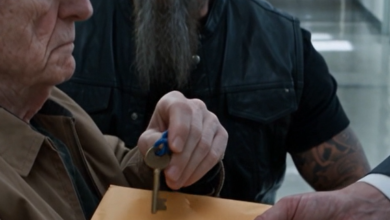
Ms. Clara handed him Lena’s letter.
He read it standing by the picture-book shelves.
Slowly.
Word by word.
His lips moved. His tattooed finger followed the lines. Halfway through, his hand started shaking. Near the little motorcycle drawing, he pressed the paper to his chest and looked at the ceiling like he was trying to keep himself from making a sound.
Ms. Clara asked, “Will you do it?”
Brick shook his head.
“I ain’t good enough.”
She said, “That is exactly why you are.”
He came the next Saturday.
Only three children showed up.
He read so slowly one little boy fell asleep.
Brick called Ms. Clara afterward and said he had failed.
She told him the sleeping boy had not slept through a full story in months.
Brick went quiet.
Then he said, “Next month?”
And he has never missed one since.
That was what Ms. Clara told me after the video went viral.
The parent who recorded him reading had posted it with a caption that said, “Only in Tulsa: biker reads princess stories better than Disney.”
It got shared everywhere.
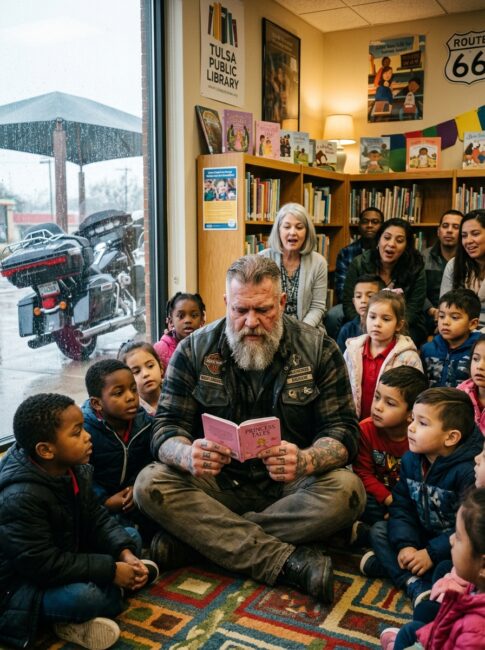
People laughed first. Of course they did. The image was strange enough to make strangers stop scrolling. A gray-bearded biker with tattooed arms holding a tiny pink book like it was a court document. His voice deep enough to vibrate the bookshelf. Eighteen kids sitting in front of him like he was the safest person in Oklahoma.
But then the comments changed.
Parents noticed how he paused when a child looked confused. Teachers noticed how he ran his finger under every sentence. Other adults admitted they had trouble reading too. Men wrote things like, “I’m 46 and I still fake it at restaurants.” Women wrote, “My dad couldn’t read, but he could fix anything.”
The whole country saw the contrast.
But only those of us in the room saw the truth under it.
Every detail had a reason.
The pink princess book was not random. It was the first book Lena used to teach him the word “once.”
The slow reading was not a performance. It was survival. It was a man refusing to be ashamed of the pace that saved him.
The way he held the book with both hands, careful and square, came from years of treating books like things that could run away if he grabbed too hard.
The tiny laminated card tucked inside his vest was not a club ID. It was Lena’s old reading rule card. Ms. Clara showed it to me once with Brick’s permission.
No quitting after one mistake.
No saying dumb.
Sound it out.
Read anyway.
Brick never gave long speeches. That would have ruined it. He arrived, read, let kids interrupt him, gave out stickers, and left. Sometimes he stopped at Mabel’s Diner on Peoria Avenue afterward and ordered black coffee with one slice of lemon pie he never finished.
One Saturday, a boy named Carter refused to sit with the group.
Eight years old. White kid. Shaved head from lice treatment. Foster placement. Angry at everything. He kicked the leg of a chair and said reading was stupid.
The room went tense.
Parents expected Brick to correct him.
Brick closed the book.
“Yeah,” he said. “Feels that way when the words bite first.”
Carter looked up.
Brick patted the rug beside him.
“Sit here. You tell me when I go too fast.”
The boy did.
For the rest of story hour, Carter sat beside the biggest man in the room and stopped him every time a word felt too quick.
“Slow down,” Carter said.
Brick nodded.
“My bad.”
Nobody laughed.
That was the moment I understood what Lena had built. She had turned her father’s wound into a doorway. Kids who struggled did not feel dumb beside Brick. They felt accompanied.
At the end of that morning, the same child who called reading stupid asked if Brick would come back next week.
Brick said, “I come every month.”
Carter frowned.
“That’s too slow.”
Brick smiled.
“Some things are worth waiting on.”
Now, on the first Saturday of every month, you can hear Brick before you see him.
The Harley rolls off Peoria, past the diner, past the pawn shop, past the old Route 66 sign with chipped paint, and into the library lot at 9:40 sharp. Not 9:39. Not 9:41. Brick says children who wait for stories should not have to wonder if the reader forgot them.
The engine cuts.
The little metal clicks begin.
Then the boots.
Heavy on the sidewalk. Slow near the children’s entrance because toddlers move like drunk birds and Brick does not trust himself to turn corners fast around them.
He takes off his gloves before touching any book.
Always.
That is one of his rules.
The Crosswind Riders started coming too, one or two at a time. Not to take over. Just to sit in the back, fix loose chair legs, carry donation boxes, and keep the coffee pot from burning down the building. Jo brings new books twice a year. Preacher built a little wooden book cart with wheels that squeak no matter how much oil he uses. The prospects clean the parking lot before summer reading day.
Brick still reads princess stories.
Dragons too. Trucks. Dinosaurs. Bears who apologize. Rabbits who get lost and find their way home.
But he always ends with a princess book.
Always.
If a new parent asks why, Ms. Clara only says, “That one has history.”
Once a year, on Lena’s birthday, Brick rides out to a small cemetery east of Tulsa before the library opens. He brings a pink book, reads one page at her stone, then closes it before the last line.
“Save me a place,” he says.
Then he rides to story hour.
The kids never know that part.
They just know the big man smells like rain, leather, coffee, and cold air. They know his beard moves when he does the dragon voice. They know he lets them correct him. They know he never laughs when they stumble.
The video made him famous for a week.
The ritual made him theirs.
Last month, I watched Brick read to twenty-six children.
The room was too full. Kids sat on coats. Parents stood near shelves. A little girl in pink rain boots crawled into the front row and placed her stuffed cat against Brick’s boot like she had appointed him security.
He looked down at it.
“Guard duty?” he asked.
She nodded.
Brick nodded back.
“Understood.”
Then he opened the same worn princess book.
The cover had tape on the spine now. The pages were soft from years of hands. His tattooed thumb found the first line like an old road.
“Once,” he read.
He paused.
A boy beside him whispered, “Upon.”
Brick smiled.
“Upon,” he repeated.
The story moved slowly. Nobody rushed him. Outside, rain slid down the windows. Somewhere in the parking lot, his Harley cooled under gray Oklahoma light. Inside, eighteen children became twenty-six, and not one of them asked why the biker read so slow.
They already knew.
When the story ended, a mother thanked him for being patient with her son.
Brick put the book back in Ms. Clara’s basket and stood with a soft grunt, knees stiff, leather cut creaking over his shoulders.
He looked at the kids, then at the parents, then at the little boy still tracing words on the carpet with one finger.
“Every kid deserves somebody who reads slow for them,” he said.
Then he walked outside.
Boots on tile.
Rain on leather.
Engine turning over.
A deep rumble fading toward Route 66.
One pink book left warm on the rug.
Read anyway.
Follow the page for more biker stories that make people look twice before they judge.