Part 2: The Biker Wore a Unicorn Backpack — Then Silenced the Whole Club
I was the secretary for the Red River Saints MC back then, which mostly meant I wrote down what men forgot, paid bills nobody wanted to look at, and kept track of which brother owed which brother an apology. Our clubhouse sat behind an old tire shop outside Amarillo, close enough to I-40 that you could hear semis downshifting at night like tired animals.
Grizzly had been with us twelve years.
Before that, he had been a lot of things.
A bouncer. A welder. A drunk. A man who disappeared for three months and came back thinner. A man who once slept behind a church because he was too proud to ask for a couch. He had done ninety days county for breaking a man’s jaw outside a pool hall, but he never bragged about it. If somebody brought it up, he’d only say, “Wasn’t my finest hour.”
That was Grizzly. He did not polish the ugly parts. He just carried them.
His old lady, Rachel, used to say he was built like a locked door and soft as bread if you knew where to knock.
Rachel died when their daughter, Maisie, was two.
A blood clot after surgery. Fast. Stupid fast. One morning she was making pancakes with too much vanilla. That evening Grizzly was sitting in a hospital hallway with a toddler asleep on his lap and a wedding ring cutting into his swollen finger.
Men like him are not taught how to be alone with a child.
They are taught how to work hurt. Ride hurt. Fight hurt. Keep their mouths shut. But nobody teaches a six-foot-four biker how to pack a daycare bag while his hands shake so hard he drops the applesauce pouch.
So the club tried.
Badly.
Preacher brought diapers but bought newborn size even though Maisie was almost three. Stitch bought a princess toothbrush and a hunting knife in the same Walmart trip. Bishop left a grocery card in Grizzly’s mailbox and pretended he had no idea how it got there.
Grizzly did not say thank you much.
He showed up.
That was his way.
He showed up to toy drives with Maisie on his hip. He showed up to funeral escorts with a car seat strapped into his truck. He showed up to meetings with dried oatmeal on his sleeve and little stickers stuck to the back of his cut. Once, he rode all the way to Tucumcari to help an old Vietnam vet fix a starter, then drove home through sleet because Maisie had a preschool Thanksgiving lunch the next morning and had ordered him to attend.
He attended.
He sat in a chair made for people half his size, wearing a black leather vest, eating dry turkey slices off a paper plate while Maisie introduced him to every stuffed animal in the room.
That little girl ran his life.
And he let her.
The seed we all missed was the way Grizzly had started carrying small things in big places. A baby spoon in his saddlebag. A sparkly Band-Aid in his wallet. A pink elastic on his throttle hand. He’d be at the club table talking about a charity ride and suddenly pull a crayon from his cut pocket like it was ammunition.
We teased him then too.
He never cared.
“Kid needs what she needs,” he’d say.
But we did not understand the full weight of that sentence until the night of the unicorn backpack.
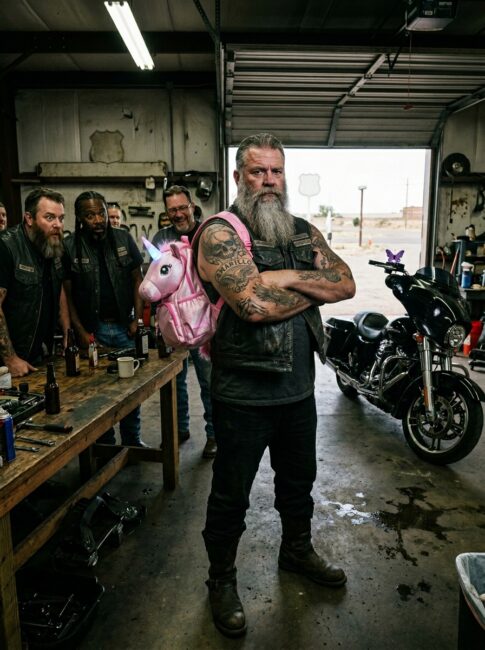
That Thursday meeting was supposed to be about a ride to Oklahoma City.
Nothing dramatic. Nothing heavy.
We were raising money for a mechanic named Daryl who had lost part of his hand in a shop accident. Good man. Three kids. Bad insurance. The club wanted to put together a run, pass the helmet around, maybe get two diners and a feed store to sponsor fuel.
Normal work.
Brotherhood sounds romantic until it becomes folding chairs, bad coffee, and men arguing for twenty minutes about whether the route should stop near a bathroom.
Grizzly was late.
That alone was strange.
He was a lot of things, but late was not one of them. If church started at nine, he was there at eight-thirty. If court said ten, he sat on the bench at nine. If Maisie’s school play started at six, he arrived at five with a bouquet and a face that warned every parent not to block his camera.
At 7:12, we heard his Harley roll in.
Deep V-twin rumble. Familiar. Then the engine cut.
The garage door was half open, and the sound of his boots came across the concrete before we saw him. Heavy. Slow. A little uneven, like he’d ridden hard or carried something awkward.
Then he stepped in with the unicorn backpack glowing behind him.
That was the false climax.
At least we thought it was.
The whole club had been tense that week. Bishop was in one of his hard moods. Daryl’s fundraiser was behind. Two younger guys had been running their mouths online, acting tougher than they were. Brotherhood was thinning around the edges. Men were tired. Money was tight. Everybody needed something to laugh at.
So they laughed at Grizzly.
Stitch asked if the unicorn had a road name.
Tank said the backpack matched Grizzly’s eyes.
A prospect snorted so hard coffee came out of his nose.
I laughed too. I hate admitting that, but I did. Not mean at first. Just surprised. A giant man wearing a child’s light-up backpack is funny when you don’t know the cost behind it.
Grizzly stood there and took it.
His face stayed still, but I saw his right hand flex once. Not into a fist. Not like anger. More like pain. His thumb rubbed the strap where tiny glitter stars had been glued to cheap nylon.
Then Bishop said, “You bring your daughter’s closet to church, brother?”
Club meetings were called church.
That made the room laugh again.
Grizzly looked at Bishop.
Not hard. Not disrespectful. Just tired.
“My daughter packed it,” he said.
That slowed a few men down.
“Maisie okay?” I asked.
He did not answer right away.
He walked to the table, slipped the backpack off, and set it down with both hands. The LED stars blinked between his scarred fingers. His shoulders rose once, then settled. His eyes were dry, but something around them looked pulled too tight.
“Had an asthma scare this morning,” he said.
The room changed.
Nobody laughed then.
Maisie had asthma. We knew that. Not bad every day, but bad enough that Grizzly watched air quality reports like other men watched football. He knew pollen counts. He knew which gas stations had clean bathrooms. He knew how far every ER was from every route we rode.
“Hospital?” Bishop asked.
“Almost.”
That one word hit harder than a speech.
Grizzly unzipped the backpack.
The zipper made a small, childish sound in that steel garage. Little plastic teeth opening under fluorescent lights.
Then he began laying things on the table.
An inhaler with Maisie’s name on it.
A spacer tube.
Wet wipes.
A tiny bottle of children’s allergy medicine.
A spare pair of socks with rainbows on them.
A folded plastic poncho.
A small stuffed bunny with one ear chewed flat.
Two granola bars.
A juice box.
A hairbrush.
A clean shirt.
A laminated card with emergency numbers, medication doses, and the address of Maisie’s school.
A little doll in a purple dress.
He lined it all up beside our ride map.
Then he looked at every man in the room.
“This backpack got my girl breathing before the ambulance came,” he said. “My leather saddlebag had a tire gauge and beef jerky.”
Nobody moved.
The unicorn lights kept blinking.
We thought the twist was that the backpack mattered.
It was not.
The real twist was that Grizzly had not come to defend himself.
He had come to call us out.
He placed both palms on the table, scarred fingers spread around the inhaler and the tiny doll, and looked at Bishop first. Not because Bishop had laughed. Because Bishop led us.
“You know what Maisie said before I left?” Grizzly asked.
Bishop stayed quiet.
“She said, ‘Daddy, your bag is ugly and it doesn’t know me.’”
A couple guys almost smiled, but nobody dared.
Grizzly continued.
“She put this unicorn thing on my back and told me it had everything I forget when I try to act like a grown man.”
That line sat there.
It was funny. It was also not funny at all.
“She was right,” he said.
Then he lifted the stuffed bunny. It looked ridiculous in his fist. Tiny. Soft. One ear flattened from years of being loved too hard.
“When she couldn’t breathe this morning, she didn’t ask for my patch. Didn’t ask how many miles I’ve ridden. Didn’t ask who feared me. She pointed at this bag.”
His voice got rough, but it did not break.
“She knew where her medicine was because a five-year-old organized what I was too proud to carry.”
That was the hidden identity twist in its own way. Not that Grizzly was secretly a doctor or a saint. He was secretly terrified. Terrified every day that he would fail the one person who still believed he hung the moon.
We had mistaken the backpack for a joke.
It was a survival kit.
A father’s confession.
A child’s trust in zipper form.
Then came the brotherhood test.
Tank leaned back and muttered, not quiet enough, “Still looks stupid.”
The room froze.
Tank was young. Big arms, small wisdom. The kind of man who thought shame was a leadership tool and tenderness was something you trained out of yourself.
Grizzly looked at him.
Bishop looked at him too.
The old President’s face went flat.
“What’d you say?” Bishop asked.
Tank shrugged, trying to save himself with a grin. “I mean, come on. We’re still a club. There’s a look. There’s a standard.”
Grizzly did not move.
But I saw his hand tremble beside the inhaler.
Not from anger.
From remembering his daughter’s chest fighting for air.
Bishop stood.
His chair scraped the concrete.
He was seventy years old, white-haired, with a bent left knee and eyes that made most men check their tone. He walked around the table, picked up the unicorn backpack, and held it by one strap. The LED horn blinked against his black cut.
“Standard?” Bishop said.
Tank swallowed.
Bishop looked around the room.
“Any man here too proud to carry what keeps his family alive can turn in his patch.”
Nobody breathed.
Then Bishop set the backpack down gently.
“Church continues,” he said.
And just like that, the joke died.
After the meeting, nobody left fast.
That was how you knew something had shifted. Usually, when church ended, men scattered toward cigarettes, engines, phones, and whatever women were tired of waiting at home. But that night, they stayed around the table, looking at the little objects Grizzly had pulled from the backpack like they were evidence from a life none of us had studied hard enough.
I finally understood all the small things from the past year.
The purple butterfly clip on his Harley was not decoration. Maisie had stuck it there after telling him the bike looked “too grumpy.” He left it because she checked every morning to see if it was still there.
The sparkly Band-Aids in his wallet were not a joke. He carried them because Maisie would let him clean a scraped knee only if the bandage had “magic.”
The crayon in his cut pocket was not trash. It was for diner placemats, long waits, and the terrible silence that comes after a child asks where her mother went.
The pink elastic on his throttle hand was not carelessness. It was for emergency ponytails, because Texas heat did not care how tough a man thought he was.
Every seed had been there.
We had just been too busy admiring leather to notice love.
Grizzly packed the items back slowly. Inhaler first. Spacer. Medicine. Wipes. Bunny. Doll. Snacks. Emergency card. Each thing had its place. Maisie had made sure of it.
Stitch stepped close.
He was the one who had laughed first, and it showed on his face.
“Brother,” he said, “I was running my mouth.”
Grizzly zipped the backpack.
“Yeah.”
That was all.
No speech. No forgiveness ceremony. Just the truth.
Stitch nodded.
“My granddaughter’s got peanut allergies,” he said. “I never carry the EpiPen. My old lady does.”
Grizzly looked at him.
“Maybe carry it.”
Stitch nodded again.
“Yeah.”
Preacher reached into his own saddlebag and pulled out a crushed pack of cigarettes, a wrench, and nothing useful to anybody under eighteen. He stared at it like it had betrayed him.
“My boy stays with me Saturdays,” he said. “I don’t even have kid Tylenol.”
“Then get some,” Bishop said.
That started it.
Not a big emotional scene. Bikers do not turn into poets just because a man opens a unicorn backpack. They grumble. They shift. They look at the floor. They act annoyed while quietly changing forever.
The next week, Stitch showed up with a red backpack covered in cartoon fire trucks. Inside were allergy meds, an EpiPen case, spare socks, peanut-free snacks, and a laminated card his daughter-in-law had made.
He dared anyone to laugh.
Nobody did.
Preacher brought a blue bag with dinosaurs because his son loved them. He had filled it with juice boxes, toy cars, wipes, and a tiny blanket that looked like it had fought a war in a washing machine.
Two prospects started keeping first-aid kits in their saddlebags. Not the macho kind with only tape and gauze. Real ones. Children’s fever reducer. Antiseptic wipes. Emergency contacts. Little comfort items.
Then Bishop came in.
That was the moment we still talk about.
Our President. Hard old Bishop. Man who once rode three states with a cracked rib and refused a hospital because “chairs there are uncomfortable.” He walked into church wearing his regular black cut, old boots, silver beard, and a green dinosaur backpack that belonged to his grandson Eli.
It had spikes.
Soft yellow spikes running down the back.
The garage went silent.
Bishop looked around.
“Say one word,” he said.
Nobody did.
He sat at the head of the table, set the dinosaur backpack beside the club ledger, and pulled out a juice pouch before the meeting started.
For himself.
“Eli says these are elite,” he said.
Grizzly laughed then.
A real laugh.
Small, rusty, surprised.
It was the first time I had heard him laugh since Rachel died.
After that, the Red River Saints changed in a way no bylaws could explain.
We still rode.
Still argued routes. Still drank bad coffee. Still had men with scars, records, ex-wives, sore knees, and tempers they had to keep on a leash.
But on Saturdays, the clubhouse looked different.
There were coloring books in the office drawer. Applesauce pouches in the fridge. A basket of ear protection for kids during charity rides. A shelf by the door where cartoon backpacks sat beside helmets and leather gloves.
Unicorn.
Dinosaur.
Fire truck.
Spider-Man.
One with sunflowers that belonged to Stitch’s granddaughter.
One plain purple bag Grizzly bought later because Maisie said the unicorn needed “a sister.”
Nobody called them diaper bags or kid bags.
Bishop named them road kits.
That made them official enough for men who needed official names before they could admit something mattered.
Every month, before a family ride, Grizzly inspected them like a sergeant. Inhalers not expired. Allergy meds labeled. Emergency cards updated. Snacks not crushed into dust. Comfort toys present. Wipes sealed.
He never made it sentimental.
He made it practical.
That helped the men accept it.
One evening, I saw him sitting outside the clubhouse at sunset, the Amarillo sky turning orange behind the tire shop, the highway humming beyond the fence. Maisie was asleep against his chest in a folding chair, one small hand hooked into his beard. The unicorn backpack sat on the ground between his boots, lights blinking weakly because the batteries were dying.
“You know she’s gonna outgrow that thing,” I said.
Grizzly looked down at the bag.
“Not yet.”
That was all.
A week later, he replaced the batteries.
Not the backpack.
Just the lights.
He kept wearing it until Maisie herself promoted him to the purple one. She gave him a whole ceremony in the driveway. Paper crown. Plastic wand. Serious face.
“You are now Daddy Pack Number Two,” she said.
Grizzly bowed like a knight.
His Harley idled by the curb, that low V-twin rumble shaking the morning air, while a five-year-old girl placed a purple backpack on a man most strangers were afraid to look at.
He wore it to church that night.
Nobody laughed.
Three years later, Daryl—the mechanic we were raising money for that first night—brought his youngest daughter to a club barbecue.
She was seven. Shy. Freckles. Red hair. The kind of kid who hides behind a parent’s leg until she knows the room won’t bite.
Halfway through lunch, she tripped near the picnic tables and scraped both knees on the gravel.
Before her father could even stand, three bikers moved.
Stitch had the first-aid kit.
Preacher had a juice box.
Bishop had a dinosaur sticker.
Grizzly crouched in front of her, knees popping, leather creaking, tattoos bright in the sun. He held out two Band-Aids.
One plain.
One sparkly purple.
The little girl sniffed and pointed at the purple one.
“Good choice,” Grizzly said.
Maisie, eight by then, stood beside him with her arms crossed like a tiny supervisor.
“You gotta blow on it first, Daddy,” she said.
Grizzly obeyed.
A dozen Harleys sat in a row behind them, chrome hot, engines cooling, metal ticking in the Texas afternoon. The clubhouse smelled like barbecue smoke, gasoline, sunscreen, and coffee. Men with skull patches and gray beards passed napkins, opened juice pouches, tied shoelaces, and argued over who had the better snack stash.
When the girl stopped crying, she looked at Grizzly’s purple backpack and asked, “Is that yours?”
He glanced at Maisie.
Maisie nodded permission.
Grizzly smiled.
“Yeah,” he said. “Best gear I own.”
Later, when the sun dropped low and the bikes rolled out toward I-40, Grizzly rode last.
Purple backpack over black leather.
Butterfly clip on the Harley.
Maisie waving from the gate.
The engine faded down the road.
The unicorn lights blinked once.
Then dark.
Some men carry softness louder than thunder.
Follow the page for more biker stories that make people look twice before they judge.