Part 2: The Biker Taught Kids to Fight — Then Told Them Why They Must Walk Away
I didn’t like Ray at first.
Most people didn’t.
He lived two houses down from my aunt on a block where half the porches sagged and the other half had cameras pointed at the street. His garage faced an alley that collected broken bottles, busted bikes, and secrets nobody reported unless blood made it necessary.
Every night, his Harley rolled in around 6:40.
You could hear him before you saw him. That deep V-twin rumble came crawling down the block like storm clouds. Dogs barked. Curtains moved. Little kids stopped chalking the sidewalk and stared.
Ray never revved for attention.
He shut the engine off quick, like he knew noise was a tax poor neighborhoods already paid too much of.
Then came the routine.
Kickstand down.
Gloves off.
Helmet on the seat.
Leather cut over the chair.
Garage door up.
Kids in.
He was fifty-two, Italian American, born in Hamtramck, raised wherever rent was late. He had a square face, heavy shoulders, tattooed forearms, and a left eye that didn’t open all the way when he got tired. His club patch read IRON SAINTS DETROIT, but he never wore it while training the kids. He hung it on a nail by the water heater.
“Club stays outside,” he’d say. “Kids come first.”
I learned the club didn’t love that.
A few of his brothers rolled by sometimes. White bikers, Black bikers, old men with gray ponytails, younger men with neck tattoos and loud pipes. They’d park at the curb and watch from the sidewalk.
One named Dogman, a huge Black American biker in his 40s with a shaved head and a scarred eyebrow, brought cases of bottled water every Monday. Another named Preacher, an older white American biker with silver hair and a limp, fixed the garage heater after it died in January.
But some of them didn’t understand.
“Ray,” one brother said one night, leaning against a chopper with chrome bars, “you running a daycare now?”
Ray was taping gloves with his teeth.
He didn’t look up.
“Yeah,” he said. “For boys men forgot.”
Nobody joked again.
That was Ray.
Short words. Heavy landing.
He didn’t talk about his past, but the neighborhood had rumors. Prison. Assault. An old fight outside a liquor store. A man who almost died. Five years gone. Came home meaner, then somehow quieter. Some said the club saved him. Some said his old lady left while he was inside. Some said he had a son somewhere who didn’t use his name.
I didn’t know what was true.
I only knew what I saw.
I saw him buy shoes for a kid named Jamal and pretend they were donated.
I saw him stop practice because a girl named Tasha had not eaten, then make everyone sit while he cooked eggs on a hot plate in the garage.
I saw him teach a fourteen-year-old boy how to breathe through panic without calling it panic.
“In through the nose,” Ray said. “Out slow. Anger can’t drive if you keep both hands on the wheel.”
The boys rolled their eyes.
They still did it.
Marcus changed first.
He was twelve, Black American, skinny, sharp-faced, always trying to look older than he was. Our father was gone. Not dead. Just gone in the way some men turn absence into a career. Marcus carried that like a brick in his chest.
Before Ray, Marcus fought at school twice a month.
After Ray, he still got angry.
But his hands stayed down.
That scared me more than the fighting, at first.
Because I didn’t understand what Ray was building.
Then I noticed the little patch sewn inside Ray’s leather cut.
Not outside, where patches tell other men who you are.
Inside.
A small white square with a number stitched in blue thread.
I saw it one night when the vest swung open as he reached for tape. The number looked too plain to be decoration.
A prison number, maybe.
Or a date.
When I asked Marcus about it, he shrugged.
“Ray said everybody got a number they’re trying not to become.”
That sounded like him.
It also sounded like a locked door.
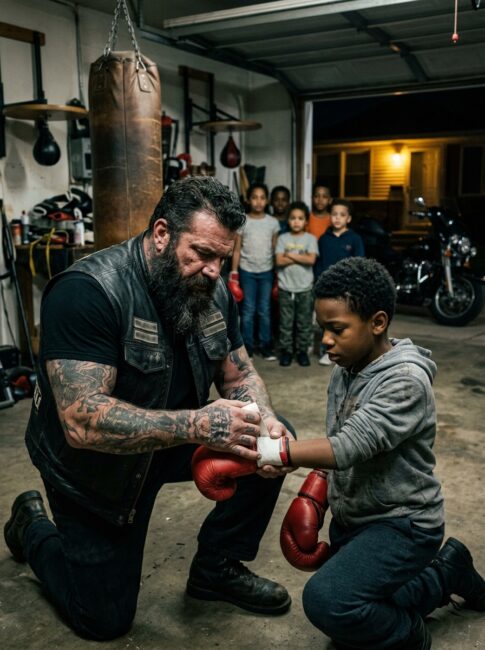
The trouble started with a boy named Andre Mills.
Andre was fourteen. Black American. Tall for his age. Thin arms, fast hands, eyes that never stayed still. His mother worked nights at a nursing home. His older brother was locked up in Jackson. His uncle stood on corners and called it business.
Andre came to Ray’s garage like he was doing everybody a favor.
He hit hard.
Too hard.
When Ray held mitts, Andre tried to punch through them. When another kid slipped a jab, Andre shoved him. When Ray said, “Again,” Andre said, “This ain’t no real gym.”
Ray looked at him.
The garage got quiet except for the old heater clicking.
“Real enough to show you what you don’t know,” Ray said.
Andre laughed.
That was a mistake.
Ray put on gloves.
He was fifty-two. Bad knee. Thick waist. Shoulder that popped when it rained.
Andre was fourteen and fast.
Ray didn’t hit him.
Not once.
He just moved.
A step left. A shoulder roll. A catch. A pivot. Andre swung at air until sweat ran into his eyes and his breathing turned ragged. After three minutes, Ray tapped him once on the forehead with a glove.
Soft.
Like a period at the end of a sentence.
“You’re not angry,” Ray said. “You’re scared.”
Andre ripped the gloves off.
“Man, shut up.”
Ray nodded.
“Come back tomorrow.”
Andre didn’t.
For six days, his duct-tape square stayed empty.
Then Friday came.
I was walking Marcus home from the corner store when we heard shouting behind the gas station on McNichols. Not loud enough to bring cops. Loud enough to pull kids like a magnet.
Andre was there.
So was a white kid named Tyler from two blocks over, fifteen, red-faced, wearing a Lions hoodie. They had been arguing over something stupid. Shoes. A phone charger. A girl. It didn’t matter. Street fights rarely start from the real wound.
A circle formed.
Phones came out.
Somebody said, “Do it.”
Tyler pushed Andre.
Andre’s hand came up.
I remember thinking Ray would’ve told him to step back.
Andre didn’t.
He threw one right hand.
It landed clean.
Tyler dropped.
Not movie-style. Real life is uglier. His head hit the curb with a sound I still hear when traffic gets quiet.
Everything stopped.
The circle broke.
Some kids ran. Some stood frozen. Tyler’s legs twitched once. Andre stared at his own fist like it had betrayed him.
Marcus whispered, “Ray.”
I ran.
Ray’s garage was open. The heavy bag swung from someone’s last punch. Kids were skipping rope. Ray stood in the middle, wrapping Tasha’s gloves.
I must have looked bad because he dropped the tape.
“What?”
“Behind the gas station,” I said. “Andre hit Tyler. He’s not getting up.”
Ray moved before I finished.
No helmet.
No gloves.
Just boots hitting concrete, leather cut thrown over his shoulder, Harley engine cracking awake so hard the windows shook.
He didn’t ride fast for show. He rode like every second had teeth.
When we got there, he was off the bike before it settled. He knelt beside Tyler, checked his breathing, barked at Dogman to call 911, then looked at Andre.
Andre was crying without sound.
Ray walked to him slow.
Everybody stepped back.
I thought he would yell.
I thought he would grab him.
I thought the old Ray would come out, the one from rumors, the one people warned about.
Ray put both hands on Andre’s shoulders.
Andre flinched.
Ray held him anyway.
“Look at me,” he said.
Andre shook his head.
“Look at me.”
Andre looked.
Ray’s voice cracked like gravel under weight.
“This is the part they don’t show you. This is the part that stays.”
The ambulance came. Tyler was breathing, but unconscious. His mother arrived screaming. Police lights washed the gas station wall red and blue. Andre tried to tell the officers he didn’t mean it.
Ray stood beside him.
When they put Andre in the back of the cruiser, Andre looked at Ray through the window.
“Am I going to prison?”
Ray’s jaw worked.
Nobody answered.
And I thought that was the story.
A kid learned too late.
A biker failed to save him.
A garage full of lessons couldn’t beat one second of rage.
I was wrong.
The real fight started after the police left.
That night, nobody trained.
The kids sat on folding chairs in Ray’s garage while the heavy bag hung still. Outside, the Harley cooled in the driveway, ticking metal into the dark.
Ray stood by the workbench with his back to us.
For a long time, he didn’t speak.
Marcus sat beside me, knees bouncing. Tasha held her gloves in her lap. Jamal stared at the floor. Everybody knew Andre might not come back.
Finally Ray reached under the bench and pulled out a green metal box.
Army surplus. Dented corners. Rust at the latch.
The whole garage changed when he touched it.
Dogman, Preacher, and two other club brothers stood near the door. I saw Preacher shake his head once, like he knew what was inside and wished Ray would leave it buried.
Ray opened the box.
Inside was an old newspaper clipping sealed in plastic. A mugshot. A prison ID. A letter folded so many times it looked soft as cloth.
And one photograph.
Ray at fourteen.
Not the biker. Not the coach. Not the hard man with prison ink.
A skinny white American kid with dark hair, split lip, swollen eye, and the same scared rage I had seen on Andre’s face.
Ray held up the newspaper clipping.
MAN HOSPITALIZED AFTER TEEN ASSAULT OUTSIDE DETROIT LIQUOR STORE.
Nobody moved.
Ray tapped the paper with one crooked finger.
“I was fourteen,” he said. “He was twenty-three. He shoved me. Called me trash. I hit him once.”
He swallowed.
“His head hit concrete.”
The heater clicked.
Somebody outside drove by slow with bass rattling the trunk.
Ray kept going.
“He lived. Barely. I got charged as an adult. Five years.”
Tasha whispered, “You were a kid.”
Ray looked at her.
“So was Andre.”
That landed hard.
Because it wasn’t an excuse.
It was a warning.
Marcus stared at the prison ID in Ray’s hand.
“Is that where you learned boxing?”
Ray shook his head.
“No. Prison taught me how to survive. Streets taught me how to hurt. Boxing taught me how to stop.”
He pulled out the folded letter.
“This came from the man I hit. Twelve years after I got out.”
His hand trembled then.
Not much.
Enough.
“He wrote that he forgave me. Said the worst part wasn’t the pain. It was knowing a boy ruined his own life because nobody taught him one step backward.”
Ray looked around the garage at every kid.
“You think I teach you to fight?”
Nobody answered.
He put the letter down.
“I teach you to know you could. So you don’t have to.”
That was the twist.
Not that Ray had been violent. Everybody guessed that.
The twist was that every jab, every slip, every footwork drill, every breath he forced into those kids was not training for a fight.
It was training for the three seconds before one.
That tiny space where a life can turn.
Ray tapped the duct-tape square on the concrete.
“This ain’t a ring,” he said. “It’s a door.”
Then he looked at Marcus.
“You learn to leave through it.”
After that night, the garage felt different.
Not softer.
More honest.
The kids still trained. Gloves still popped against mitts. Jump ropes still slapped concrete. Ray still barked, “Chin down,” and “Hands up,” and “Feet first, mouth last.”
But now the rules had weight.
You don’t hit outside this garage.
Before, it sounded like control.
Now, it sounded like mercy.
I finally understood why Ray checked every kid’s hands before practice. Not just wraps. Not just cuts. He was looking for damage from fights they weren’t telling him about. He’d tap bruised knuckles and ask, “Bag or face?”
If they lied, he knew.
He always knew.
I understood the patch inside his cut too.
His prison number.
He didn’t hide it because he was proud. He carried it close because forgetting was dangerous. The number was not his identity. It was a scar with digits.
One night, I saw Marcus touch it when Ray’s vest hung on the nail.
Ray caught him.
I froze, waiting for him to snap.
He didn’t.
He took the cut down and held it open so Marcus could see the blue stitching.
“That was my name for five years,” Ray said.
Marcus asked, “Why keep it?”
Ray said, “So I don’t make another kid wear one.”
Then he hung the vest back up and put Marcus on jump rope for ten minutes.
That was how Ray handled emotion.
He turned it into work.
Andre came back three weeks later.
Not to train.
To apologize.
Tyler had survived. Concussion. Stitches. A mother who looked ten years older overnight. Charges were pending, but because Tyler’s family told the truth about the shove and because Ray showed up at court with half the neighborhood, Andre got probation, mandatory counseling, and community service instead of detention.
Ray never bragged about that.
He just picked Andre up every Tuesday for court programs on the back of his Harley, made him wear a helmet, and never let him pretend it was a victory ride.
The first night Andre returned to the garage, nobody clapped.
Ray wouldn’t allow it.
Andre stood by the door with both hands in his hoodie pocket, eyes red, shoulders tight.
Ray pointed to the duct-tape square.
Andre stepped in.
Ray tossed him gloves.
Andre let them fall.
“I can’t,” he said.
Ray nodded.
“Then don’t.”
That surprised all of us.
Ray walked to the heavy bag and placed one palm against it.
“Put your hand here.”
Andre did.
“Feel that?”
The bag moved slightly.
“That’s what power is,” Ray said. “It don’t need to prove it’s there every second.”
Andre’s mouth twisted.
He was trying not to cry.
Ray saw and gave him the only kindness a boy like Andre could accept.
“Twenty pushups,” he said.
Andre dropped and did them.
By number twelve, he was crying into the concrete.
Nobody said a word.
Brotherhood got tested too.
Some Iron Saints didn’t like police near the club. Didn’t like courtrooms. Didn’t like Ray putting his name on paperwork for a kid who wasn’t blood.
One brother, Cutter, said it plain outside the garage.
“You keep dragging us into this, Ray, some of that stink gets on the patch.”
Ray looked at him for a long time.
Then he took off his leather cut.
Folded it.
Set it on the hood of a rusted Buick.
“If the patch can’t stand next to a kid in trouble,” he said, “it’s cloth.”
Nobody breathed.
Cutter looked at the cut. Then at Ray.
Dogman stepped forward, slow and huge.
Preacher did too.
Then another brother.
Then another.
No threats. No chest beating.
Just men choosing where to stand.
Cutter left.
Two weeks later, he came back with three pairs of new gloves and no apology.
Ray accepted the gloves.
That was his apology.
The garage grew after that. Not because of flyers. Not because of grants. Because mothers started noticing their sons walking away from fights. Teachers noticed fewer suspensions. A store owner on Fenkell said two boys who used to steal chips now swept his sidewalk for Gatorade money.
Ray never smiled when people thanked him.
He looked uncomfortable, like praise was a shirt that didn’t fit.
But every night at 7:00, that garage door went up.
And the kids came.
Years passed like rounds on a timer.
Three minutes of noise.
One minute to breathe.
Again.
Marcus got taller than me. His shoulders filled out. His anger didn’t vanish, but it stopped driving. He graduated high school with a split eyebrow from sparring and no assault charges, which in our neighborhood felt like a miracle nobody wanted to say out loud.
Andre became the quiet one.
He showed up early. Swept the garage. Wrapped younger kids’ hands. When a boy got embarrassed and tried to swing too hard, Andre would step between him and shame.
“Breathe,” he’d say.
Ray’s word.
Ray kept the same ritual.
Every evening, he rode home down Livernois, engine low, never showing off. He parked outside the garage, touched the handlebars once with his bare hand, then lifted the door.
Before any kid put on gloves, Ray made them stand in their duct-tape squares.
“Where are your feet?” he’d ask.
“Under us,” they answered.
“Where are your hands?”
“With us.”
“Who decides if they move?”
“We do.”
It sounded silly the first time.
By the hundredth, it sounded like prayer.
On the anniversary of the gas station fight, Ray rode alone to the corner of McNichols and Livernois before practice. He never told anyone. I followed once from half a block back.
He parked near the curb where Tyler had fallen.
He shut off the Harley.
For two minutes, there was no sound except traffic and a loose chain tapping against a signpost.
Then Ray took a piece of chalk from his pocket and drew one small square on the sidewalk.
A boxing square.
A door.
After that, he rode back to the garage and trained the kids like any other night.
No speech.
No memorial.
Just work.
Tyler came by once, years later. White American kid, now taller, with a faint scar near his hairline. He stood outside the garage while Andre wrapped a little boy’s gloves.
The whole room froze.
Andre walked over.
No drama.
No big apology speech.
He held out his hand.
Tyler looked at it, then pulled him into a rough hug.
Ray turned his back fast and started organizing tape that was already organized.
His eyes were wet.
He did not cry.
Not where anyone could see.
Ray is sixty-three now.
His beard has gone almost white. His left hand doesn’t close all the way in winter. The Harley takes longer to start, and some mornings Dogman has to come by with jumper cables and jokes Ray pretends not to hear.
The garage is still there.
The roof leaks over the corner by the speed bag. The heavy bag has been replaced twice. The duct-tape squares have been peeled up and laid down so many times the concrete underneath is darker than the rest.
Kids still come at 7:00.
Some of them bring their own kids now.
Marcus is a school counselor in Detroit. Andre works with teenagers on probation. Tasha runs the warm-up drills and scares the boys more than Ray ever did.
Ray mostly sits on a folding chair now, leather cut over his shoulders, prison number still stitched inside where the heart would be.
He doesn’t throw many punches.
He doesn’t need to.
Last winter, a new boy asked him the same question Marcus asked years ago.
“Where’d you learn to fight?”
The garage went quiet.
Ray looked at the boy’s hands. Bruised knuckles. Fresh anger. Old fear.
Then he said, “Wrong places.”
The boy waited.
Ray leaned forward, boots flat on the concrete, voice low.
“So I built the right one.”
Outside, the Harley ticked in the cold.
Inside, ten kids raised their hands, not to hurt anybody, but to learn where to put them when the world tried to make them swing.
Ray stood slowly.
His knees cracked.
His leather vest creaked.
He pointed at the taped square.
“Step in,” he said.
The boy did.
Ray nodded once.
“Now learn how to leave.”
The garage door stayed open.
Follow the page for more biker stories about the scars people carry, the roads they survive, and the quiet ways they come back.