Part 2: The Biker Who Had No Family — And The Girl Who Chose Him Back
Ray did pass the background check.
People always ask me that first.
Not because they care about procedure, but because they want the story to be simple. They want the old biker to be dangerous, then good. Or bad, then redeemed. Life doesn’t work that clean. Neither did Ray.
His record had old stains on it. Bar fights. A night in county lockup when he was twenty-three. A disorderly conduct charge from a club dispute outside Billings in the nineties. Nothing that disqualified him, but enough to make the board ask questions.
Ray answered every one.
He didn’t dress up for the interview. Same boots. Same vest. Same gray beard. But his fingernails were clean, cut short. His references were strange and solid. A retired nurse. A highway patrol officer. A diner owner named Marlene who said Ray had been eating breakfast at her counter for fourteen years and had never once let an old man leave without paying if he came up short.
“He looks like trouble,” Marlene told me on the phone. “But trouble doesn’t refill coffee for widows.”
Ray had been a mechanic most of his life. He worked out of a garage behind a bait shop near Lolo. He rode a black Road King with a dented tank, loud pipes, and a little silver bell hanging near the frame. He was part of a loose riding club called Iron Saints, though “club” might be too fancy. Mostly old men with stiff knees, bad backs, and names like Mule, Preacher, Tank, and Doc, who met at diners before charity rides and argued about pancakes like national policy depended on it.
Ray had been married once.
He told me that during a home visit while we sat at his kitchen table, drinking coffee strong enough to stand a spoon in. The house was small and plain. No family photos on the fridge. No children’s drawings. No Christmas cards still taped to cabinets. Just a jar of quarters by the door, a row of work gloves, and a calendar with every Saturday circled in blue.
“My wife’s name was Ellen,” he said.
I waited.
Ray looked toward the garage, where the Harley sat under a canvas cover.
“We had a baby once,” he said. “Didn’t come home from the hospital.”
That was all.
No speech. No tears. No dramatic pause. Just one sentence that changed the temperature in the room.
Later, when I looked at his file again, I understood the dates. The old charges, the bar fights, the bad years. They all came after the baby. After Ellen left. After Ray became a man with too much silence in the house and no idea where to put it.
Jade didn’t know any of that at first.
To her, Ray was just Saturday.
Every Saturday at ten, his Harley would rumble up outside her apartment complex near Reserve Street. He never honked. He never revved the engine. He shut it off and waited by the curb with two helmets, even though Jade didn’t ride with him for the first year. Her mother, Elena, had set that rule, and Ray respected it without complaint.
“No kid gets on my bike unless her mama says so,” he told me.
So they went places in his old pickup.
The park. The library. The carousel downtown. The zoo over in Great Falls once, because Jade wanted to see penguins and Ray had never seen a penguin either.
He bought her ice cream every Saturday, even in winter. She always picked huckleberry. Ray always picked vanilla and pretended it was because he liked it, though I once saw him scrape freezer-burned vanilla from a bowl at a community event and make the same face a man makes when he drinks bad whiskey.
Jade noticed everything.
At nine, she noticed Ray never answered calls during their time together.
At ten, she noticed he kept a plastic folder in the truck full of her drawings.
At eleven, she noticed the pink bracelet was still on his wrist, faded now, the cheap plastic edges cloudy from weather and grease.
“I made that for you,” she said one Saturday.
Ray looked down like he’d forgotten it was there.
“Yep.”
“You still have it.”
“Yep.”
“It’s ugly now.”
“Most things my age are.”
She laughed so hard she got huckleberry ice cream on her sleeve.
That was the first time I saw her grab his hand without thinking.
And Ray froze like he’d been handed something holy.
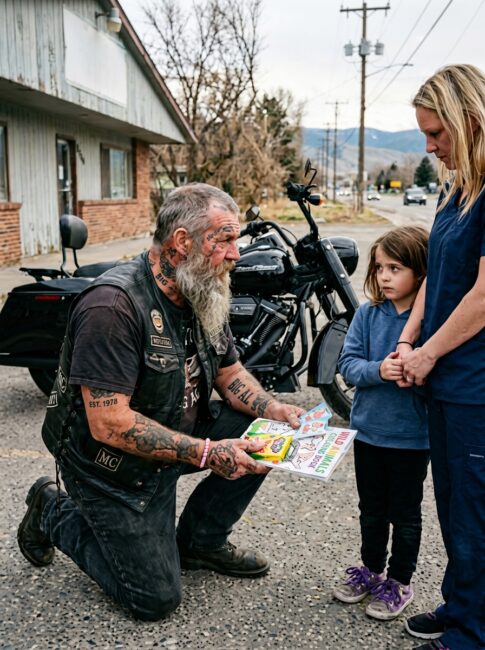
The program officially lasted one year.
That was the agreement. One year of weekly meetings, supervised check-ins, support from our office, and then a review. If both sides wanted to continue independently, they could.
Most matches didn’t last.
People had good hearts and full calendars. Kids moved. Parents changed jobs. Mentors got busy. The first few months were easy. A year was hard. Anything beyond that was rare.
When Jade and Ray hit their first-year review, I asked Jade if she wanted to continue.
She was nine by then, taller, sharper, less willing to please adults just because they had clipboards.
She looked at Ray across the table.
He looked at his boots.
Jade shrugged and said, “Who else is going to take me to see the penguins?”
Ray coughed into his fist.
That meant yes.
Year two came.
Then year three.
Jade’s mother got sick that winter. Not dying sick. Not yet. But sick enough that the hospital shifts became harder, bills stacked up, and Jade started coming to Saturday mornings with dirty hair and that flat look kids get when they’ve learned not to ask for anything.
Ray didn’t ask too many questions.
He just started showing up early.
He fixed a broken kitchen cabinet. Changed a tire on Elena’s car. Sat in the waiting room during one of her treatments, his leather vest folded across his lap like he was in church. When Elena apologized for needing help, Ray looked offended.
“Don’t insult me,” he said.
That was Ray’s version of tenderness.
The first real crisis came when Jade was thirteen.
Elena died on a Tuesday morning.
I got the call from the school counselor. Jade had gone silent in English class. Not crying. Not screaming. Just silent, staring at the same page until the bell rang and the next class came in.
By then, Ray was already in the parking lot.
He had been at his garage when Jade called him from the school office. He rode across town so fast his pipes echoed off the brick buildings downtown, but he walked into that school like a man entering a hospital room. Slow. Careful. No sudden movements.
I was there when he found her.
Jade sat in a plastic chair, knees pulled to her chest, purple backpack at her feet. She had her mother’s phone in one hand. She looked smaller than eight.
Ray stopped ten feet away.
He didn’t rush her. Didn’t open his arms. Didn’t say, “Come here.” Men like Ray know what a frightened animal looks like. They know you don’t grab grief.
He just lowered himself onto the floor across from her. His knees cracked loud enough for the secretary to glance over.
Jade looked at him.
Ray said, “I’m here.”
That was it.
Two words.
She broke.
Not pretty crying. Not movie crying. The kind that folds a kid in half. Ray stayed on the floor while she crawled into him and shook. His hands hovered for a second like he still didn’t trust them, then settled on her back, huge and careful.
I remember the sound of his leather cut creaking as he breathed. I remember the secretary crying behind her desk. I remember Ray’s eyes going wet but never spilling. He stared at a poster about attendance on the wall like it was the only thing keeping him upright.
After the funeral, Jade went to live with her aunt in a town forty minutes south.
Everyone thought that would end it.
Even me.
Forty minutes doesn’t sound like much until winter comes to Montana and the roads glaze over, and a man with a bad hip has to choose between staying home warm or riding through sleet because a girl might be looking out a window.
Ray didn’t miss a Saturday.
If the weather was too bad for the Harley, he drove the pickup. If the pickup broke down, one of the Iron Saints drove him. Mule took him once in a farm truck that smelled like hay and chewing tobacco. Preacher took him twice and complained the whole time. Doc brought soup.
That was brotherhood. Not speeches. Not patches. Just old men making sure one man kept a promise to a child who had already lost too many.
The false ending should have been Jade’s high school graduation.
By then, she was seventeen, tall, steady, and smart enough to scare every adult around her. She had a scholarship interview coming up, a stack of college brochures, and a habit of pretending she didn’t need anyone.
Ray showed up in the front row wearing the same vest and the same pink bracelet.
When they called Jade’s name, he stood too fast and nearly knocked over his chair.
She crossed the stage, took her diploma, and looked right at him.
He lifted one hand.
She lifted hers back.
On her wrist was another bracelet. The matching one she had kept since she was eight.
I thought that was the moment.
I thought that was the payoff.
I was wrong.
The real envelope came one year later.
Jade was eighteen when she brought the envelope to Ray.
She had been accepted to the University of Montana. First in her family. She was leaving Missoula in August, though “leaving” meant twenty minutes across town. Still, to Ray, it might as well have been the moon.
He tried not to show it.
Ray was good at pretending.
That summer, he tuned her aunt’s car twice even though it didn’t need it. He bought Jade a tire pressure gauge and made her learn how to use it. He gave her a little flashlight, jumper cables, a can of fix-a-flat, and a lecture about not trusting anyone who said, “It’ll only take a second.”
Jade rolled her eyes through all of it.
But she put every item in her trunk.
The envelope came on a Saturday outside Marlene’s Diner on Highway 200. Same diner where Ray’s club ate breakfast. Same cracked red booths. Same burnt coffee. Same bell over the door that sounded tired.
I was there because Marlene had asked me to stop by and pick up donation forms for the fall mentor ride. The Iron Saints were in the back, arguing over hash browns. Ray sat in his usual booth, back to the wall, Jade across from him with a laptop bag under her chair.
She looked nervous.
That alone made me stop near the counter.
Jade Morales did not do nervous. She had buried a mother, survived middle school, interviewed for scholarships with thrift-store blazers and steady eyes. But that morning, she kept rubbing the old bracelet on her wrist.
Ray noticed.
“You in trouble?” he asked.
“No.”
“You need money?”
“No.”
“You wreck the car?”
“No, Ray.”
He leaned back.
“Then why do you look like you swallowed a wasp?”
She pulled out a manila envelope and slid it across the table.
“My college essay,” she said. “I have to submit it Monday. I wanted you to read it first.”
Ray stared at the envelope like it might explode.
“What’s it about?”
Jade swallowed.
“You.”
The diner got quieter, though nobody admitted they were listening.
Ray picked up the envelope with those big mechanic’s hands. His thumb left a dark grease mark on one corner. He opened it slowly. Inside were four typed pages.
At the top, in bold, was the title:
The Man I Call Uncle
Ray read the first paragraph.
His face changed.
Not all at once. Ray didn’t crumble easy. His jaw tightened first. Then his breathing got rough. Then his eyes went red around the edges, the way they had in the school office after Elena died.
He kept reading.
Marlene stopped pouring coffee.
Mule took off his cap.
Jade sat perfectly still, hands folded in front of her like she was waiting for a verdict.
Halfway down page two, Ray set the papers on the table and pressed the heel of his hand to his mouth.
Jade whispered, “Ray?”
He stood up too fast.
The chair scraped the tile.
Then the biggest man in that diner walked outside, sat down on the curb beside his Harley, and cried into his hands while traffic hissed by on wet pavement.
Jade followed him.
So did I, though I stayed near the door.
Ray held the essay against his chest like a wound.
Jade sat beside him on the curb.
After a long time, he looked at her and said, “Kid, I was supposed to be helping you.”
Jade leaned her shoulder against his arm.
“You did,” she said. “But that’s not the twist.”
Ray looked at her.
She tapped the pages.
“Read the last one.”
Ray read the last page sitting on that curb.
The Harley was parked beside him, black tank spotted with rain, chrome dull under the gray Montana sky. The diner door kept opening and closing behind us, but nobody came out. Even the Iron Saints knew when to leave a man alone.
I still remember the paragraph Jade had underlined.
She gave me permission to share it years later, so long as I didn’t change the words.
“My mother did not have time. My father was not there. The only person who asked me what I wanted to do this weekend — every weekend — for ten years, was a man in a leather vest who was not related to me, not responsible for me, and not obligated to stay. He chose. Every week. For ten years. He chose me.”
Ray read it twice.
Then he got to the last section.
That was where Jade told the truth none of us had fully seen.
She wrote about the first day, when she thought he looked mean. She wrote about the coloring book. The ice cream cards. The way he never stood too close. The way he asked permission before every hug for almost three years.
She wrote about the pink bracelet.
Not as a cute detail. As evidence.
“I made him a bracelet out of cheap plastic beads when I was eight,” she wrote. “I expected him to throw it away. Adults threw away things from kids all the time, especially ugly things made badly. Ray wore it to diners, funerals, school meetings, mechanic shops, and once to court when my aunt needed support. He wore it until the beads faded. He wore it when I was embarrassed by him. He wore it when I pretended I was too old to need him. He wore it when I needed proof that one promise in my life had not broken.”
Ray’s hand went to his wrist.
The bracelet was barely pink anymore. More like the color of old gum. One bead had cracked. The elastic had been replaced twice with fishing line.
Then Jade explained the turned-in patch.
For ten years, people had whispered about it. The old club patch on the inside of Ray’s vest, stitched facing inward. Some thought it meant shame. Some thought it meant exile. Some thought it meant Ray had done something he couldn’t outrun.
Jade wrote the truth.
“I asked him once why one patch was turned inside out. He told me, ‘Some names belong close to the heart, not out where people can stare at them.’ I found out later it was not a club patch anymore. It was a hospital blanket square, sewn into the shape of one. It had belonged to his daughter, who lived for only nineteen hours. Her name was Lily.”
I didn’t know that.
Marlene didn’t know that.
Even Mule, who had ridden with Ray for twenty-five years, later admitted he didn’t know.
Ray bent over the pages like the words had put weight on his spine.
Jade kept going.
She wrote that when Ray signed up to be a mentor, he wasn’t trying to replace the baby he lost. He wasn’t trying to become a hero. He was trying to survive Saturdays.
Saturdays had been the day Ellen used to take baby clothes out of drawers and fold them again after Lily died. Saturdays had been the day Ray started drinking. Saturdays had been the day the bar fights happened. Saturdays had been the day his old life fell apart, over and over, until one day he walked into our office and asked if one hour of his week might be useful to somebody else.
That was the reverse role.
We all thought Ray had saved Jade from loneliness.
Jade had saved Ray from being alone with his.
The essay ended with this:
“I am going to college because my mother worked until her body gave out, because my aunt opened a door when she had no extra room, and because an old biker with oil under his nails showed up every Saturday until I believed showing up was a form of love. I call him Uncle because English does not have a better word for the man who chose you without needing your blood.”
Ray folded the pages carefully.
Very carefully.
Then he looked at Jade.
He didn’t give a speech. Of course he didn’t.
Ray reached into the inside pocket of his vest and pulled out a small velvet box, the kind jewelry stores use for earrings. His hands shook when he opened it.
Inside was a new bracelet.
Not plastic this time. Silver. Simple. Strong.
A small charm hung from it, engraved with two words.
Every Saturday.
Jade covered her mouth.
Ray cleared his throat.
“Figured the old one’s had a hard ride,” he said.
She held out her wrist.
He fastened the new bracelet beside the old one.
Not replacing it.
Never replacing it.
Beside it.
After Jade started college, Ray still rode on Saturdays.
That surprised people.
They thought his job was done. They thought the story had wrapped itself up neat. Little girl grows up. Old biker waves goodbye. Everybody claps.
Ray never liked neat endings.
Every Saturday at ten, he rolled the Road King out of the garage behind the bait shop. The engine would turn over with that low, uneven cough, then settle into a rumble that shook dust from the shelves. He’d check the tires, wipe the mirrors, tug on the old leather gloves Jade had bought him for Christmas when she was fourteen.
Then he’d ride.
Sometimes he went to campus and took Jade to breakfast if she had time. Sometimes she was buried in exams, work-study shifts, or friends, and she’d text him a picture of coffee instead. Ray always replied the same way.
“Eat something real.”
Sometimes he rode Highway 200 alone to Marlene’s and sat in the corner booth with two coffees, one he didn’t drink. Sometimes one of the Iron Saints joined him. Sometimes they all did, pretending it wasn’t about Jade, pretending old men in leather had gathered because of the pancakes.
But there was a ritual nobody joked about.
Every year, on the Saturday closest to the day he first met Jade, Ray rode to the little park where they had shared their first ice cream.
He parked under the cottonwoods.
He shut off the Harley.
The sudden silence always felt bigger than the engine.
Then he took off his gloves, touched the old pink bracelet, and sat there for a few minutes watching kids run around the playground. He never stayed long. Just long enough.
One year, I asked him what he thought about when he sat there.
Ray looked at the swings moving in the wind.
“Depends,” he said.
“On what?”
“Whether I’m thanking her,” he said, “or apologizing to Lily.”
That was the most he ever gave me.
The old patch stayed inside his vest. The hospital blanket square. Lily’s name close to his heart where strangers couldn’t stare at it.
The pink bracelet stayed on his wrist.
The silver one stayed on Jade’s.
Every Saturday became less of a schedule and more of a language. A way of saying things neither one of them could say without getting embarrassed.
Are you eating?
I’m here.
You mad at the world today?
Still here.
You need anything?
Always here.
When Jade struggled her sophomore year, she didn’t call a counselor first. She called Ray from a bench outside the library at 11:38 p.m., crying so hard he could barely understand her.
He didn’t lecture her.
He drove over in the pickup with two gas station burritos, a blanket, and a thermos of coffee he watered down because “college kids are already nervous enough.”
They sat in the truck until 2 a.m.
When she apologized for waking him, he looked through the windshield at the empty campus road and said, “Kid, I signed up for Saturdays. Nobody said I clocked out the rest of the week.”
That line made it into her graduation speech two years later.
Ray pretended not to hear it.
Everyone saw him wipe his face.
At Jade’s college graduation, Ray sat in the front row.
His beard was whiter. His walk was slower. The Road King was parked three blocks away because campus security wouldn’t let him bring it closer, even though half the officers knew him by then. His vest was the same one from ten years earlier, black leather worn soft at the shoulders, patches faded, seams repaired by hands more patient than pretty.
The pink bracelet was still on his wrist.
It looked impossible there. Tiny. Faded. Stubborn.
When Jade’s name was called, she crossed the stage in her cap and gown with the silver bracelet flashing on one wrist and the old plastic bracelet on the other. She had never taken it off. Not for prom. Not for job interviews. Not for scholarship photos. Not for graduation.
Ray stood before anyone else did.
His knees argued with him, but he stood.
Mule and Preacher stood behind him. Then Marlene. Then me. Then a whole row of bikers in black leather rose in the middle of that polished university crowd like thunderheads.
Jade took her diploma.
She turned.
She found Ray.
Then she lifted her hand, the one with both bracelets.
Ray lifted his.
For a second, the room was full of clapping, but all I heard was that old Harley sound in my memory. The engine cutting off outside our office. The boots on the floor. The gravel voice saying, “Maybe that’s enough for somebody.”
After the ceremony, Jade walked straight past photographers, professors, and friends, and put her arms around Ray’s neck.
He held her like she was still eight.
Careful.
Like something holy.
Then he leaned close and said the only thing he could manage.
“Proud of you, kid.”
Jade smiled through tears.
“Every Saturday,” she said.
Ray nodded.
The bracelet caught the sun.
And the old biker cried again.
Follow the page for more true-feeling biker stories about the people you’d never expect to save a life.