Part 2: The Bikers Guarded a Broken Boy — Years Later, He Returned in a Suit
My name is Ethan Cole, and for most of my childhood, I thought bikers were the kind of men mothers warned their children about.
Then they became the reason I made it to court.
It started at a gas station outside Bastrop, twenty-nine miles east of Austin, where Highway 71 runs past pine trees, cattle fences, and little churches with signs about forgiveness. My mother had stopped for coffee because she had not slept the night before my first hearing. I was in the back seat of her old Corolla, wearing a white shirt that scratched my neck and shoes too new to bend.
I saw them pull in.
Six Harleys first. Then three more. Then a woman on a big touring bike with purple flames on the tank. The sound came through the windows before they did, low and heavy, the kind of rumble you feel in your ribs. My mother’s hand went stiff around the paper coffee cup.
“Don’t stare,” she whispered.
But I stared.
One of them saw me.
That was Moses.
He was bigger than the others. Not taller, maybe, but built like somebody had stacked cinder blocks under his shirt. His beard was gray at the chin. His forearms were tattooed with names, dates, a cracked cross, and a little set of handprints no bigger than a baby’s.
He walked toward our car, and my mother locked the doors.
I remember that sound.
Click.
Moses stopped when he heard it. He did not get offended. He did not smile. He just lifted both hands where she could see them, palms out, scarred and empty.
A woman biker came around him. Her road name was Mercy, though I learned later she had earned it in an emergency room, not on a highway. She had kind eyes and a voice that made room for scared people.
“You must be Ethan,” she said through the glass. “Your advocate called us.”
My mother looked like she might cry right there between pump number four and the ice machine.
The advocate had told her about a group that escorted abused children to court so they would not feel alone. My mother said no at first. She thought it would make things worse. She thought people would judge us. She thought my stepfather’s lawyer would say she was trying to intimidate the court.
But the advocate said, “They don’t go inside to scare anyone. They go so the child can walk.”
That was all.
So they came.
Not like a gang.
Not like a parade.
Like a fence.
Moses did not ask me what happened. Not once. None of them did. That was the first kindness I understood.
Adults always wanted the story. Police wanted the story. Doctors wanted the story. Therapists wanted the story. Lawyers wanted the story in exact words, with dates and rooms and details. Every grown-up said they were helping, and most of them were, but every question made me live in that house again.
The bikers never asked.
They asked whether I liked chocolate milk. They asked if my shoes hurt. They asked if I wanted to sit close to the door at the diner or far from it. They asked if loud engines bothered me, and when I said yes, they rolled the bikes half a block away before starting them.
Moses asked the fewest questions.
He was the one who remembered answers.
Second hearing, he brought earplugs in a plastic case.
Third hearing, he stood on my left because I flinched when people came up on that side.
Fourth hearing, he put himself between me and a man wearing the same cologne my stepfather used. He did it without looking at me, without making a scene, just moved one boot over and became a wall.
Their clubhouse sat behind a tire shop on South Congress, not far from a taco truck and a pawn shop with neon bars in the window. The first time they took me there after a hearing, I expected beer bottles and knives and trouble.
There was a locked cabinet of case files.
There was a pot of burnt coffee.
There was a shelf full of stuffed animals still wearing tags.
There was a folding table where a prospect named Lenny was carefully printing court dates onto a calendar with a purple marker because Mercy said black ink looked too harsh.
And there was Moses, sitting in the corner, sewing.
That shocked me more than the motorcycles.
The biggest man in the room had a needle between his fingers.
He was repairing a ripped teddy bear, pulling brown thread through its shoulder while the other bikers argued quietly about who would take the 6 a.m. escort shift for a little girl in Round Rock.
I saw that same pink thread again, peeking from the inside of his cut.
“What’s that?” I asked.
Every biker in the room got quiet.
Moses tied off the teddy bear stitch.
“Something I keep close,” he said.
That was all he gave me.
Back then, I thought all secrets were dangerous.
I did not know some secrets were just grief with nowhere to sit.
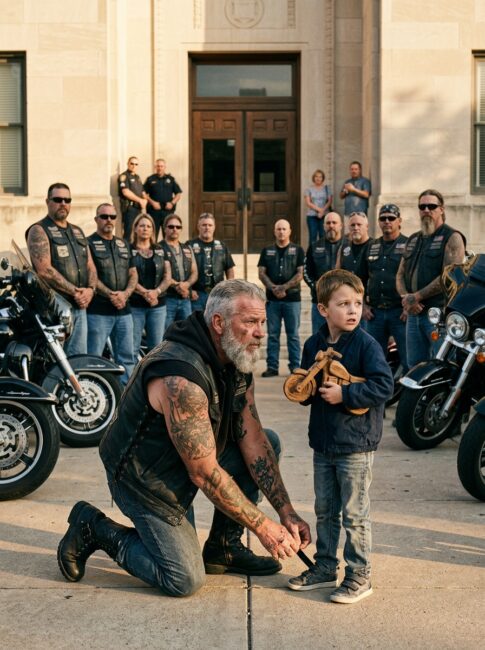
The fifth court date was the one that almost broke me.
It was July, so hot the sidewalk outside the courthouse looked white and mean. The Harleys rolled in before dawn, their headlights sliding across the stone steps. My mother wore the same blue dress she wore to church because she said judges liked respect. Her hands shook so badly she spilled coffee down the front of it before we left the parking garage.
Moses saw the stain and handed her a folded bandana.
“Doesn’t matter,” he said.
“It matters,” she whispered.
“Not today.”
Inside, the courthouse smelled like floor polish, paper, old air conditioning, and fear.
That is a real smell.
Ask anyone who has waited outside a courtroom with their life in somebody else’s hands.
The defense attorney had delayed twice already. He wore perfect suits and had a voice smooth enough to make lies sound like weather reports. That morning, he stood near the courtroom doors with my stepfather and laughed at something on his phone.
My stepfather looked different than I remembered.
Smaller, somehow.
Still, my body remembered him before my brain could.
My hands went cold. My jaw locked. The little wooden motorcycle in my pocket dug into my palm.
Then he saw me.
He smiled.
Not big. Not enough for anyone else to notice. Just one corner of his mouth.
My knees stopped working.
Moses stepped in front of me so fast his leather cut snapped like a flag.
He did not touch my stepfather. He did not threaten him. He did not say the things I later learned he probably wanted to say.
He just stood there.
Boots planted.
Hands open.
Eyes flat.
The hallway changed.
People stopped talking. A deputy looked over. Mercy moved close to my mother. The other bikers spread out without being told, not blocking doors, not making trouble, just filling empty space with bodies that had decided a child would not stand alone.
My stepfather’s lawyer said, “Is this really necessary?”
Moses looked at him.
“One kid breathing?” he said. “Yeah.”
That was the most I heard him say all day.
I wish I could tell you I testified brave.
I did not.
I made it through my name. I made it through my age. Then the defense attorney asked me if I was angry at my stepfather because he had rules in the house.
My throat closed.
The courtroom blurred.
The judge leaned forward. My mother covered her mouth. Somewhere behind me, leather creaked.
I squeezed the wooden motorcycle until its little handlebar broke off in my hand.
The attorney asked again, softer this time, worse this time.
“Ethan, isn’t it true that your mother told you what to say?”
That was when I heard it.
Not a voice.
A sound.
Moses’s chain wallet shifted when he moved in the back row.
One small metal scrape.
I turned, even though I wasn’t supposed to.
He was sitting there with both hands on his knees. Huge. Still. His eyes were not on the lawyer. They were on me.
He tapped two fingers against his chest.
Once.
Then pointed at the floor.
Here.
That was our signal.
He had taught it to me behind the tire shop after the second hearing. When your head goes back there, find something here. Boots on tile. Air in your nose. Wood in your hand. One breath. Then the next.
So I looked at the floor.
I breathed.
I told the truth.
Not perfectly. Not clean. Not like movies.
I stuttered. I forgot dates. I cried once and hated myself for it. The judge called a break. My mother shook in the hallway like she had a fever. Mercy held her upright. Moses sat on the floor beside me because I had slid down against the wall and could not get up.
Adults stepped around us.
Lawyers with briefcases. Deputies. Clerks. People whose lives were not ending that day.
Moses took the broken wooden motorcycle from my hand. He looked at the snapped handlebar.
“I can fix it,” he said.
I said, “You can’t fix me.”
For the first time, I saw his face change.
Not much.
Just enough.
Something old moved behind his eyes.
“No,” he said. “But I can sit here while you do.”
My stepfather took a plea that afternoon.
That was the false ending everyone wanted.
The bad man was led away. My mother cried. Mercy hugged her. The prosecutor said I had done well. The bikers walked me down the courthouse steps like I was somebody important.
People clapped from the sidewalk.
A local photographer took a picture of Moses’s huge hand resting lightly on my shoulder.
That picture went around Austin for a week.
“Bikers Protect Abused Boy,” the caption said.
Everybody thought that was the story.
It was not.
The real story started after the cameras left.
Seventeen years passed.
I grew tall. I learned to sleep through thunderstorms. I stopped checking locks three times before bed and got it down to once. My mother remarried a quiet electrician who never raised his voice in our house. I went to community college, then the University of Texas, then law school.
I became the kind of man who wore suits to the same courthouse where I once sat on the floor with a biker named Graveyard.
On my first day as an assistant attorney working child protection cases, I carried a leather briefcase and the old wooden motorcycle in my pocket.
Moses had fixed it.
Not perfectly. The handlebar was still crooked, wrapped with a bit of silver wire. He gave it back to me after the final hearing and said, “Crooked still rides.”
I kept it through foster interviews, graduation, bar exam panic, and nights when I woke up eight years old again.
By then, I had lost touch with most of the club.
Mercy sent Christmas cards for a while. Lenny became a full patch member. One of the old riders died of cancer. Another moved to Arizona. That is what time does. It doesn’t erase people. It scatters them.
Then one afternoon, a little girl named Ava came into my office.
She was seven.
White socks. Red shoes. Purple backpack. Eyes too old for her face.
Her foster mother sat beside her, twisting a tissue until it tore apart. Ava had to testify in a hearing the next week. Her abuser was not a stranger. They almost never are.
I explained the process gently.
Ava stared at the floor.
Then she whispered, “Will he see me?”
I knew what she meant.
Not the judge.
Not the lawyers.
Him.
I opened my desk drawer and took out the wooden motorcycle.
Ava looked at it like it was a key.
“A man gave me this,” I said. “When I had to go to court.”
“Was he a police?”
“No.”
“Was he your dad?”
“No.”
“What was he?”
I thought about Moses kneeling on courthouse steps. Mercy with her purple marker. Engines cutting off before sunrise. A wall of leather between a child and a nightmare.
“He was a biker,” I said.
That evening, I drove to South Congress.
The tire shop was still there, though the sign had changed. The taco truck was gone. The pawn shop was now a vape store. But behind the building, through a rusted gate, the clubhouse still stood.
I heard Harleys before I saw them.
The sound hit my chest and, for a second, I was eight years old again.
A prospect opened the door. He was young, maybe twenty-two, with nervous shoulders and a shaved head.
“Can I help you?”
I handed him my card.
“Tell Moses that Ethan Cole is here.”
The prospect blinked.
Then from inside came a voice like gravel under tires.
“Let him in.”
Moses was older.
Smaller, though I would never have said that out loud. His beard had gone white. His hands shook slightly when he reached for his coffee. The tattoos on his arms had blurred at the edges. But his eyes were the same.
He looked at my suit.
Then my tie.
Then my polished shoes.
“Lawyer,” he said.
I nodded.
“Damn shame.”
I laughed before I could stop myself.
The room watched us.
Mercy was there, older too, her hair silver under a red bandanna. Lenny stood near the calendar, no longer a prospect, his vest heavy with patches.
I reached into my pocket and placed the wooden motorcycle on the table.
Moses stared at it.
“I need an escort,” I said. “Seven-year-old girl. Hearing next Thursday.”
Mercy nodded. “We can do that.”
I swallowed.
“That’s not all.”
The room went quiet.
I looked at Moses, at the man people once crossed the street to avoid, the man who had sat on a courthouse floor until I could breathe.
“I want to prospect,” I said.
A chair scraped.
Somebody coughed.
Lenny said, “You ride?”
“No.”
Moses leaned back.
“You own a bike?”
“No.”
“You got a license?”
“No.”
“Then why the hell do you want in a motorcycle club?”
I looked at the wooden motorcycle between us.
“I’m not here to ride,” I said. “I’m here to walk the next kid up the steps.”
Nobody moved.
Then Moses looked down at his own vest.
The pink thread was still there.
Old. Faded. Almost hidden.
And for the first time in seventeen years, he told me what it meant.
Her name was Lily.
That was all Moses said at first.
Just the name.
He did not soften his voice. He did not stare at the ceiling. He did not make a speech for the room. Bikers don’t hand you grief wrapped in ribbon. They put it on the table like a tool and let you decide how heavy it is.
Mercy pulled out a chair for me.
Moses remained standing.
“She was six,” he said. “My niece.”
The clubhouse got quieter than any courtroom.
Before BACA, before the white patch, before courthouse escorts and teddy bears on shelves, Moses had been a mechanic with a record, a temper, and a sister who still called him when her car made bad sounds. He had done eighteen months in Huntsville when he was younger for aggravated assault after a bar fight that left another man with a broken jaw.
He did not excuse it.
He just said, “I was stupid and mean, and I thought those were the same as strong.”
His sister had a daughter named Lily who loved pink shoelaces, knock-knock jokes, and sitting on his Harley when it was parked with the keys in his pocket. Moses said she called it “the thunder chair.”
When Lily disclosed abuse by a family friend, the case went to court. Moses wanted to go. His sister begged him not to. She was afraid the judge would see his tattoos, his record, his club friends, and think the whole family was trouble.
So Moses stayed away.
He waited in a diner off Route 183 while Lily testified.
He drank coffee until it tasted like metal.
He watched the courthouse doors from across the street.
Lily made it through the hearing. The man was convicted. Everyone said justice had worked.
But Lily changed after that. Nightmares. Silence. Panic in grocery stores. She would not wear pink shoelaces anymore. Moses blamed the man who hurt her, yes. But he also blamed the hallway, the waiting, the walking in alone, the way adults had made a little girl carry terror across marble floors by herself.
“She asked me later,” Moses said, “‘Uncle Mo, why didn’t you come?’”
His jaw flexed.
He looked at the table, not at me.
“I didn’t have an answer worth giving.”
Lily died years later in a car wreck outside San Marcos. Nineteen years old. Wrong place, wet road, tired driver. No dramatic last words. No time for goodbye.
After the funeral, Moses found one of her old pink shoelaces in a box at his sister’s house. He cut a piece of it and stitched it inside his vest.
“That’s the thread,” he said.
The room stayed still.
Every seed came back at once.
The pink stitch. The baby handprints on his forearm. The way he knelt for shoes. The way he never asked children for their stories. The way he stood on the left after learning where fear lived in my body. The teddy bear repaired by scarred hands. The purple marker on the court calendar because black ink looked too harsh.
None of it was random.
It was a language.
Moses had been speaking it for years.
Not with speeches.
With shoe straps. Earplugs. Diner booths. Quiet signals. Broken toys repaired with silver wire.
I looked at him and realized something that still makes my throat tighten.
When I was eight, I thought Moses had saved me because he was fearless.
He had saved me because he was haunted.
There is a difference.
Fearless men can be careless.
Haunted men remember where the floor drops out.
Moses picked up the wooden motorcycle from the table. His thumb ran over the crooked handlebar.
“You sure about this?” he asked.
“No,” I said.
That made him smile.
Barely.
“Good. Sure men get people hurt.”
Mercy slid a prospect form across the table.
“You understand the rules?” she asked. “No violence. No intimidation. No cowboy crap. The child leads. We follow. Court staff gets respect. Parents get support. We don’t make ourselves the story.”
“I understand.”
Lenny crossed his arms. “You’ll clean bathrooms.”
“I’ve cleaned worse.”
“You’ll make coffee.”
“I drink courthouse coffee. I’m immune.”
Someone chuckled.
Moses did not.
He reached inside his cut and pulled something from a pocket.
A small folded piece of pink thread.
Not the one sewn into his vest. Another piece. Saved. Waiting.
He placed it beside the form.
“Prospects don’t wear patches,” he said. “But they can carry reminders.”
I touched the thread with two fingers.
It was soft from age.
I thought of Lily asking why he had not come. I thought of Ava asking whether the man would see her. I thought of myself on the courthouse floor telling him he could not fix me.
He had been right.
He had not fixed me.
He had stayed close enough that I could begin.
I signed the form.
Moses picked it up, looked at my name, and grunted.
“Lawyer handwriting,” he said. “Already a problem.”
That was his blessing.
The next Thursday, we met before sunrise at a gas station off Highway 71.
Same road.
Different child.
Ava arrived in the back seat of her foster mother’s minivan wearing red shoes and holding my wooden motorcycle in both hands. I had loaned it to her the day before. She had not let go since.
The Harleys were parked away from the pumps so the engines would not scare her. Mercy brought chocolate milk. Lenny brought a stuffed rabbit with one ear slightly crooked because somebody had repaired it in a hurry. Moses brought nothing visible.
He walked to the minivan slowly.
Age had put a hitch in his right knee. His boots still landed heavy on the pavement. His leather still smelled like oil, dust, rain, and old miles.
Ava looked at him through the window.
I saw the calculation in her eyes.
Big man.
Beard.
Tattoos.
Danger.
Then Moses lowered himself onto one knee. It took effort. His hand braced against the doorframe. For half a second, pain crossed his face.
He ignored it.
“Morning,” he said.
Ava did not answer.
He looked at her red shoes.
“Good shoes,” he said. “Fast color.”
She glanced down.
“My mom hated red.”
Moses nodded like she had told him the weather and a secret at the same time.
“Then they’re yours.”
Ava studied him.
“Are you going to make him go away?”
“No.”
“Are you going to yell?”
“No.”
“Are you going to hurt him?”
“No.”
She looked disappointed and relieved, both at once.
Moses pointed at the courthouse direction with one thick finger.
“We walk. You breathe. If you stop, we stop.”
That was it.
No promise he could not keep.
No movie line.
Just a plan small enough for a terrified child to carry.
At the courthouse, people stared the way they always do.
A security guard recognized Moses and nodded. A young prosecutor looked nervous until Mercy handed her the schedule. A man in a suit frowned at the motorcycles and then looked away when Lenny stared too long.
I walked behind Ava, not in front.
That mattered.
Moses had taught me that morning without saying it.
The child leads. We follow.
On the steps, Ava froze.
The wooden motorcycle shook in her hands.
I felt time fold.
For a second, I was eight again, with blood in my mouth and marble above me.
Then Moses tapped two fingers against his chest.
Once.
Pointed at the floor.
Here.
Ava looked down.
Red shoes on stone.
Breath in.
Breath out.
She took one step.
Then another.
The line of bikers moved with her, leather creaking softly, boots keeping pace, engines cooling behind us in the street like thunder waiting its turn.
Moses died three winters later.
Not on a bike. Not in some dramatic highway legend. He died in his sleep in a recliner at the clubhouse with a cup of coffee gone cold beside him and a stack of court calendars on his lap.
That was more like him.
No announcement.
No trouble.
Just done.
At his memorial ride, more than eighty motorcycles lined up outside Austin and took Highway 71 east at sunrise. I rode in the passenger seat of Mercy’s trike because I still did not have my motorcycle license, and she told anyone who laughed that lawyers were not trusted with handlebars.
Moses’s cut was folded in a glass case at the clubhouse afterward.
The patches were there.
His road name.
His BACA patch.
The worn edges.
The little oil stains.
And inside the lining, almost hidden unless you knew where to look, was that faded pink stitch from Lily’s shoelace.
Beside it, Mercy had added one more thing.
A crooked silver wire.
From the handlebar of a wooden motorcycle.
I still escort children to court.
Sometimes in a suit. Sometimes in jeans. Never pretending I am the hero. The kid is always the one doing the hard thing.
Ava is fourteen now. She wears red whenever she has a bad day. She says it reminds her her feet belong to her.
Last month, a boy outside the courthouse pointed at my tattooed brothers and whispered to his caseworker, “Are they scary?”
I knelt in front of him before anyone could answer.
My knees cracked.
Moses would have laughed.
I tightened the strap on his shoe and said, “Only to the right people.”
Behind us, the engines went quiet.
Then the child walked.
Follow the page for more true-feeling biker stories about the people behind the leather, scars, and road names.