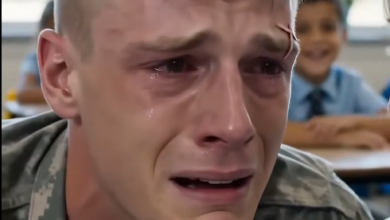
Part 2: The Boy Cut From the Soccer Team Because He Couldn’t Pay — Then the Coach’s Next Move Froze Every Parent
Lakeside Youth Soccer Park looked like the kind of place where childhood stayed clean.
The grass was always trimmed. The snack bar sold orange slices in plastic cups. Parents parked SUVs along the curb and opened trunks full of chairs, water coolers, sunscreen, and matching blankets.
The Lakeside Hawks were one of the best under-12 teams in the county.
That mattered more than people admitted.
Parents called it “discipline.” They called it “commitment.” They called it “a good environment.”
But everyone knew what it really meant.
If your child made the Hawks, your child had a chance at travel leagues, better coaches, private trainers, and maybe one day a high school scholarship.
That was why fees existed.
Uniform fees. Tournament fees. Field fees. Referee fees. Travel deposits. Winter training fees.
The number was printed on every parent email, but to some families, numbers did not sit flat on a page. They rose like walls.
Noah Reyes had made the team during open tryouts three weeks earlier.
Nobody expected it.
He arrived wearing cleats that were a half-size too small and shin guards with one strap missing. He did not have a private coach. He did not know the other boys. He did not own a matching warm-up jacket.
But once the scrimmage started, the field changed around him.
Noah was quick without looking rushed. He saw openings before they opened. He passed to boys who had not realized they were free yet.
Coach Miller noticed.
He tried not to.
He stood with his clipboard tucked under one arm, watching Noah thread the ball between two defenders and tap a pass into empty space. The receiving boy scored easily, then lifted both arms as if he had created the goal himself.
Noah only smiled and jogged back.
Coach Miller wrote one word beside his name.
Vision.
Later that day, when the team list went up, Noah stared at it for almost a full minute.
His mother stood beside him with grocery bags still in her car.
“You made it?” she asked.
Noah nodded, unable to speak.
Elena covered her mouth with both hands.
For a moment, mother and son stood in the parking lot as if the world had handed them something fragile.
Then the payment email came.
Three hundred eighty dollars due before the first official practice.
Elena read it twice on her phone during her lunch break in the break room of Wilson’s Market. She had $74 in her checking account, rent due in six days, and a car that made a grinding sound whenever she turned left.
She did not tell Noah.
Instead, she picked up two extra evening shifts, sold a small gold bracelet her mother had given her, and placed cash in an envelope inside the kitchen cabinet.
By Friday night, she had $310.
Still short.
She counted it again, as if numbers might change for mothers who needed them to.
Noah found her at the table.
“Mom?”
She folded the envelope quickly.
“Go wash up for dinner.”
“Is it for soccer?”
Elena smiled too fast.
“It’s handled.”
Children hear the cracks in adult voices.
Noah heard it.
On Saturday morning, he put on his cleanest T-shirt and tied his too-small cleats carefully. He tucked the team jersey into his backpack because he wanted to put it on at the field, in front of the other boys, like it was a ceremony.
Elena drove him there in silence.
When they arrived, the other players were already warming up.
The Hawks wore bright blue practice tops. Parents stood near the fence, talking about tournament schedules and hotel blocks.
Noah stepped out of the car with his backpack over one shoulder.
His face lit up.
Coach Miller saw him from across the field.
For one second, something passed through the coach’s expression. It was not warmth exactly, but it was not irritation either.
Then Ms. Brennan, the registration director, approached him with a clipboard.
Her voice was low, but not low enough.
“Coach, Reyes still has an unpaid balance.”
Coach Miller looked at the paper.
“How much?”
“Seventy dollars.”
He exhaled through his nose.
“Was the scholarship form submitted?”
“No.”
Elena had not known there was one.
Ms. Brennan tapped the clipboard.
“We can’t make exceptions. Other parents already complain about the fees.”
Coach Miller looked toward Noah, who was pulling the blue jersey from his backpack.
Elena stood beside him, one hand gripping her car keys.
“Not today,” Coach Miller said.
Ms. Brennan raised her brows.
“You’ll tell them?”
“I’ll tell them.”
That was the first strange detail.
He did not let the registration director do it.
He walked to Noah himself.
“Noah,” he said.
The boy straightened.
“Yes, Coach?”
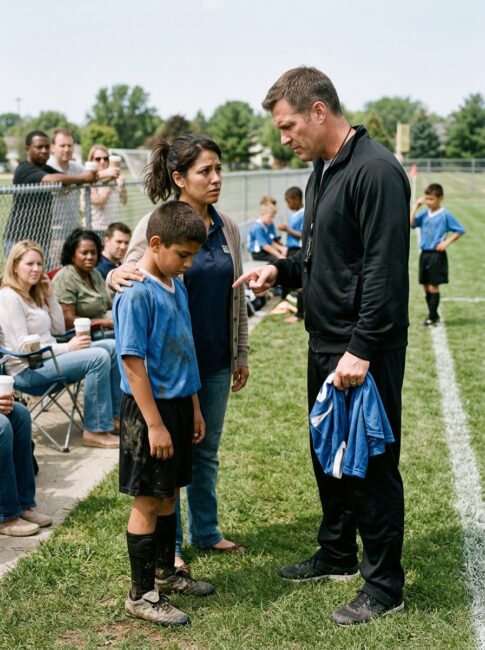
“You can’t practice today.”
The words landed harder because they were clean.
No explanation full of apology. No private conversation. No hand on the shoulder.
Just the rule.
Noah’s eyes moved to the field, then back to the coach.
“But I made the team.”
“You did.”
“I brought my cleats.”
“I see that.”
Elena stepped forward.
“Coach, I have most of it. I can pay the rest Friday.”
Coach Miller’s face did not change.
“Fees are due before participation.”
A silence formed around them.
The kind parents pretend not to hear while listening carefully.
One mother in sunglasses looked down at her coffee.
A father wearing a Hawks cap crossed his arms and muttered, “If they bend rules now, it never stops.”
Noah heard that too.
His face changed, not into anger, but into something smaller.
Coach Miller held out his hand.
“The jersey.”
Elena’s eyes widened.
“Please, don’t do that in front of—”
“The jersey,” he repeated.
Noah slowly removed it from his backpack.
It was too new, too bright, too clean for the moment.
He handed it over.
Coach Miller placed it on the bench, folded once, number facing down.
Then he turned to the rest of the team.
“Run laps.”
The boys ran.
Noah stood still.
Elena put one hand on his shoulder, but he stepped away gently, as if comfort would make him break.
Coach Miller blew the whistle.
Parents watched him with different kinds of judgment.
Some thought he was cruel.
Some thought he was correct.
Some thought both.
But nobody noticed what Coach Miller did ten minutes later.
While the boys ran passing drills, he walked to the bench and picked up Noah’s jersey again.
He did not return it.
He folded it more carefully.
Then he placed it inside his own equipment bag.
Practice lasted ninety minutes.
Noah and Elena stayed for twelve.
That was all the pride Elena could ask her son to survive.
They walked back to the car with the slow, stiff movements of people trying not to be seen leaving.
Noah climbed into the passenger seat and stared out the window.
Elena started the engine, but did not drive.
“I’m sorry,” she said.
Noah shook his head.
“It’s okay.”
That was the sentence that hurt her most.
Children say “it’s okay” when they know the adult already feels broken.
At the field, Coach Miller continued practice like nothing had happened.
He corrected footwork. He stopped a drill when players got lazy. He made one boy redo a pass six times until he learned to look up before kicking.
The parents were less focused on practice.
They were focused on him.
Mrs. Whitman, whose son played striker, leaned toward another mother.
“That was humiliating.”
The other mother sighed.
“It was harsh, but the fees pay for everything.”
A father near the fence said, “The kid is good, though.”
“He can join rec league,” someone replied.
“He made this team.”
“Then his parents should make it work.”
Coach Miller heard pieces of it.
He always did.
People assumed silence meant absence.
But Coach Miller collected words the way old coats collected dust.
After practice, he dismissed the boys and told them to hydrate, stretch, and be back on Tuesday.
Parents began packing chairs.
That was when Coach Miller called out.
“Parents, stay a minute.”
The field quieted.
Ms. Brennan looked surprised.
Coach Miller walked to the bench and lifted the clipboard.
“I need to address something from this morning.”
A few parents exchanged glances.
Mrs. Whitman folded her arms.
“If this is about the boy,” she said, “I hope you know how that looked.”
Coach Miller looked at her.
“I know exactly how it looked.”
His voice was flat.
That made the room of parents, though they were outside, feel like a room with no exits.
Another father said, “Coach, we all agree it’s unfortunate, but rules are rules.”
Coach Miller nodded once.
“I said that.”
He reached into his equipment bag and pulled out Noah’s jersey.
The blue fabric moved in the breeze.
Number 14.
“I took this from him in front of everyone.”
No one spoke.
“I did it because I wanted all of you to feel uncomfortable.”
Mrs. Whitman frowned.
“What does that mean?”
Coach Miller looked past the parents toward the empty spot where Noah had stood.
“It means you all watched a child lose something he earned because seventy dollars stood between him and the field.”
Ms. Brennan stiffened.
“We have a scholarship process.”
“Then why didn’t his mother know about it?”
The question hit harder than a shout.
Ms. Brennan opened her mouth, then closed it.
Coach Miller turned to the parents.
“Better question. Why does a youth team for eleven-year-olds need a process complicated enough to keep out a mother who works two shifts?”
A father shook his head.
“With respect, Coach, are you blaming the rest of us?”
Coach Miller’s jaw tightened.
“No. Not yet.”
The word “yet” moved through them like a cold wind.
He held up the jersey.
“This boy earned his spot. Not because he paid. Because he played.”
A mother near the back said quietly, “Then why cut him?”
Coach Miller looked at her.
“Because if I had quietly covered his fee and let him practice, most of you would have never known anything was wrong.”
The parents went still.
That was the first turn.
Coach Miller reached into his jacket pocket and removed an envelope.
“I paid his balance before practice started.”
Ms. Brennan looked stunned.
“You did?”
“Yes.”
“Then why—”
“Because paying one boy’s fee doesn’t fix a system that makes children stand at a fence while adults discuss whether they are worth including.”
Nobody had a quick answer for that.
For the first time all morning, Coach Miller did not look like a hard man defending rules.
He looked like a man who had finally grown tired of carrying them.
Mrs. Whitman’s voice softened slightly.
“You could have told us without embarrassing him.”
Coach Miller looked down at the jersey.
“Yes.”
The admission surprised them.
“I could have. And I will apologize to Noah for that part for the rest of the season if he lets me.”
His thumb brushed over the number.
“But I know this sideline. I know what happens when poor kids get helped quietly. Parents start asking whose child is being favored. They say words like fairness while meaning comfort.”
Several faces changed.
Not angry.
Caught.
Coach Miller continued.
“I wanted you to hear yourselves.”
No one spoke.
“So here is what happens now. Either this team creates a fund tonight that covers any child who earns a spot and cannot pay, or I resign before Tuesday.”
Ms. Brennan stared at him.
“Daniel, you can’t just—”
“I can.”
He placed his whistle on the bench.
That was the second turn.
The whistle looked small there, but every parent understood what it meant.
The Hawks without Coach Miller were not the Hawks.
They had come for his discipline. His reputation. His winning record. His connections to high school coaches.
Now he was using all of that for a boy who had already gone home.
A father near the fence laughed once, uncomfortable.
“You’d quit over seventy dollars?”
Coach Miller looked at him.
“I almost quit over seventy dollars thirty-four years ago.”
The field went silent.
This was the truth no one knew.
Coach Miller took a breath.
“When I was twelve, my mother couldn’t afford baseball fees. My coach told me to return the uniform in front of the team.”
Mrs. Whitman’s face changed.
“I still remember the bench,” he said. “Green paint peeling under my fingers. I remember the boys pretending not to look. I remember my mother saying she was sorry in the car.”
He paused.
“I don’t remember that coach’s name. But I remember how he made me feel.”
The parents were not looking away now.
“I became a coach because one year later, another man let me play anyway. He never told me he paid. I found out at his funeral.”
His voice roughened at the edge.
“There was a box of receipts in his garage. Mine was inside. Marked paid.”
A few parents lowered their heads.
Coach Miller picked up the whistle from the bench, then held it in his palm.
“I spent years thinking the best way to protect kids was to make rules clear. No exceptions. No confusion. No favoritism.”
He looked toward the parking lot.
“Then this morning, I saw Noah’s face, and I realized I had become the first coach.”
That was the third turn.
The cruel man was not defending cruelty.
He was standing inside the moment he had failed to escape.
Mrs. Whitman wiped under one eye.
Ms. Brennan spoke quietly.
“We can set up a hardship fund.”
“No,” Coach Miller said.
She blinked.
“No?”
“Hardship sounds like a label. Kids hear labels.”
He turned to the parents.
“We call it the Hawks Team Fund. Everyone pays what they can. No child knows who used it. No parent has to perform poverty in front of a committee. No kid returns a jersey at the fence.”
The parents stood in the sunlight with their coolers and clean sneakers and suddenly looked less certain of themselves.
One father reached for his wallet.
Then another.
Mrs. Whitman opened her purse.
Ms. Brennan, still shaken, pulled up the team payment app and created a new category with trembling fingers.
But Coach Miller raised one hand.
“Not for Noah only.”
He placed Noah’s jersey across the bench, number facing up.
“For every kid after him.”
The donations came awkwardly at first.
Twenty dollars.
Fifty.
Two hundred from a father who had muttered about rules earlier.
Mrs. Whitman gave five hundred and said nothing.
By the time the last parent walked away, the fund had enough to cover six players for the season.
Coach Miller looked at the total on Ms. Brennan’s phone.
His face did not change much.
But he sat on the bench for a moment after everyone left.
He stared at the jersey.
Then he picked it up and drove to the Reyes apartment.
Elena opened the door still wearing her grocery store name tag.
Her eyes hardened when she saw him.
“Noah doesn’t want to talk.”
“I don’t blame him,” Coach Miller said.
She stared at the jersey in his hands.
“I paid the balance,” he said.
Her face flushed.
“We didn’t ask for charity.”
“No, ma’am.”
He held the jersey out.
“He earned this.”
She did not take it.
“What you did today…”
“I know.”
“No, you don’t,” she said, her voice shaking. “You made my son stand there while people looked at him like he was less.”
Coach Miller lowered his eyes.
“Yes.”
The answer stopped her.
Most people defended themselves.
He did not.
“I came to apologize to him,” he said. “And to you.”
Behind Elena, Noah appeared in the hallway.
He had changed out of his soccer clothes. His face was clean, but his eyes were swollen.
Coach Miller crouched slightly so he was not towering over him.
“Noah, I was wrong to take your jersey in front of people.”
Noah looked at the floor.
“You said rules are rules.”
“I did.”
“Were you lying?”
Coach Miller swallowed.
“No. I was hiding behind a true sentence so I didn’t have to say a harder one.”
Noah looked up.
“What harder one?”
Coach Miller held out the jersey.
“That adults make rules, and sometimes we make them in ways that hurt kids who already have enough to carry.”
Noah’s eyes moved to the blue fabric.
“You still want me on the team?”
Coach Miller’s voice softened.
“I wanted you on the team from the first pass you made at tryouts.”
Noah did not reach for the jersey.
“Everyone saw.”
“I know.”
“They laughed.”
Coach Miller shook his head.
“Some did. Some looked away. Some heard themselves afterward.”
Noah’s lips pressed together.
“I don’t want them to feel sorry for me.”
“They won’t know who the fund helps.”
“What fund?”
Coach Miller glanced at Elena.
“The team made a fund today. Not because you needed saving. Because the team needed fixing.”
Elena’s face changed then.
Not forgiveness.
Not yet.
But the anger had met something solid.
Noah reached slowly for the jersey.
He held it against his chest.
Like it was not cloth.
Like it was a place he had almost lost.
Coach Miller stood.
“Tuesday practice,” he said. “If you come, you run two laps for being late to the team.”
Noah frowned.
“I wasn’t late.”
The smallest smile touched Coach Miller’s face.
“You are now.”
Noah looked at his mother.
For the first time that day, he smiled.
Not wide.
Not healed.
But real enough to begin.
Tuesday arrived with clouds low over the field and rain threatening from the west.
By 5:20 p.m., parents had lined the fence again, quieter than usual.
The chairs were there. The coffee cups were there. The expensive cleats and team bags were there.
But something had shifted.
People were careful with their voices.
At 5:27, Coach Miller walked onto the field and placed a blue jersey on the bench.
Number 14.
At 5:31, Elena’s car pulled into the far corner of the parking lot.
Noah got out slowly.
He wore his old cleats, the ones too small at the toes. He carried no fancy backpack. His blue jersey was folded over one arm.
For a second, he stopped near the fence.
Every parent saw him.
This was the moment adults often ruin by trying too hard.
No one clapped.
No one rushed him.
No one said, “We’re so proud of you,” in that voice children recognize as guilt.
They simply let him walk.
Coach Miller waited at the center line.
Noah approached him with his shoulders tense.
The other boys stood nearby, uncertain.
Coach Miller blew the whistle once.
“Team,” he said, “new rule.”
The boys straightened.
“No one earns a spot alone. No one keeps a spot alone. If one of you gets knocked down, the rest of you do not keep running like you didn’t see it.”
He looked at Noah.
“Understood?”
The boys answered, “Yes, Coach.”
Then Parker Whitman, the striker whose mother had complained the most, stepped forward holding a pair of cleats.
They were not new, but they were better than Noah’s.
“My feet grew,” Parker said, awkwardly. “My mom said throwing these away would be dumb.”
Noah looked at the cleats.
Then at Parker.
“Thanks.”
Parker shrugged.
“They’re fast.”
Noah almost smiled.
Coach Miller pointed to the field.
“Warm up.”
The boys began jogging.
Noah joined them.
At first, he ran like someone waiting to be removed again. His arms were tight. His eyes stayed down.
Then the ball rolled toward him during the first passing drill.
A defender closed in.
Noah glanced left.
One touch.
A quick turn.
A pass through a gap nobody else had seen.
The receiving player scored into the small practice net.
For a moment, the field held still.
Then one boy shouted, “Nice pass!”
Another slapped Noah’s shoulder as he ran by.
Noah’s face opened in a way Elena had not seen all weekend.
She stood near the fence in her grocery store uniform, both hands wrapped around the chain link.
Mrs. Whitman approached slowly.
Elena stiffened.
Mrs. Whitman held out a folded paper.
“It’s the new team fund policy,” she said. “I thought you should see it first.”
Elena did not take it right away.
Mrs. Whitman’s voice dropped.
“I said things Saturday. I am sorry.”
Elena looked at her for a long moment.
Then she accepted the paper.
“Thank you.”
That was all.
It was enough.
Across the field, Coach Miller watched Noah chase down a loose ball near the sideline.
The boy stumbled once, recovered, and kept running.
Coach Miller’s hand moved to the whistle at his chest, then stopped.
He remembered another field.
Another boy.
Another coach who had chosen rules over mercy.
For years, he had thought strength meant never bending.
Now he watched an eleven-year-old pass the ball to a teammate instead of taking the shot himself, and he understood something quieter.
Some children do not need adults to carry them.
They need adults to stop placing weight on their backs.
The season did not become a movie after that.
The Hawks lost two games.
Parents still complained about playing time.
Noah still missed one practice when Elena’s car would not start.
Coach Miller still raised his voice when players got lazy.
But the team changed in small ways.
A box appeared near the equipment shed labeled “Take What Fits.”
Inside were extra cleats, shin guards, socks, and water bottles. No names. No questions.
Parents began bringing more snacks than their own children needed.
Ms. Brennan rewrote the registration forms in plain language and added one sentence in bold.
If fees are difficult, your child is still welcome here.
Noah kept playing.
He scored only four goals that season, but he assisted on seventeen.
Coach Miller said assists told you who a player really was when nobody was keeping track of kindness.
On the final Saturday, after the last game, the Hawks gathered near the bench for team photos.
Parents fussed over hair, grass stains, and crooked collars.
Noah stood in the back row at first.
Coach Miller noticed.
“Number 14,” he called.
Noah looked up.
“Front row.”
Noah hesitated.
Then he stepped forward.
Coach Miller placed one hand on his shoulder, not heavily, just enough to say he belonged there.
The camera flashed.
In the photo, Noah’s cleats were still a little worn. His jersey hung slightly loose. His smile was shy, but steady.
Coach Miller did not smile much.
But in that picture, if you looked closely, his eyes did.
After everyone left, Coach Miller found something on the bench.
It was a small envelope with his name written in careful pencil.
Inside was seventy dollars.
One twenty.
Two tens.
The rest in fives and ones.
There was also a note from Noah.
Coach, my mom said we can pay some now. I know the fund is for the team. Please use this for another kid who needs to play.
Coach Miller sat on the empty bench until the sun dropped behind the trees.
The field was quiet.
A breeze moved the corner flags.
He folded the note carefully and placed it in his wallet, behind an old receipt he had kept for thirty-four years from a coach whose name he did remember after all.
Then he walked to the equipment shed and taped Noah’s note above the box of cleats.
Not as a lesson.
Not as a speech.
Just as a small piece of proof that a boy who had been made to feel excluded still chose to leave the door open behind him.
Follow the page for more emotional stories that stay with you long after the last line.