Part 2: The Student Accused of Cheating Because She “Didn’t Come From That Kind of Family”
Nobody at Whitmore High expected Lila Moreno to be the center of anything.
She came in quietly every morning before the first bell, slipped into the library, and sat at the same back table beside the radiator. She never joined clubs. She never stayed for games. She never asked for rides home.
Most people knew only pieces of her.
Her mother cleaned rooms at the Hampton Inn off Route 9. Her father had disappeared years before, depending on which rumor you believed. Lila lived with her mother and little brother in a second-floor apartment above a laundromat where the dryers shook the walls until midnight.
She was the kind of student teachers called “polite” when they did not know what else to say.
She turned in homework late sometimes.
She wore the same gray hoodie three days in a row.
She kept her head down.
That was why the county math placement exam changed everything.
The exam was supposed to determine which seniors qualified for state scholarships, college-track programs, and early admission recommendations. It was difficult enough that even Whitmore’s top students treated it like a battlefield.
Parents paid for tutors.
Students took practice tests for months.
Some families drove their children two towns over for private coaching.
Lila did none of that.
At least, that was what everyone thought.
So when the district sent preliminary results and Lila Moreno’s score came back perfect, the first reaction was not applause.
It was suspicion.
Mrs. Whitlock saw the number first.
She read it twice, then a third time. Her jaw tightened. Around her, the math department office hummed with printers, coffee machines, and the low chatter of teachers grading late assignments.
“A perfect score?” Mr. Dalton asked, leaning over her shoulder.
Mrs. Whitlock did not answer.
She looked down the list.
There was Ethan Carrington, son of a surgeon and a school board member, two questions missed.
There was Madison Bell, class president, four questions missed.
There was Andrew Kim, the district spelling champion, three questions missed.
And above all of them, at the very top, was Lila.
Perfect.
No erasures flagged.
No answer pattern irregularities.
No timing violation.
Just perfect.
Mrs. Whitlock stood so quickly her chair rolled back and struck the filing cabinet.
“Something is wrong,” she said.
That sentence traveled faster than the results.
By lunch, everyone had heard a version of it.
By sixth period, Lila’s locker had been photographed and posted in a private student group.
By the final bell, someone had written “GENIUS?” on a sticky note and slapped it to her desk.
Lila peeled it off without looking at anyone.
Mrs. Whitlock asked her to stay after class.
The room emptied slowly, because students could smell trouble. They packed bags with exaggerated slowness. They tied shoes that did not need tying. They lingered near the door until Mrs. Whitlock lifted her chin.
“Out.”
When they were alone, Lila stood beside the front desk.
She did not sit.
Mrs. Whitlock placed the printed score sheet on the desk between them.
“Do you know why I asked you to stay?”
Lila nodded.
“Then explain it.”
Lila’s eyes moved to the paper, then away.
“I studied.”
Mrs. Whitlock almost smiled, but it did not reach her eyes.
“So did everyone.”
“I know.”
“You never attended review sessions.”
“I couldn’t.”
“You never asked questions.”
“I had the book.”
“You missed two homework assignments last month.”
Lila swallowed.
“My brother was sick.”
Mrs. Whitlock folded her hands.
“Lila, this is serious. If someone helped you during the exam, if you saw a copy beforehand, if another student gave you answers, now is the time to tell the truth.”
Lila stared at her hands.
Her fingernails were short, uneven, and marked faintly with blue ink.
“No one helped me during the test.”
Mrs. Whitlock leaned back.
“During the test?”
The correction hung in the room like a trap snapping shut.
Lila realized it too late.
Her fingers tightened around her backpack strap.
Mrs. Whitlock noticed.
“What’s in the bag?”
“Nothing.”
“Open it.”
Lila shook her head.
Mrs. Whitlock’s expression hardened.
“Lila.”
“Please don’t.”
That was the first small crack in the story.
Not because Lila looked guilty.
Because she looked ashamed.
The next morning, the principal called Lila to his office. Mrs. Whitlock was already there. So was Mr. Harlan, the testing coordinator, with a folder full of forms and district guidelines.
Lila sat in the chair closest to the door, her backpack on her lap.
Principal Reeves tried to sound gentle.
“Lila, no one here wants to embarrass you.”
She looked at the carpet.
“We only need to verify a few things,” he continued.
Mrs. Whitlock watched the backpack.
It was old canvas, brown at the bottom from years of use. One zipper pull had been replaced with a piece of red yarn. The front pocket bulged slightly, not enough to hold anything large, but enough to draw attention.
“Did you bring any unauthorized materials into the testing room?” Mr. Harlan asked.
“No.”
“Notes?”
“No.”
“Calculator programs?”
“No.”
“Formula sheets?”
“No.”
“Phone?”
Lila shook her head.
Mrs. Whitlock leaned forward.
“Then open your bag.”
Lila whispered, “I can’t.”
The principal sighed.
“Lila, refusal makes this harder.”
Her eyes filled, but she did not cry.
“I know.”
Mrs. Whitlock’s voice cooled.
“You understand a scholarship may be involved. Other students have worked for years for this opportunity.”
At that, Lila looked up.
Something passed over her face.
Not anger exactly.
Something more tired than anger.
“I worked too.”
Mrs. Whitlock did not blink.
“Then prove it.”
For the first time, Lila looked directly at her.
“My mother says proving yourself to people who already decided is like pouring water into a cracked cup.”
Nobody spoke.
The sentence was too old for a seventeen-year-old girl. Too worn. Too lived-in.
Principal Reeves rubbed his forehead.
“We are going to contact your mother.”
Lila’s face changed instantly.
“Please don’t call her at work.”
“We have to.”
“She’ll lose hours.”
“Lila.”
“She already lost Thursday because Mateo had a fever.”
“Lila, this is school business.”
Her mouth shut.
That was the second crack.
Not the backpack.
Not the score.
Her first fear was not discipline.
It was her mother losing money.
By the end of the day, the district ordered a formal review.
That should have been private.
It was not.
Whitmore was a school where parents had opinions and knew where to place them. By Monday morning, the story had grown teeth.
Some said Lila had stolen the exam from Mrs. Whitlock’s desk.
Some said her mother had found a copy while cleaning a district office.
Some said she had hidden answers in her sleeves.
Nobody asked why a girl who ate peanut butter sandwiches wrapped in paper towels would risk everything so clumsily.
On Tuesday, Lila found her locker open.
Nothing was missing.
But her notebooks had been turned upside down, shaken, and shoved back carelessly.
A folded paper slipped from the top shelf and landed near her shoes.
It was not a cheat sheet.
It was a receipt from the public library.
Due date: March 14.
Book title: Advanced Algebra and Number Theory.
Beside it was another receipt.
Calculus for Beginners.
Then another.
Competition Math Strategies.
A freshman standing nearby saw them and frowned.
“You actually read those?”
Lila bent down quickly.
Before she could gather them all, Mrs. Whitlock appeared at the end of the hallway.
Her eyes dropped to the receipts.
For a second, something uncertain moved across her face.
Then Ethan Carrington walked by with two friends and muttered, “Library books don’t make you a genius.”
Lila gathered the receipts and shoved them into her backpack.
Mrs. Whitlock said nothing.
But that afternoon, she went to the school library.
The librarian, Mrs. Anson, was nearly seventy and had known generations of Whitmore students. She wore cardigans with wooden buttons and kept cough drops in her desk for children who pretended not to be sick.
Mrs. Whitlock approached her counter with the stiffness of someone who already knew what answer she wanted.
“Has Lila Moreno been checking out advanced math books?”
Mrs. Anson looked over her glasses.
“Is this about those awful rumors?”
“It is about a testing review.”
Mrs. Anson’s face closed slightly.
“Yes. She has.”
“How often?”
Mrs. Anson turned to her computer.
“Since September? Often enough that I stopped reshelving the books. I kept them on the return cart for her.”
Mrs. Whitlock stood very still.
“She came here for help?”
“No,” Mrs. Anson said. “She came here for quiet.”
That was the third crack.
Mrs. Anson lowered her voice.
“She sits by the radiator because it is warmest there. She copies problems by hand because she cannot pay for printing. Sometimes she falls asleep with her pencil still moving.”
Mrs. Whitlock looked toward the back table.
It was empty now.
But she could picture it.
Lila in her gray hoodie. Her head bent over problems too advanced for most seniors. Her backpack at her feet like a locked door.
“Why did she never tell me?” Mrs. Whitlock asked.
Mrs. Anson gave her a look so steady it almost hurt.
“Would you have believed her?”
Mrs. Whitlock did not answer.
The district review was scheduled for Friday morning in the auditorium because Whitmore had no smaller room available that could hold the committee, school administrators, student representatives, and parents who demanded transparency.
That was the official reason.
The unofficial reason was simpler.
Everyone wanted to watch.
Lila arrived with her mother at 8:10.
Rosa Moreno still wore her hotel uniform. Her hair was pinned back, but a few strands had escaped near her temples. She looked exhausted in a way makeup could not hide.
Mateo, Lila’s nine-year-old brother, sat beside her holding an inhaler in both hands.
Mrs. Whitlock noticed that immediately.
The boy’s breathing was shallow.
Lila kept one hand on his shoulder.
Even then, while her future sat inside a sealed envelope on the table, she watched her brother more than the adults.
Principal Reeves began with a careful statement about fairness, procedure, and maintaining trust in academic standards.
Mrs. Whitlock sat two seats away from Lila.
She looked at the backpack.
Still there.
Still closed.
The testing coordinator asked the first questions.
Lila answered each one quietly.
Where did you sit?
Third row, second seat from the left.
Did you leave during the exam?
No.
Did you speak to anyone?
No.
Did you bring additional papers?
No.
Did you use a phone?
No.
Then came the question everyone had been waiting for.
“Will you open your backpack for review?”
Lila’s face went pale.
Rosa touched her daughter’s wrist.
“Mija,” she whispered, “it’s okay.”
Lila shook her head.
“No, Mama.”
Mrs. Whitlock heard the fear in that whisper.
Not of being caught.
Of being exposed.
The principal said her name again.
Lila hugged the backpack.
A murmur moved through the auditorium.
And Mrs. Whitlock, who had built a career on order, rules, and neat columns of proof, suddenly felt something inside her begin to loosen.
Because the girl holding that bag did not look like a thief protecting evidence.
She looked like a child protecting the last private thing her family had left.
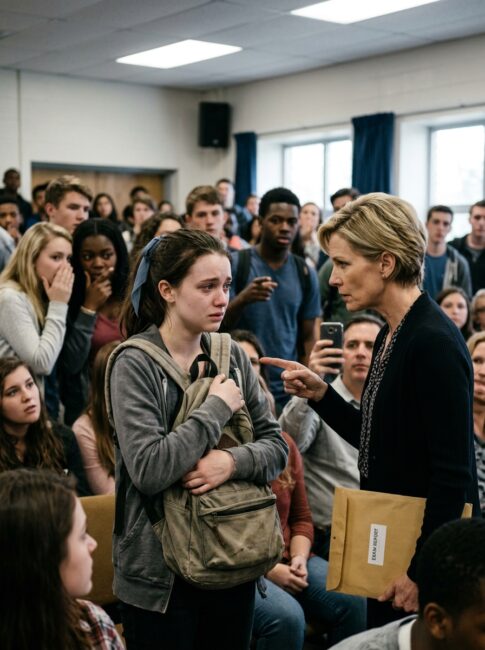
The district representative, a woman named Dr. Elaine Porter, lifted one hand and asked the room to settle.
She had driven in from the county office wearing a navy suit and expressionless glasses, the sort of official presence that made students sit straighter without knowing why.
“Miss Moreno,” Dr. Porter said, “we are not here to shame you. We are here to establish whether your score is valid.”
Lila nodded, though her eyes stayed on the floor.
Dr. Porter looked at the backpack.
“If there is something personal inside, we can inspect it privately.”
Lila’s fingers tightened.
“No.”
The single word moved through the auditorium.
Mrs. Whitlock closed her eyes for half a second.
She remembered every time Lila had sat in the back of class and said nothing. Every time she had mistaken silence for laziness. Every time she had called on another student because Lila’s hand never rose.
But silence, she was beginning to understand, was not always emptiness.
Sometimes it was survival.
Dr. Porter opened the sealed envelope and removed the complete scoring report.
There were several pages.
Most people expected one number.
Instead, she read aloud the technical findings first.
“No irregular answer pattern. No timing anomaly. No statistical match with any other student booklet. No evidence of copied responses.”
The auditorium quieted.
Ethan Carrington’s mother shifted in her seat.
Mrs. Whitlock felt her pulse in her throat.
Dr. Porter continued.
“Because Miss Moreno’s score was substantially higher than her prior class performance, the district also reviewed her written solutions.”
Lila looked up.
Mrs. Whitlock looked at her too.
“Her work was not only correct,” Dr. Porter said. “It showed multiple solution paths, including methods not commonly taught in the standard curriculum.”
Someone whispered, “What?”
Dr. Porter turned a page.
“In fact, one of her solutions to the final proof problem was unusually elegant.”
The word seemed to embarrass Lila more than the accusation had.
Her cheeks flushed.
Mateo smiled faintly beside Rosa, as if he had known all along.
Mrs. Whitlock felt heat rise in her face.
She had graded hundreds of students. She knew the difference between memorized answers and thinking. She knew it better than most people in that room.
And she had ignored it because the thinker wore worn shoes.
Dr. Porter placed the report on the table.
“Miss Moreno’s score is valid.”
For one breath, nobody moved.
Then the room broke into low murmurs.
Some surprised.
Some uncomfortable.
Some defensive.
But Dr. Porter was not finished.
“There is more.”
Lila’s head snapped toward her.
Rosa whispered, “What more?”
Dr. Porter looked at the principal.
“I was instructed to keep this confidential unless it became relevant to the review. It is now relevant.”
Lila’s lips parted.
“No,” she whispered.
Dr. Porter softened her voice.
“Lila, the committee needs to understand why your class record did not reflect your ability.”
Mrs. Whitlock’s stomach tightened.
The backpack sat between Lila’s knees.
Dr. Porter removed another sheet.
“Three months ago, Miss Moreno submitted independent work to the county scholarship board under student ID only. Names were hidden for initial review.”
Mrs. Whitlock turned slowly toward Lila.
“She did not submit through Whitmore High,” Dr. Porter said. “She submitted through the public library’s community access program.”
Mrs. Anson, sitting near the back, pressed her hand to her mouth.
“The project was a mathematical model estimating bus arrival delays in low-income neighborhoods and their effect on student attendance.”
The room became still in a new way.
Not judgment now.
Attention.
Dr. Porter continued.
“Her project placed first in the county and was forwarded to the state level last week.”
Principal Reeves stared at Lila.
Mrs. Whitlock could barely breathe.
Lila was not only the highest scorer.
She had been solving problems Whitmore had never bothered to notice.
Dr. Porter looked at the audience.
“The board was scheduled to announce this next month, but due to today’s review, I can confirm Miss Moreno is a finalist for the Harwell State Scholarship.”
A sound escaped Rosa, small and broken.
Lila turned to her mother immediately.
“Mama, I was going to tell you after.”
Rosa touched her daughter’s face.
“After what?”
Lila looked down.
“After I knew if it was real.”
Mrs. Whitlock lowered her eyes.
There it was.
The quiet wound under everything.
Lila had not hidden success because she was dishonest.
She had hidden it because she did not trust good news to stay.
Dr. Porter folded her papers.
“Now, regarding the backpack.”
Lila closed her eyes.
Mrs. Whitlock suddenly stood.
The movement surprised everyone, including herself.
“May I say something?”
Principal Reeves looked uncertain.
Dr. Porter nodded.
Mrs. Whitlock turned toward the auditorium.
She had spoken in front of rooms for decades. Parent nights. Board meetings. Award ceremonies. She knew how to sound certain.
But certainty had led her here.
So when she spoke, her voice was smaller.
“I was the first person in this building to doubt Lila.”
Lila looked at her.
Mrs. Whitlock continued.
“I told myself I was protecting fairness. I told myself scores needed explanation. But the truth is uglier than that.”
The room was silent.
“I saw a student from a poor family achieve something extraordinary, and instead of asking what she had survived to get there, I asked what she had stolen.”
Rosa’s eyes filled.
Ethan looked down at his shoes.
Mrs. Whitlock turned fully toward Lila.
“I am sorry.”
No one moved.
An apology from Mrs. Whitlock was not a common thing. Students said she could correct a decimal from across the room but never admit a mistake.
Lila did not answer.
She only looked at her teacher with an expression too tired to be triumph.
Mrs. Whitlock stepped away from the table and addressed Dr. Porter.
“I withdraw my request for the backpack inspection.”
A stir moved through the room.
Principal Reeves frowned.
“Catherine, the procedure—”
“No,” Mrs. Whitlock said, and this time her voice was steady. “We have no evidence of cheating. We have evidence of our own assumptions.”
Dr. Porter studied her.
Then she nodded once.
“The review can be concluded without inspection.”
Lila’s shoulders dropped as if a weight had been cut from them.
But Mateo, who had been quiet the entire time, suddenly coughed.
Hard.
Rosa reached for the inhaler, but her hands shook. Lila opened the backpack before anyone could stop her.
Everything inside spilled partly onto the floor.
No cheat sheets.
No hidden phone.
No stolen exam.
Just a cracked plastic folder, library books, a half-empty bottle of children’s medicine, a folded bus schedule, a small packet of crackers, two inhalers, and a spiral notebook so worn the cover had nearly come off.
The auditorium watched in silence.
Lila grabbed one inhaler and handed it to Mateo.
“Slow,” she whispered. “Like we practiced.”
He breathed in.
Then again.
Rosa held him close.
Mrs. Whitlock stared at the items on the floor.
This was what Lila had protected.
Not proof of guilt.
Proof of poverty.
Proof of responsibility.
Proof that while other students carried laptops and college brochures, Lila carried medicine, food, bus routes, and the fear that one exposed detail could become another reason to pity her.
The spiral notebook lay open near Mrs. Whitlock’s shoe.
She bent to pick it up, then stopped.
“May I?”
Lila hesitated.
Then nodded.
Mrs. Whitlock lifted it carefully.
The pages were filled edge to edge with math.
Problems copied from library books.
Errors crossed out.
Solutions rewritten.
Not once.
Not twice.
Sometimes six different ways.
In the margins were notes that did not sound like schoolwork.
If bus is late 12 minutes, Mateo waits outside longer.
If shift ends 11:30, Mama reaches home 12:08.
Scholarship = no second job senior year?
One page had a list titled Things to Fix When I Can.
Pay electric.
New shoes for Mateo.
Mom dentist.
College application fee.
At the bottom of the page, written smaller than the rest, was one sentence.
Do not let them think you are asking for mercy.
Mrs. Whitlock’s vision blurred.
She had spent twenty-six years telling students to show their work.
Here was Lila’s work.
Not just algebra.
Not just proofs.
A whole life calculated in the margins.
Mrs. Whitlock closed the notebook and handed it back.
“I should have asked you what you were carrying,” she said quietly. “Not accused you of hiding something.”
Lila took the notebook.
For a moment, it seemed she might finally cry.
Instead, she zipped the backpack.
Dr. Porter officially announced the score again for the record.
“Lila Moreno’s county exam result stands as submitted. Perfect score.”
This time, the silence broke differently.
Mrs. Anson started clapping first.
One pair of hands in the back of the auditorium.
Then another.
Then another.
The applause spread unevenly, awkward at first, then stronger.
Lila looked startled by it.
Not proud.
Startled.
As if applause were a language she had never been taught.
Mrs. Whitlock did not clap immediately.
She stood with her hands folded in front of her.
Then she lowered her head.
Not dramatically.
Not for the room.
For Lila.
It was the smallest bow imaginable.
But everyone saw it.
And somehow, that small motion carried more weight than a speech.
The teacher who had made the accusation bowed before the student she had underestimated.
Lila looked at her for a long moment.
Then she gave one tiny nod.
Not forgiveness exactly.
Not yet.
But something close to opening a door.
The story should have ended there, with applause and a corrected record.
But real life rarely closes so neatly.
The next Monday, Lila returned to school early as usual.
There were no sticky notes on her desk.
No whispers loud enough to reach her.
Someone had cleaned her locker.
A few students said congratulations in the hallway, but most did not know how to speak to her now. They had been comfortable judging her. They were less comfortable respecting her.
Ethan Carrington approached her near the vending machines.
He held a folder against his chest and looked younger than he had all year.
“I’m sorry,” he said.
Lila stopped.
He shifted his weight.
“My mom talked a lot. I did too.”
Lila looked at him, then at the floor.
“Okay.”
It was not warm.
But it was not cruel.
Ethan nodded, accepting what little he deserved, and walked away.
By second period, a different kind of rumor had begun.
That Lila was a genius.
That she had fooled everyone.
That she might go to any college she wanted.
Even admiration made her uncomfortable. It turned her into a symbol, and symbols could not be tired, hungry, scared, or angry.
At lunch, she carried her tray to the far table near the window.
Before she could sit, Mrs. Whitlock appeared beside her.
For a second, both of them froze.
The cafeteria noise seemed to dull around them.
Mrs. Whitlock held an envelope.
“I won’t take much of your time,” she said.
Lila’s face became guarded.
Mrs. Whitlock placed the envelope on the table.
“This is not charity.”
Lila did not touch it.
“It is an application packet for the state math mentorship program. I should have given it to you months ago.”
Lila looked at the envelope.
Mrs. Whitlock continued carefully.
“I also wrote a recommendation. You do not have to use it.”
Lila’s eyes lifted.
“You wrote one?”
“Yes.”
“What did you say?”
Mrs. Whitlock swallowed.
“The truth.”
Lila waited.
“I wrote that you are the most disciplined student I have taught in twenty-six years. I wrote that your ability was not hidden because it was small, but because we were not looking carefully enough.”
Lila looked away toward the window.
Outside, rain tapped lightly against the glass.
Mrs. Whitlock’s voice softened.
“And I wrote that I failed you before I understood you.”
Lila said nothing for several seconds.
Then she reached for the envelope and slid it into her backpack.
“Thank you,” she said.
It was quiet.
But it was real.
That afternoon, Mrs. Whitlock did something no one expected.
She moved the advanced math review session from 4:00 p.m. to 7:15 a.m.
When a parent complained that early sessions were inconvenient, Mrs. Whitlock replied that late sessions were impossible for students who worked, cared for siblings, or depended on buses.
She did not mention Lila.
She did not have to.
Within a week, eight students began attending who had never come before.
One boy arrived still wearing his grocery store uniform.
One girl brought her little sister and sat her in the corner with coloring pages.
Lila came too.
She sat in the back at first.
Then, one morning, Mrs. Whitlock placed a difficult proof on the board and turned to the class.
“Would anyone like to try a different method?”
The room stayed quiet.
Then Lila raised her hand.
Slowly.
Almost reluctantly.
Mrs. Whitlock stepped aside.
Lila walked to the board with the blue ribbon in her hair and a piece of chalk in her hand.
She did not solve it quickly to impress them.
She solved it carefully enough for everyone to follow.
Line by line.
Reason by reason.
When she finished, the room was silent.
Then the boy in the grocery uniform whispered, “Can you show that middle part again?”
Lila turned back to the board.
“Yeah,” she said. “That part confused me too at first.”
Mrs. Whitlock watched from the side of the room.
Not as a judge.
Not as a rescuer.
As a teacher finally learning from her student.
Spring arrived late that year.
The scholarship announcement came on a Thursday afternoon.
Lila won.
There was an assembly, smaller than the first one, but warmer. Rosa took off work for it, even though Lila begged her not to lose the hours. Mateo wore a button-down shirt and carried his inhaler in his pocket like treasure.
When Lila’s name was called, she walked to the stage stiffly, as if applause still startled her.
Dr. Porter returned to present the award.
Mrs. Anson sat in the front row, crying openly into a tissue.
Mrs. Whitlock stood near the aisle.
This time, when Lila accepted the certificate, she looked out at the room and found her teacher.
For a brief second, neither of them smiled.
They simply remembered.
The accusation.
The backpack.
The notebook.
The bow.
Then Lila smiled first.
Small, but clear.
Mrs. Whitlock pressed one hand lightly to her chest.
After the assembly, students crowded around Lila, and for once she did not disappear right away.
Rosa stood back, watching her daughter answer questions from classmates who had once ignored her.
Mateo tugged at Mrs. Whitlock’s sleeve.
“Are you the teacher who thought she cheated?”
Rosa gasped softly.
“Mateo.”
Mrs. Whitlock bent so her eyes were level with his.
“Yes,” she said.
He studied her.
“But you said sorry?”
“I did.”
He thought about that.
Then he nodded once.
“Good. Lila likes people who fix their mistakes.”
Mrs. Whitlock almost laughed, but the sound caught in her throat.
“I’m trying,” she said.
Later, after the auditorium emptied, Lila returned alone to the stage.
She had forgotten her backpack beside the podium.
Mrs. Whitlock was still there, stacking programs from the chairs.
Lila picked up the old canvas bag and slung it over one shoulder.
“You know,” Mrs. Whitlock said, “the scholarship office provides new laptop bags.”
Lila looked down at her backpack.
The red yarn zipper pull had frayed even more.
“I know.”
“You can replace it.”
Lila ran her thumb over the worn strap.
“I will.”
But she did not move.
Then she opened the front pocket and took out the old blue library ribbon she had once used in her hair. It was faded now, almost gray at the edges.
She tied it carefully around the broken zipper pull.
Mrs. Whitlock watched without speaking.
“My mom fixed this bag three times,” Lila said. “Mateo spilled soup in it once. I carried his medicine in it when he got sick. I carried those books in it when I didn’t know if I was smart or just desperate.”
She pulled the knot tight.
“I don’t want to forget what it held.”
Mrs. Whitlock nodded.
Outside, the late afternoon sun came through the auditorium doors, turning the dust in the air gold.
Lila walked down the aisle toward her mother and brother.
Her shoes were still worn.
Her backpack was still old.
But the way people looked at her had changed.
Not because she had become someone new.
Because, for once, they had finally seen who had been standing there all along.
At the door, Lila paused and looked back.
Mrs. Whitlock expected another thank-you, or perhaps nothing at all.
Instead, Lila said, “I’ll be at review tomorrow.”
Mrs. Whitlock smiled gently.
“I know.”
Then the girl with the perfect score, the old backpack, and the life written in the margins stepped into the sunlight without asking anyone to believe in her first.
Follow the page for more emotional stories that stay with you long after the last line.