The Boy Nobody Came Back For — Until the Biker on the Bleachers Stood Up
“If nobody comes by dark, he rides with me,” the biker said from the top row of the bleachers, and suddenly every parent at the field stopped pretending not to watch him.
It was 7:18 p.m. on a damp Thursday in October, the kind of cold that settled early over Dayton, Ohio, turning the aluminum bleachers slick and the grass beyond the chain-link fence almost black. Practice had officially ended thirteen minutes ago at Roosevelt Middle School, but the parking lot was still coughing up brake lights, slammed minivan doors, and the last bursts of shouted goodbyes.
Coach Darnell was locking the equipment shed.
Two mothers stood near the gate, arms folded tight against the wind, watching the man on the bleachers with the narrowed eyes people used when they had already decided what kind of trouble they were looking at.
He looked like trouble.
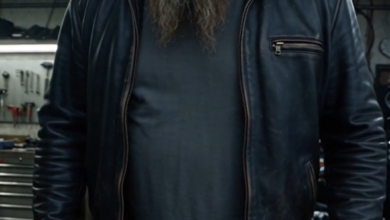
He was broad through the shoulders, gray threaded into his beard, leather vest over a thermal shirt despite the cold, tattooed forearms crossed over his chest as if he had every right in the world to stay exactly where he was. A black motorcycle was parked just beyond the lot under the dying stadium lights, its chrome catching the last weak orange of sunset. He hadn’t spoken through most of practice. Hadn’t cheered. Hadn’t moved much at all.
Just watched.
Not the whole team, either.
One boy.
That was what made it worse.
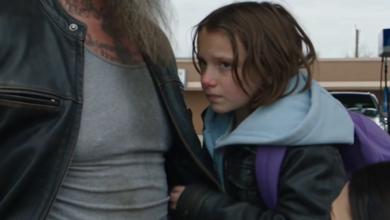
Eli Mercer sat alone on the lowest bench by the sideline, too small for twelve, still in his practice jersey, shoulder pads off but cleats on, his duffel bag resting against his shins. He kept glancing toward the parking lot every time headlights swung past the field entrance, and every single time his face did the same little thing—hope first, then correction, then nothing.
The kind of nothing adults liked to look away from.
The biker hadn’t looked away once.
Tina Holloway noticed it before anyone else because her daughter, Kelsey, had forgotten her water bottle and dragged her back through the gate just as the field was emptying. Kelsey was nine, all knees and pink earmuffs, and she stopped dead when she saw Eli still sitting there.
“Mom,” she whispered, tugging her sleeve. “Why is he alone?”
Tina didn’t answer right away. Her eyes were on the biker.
He had shifted forward, elbows on his knees, gaze still on the boy. Not hungry. Not wild. Just fixed. But in the wrong body, with the wrong face, in the wrong kind of silence.
That was enough.
“Coach,” Tina called, sharper than she meant to. “Does that man belong here?”
Coach Darnell turned, keys in hand. He followed her gaze up to the bleachers, then down to Eli, then back up again.
The biker didn’t flinch. Didn’t wave. Didn’t explain.
Coach lifted his chin. “Sir, practice is over.”
“I know.”
The voice was low, flat, controlled.
Not friendly. Not apologetic.
Tina took Kelsey’s shoulder and pulled her a little closer. Another parent—Mark Pelham, loud in the way men often got when they were nervous—stepped back through the gate from the parking lot.
“What’s going on?” he asked.
Tina didn’t lower her voice. “That guy’s been sitting there staring at one of the kids for half an hour.”
That wasn’t exactly true, but it landed the way truth often didn’t.
Coach Darnell straightened. “Sir, do you know that boy?”
The biker looked at Eli first, not the coach. Then he said, “I know he’s still waiting.”
The answer only made the air colder.
Eli’s head dropped lower. He picked at a loose thread on his sleeve. The stadium lights kicked on above them with a hard electrical hum, and in that white glare the whole scene took on something harsher, more public, like a moment people would later swear they had seen more clearly than they really had.
Tina felt Kelsey step behind her leg.
Mark muttered, “Call security.”
Coach Darnell walked a few yards toward the bleachers. “I asked if you knew him.”
The biker stood then, slow and deliberate, boots ringing once on the metal bench before he moved down one row. Every adult near the gate went rigid at the same time. He was bigger standing up than anyone had guessed sitting down. Mid-fifties maybe. Built like somebody who had spent years lifting things heavier than most people’s excuses.
“No,” he said. “But I know what it looks like when a kid keeps checking the road like that.”
No one answered.
Because there were things in that sentence people heard and things they imagined hearing underneath it.
And neither helped him.
Eli finally spoke, voice thin with embarrassment. “My mom said she was coming.”
The words were not dramatic. That was what made them bad.
Coach Darnell’s expression changed first. Less suspicion. More discomfort.
He looked at his phone. “Did you try calling?”
Eli nodded. “Three times.”
“And?”
No answer.
The biker was still standing above them on the bleachers, hands loose at his sides, saying nothing more, which somehow made every second stretch tighter.
Then Eli added, almost too quietly to hear, “My phone died last week.”
Tina felt something twist low in her chest. Not guilt. Not yet. Just the first small crack in the easy version of the situation.
But the biker spoke before anyone else could.
“If nobody comes by dark,” he said, eyes still on the boy, “he rides with me.”
And that was when outrage finally flooded the field.
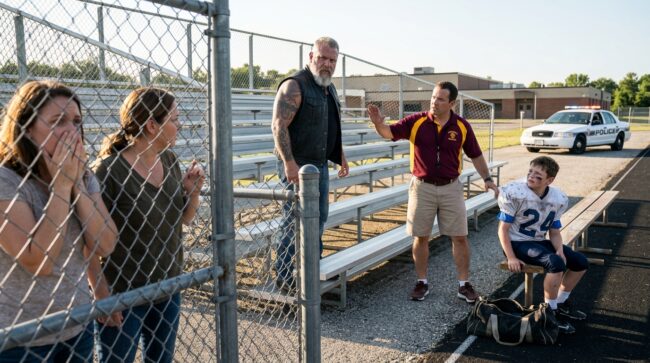
Everything happened at once after that.
Tina pulled Kelsey fully behind her. Mark barked, “Like hell he does,” with the reflexive courage of a man standing twenty feet away and surrounded by witnesses. Coach Darnell threw one arm out toward Eli without quite stepping in front of him, as if he had suddenly remembered that protection was part of his job and wasn’t sure whether he was already too late.
“Sir,” he said, voice hard now, “you need to leave.”
The biker didn’t move.
The lights above the field buzzed and flickered once, then settled. Beyond the fence, the last of the traffic thinned on Salem Avenue. The air smelled like wet metal and cut grass and the faint burned scent from the concession stand grills that had gone cold an hour ago.
“Did you hear me?” Coach asked.
The biker looked down at him, not challenging, not backing off. “I heard you.”
“Then go.”
“No.”
That single word dropped like something heavy.
Mark was already pulling out his phone. “I’m calling the cops.”
“Do it,” the biker said.
That didn’t help either.
People expected dangerous men either to bluster or retreat. They didn’t know what to do with one who sounded calm enough to be certain.
Tina watched Eli during all of it. That was the strange part. The boy didn’t look scared of the biker. He looked scared of the scene, of being the reason adults were staring, talking louder, deciding things over his head. His cleat tapped once, twice, against the concrete. His hands had disappeared into the sleeves of his hoodie.
Kelsey peeked around Tina’s coat and whispered, “He looks cold.”
Tina almost hushed her, but the words hung there longer than they should have.
Coach Darnell tried another angle. “The boy’s not going anywhere with a stranger.”
The biker nodded once. “Good.”
Coach blinked, thrown off balance by agreement where he expected resistance.
“Then what exactly are you doing here?” Tina snapped.
For the first time, the biker looked directly at her.
His eyes were lighter than she expected. Tired, maybe. Or just old in a way that had seen too much and stopped advertising it.
“Waiting,” he said.
“For what?”
He shifted his gaze back to Eli. “For the part adults always think someone else is handling.”
Tina opened her mouth, then shut it. It sounded rehearsed, and yet it didn’t. More like something worn smooth from being true too many times.
Mark strode closer to the sideline, putting a little performance into it now that 911 was on speaker. “Yeah, I’m at Roosevelt Middle. There’s a suspicious male refusing to leave and trying to take a child—”
“I didn’t touch him,” the biker said.
“But you said—”
“I said I’m not leaving him here.”
The dispatcher’s tinny voice crackled through Mark’s phone. Coach Darnell rubbed one hand over his mouth. He was a decent coach, the kind who remembered birthdays and made kids run extra laps only when they mouthed off, but this wasn’t a dropped pass or a twisted ankle. This was liability, optics, instinct, fear. Things schools hated because they stuck.
He crouched beside Eli. “Listen to me. Is there another number we can call? Dad? Grandma? Anybody?”
Eli swallowed. “My grandma’s in hospice.”
The field went still in a different way.
Coach’s voice softened. “Your dad?”
Eli stared at the parking lot.
Tina didn’t know why the silence that followed felt worse than any answer.
Then a sedan rolled slowly past the open gate, headlights sweeping across the fence. Eli sat up so fast his bag tipped over.
But the car didn’t stop.
It kept going.
He watched it disappear, and something in his face closed so completely that even Mark fell quiet.
From the bleachers, the biker came down another row.
Only one.
Metal rang under his boots.
Coach stood immediately. “Stay where you are.”
The biker stopped.
He lifted both hands slightly, empty palms, not surrendering exactly, just making a fact visible. “I’m staying.”
Mark, still on with dispatch, said, “He’s moving toward the kid now.”
“I moved one row.”
“You don’t get to argue details.”
That pulled a humorless breath through the biker’s nose, not quite a laugh. He seemed to know something the rest of them didn’t, and everybody hated him for it.
Tina hated him for that.
Because part of her wanted him to be exactly what he looked like. It made the scene simple. Villains simplified things. Men with leather vests who watched children from bleachers and made strange claims about taking them home—those men fit somewhere obvious.
Men who stayed calm while a boy was forgotten did not.
Another figure emerged near the concession stand then, bent slightly at the shoulders, wrapped in a cafeteria apron under a winter coat. Mrs. Alvarez, who ran snacks on game nights and cleaned up after school events, was carrying a black trash bag to the dumpster. She paused when she saw the cluster near the field.
“What happened?” she called.
“No problem,” Coach said automatically, the lie of institutions everywhere.
But Mrs. Alvarez squinted past him at Eli and set the bag down. “That child’s still here?”
Eli gave a tiny nod.
Her expression sharpened. “Again?”
The word slipped out before she could catch it.
Heads turned.
Tina felt it this time—something colder than suspicion, because suspicion was easy. This was the first hint that the ugliest part of the evening might not be the biker at all.
Coach Darnell straightened too fast. “Mrs. Alvarez—”
But she was already walking closer, wiping her hands on the front of her apron. “Last month it was almost dark before somebody came. I sat with him by the office because the custodian was locking up.”
Eli shrank in on himself, cheeks burning.
Tina looked from the boy to the biker, and for the first time she saw that he wasn’t staring with curiosity.
He was keeping count.
Mark lowered his phone from his ear. The dispatcher was still talking, asking whether anyone was in immediate danger, and suddenly nobody seemed eager to answer.
The biker stepped down one more row.
Coach snapped, “I said don’t.”
This time the biker’s jaw tightened. Not with temper, exactly. With effort.
“He’s shivering.”
“I said I’ve got it.”
The biker’s eyes moved to Coach’s thin school windbreaker, then to Eli’s bare hands, then to the darkening sky. “No,” he said quietly. “You had it.”
That landed harder than shouting would have.
Somewhere beyond the field, a siren chirped once and went silent. Not here yet. Close enough to make everybody more aware of themselves.
Eli bent to pick up his fallen duffel bag, and a folded slip of paper slid from the side pocket onto the concrete.
No one would have noticed if the wind hadn’t pushed it halfway open.
The biker did.
His whole body changed so subtly Tina almost doubted it, but she saw it—a sudden stillness so complete it felt like impact. His gaze fixed on the paper. Not on Eli. Not on the adults. On the paper.
Coach saw it too and moved first, snatching the slip up from the ground.
It was lined notebook paper, folded twice, edges dirty from being carried around too long.
“What is this?” he asked.
Eli went pale. “Nothing.”
“Eli.”
“Give it back.”
Coach unfolded it.
His eyes scanned the page once. Then again, slower.
Something in his face drained away.
Tina took a step forward. “What is it?”
Coach didn’t answer.
The biker’s voice came low from the bleachers. “Read it.”
Coach looked up sharply. “How do you know what it is?”
The man held his gaze. “Because I wrote one just like it twenty-one years ago.”
And that was the moment the first patrol car turned into the lot.
The flashing lights painted the wet asphalt in pulsing red and blue, turning every parent, every fence post, every raindrop caught on the bleachers into something harsher and more exposed than it had been a minute earlier.
Officer Lena Brooks got out first, young but not green, hand resting near her belt more from habit than threat. Her partner, Ruiz, came around the other side of the cruiser and took in the field with one sweeping look that probably told him three things immediately: no one was fighting, too many people were talking, and the biggest man present had already been chosen as the danger.
That man remained exactly where he was.
Halfway down the bleachers now. Unmoving.
Coach Darnell folded the paper once, too quickly, as if hiding it might undo whatever he had just read.
Officer Brooks approached the gate. “Who called?”
Mark raised his hand. “I did. That guy”—he pointed without subtlety—“refused to leave and said he was taking the boy.”
Brooks looked to the biker. “Sir?”
The biker didn’t answer right away.
Then: “I said I wasn’t leaving him here.”
Ruiz glanced at Eli, then at the crowd, then at Coach. “Whose kid?”
No one replied immediately.
That silence said more than any accusation had.
Eli sat small and rigid on the bench, duffel bag clutched to his chest now like something that could make him disappear if he held it hard enough. Tina could see the shame on him from where she stood. Shame, not fear. And that bothered her more than she wanted to admit.
Officer Brooks turned to Coach. “What’s the situation?”
Coach opened his mouth, then stopped. He still had the folded note in one hand.
“Coach?” Brooks pressed.
He looked at Eli. “His ride hasn’t shown.”
“How long?”
“Almost forty minutes.”
Ruiz exhaled through his nose. “And the gentleman?”
Nobody seemed willing to say it cleanly now.
Mrs. Alvarez did. “He stayed.”
The officers both looked at her.
She jerked her chin toward the bleachers. “Everybody else was leaving. He stayed.”
Mark scoffed. “That doesn’t make it less weird.”
“No,” Mrs. Alvarez said. “But maybe it makes the rest of us look worse.”
The words hit with a quiet force that scattered people into silence again.
Officer Brooks stepped toward the bleachers. “Sir, I need you to come down and talk to me.”
The biker obeyed immediately.
No argument. No sudden movement. He came down slowly, boots striking metal with a steady rhythm until he reached the track. Up close, he looked older than Tina had guessed. The face was hard, yes, but not reckless. There was a scar near his chin. Another near one eyebrow. His leather vest had no flashy slogans, no cartoon skulls, no attempt at theater. Just a worn patch over the chest and a name stitched above it.
M. Rourke.
Brooks noticed it too. “You have ID, Mr. Rourke?”
He reached inside his jacket carefully and handed it over.
Ruiz stayed near Eli and Coach. “Mind telling us why you were watching practice?”
M. Rourke looked past him to the boy. “I was waiting to see if today was different.”
Tina felt the words before she understood them.
Brooks glanced at the bleachers, then at the motorcycle beyond the lot. “Do you know the child?”
“No.”
“Then why were you here?”
He rubbed one thumb against the side of his hand, once, like a man holding something back by muscle memory alone. “Because three Thursdays ago I was filling up at the gas station across from the school when I saw him sitting by the fence alone after dark.”
Coach’s head snapped up.
Rourke continued, voice level. “A janitor sat with him for twenty minutes. Then a woman came. She was crying before she got out of the car. Boy never moved. Just picked up his bag and got in.”
Nobody said a word.
“So you came back?” Brooks asked.
Rourke nodded.
“Why?”
For the first time, a flicker of something crossed his face. Not anger. Not pride. Something older. Something he clearly hated being forced to show in front of strangers.
“Because kids learn things when they wait like that,” he said. “Things they keep.”
Ruiz looked toward the folded paper in Coach’s hand. “What note is that?”
Coach hesitated.
Brooks held out her hand. “Let me see it.”
He gave it over.
The officers read it together under the wash of the cruiser lights. Tina couldn’t make out the full page from where she stood, only a few scattered lines when Brooks shifted it.
If practice ends and nobody comes…
I can sit by the field until the lights go off…
Do not call Mom at work unless—
Brooks lowered the paper slowly.
There was no drama in her face now. Just understanding. And that was somehow more devastating than alarm.
“What is it?” Mark asked, but his voice had lost its certainty.
Brooks didn’t answer him. She looked at Eli instead. “Honey, who told you to write this?”
Eli kept his eyes on his bag.
“No one,” he whispered. “I just didn’t want Coach to get mad again.”
Coach went white.
The whole field seemed to tilt around that single sentence.
Rourke looked away then, toward the dark edge of the parking lot, jaw locked so hard that a muscle jumped once in his cheek.
Tina knew, with sudden clarity, that whatever bound this man to the moment had nothing to do with curiosity and everything to do with recognition.
Officer Ruiz crouched near Eli. “Is your mother in trouble?”
A pause.
Then the boy said, “She works double shifts.”
“Okay.”
“She says she’s trying.”
His voice cracked on the last word, and he bit it back so fast it hurt to hear.
Ruiz softened further. “I know.”
“No.” Eli’s fingers tightened around the bag strap. “You don’t. She says if I make it harder, she could lose the job.”
A wind moved across the field, cold enough to sting the eyes. Tina wasn’t sure whether that was why hers suddenly did.
Brooks straightened and looked over at Rourke. “How did you know about the note?”
He took a breath like it cost him. “Because when I was eleven, my mother cleaned rooms at a motel off Route 40 and my stepfather drank up every ride we ever had.” He nodded at the paper in Brooks’s hand. “I wrote instructions too. How long to wait. When not to cry. What lies to tell if teachers asked.”
Nobody moved.
Even Mark.
Even Coach.
Rourke’s gaze drifted back to Eli, but he spoke like he was addressing a place much farther away. “I used to sit on aluminum benches just like these and pretend I liked the quiet.”
Officer Brooks said, more gently now, “So you came back to watch him?”
Rourke answered without looking at her. “I came back so one of us wouldn’t have to sit there thinking nobody noticed.”
The field fell into a silence so complete that the buzz of the lights sounded suddenly enormous.
Then, from somewhere in the parking lot, a car engine revved hard and fast.
Headlights swung through the gate.
A dented silver sedan came in too quickly, tires spitting gravel, and Eli was on his feet before anyone could stop him.
“Mom.”
Rourke took one step forward.
Officer Ruiz threw out an arm automatically to hold the line.
The car door flew open.
And the woman stumbling out looked nothing like the careless monster everyone had been building in their heads.
She looked terrified.
And when she saw the police, she didn’t run to her son first.
She looked straight at the biker—
and went dead still.
For one suspended second, nobody on the field seemed to breathe.
The woman by the sedan had one hand still on the open car door, the other pressed flat against the roof as if she needed help staying upright. She was younger than Tina expected, maybe early thirties, but exhaustion had a way of adding years in the wrong places. Her hair had come loose from a work knot. One sleeve of her gray uniform shirt was damp at the wrist. There was grease on one cuff, and her face carried the raw, stunned look of someone who had been running on fear long before she turned into the school lot.
Eli took a step toward her.
“Mom.”
But she was staring at the biker as though the rest of the field had dropped away.
Rourke had stopped too. He looked no more prepared for her face than she was for his.
Officer Brooks shifted immediately, reading threat where the silence gave her none to work with. “Ma’am, stay where you are.”
The woman blinked, dragged herself back into the moment, and finally looked at Eli. That one look cracked her open. Not loudly. Not theatrically. Just enough for everyone there to see that whatever had delayed her, whatever had shaped this evening into something public and humiliating, it had not been indifference.
“Eli, baby—”
He was already moving.
Ruiz caught him lightly by the shoulder. “Hold on a second.”
The boy froze, not because he was afraid of the officer, but because he was used to stopping himself when adults’ voices changed. Tina saw it clearly now. How quickly he folded inward. How practiced it was.
The woman swallowed hard. “Please. Please let me go to him.”
Brooks glanced at Eli, then nodded once. Ruiz stepped aside.
Eli crossed the track in three quick strides and ran into her so fast she stumbled back against the sedan. She wrapped both arms around him, burying her face against his hair, and what came out of her was not elegant and not controlled. It was the kind of crying people did when they had been holding a collapse in place with whatever scraps of strength they could find.
“I’m sorry,” she kept saying. “I’m sorry, I’m sorry, I’m sorry.”
Eli didn’t answer. He held on.
That should have been the end of it. A late parent, a child retrieved, an ugly misunderstanding dissolving under ordinary pain. But the field was too full of witnesses now, too full of questions sharpened by embarrassment. And the woman still hadn’t looked away from Rourke for long.
Brooks approached carefully. “Ma’am, I’m Officer Brooks. Can you tell me your name?”
“Rachel Mercer.”
“Ms. Mercer, were you delayed?”
Rachel laughed once, and the sound had no humor in it. “Yeah.”
Brooks waited.
Rachel wiped her face with the heel of her hand, then looked toward the school building, the officers, Coach Darnell, the parents who had judged her before knowing anything, and finally back to Rourke. Her shoulders tightened the moment her eyes reached him.
“I got held at work,” she said. “Then my manager said if I left before the fryer line was cleaned, I shouldn’t bother coming back tomorrow.” She took a breath that shook halfway through. “I left anyway.”
Coach Darnell looked down.
“My phone died around six,” she added. “I borrowed one at the gas station, but I couldn’t remember the school office number, and by the time I got there, the woman said the front office was already closed.”
Tina thought of all the easy stories adults told themselves about neglect. How often neglect looked like somebody not caring, when sometimes it looked like somebody drowning in public and trying not to splash anyone.
Brooks’s voice stayed level. “Do you know this man?”
That changed the air again.
Rachel’s grip on Eli tightened almost invisibly. The boy felt it and turned his face against her coat.
She looked at Rourke with the expression of someone opening a door she had spent years bracing shut. “I know who he is.”
Coach Darnell spoke before he could stop himself. “Then why didn’t you say something?”
Rachel didn’t even look at him. “Because I didn’t know he was alive.”
A silence went through the crowd like a cold current.
Rourke’s face didn’t change much. Only his eyes did, and only if you were close enough to notice. Tina was.
Brooks glanced between them. “Ms. Mercer, I need a little more than that.”
Rachel gave a short nod. She seemed to understand that by now the story no longer belonged only to her. Not with her son standing in the middle of it. Not with police lights bouncing off the school windows.
“When I was sixteen,” she said, “my brother disappeared for three days.”
No one interrupted.
“We lived in Springfield then. Our mother was sick. My brother got mixed up with older guys, pills, stealing parts, stupid things that stop being stupid once people start carrying them across county lines.” She swallowed and looked toward Eli, not because he needed the details, but because she seemed to need him there to say them. “One night he didn’t come home. Mom kept calling hospitals. Nothing. By the second day she could barely stand.”
Her gaze returned to Rourke.
“This man found him.”
Mark, who had spent the last half hour sounding certain about everything, went silent so completely he might as well have vanished.
Rachel continued, voice thinner now. “My brother had passed out behind an auto shop with two men who weren’t going to let him walk away owing them money. Mr. Rourke got him out. Drove him home. Sat with my mother at the kitchen table until dawn while she figured out which rehab bed she could beg for.” She let out a breath that trembled. “I was sixteen. He was just a man in a leather vest standing in our doorway, and I remember thinking he looked like the last person in the world you should trust.”
No one on that field missed the shape of the sentence.
Rourke glanced at the wet track, saying nothing.
“Then my brother got clean,” Rachel said. “For a while.”
The words darkened as they landed.
Brooks spoke gently. “For a while?”
Rachel nodded. “He relapsed two years later. Overdosed in a motel outside Columbus.” She pressed her lips together until the next sentence became manageable. “By then Mr. Rourke had moved on. Or that’s what I thought. We lost track of him after the funeral.”
Eli pulled back just enough to look up at her. “Mom?”
Rachel touched his cheek and forced something steadier into her face.
“It’s okay.”
But it wasn’t. Not fully. Not yet.
Brooks turned to Rourke. “You know them from back then?”
Rourke finally answered. “Her brother, Danny.”
Just the name. Nothing else. But he said it like someone setting down something fragile after carrying it too long.
Rachel looked at him with a mixture Tina had never seen so plainly on another person’s face—gratitude, grief, and anger braided so tightly together that even she might not have known where one ended and the next began.
“You used to tell him one thing,” she said quietly.
Rourke’s jaw moved once.
Rachel repeated it, as if she had been hearing it in her head for years. “You used to tell him, ‘A kid should never feel forgotten twice.’”
The field went still again.
And Rourke, who had given almost nothing all evening, lowered his eyes for the first time.
No one rushed him now.
Not the officers. Not Coach. Not the parents who, half an hour earlier, had been ready to assign every dark motive a frightened imagination could manufacture. The stadium lights still hummed overhead, and the cold had sharpened, but the urgency in the air had changed shape. Suspicion had cracked. Something more difficult had taken its place.
Recognition, maybe.
Or shame.
Eli stood close against his mother’s side, looking from Rachel to Rourke with the alert confusion of a child who understands that adults are standing inside an old story without knowing the ending.
Officer Brooks handed the folded note back to Coach Darnell. “I think we’re done treating this like an abduction risk.”
Coach took the paper as if it weighed more now than it had before. His face had gone drawn and older. “I wasn’t—”
Brooks stopped him with a look that wasn’t cruel, only precise. “You weren’t what?”
The question stayed there.
Coach looked at Eli, then at the field, then finally at Rachel. “I didn’t know this had happened before.”
Mrs. Alvarez spoke from behind him. “That’s because nobody asks children the questions that make adults uncomfortable.”
Coach flinched. Nobody argued with her.
Rachel crouched in front of Eli and started untying one of his cleats with stiff fingers. “Did you eat after practice?”
Eli hesitated. “No.”
She closed her eyes briefly, as if that answer had hit exactly where she expected it to. “I packed crackers in your side pocket.”
He gave a tiny nod. “I know.”
“And you didn’t eat them?”
Another pause. “I wanted to save them in case you were later.”
Several people looked away at that.
Tina felt heat climb into her face. She had spent forty minutes building the wrong villain and had not once asked herself what kind of child rationed crackers against his mother’s lateness.
Rourke remained a few steps back, hands relaxed at his sides. He had not tried to approach Rachel. Had not inserted himself. If anything, he seemed determined now to reduce his presence, as though the purpose that brought him there had already been exceeded by too many words.
But Rachel rose slowly and faced him.
“You came back every Thursday?”
He nodded once.
“For how long?”
“Four weeks.”
“And if I showed up?”
“I left.”
“And if I didn’t?”
His eyes moved briefly to Eli. “I stayed until he got in a car.”
Rachel took that in without blinking.
“You never spoke to him?”
“Not until tonight.”
“Why?”
Rourke seemed to consider the question carefully, not for an answer, but for one honest enough to survive saying aloud. “Because boys that age know when they’re being pitied,” he said. “And they hate it.”
That landed with a force no one could pretend not to feel.
Eli looked up at him then, properly, maybe for the first time all evening. Not scared. Not trusting either. Just searching.
Rourke met the look and said nothing.
Rachel drew a breath. “You could have come to me.”
“Maybe.”
“Why didn’t you?”
He gave the smallest shake of his head. “Because I wasn’t there to make you feel smaller.”
The sentence passed through Tina like a blade wrapped in cloth. Not flashy. Not loud. Just clean.
Rachel pressed one hand to her mouth. She was trying not to cry again in front of strangers and losing the fight by inches.
Officer Ruiz shifted his weight and looked out toward the lot, politely pretending to watch traffic. Brooks gave them space. Even Mark had found nothing left to say.
Coach Darnell spoke at last, quieter than before. “Ms. Mercer… I need to apologize.”
Rachel nodded, but there was no relief in it. “You probably do.”
He swallowed. “I should have handled this differently.”
Mrs. Alvarez muttered, “You should have handled it earlier.”
That one nobody contested.
Brooks addressed Rachel more formally. “Do you feel safe taking your son home tonight?”
“Yes.”
“Do you need any assistance? We can call someone—”
Rachel shook her head. “No. Thank you.”
Ruiz bent slightly toward Eli. “You okay, buddy?”
Eli considered that like a serious question. Then he said, “I’m tired.”
Ruiz smiled faintly. “That makes two of us.”
For the first time all evening, a tiny fracture appeared in the tension around the boy’s mouth. Not quite a smile, but the memory of one.
Then Rachel turned again to Rourke.
“Why today?” she asked.
His answer came without hesitation. “Because it got cold.”
Nothing about the sentence was dramatic, yet it cut the deepest. Not because of what it said, but because of what it implied—that this man had been taking the weather into account while everyone else had been trusting that somebody else, somewhere, was managing the child’s loneliness for him.
Rachel stared at him for a long moment. “Danny would’ve remembered you.”
A shadow moved through Rourke’s face. “He did.”
She frowned. “What do you mean?”
He looked away toward his motorcycle, toward the road beyond the school, toward a distance none of them could see yet. “He found me three weeks before he died.”
That changed everything again.
The words hit Rachel so hard she took a half-step back.
“No,” she said, instantly, reflexively, as if refusal itself could alter the past. “No, he didn’t.”
Rourke lifted his eyes to hers. There was no drama in him, no attempt to soften the truth by staging it. That was what made him credible. And terrible.
“He did.”
Rachel’s voice sharpened. “Why wouldn’t he tell me that?”
“I asked him not to.”
This time the silence turned jagged.
Brooks and Ruiz exchanged a look but did not interfere. Even they seemed to understand that the most important thing happening on that field no longer belonged to procedure.
Rachel’s face had gone pale beneath the parking lot lights. “You asked my brother to keep that from me?”
Rourke nodded once. “From all of you.”
“Why would you do that?”
He took longer answering this time. “Because he wasn’t asking for another rescue.”
Tina felt every adult on that field lean inward, not physically, but with that terrible stillness people enter when they sense the shape of a wound before it fully opens.
Rourke’s voice remained even, but it had roughened at the edges. “He found the garage where I was working in Cincinnati. Came in on a Tuesday afternoon looking like he’d slept in a bus station. Said he’d been clean four months. I believed him.”
Rachel had stopped blinking.
“He asked if I could lend him money,” Rourke said. “I told him no. He nodded like he expected that. Then he asked if I could drive him to Columbus the next morning for a job interview.” He looked down at his hands for one brief second. “That part was true.”
Rachel whispered, “What job?”
“Warehouse loading. Third shift. Nothing glamorous. Honest work.” A pause. “He got it.”
She stared at him as though the field itself had tilted. “Danny got a job?”
Rourke nodded again. “Bought him a cheap work jacket from a thrift place near Parsons Avenue because he didn’t have one decent enough to walk in wearing.” His mouth tightened. “Blue canvas. Too big through the shoulders.”
Rachel let out a small, broken breath.
“I told him,” Rourke continued, “if he wanted to call his family after the first paycheck, call after the first paycheck. Not before. I said don’t go home with promises in your hands. Go home with proof.”
Now even Tina had to look down.
Because there it was—the kind of practical hope poor people recognized immediately. Not speeches. Not miracles. Just one week at a time, one shift at a time, one reason not to disappoint the people you already hurt.
“What happened?” Brooks asked quietly.
Rourke looked toward Eli before he answered, as if measuring what a child should hear and deciding there was no clean way to do this.
“He made it eight days.”
Rachel closed her eyes.
“He showed up to every shift. Called me twice from the vending machines out back because he didn’t trust himself on payday. I picked him up after work the second Friday. We were supposed to drive to Dayton the next morning so he could see you.” Rourke’s voice thinned for the first time. “That night he asked me to stop at a motel because he said somebody from his old crowd had tracked him down and he didn’t want them seeing where I lived.”
Rachel’s hand flew to her mouth.
“I believed that too,” he said.
Nobody moved.
“He told me to come back in thirty minutes. I knew better. I knew better and still left.”
The last sentence came lower than the rest, like something dragged over gravel.
“When I went back,” he said, “he was gone.”
Rachel looked at him with tears standing openly now, no strength left for holding them back. “They said he used alone.”
“He did.”
“And you found him?”
Rourke nodded.
Eli looked from one face to another, sensing enough to stay quiet.
Tina thought of every crude assumption she had made about this man in the bleachers. How easy it was to assign menace to somebody whose grief had simply hardened in visible places.
Rachel’s voice came thin and shaking. “You were the last person with him.”
“Yes.”
“And you still came here for my son?”
That question should have sounded accusing. It didn’t. It sounded lost.
Rourke answered it the only way he seemed capable of answering anything. Plainly. “Your brother sat in my truck that last morning and told me one thing he remembered from being a kid.” He looked at Eli. “He said the worst feeling in the world wasn’t getting hit, wasn’t being hungry, wasn’t even being scared. He said it was watching every car that passed and knowing none of them slowed down for you.”
Rachel made a sound then—not a sob exactly, more like something inside her had been struck in a place without words.
Rourke went on. “He said if he ever had money, the first thing he’d do is make sure no kid of his waited alone after dark.” He paused. “He laughed right after. Said that wasn’t likely, since he couldn’t even keep a cactus alive.”
A wet, breathless laugh escaped Rachel before it broke again into crying.
“That sounds like Danny,” she whispered.
Rourke nodded.
And the twist, when it came, did not arrive with a shout or a reveal staged for maximum effect. It came the way the hardest truths usually did—quietly, almost gently, before anyone had time to brace.
Rourke reached into the inner pocket of his jacket and drew out a small, weathered envelope.
“I should’ve mailed this years ago,” he said.
Rachel stared at it.
“It was in the blue jacket pocket,” he said. “Addressed to you. Never stamped.”
He held it out.
She didn’t take it immediately. Her hand trembled halfway there.
On the front, in thick slanted writing worn soft at the edges, were the words:
For Rach — after first paycheck.
Rachel gave a sound Tina would remember long after she forgot everyone else’s face on that field.
Because in that single second, the whole evening shifted one last time.
This was not a stranger waiting on bleachers.
Not really.
This was the man who had failed to save her brother, carried that failure for years, and then came back—without asking forgiveness, without introducing himself, without forcing his presence into her life—to keep one promise a dead man never got the chance to keep himself.
Nobody spoke for a while after Rachel took the envelope.
The stadium lights hummed overhead. Traffic moved beyond the fence in a steady ribbon of ordinary life, people heading home from shifts and grocery runs and errands, never knowing that under those lights a woman was holding a letter from her dead brother while her son leaned sleep-heavy against her coat.
Rachel opened it carefully, like the paper might tear from more than age.
She read silently.
No one asked to see. No one stepped closer.
Tina watched Rachel’s eyes move line by line, watched her mouth break first at the corner and then completely. She pressed the letter to her lips and closed her eyes.
Whatever Danny had written was hers. But some things were visible anyway. Regret. Hope. The clumsy honesty of somebody trying, at least once, to come back clean.
After a long moment, Rachel folded the paper again and slipped it into her pocket over her heart.
Then she looked at Rourke.
“I was angry at you for years,” she said.
He nodded as if he had expected nothing else.
“I thought whoever was with him at the end had failed him.”
“I did.”
The answer came too fast for performance.
Rachel’s face tightened. “Maybe. But maybe not the way I thought.”
Rourke said nothing.
She glanced down at Eli, who was swaying on his feet now, the adrenaline finally draining out of him. “Did you know it was me? When you saw him?”
“The first week, no. Second week I heard Coach say his last name.”
“And you stayed anyway.”
“Yes.”
“Why didn’t you tell me tonight? Right away.”
His gaze settled somewhere just past her shoulder. “Because some people hear a name before they hear the truth.”
That was so painfully wise that Tina almost hated him for it.
Rachel wiped her eyes. Then, with great care, she did something that seemed almost too intimate for all those witnesses: she stepped forward and hugged him.
Rourke froze.
Not out of resistance. Out of unfamiliarity.
He stood there awkward and still, one hand half-lifted, as if unsure whether a man like him was allowed to receive comfort from the people he had spent years failing in his own mind. Then his hand settled once, lightly, between her shoulder blades.
Just once.
That was enough.
When Rachel stepped back, she said, “Thank you for staying.”
He gave the smallest nod. “He shouldn’t have had to wait alone.”
Coach Darnell cleared his throat, the sound rough and embarrassed. “Ms. Mercer… tomorrow I’m speaking to the principal. We need a better pickup policy. And I should’ve called sooner. I should’ve asked more.”
Rachel looked at him for a moment. “Then do better for the next kid.”
He nodded. It was the only answer available to him.
Mrs. Alvarez walked over and pressed a wrapped granola bar into Eli’s hand. “For the ride home.”
“Thank you,” Eli murmured.
Officer Brooks took down a few final details, softer now, more out of form than suspicion. Ruiz offered Eli a tired little salute that made the boy blink and then, finally, smile for real. Mark drifted off toward his truck without another word. Tina crouched and pulled Kelsey’s earmuffs straight while feeling the full, unflattering weight of having mistaken vigilance for understanding.
The field began to empty.
One by one, adults returned to their cars, their routines, their kitchens and tired marriages and glowing televisions. But the air they left behind had changed. It carried something heavier than gossip and harder than judgment.
Rourke turned toward the gate as if he meant to leave without adding himself to the ending any more than he already had. His motorcycle waited under the lights, dark and still, rain beading on the tank.
“Mr. Rourke,” Rachel called.
He stopped.
She hesitated, not from doubt but from the care of choosing something that would last. “Would you… would you come by Sunday?”
He looked back at her.
“We eat at my place after church,” she said. “Nothing fancy. Eli likes burnt grilled cheese more than good food, so the standards are low.” A faint, shaky smile touched her mouth. “I think Danny would be mad at me if I didn’t ask.”
Rourke stood very still.
Then he said, “Maybe.”
It was not a promise. But it wasn’t a refusal either.
Rachel seemed to understand the difference.
She opened the passenger door for Eli, but before getting in, the boy turned around. He looked at Rourke, at the big quiet man under the stadium lights, and in the solemn, direct way only tired children can manage, he asked, “Were you really going to wait until dark?”
Rourke’s expression softened by degrees so slight most people might have missed them.
“Yes.”
“How dark?”
Rourke glanced up at the lights, then out beyond the field where the road ran black and endless. “All the way.”
Eli absorbed that without dramatics. Then he nodded once, as if accepting a fact he intended to remember, and climbed into the car.
Rachel got in behind the wheel. She didn’t start the engine right away. She sat there one second longer, both hands on the steering wheel, forehead bowed. Then she looked up and gave Rourke one last nod through the windshield.
The sedan rolled out of the lot slowly this time.
No spinning gravel. No panic.
Just taillights receding into the Ohio dark.
When they were gone, the field felt larger than before. Emptier. Honest in a way public places rarely were.
Rourke stood alone near the track for another moment. Then he walked to the lowest bench where Eli had been sitting. Something small lay there, half-hidden against the cold metal.
One of the boy’s practice wristbands.
Blue, frayed, cheap.
Rourke picked it up. Turned it once between two thick fingers. Then, instead of pocketing it, he carried it to the fence near the gate and looped it carefully over the wire at eye level, where it would be the first thing a kid saw walking in tomorrow.
Not lost.
Waiting.
He didn’t say a word after that. He just pulled on his gloves, swung onto the motorcycle, and rode out under the stadium lights with no roar, no flourish, no need to be watched.
And on the chain-link fence behind him, in the wet October night, the little blue band trembled in the wind long after the sound of the engine was gone.