Part 2: The Child Drew a Biker — And the Hospital Learned Why
His real name was Cyrus Cole.
Nobody called him that except the hospital receptionist, and even she said it carefully, like she was reading the name off a court document.
Everybody else called him Grim.
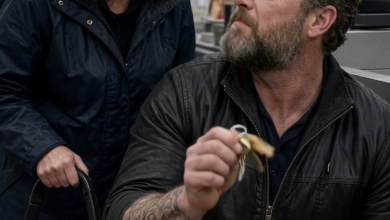
He rode a black Harley-Davidson Road King with a cracked windshield, rust freckles around the footboards, and two tiny pink beads tied to the right mirror. The beads didn’t match anything else about him. They clicked softly when he rolled into the parking lot. Pink plastic against chrome. A sound so small it almost got swallowed by the engine.
I learned later that his club, the Iron Saints, ran charity rides through the Blue Ridge every December. Toys. Coats. Grocery cards. Gas money for families who had to drive Route 74 and I-40 for treatments they couldn’t afford to miss.
But Grim didn’t talk about charity.
He just showed up.
He would park under the same crooked pine near the hospital entrance, kill the engine, sit for ten seconds with both hands still wrapped around the bars, then climb off like every bone in him had been tightened overnight.
He smelled like cold air, leather, gasoline, and the burnt coffee from the truck stop near Exit 44. He never came in empty-handed. Sometimes he carried stuffed animals in a trash bag because, as he told the nurses, “Bags don’t need to be pretty. Toys do.” Sometimes he carried grocery cards rubber-banded with no note. Sometimes he carried tiny fleece blankets his old lady had sewn before she passed.
He never stayed long.
That was his rule.
Drop it. Nod. Leave.
Until Milo.
After the glove, Milo started waiting for him.
“Is the biker coming today?”
Not “Grim.” Not “Mr. Cole.” The biker.
On good days, Milo would sit up straight when he heard boots in the hall. On bad days, when nausea made his lips gray and his hands cold, he would still lift that glove from his nightstand and slide his fingers inside.
It swallowed his whole hand.
The glove was black leather, old, soft at the palm and stiff around the knuckles. There was a burn mark near the thumb and a faded strip of silver tape wrapped around one finger. Inside the cuff, almost hidden, was a tiny sticker of a yellow star.
I asked Grim about it once.
He looked at the glove in Milo’s lap and said, “Old road junk.”
Then he changed the subject.
That was how Grim talked. Three words where another man would use thirty.
But kids are strange. They can walk right past walls adults keep slamming into.
Milo asked him everything.
“Do bikers eat cereal?”
“Some.”
“Do bikers go to church?”
“Depends what they’ve done.”
“Are you scared of shots?”
Grim paused at that one.
The room was quiet except for the IV pump clicking.
“Yeah,” he said.
Milo’s eyes widened. “You are?”
“Only liars ain’t scared.”
That answer became scripture to my son.
Every needle after that, Milo put on the glove and said, “I’m a biker. I don’t scare easy.”
Not loud. Not proud. Just steady.
The nurses started waiting for it. Even the phlebotomist with purple glasses would pause before the stick, giving him room to say the line.
Then one Friday, Grim brought two more bikers with him.
One was a Black man in his sixties named Preacher, tall and narrow, with a white beard and a Bible verse tattooed down his forearm. The other was a younger white prospect named Danny, maybe twenty-five, nervous, red-haired, still trying to earn his patch.
Danny stood outside Milo’s room like the floor might fall through.
Grim looked at him. “In or out.”
Danny swallowed. “I don’t like hospitals.”
“None of us do.”
Preacher touched the kid’s shoulder. “Brotherhood ain’t a parking lot thing.”
So Danny stepped in.
Milo gave him a thumbs-up with the glove.
The prospect looked at my son’s bald head, the taped IV line, the bruises on his little arm, and his face twisted before he could hide it.
Grim saw it.
“Hold your shape,” he muttered.
Danny straightened.
That was the first time I understood the club wasn’t just men on motorcycles. It was men holding each other upright in rooms where nobody wanted to stand.
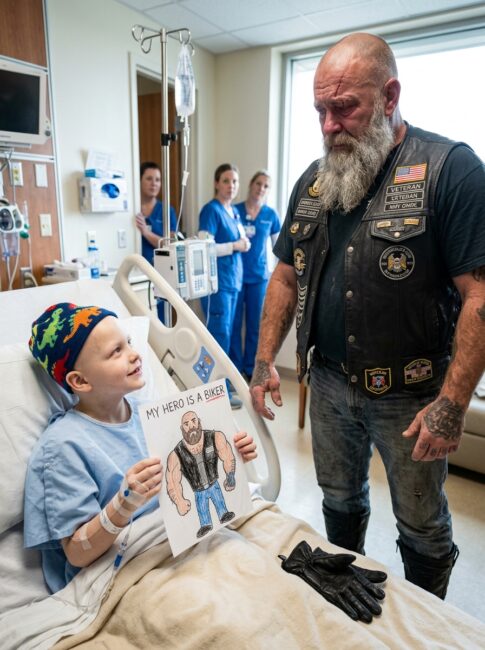
The art show happened on the first warm Saturday in March.
The hospital called it “Heroes on the Wall,” which sounded cheerful enough until you remembered most of the artists were children who knew the names of their medications better than the names of baseball players.
They hung the drawings along the pediatric hallway with blue painter’s tape.
A six-year-old girl drew her surgeon with angel wings.
A boy with cystic fibrosis drew his big sister carrying an oxygen tank like a rocket pack.
Milo drew Grim.
Not small. Not in the corner.
He filled the whole page with him.
A giant biker stood with his boots planted wide, one hand holding a black leather glove, the other hand blocking a silver needle as big as a sword. Milo had colored the vest black and added shaky little patches. He got the beard right. He got the skull ring right. He even drew two tiny pink dots on the motorcycle mirror.
At the top, in crooked letters, he wrote:
MY HERO IS A BIKER.
I laughed when I saw it.
Then I cried because I laughed.
Milo was proud in a way I had not seen in months. He wore a knit cap with dinosaurs on it and sat in his wheelchair under the drawing like he was guarding a museum piece.
The nurses came by. Doctors came by. Parents came by.
Some smiled politely, confused.
Others stared at the drawing, then at Grim when he finally walked in with six members of the Iron Saints behind him.
The hallway changed when they entered.
Leather. Boots. Chain wallets. Gray beards. Tattooed necks. Men big enough to block doorways, trying to make themselves smaller around children.
Grim stopped in front of the drawing.
For a moment, nothing moved.
Then his right hand opened and closed once.
I had seen that hand hold a coffee cup, a stuffed bear, Milo’s blanket when it fell. I had never seen it shake.
Milo rolled forward.
“That’s you,” he said.
Grim didn’t answer.
“You’re the hero.”
Grim’s jaw moved, but no sound came out.
Preacher stepped closer, saw the drawing, and whispered something I couldn’t hear.
Grim turned hard. “Don’t.”
That one word cut through the hallway.
Milo’s smile faded.
I stepped between them, mother instinct rising. “What’s wrong?”
Grim looked at me, and for the first time since I met him, I saw fear on his face. Not anger. Not discomfort. Fear.
Then the nurse from oncology came running.
“Milo’s labs are back.”
Her voice had that careful hospital calm, the one that means the floor is opening.
My stomach went cold.
The doctor came five minutes later and asked to speak privately.
No parent ever wants that sentence.
Milo’s counts had crashed again. The treatment wasn’t holding. They needed to move faster. Bone marrow transplant had gone from possibility to urgency.
I remember the hallway blurring. The art on the walls. The smell of latex. The Iron Saints standing too still, like a line of dark statues.
I asked the doctor about donors.
He said the registry was being searched.
He said they were doing everything.
He said we should prepare.
Prepare.
Hospitals use soft words for hard cliffs.
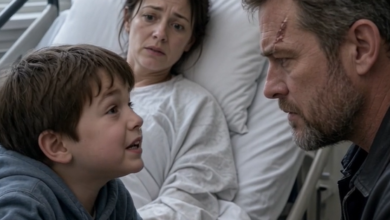
Milo heard enough from the room to understand something had shifted. When I came back, he was gripping the leather glove to his chest.
“Mom,” he whispered, “do bikers get transplants?”
I sat beside him and tried not to fall apart.
Grim stood at the doorway, one hand braced on the frame, eyes fixed on the glove.
Then he turned and walked away.
No goodbye.
No nod.
Just boots down the hallway, faster than usual, leather creaking, the exit door banging open.
Milo watched him go.
That hurt worse than the doctor’s words.
Because my son had just drawn his hero, and his hero had run.
For three days, Grim didn’t come back.
Milo pretended not to care.
That was worse.
He still wore the glove for every needle, but he stopped asking if the biker was coming. He turned his face to the window when Harleys passed on the road below. He told the nurses he was tired, even when he wasn’t.
On the third night, I found him awake at 2:13 a.m., staring at his drawing taped beside the bed.
“Maybe heroes leave,” he said.
I didn’t know what to say to that.
The next morning, Preacher showed up alone.
No club. No engine thunder. Just one old biker in a denim shirt standing at our door with a paper coffee cup in his hand.
“Can I sit?” he asked.
I nodded.
He sat in the chair Grim usually took.
For a long time, he didn’t speak.
Then he pointed at the glove on Milo’s bed.
“That belonged to Lily.”
Milo looked at him.
I looked at the glove.
“Who’s Lily?” I asked.
Preacher rubbed both hands over his knees.
“Grim’s daughter.”
The room seemed to shrink.
“She was treated here?” I asked.
Preacher nodded. “Room 414. Same floor. Different year.”
“How long ago?”
“Eleven years.”
Milo’s fingers touched the yellow star sticker inside the glove cuff.
Preacher saw it.
“She put that there,” he said. “Said every biker needed a star in case he got lost.”
I could hear the IV pump. Click. Click. Click.
Preacher’s voice stayed low.
“She was seven. Hated needles worse than any kid I ever saw. Grim gave her that glove during chemo. Told her it was armor. She’d put it on and say, ‘I’m a biker. I don’t scare easy.’”
My throat closed.
Milo stared down at the glove like it had become alive.
Preacher kept going.
“After she passed, Grim never came past the lobby. For eleven years, he delivered toys and left. Then he heard your boy crying.”
I remembered the way Grim had stopped outside the room. Not curious. Struck.
“He gave Milo Lily’s glove?” I whispered.
Preacher nodded.
“But why did he run from the art show?”
The old biker’s eyes lifted to mine.
“Because Lily drew the same picture.”
No one moved.
“Same words,” he said. “Different crayon. ‘My hero is a biker.’ We found it folded inside his cut after her funeral.”
That was the first twist.
The second came when the transplant coordinator walked in fifteen minutes later.
She carried a folder. Her face looked different.
Careful, but bright around the edges.
“We found a donor,” she said.
I stood so fast the chair scraped.
“A full match?” I asked.
She nodded.
“Who?”
She hesitated.
Then from the hallway came the sound of boots.
Slow. Heavy. Familiar.
Grim appeared in the doorway wearing no vest, no skull ring, no gloves.
Just a hospital wristband.
He looked smaller without the leather.
Not weak.
Never that.
Just human.
His tattoos ran down both arms, but the hospital gown under his open flannel made him look like any other man waiting to be cut, tested, measured, and told when to breathe.
Milo sat up.
“Grim?”
The biker looked at him.
“Hey, little brother.”
The transplant coordinator cleared her throat. “Mr. Cole asked that his identity remain private, but since he has chosen to tell you—”
“I didn’t choose nothing,” Grim said. “Preacher’s got a big mouth.”
Preacher smiled without apology.
I couldn’t process it.
“You’re the donor?” I asked.
Grim shrugged one shoulder. “Looks that way.”
“You knew?”
“Not at first.”
He stepped into the room. His boots were gone. He wore hospital socks with rubber grips. Somehow that broke me more than anything.
“They swabbed us at a charity ride two years back,” he said. “Club did the registry thing. Most forgot about it. I got a call after Milo’s labs went bad.”
I remembered him leaving the art show.
“You ran because of the drawing.”
His jaw tightened.
“I ran because I saw two kids at once.”
Nobody spoke.
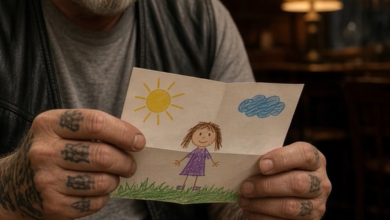
He reached into the pocket of his flannel and pulled out a folded piece of paper, worn soft at the creases. He handed it to me.
It was a child’s drawing.
Yellowed now. Edges bent.
A giant biker stood beside a little girl in a hospital bed. One black glove was drawn bigger than both of them. At the top, in shaky purple marker, were the words:
MY HERO IS A BIKER.
At the bottom, smaller:
Daddy.
Milo leaned forward.
“She drew you too,” he whispered.
Grim nodded once.
His eyes were wet, but nothing fell. Bikers like him didn’t cry easy. Maybe they learned young that tears attract the wrong kind of attention. Maybe they saved them for inside helmets, at seventy miles an hour, where no one could ask questions.
Instead, he acted.
He took Lily’s old glove from Milo’s bed and turned the cuff inside out.
There, under the yellow star sticker, was tiny writing in faded silver marker.
I had never noticed it.
Milo read it slowly.
“L-I-L-Y.”
Grim said, “She wanted me to put that star inside so I wouldn’t get lost.”
His thumb moved over the letters.
“I did anyway.”
That explained the clean nails.
Grim had started washing like a man about to enter a sacred room the day he gave Milo that glove. Every visit, his hands were scrubbed raw. Not because he was soft. Because he remembered infection protocols from eleven years of terror.
That explained the pink beads on his mirror.
Lily had tied them there during her last ride home from the hospital, when Grim had driven the truck and Preacher had ridden the Harley beside them because she wanted “the motorcycle thunder” outside her window.
That explained why he never stayed long.
The hallway was haunted.
That explained Danny, the young prospect.
His little brother had died in a pediatric unit in Tennessee. Grim had brought him to Milo’s room not to toughen him up, but to teach him that running from pain does not make pain smaller.
And that explained the club.
The Iron Saints weren’t just delivering toys.
They had been paying gas cards for families on transplant waiting lists for years because Grim knew exactly how expensive hope gets when it has to travel.
I looked at the man I had been afraid of in the hallway.
The skulls. The scars. The DEATH tattoo. The black leather. The voice like gravel dragged over concrete.
All of it was true.
But it was not the whole truth.
Milo held up the glove.
“Can I still wear it?”
Grim sat carefully on the edge of the chair. His body looked tired, like the last three days had taken years from him.
“Until you don’t need it.”
“What if I always need it?”
Grim looked at Lily’s drawing in my hands.
“Then you keep it.”
The transplant happened two weeks later.
I won’t dress it up. It was not beautiful. It was fear, paperwork, fevers, waiting, machines, mouth sores, alarms, prayers from people who hadn’t prayed in years.
Grim recovered in a room two floors away and refused pain medication twice until a nurse threatened to call Preacher.
The club took shifts.
Not dramatic shifts. Real ones.
One biker sat with me during the four-hour fever spike when I thought I was going to lose my mind. Another fixed the broken zipper on Milo’s backpack. Danny learned which vending machine had the least terrible coffee. Preacher read to Milo from a worn paperback western, skipping the violent parts and pretending he didn’t.
Grim came back to Milo’s room after the doctors allowed it.
He moved slowly. He smelled like antiseptic instead of gasoline.
Milo lifted the glove.
“I did it,” he said.
Grim nodded.
“Knew you would.”
Then Milo said the thing that changed the room.
“You saved me.”
Grim looked at him for a long time.
“No,” he said. “You brought me back.”
That was the part nobody put in the hospital newsletter.
They wrote about a local motorcycle club supporting pediatric patients. They wrote about a successful donor match. They took a photo of Grim standing beside Milo’s drawing, though Grim hated photos and looked like he was being arrested.
They did not write that an eight-year-old boy had walked into an old man’s locked room without knowing it.
They did not write that Lily’s glove had waited eleven years for another small hand.
They did not write that the man everyone feared had been living with a hospital hallway inside his chest.
But I saw it.
So did Milo.
Milo still has the glove.
He is twelve now.
His hair came back darker. His face filled out. He has a thin scar near his collarbone from the port, and he tells people it is where the doctors installed his motorcycle engine.
Every March, on the Saturday closest to the art show, the Iron Saints ride to the hospital.
Not loud near the entrance. Grim made that rule.
They cut the engines at the bottom of the hill and coast the last stretch when they can, boots down, bikes rumbling low, like thunder trying not to wake a baby.
They bring gloves now.
Not riding gloves for the kids to keep forever. Soft little leather cuffs made by one of the old ladies, stitched with stars inside. Each one has a blank space where a child can write their own name.
They call it Lily’s Armor.
Grim hates the name.
Which is how we know he loves it.
He still parks under the crooked pine. The Road King is older, more rust around the footboards, same cracked windshield, same pink beads clicking against the mirror. He still sits for ten seconds before going inside.
Some days he makes it straight to the ward.
Some days he stops at the lobby, puts one hand on the wall, and waits until the ghosts move over.
Nobody rushes him.
Milo doesn’t ride motorcycles. Not yet, anyway. He rides a bicycle with black handlebar grips Grim gave him and a tiny bell that sounds ridiculous when he passes our mailbox. Grim told him every machine needs a voice.
On needle days, which are fewer now, Milo still brings the glove.
He doesn’t always put it on.
Sometimes he just lays it beside him.
The nurses know.
They let it stay.
One afternoon last fall, a little girl in the infusion chair next to him started crying before her blood draw. She was maybe five, with a purple hat and eyes too big for her face.
Milo looked at me.
I looked at him.
He picked up the glove, leaned across the space between chairs, and placed it on her blanket.
“That’s armor,” he told her.
His voice was steady.
“You say this when the needle comes.”
I could hear Grim in every word.
Last week, the hospital hung a new wall of drawings.
The theme was the same.
“My hero.”
There were doctors again. Nurses. Mothers. Fathers. One Batman. Three Spider-Men. A golden retriever with wings.
And there, near the end of the hall, was a picture drawn by the little girl with the purple hat.
It showed a boy in a dinosaur hoodie handing a black glove to a smaller child.
Behind him stood a huge biker with a gray beard.
Behind the biker stood a little girl made of yellow stars.
Milo stared at it for a long time.
Grim stood beside him, arms crossed, leather vest creaking when he breathed. His face looked hard enough to scare strangers in a grocery store.
But his hand found Milo’s shoulder.
Just rested there.
No speech.
No lesson.
Outside, down the hill, the Iron Saints started their engines one by one. The sound rolled up through the glass, low and patient, not like a threat.
Like a promise keeping itself.
Milo slid Lily’s glove over his hand.
Grim looked at him.
“You scared?”
Milo smiled.
“Only liars ain’t scared.”
The old biker nodded once.
Then they walked down the hall together.
Boots. Sneakers. Leather. Hospital lights.
And the glove between them.
Follow the page for more stories about the people you almost judged too quickly.