The Little Girl Locked Outside During Her Parents’ Fight — But the Biker Who Called 911 Wouldn’t Leave
“If either of them opens that door before the police arrive, don’t let the child move,” the biker said, standing on the front lawn like he owned the street, and that was the moment the neighbors decided he was the danger.
It was 6:12 p.m. on a humid Thursday in August, the kind of late-summer evening when the air in Dayton, Ohio, felt sticky even after sunset, and every sound on a quiet block carried farther than it should. Sycamore Lane was usually a street of ordinary routines—sprinklers ticking over dry lawns, screen doors slamming, someone grilling too late, kids riding scooters in the last usable daylight—but that night the whole block seemed to gather around one house the way people gather around a car crash without wanting to admit that’s what they’re doing.
The shouting had started inside number 48.
At first, nobody paid much attention. Married people yelled. Teenagers slammed doors. Televisions got too loud. That was suburbia’s favorite lie: if the noise stayed inside walls, it still counted as private.
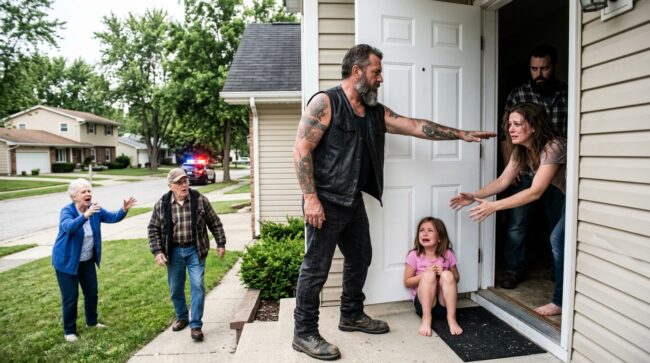
Then a little girl appeared barefoot on the front porch.
She couldn’t have been older than seven. White. Thin legs. Pink T-shirt with one shoulder sliding off. One sock on, one gone. She was pounding on the door with both fists so hard her whole body jerked with every strike.
“Mommy!”
Something hit the wall inside the house.
Then a man’s voice. Then a woman’s. Then the girl turned around and stepped backward off the porch like she had forgotten the stairs were there.
That was when people started coming outside.
Mrs. Darlene Pike from across the street had been watering her hydrangeas. She left the hose running in the grass. A retired Marine named Walter Boone, who lived two doors down and spent most evenings on a folding chair in his garage, stood up and squinted across the street. Two teenage boys stopped their bikes at the curb. A younger mother halfway down the block came out holding a toddler on one hip and didn’t even notice she was still clutching a spatula.
And then the motorcycle rolled up.
No hesitation. No circling the block. Just one heavy black bike cutting into the curb hard enough to make every head turn at once. The rider killed the engine, took off one glove with his teeth, and was already striding toward the house before anyone had time to decide whether that meant help or trouble.
He looked like trouble.
Big shoulders. Sleeveless leather vest. Gray-black beard. Tattooed arms dark against the porch light. Boots heavy on the sidewalk. He moved like a man who knew exactly how much space he took up and didn’t apologize for it.
The little girl had backed herself against the porch railing by then, still crying, still looking over her shoulder at the door as if it might open any second or never again.
The biker stopped at the bottom of the steps.
He didn’t touch her.
Didn’t kneel.
Didn’t soften himself into something polite for the neighborhood.
He just looked once at the front window, where shadows were jerking across the curtains inside, then pulled a phone from his vest pocket and dialed.
That should have reassured people.
It didn’t.
Because the way he did it—silent, focused, already acting like the situation belonged to him—made the whole block instantly suspicious. Nobody knew him. Nobody had seen him on Sycamore Lane before. Nobody had asked him to intervene. And yet here he was, between a frightened little girl and a house full of screaming, speaking low into a phone like he had walked into this kind of disaster a hundred times before.
Mrs. Pike crossed the street first because fear always made her louder. “Sir, what are you doing?”
He didn’t look at her.
“Domestic disturbance,” he said into the phone. “Child locked outside. 48 Sycamore. Send somebody now.”
That should have ended it.
Instead, it lit the fuse.
Because the girl flinched at the word child as if hearing herself described by a stranger made the whole thing suddenly more real. Mrs. Pike gasped and clutched the front of her blouse. Walter Boone started down the driveway with the stiff, determined walk of old soldiers who didn’t trust unknown men near crying children. One of the teenage boys lifted his phone and started recording before anyone told him not to.
And the biker, without asking permission from a single person, stepped onto the lawn and said to the little girl, “Stay where I can see you.”
Wrong tone. Wrong face. Wrong body for a sentence like that.
The whole block heard control where maybe there was only urgency.
The little girl—Maddie, though no one had said her name out loud yet—wrapped both arms around herself and stared at him with those wide, wet eyes children get when their fear is already too tangled to sort out. Behind the front door, something else crashed. Glass maybe. Or a lamp. A woman screamed one word no one on the lawn could make out.
Then the biker added, still on the phone, “If either of them opens that door before the police arrive, don’t let the child move.”
And just like that, every adult standing outside number 48 decided he had crossed a line nobody had given him permission to approach.
The block changed in seconds.
People who had come outside because they were curious now stayed because they were angry. People who had come outside afraid for the little girl suddenly seemed just as afraid of the man standing ten feet from her, talking to dispatch like he had authority no one else could challenge. It was the oldest kind of panic in America—when something real and ugly happens, the first person who looks frightening becomes the simplest place to put the fear.
“Don’t tell her what to do,” Mrs. Pike snapped, marching up the walkway with her garden gloves still on.
The biker ended the call and finally looked at her.
His eyes were lighter than his face suggested. Steadier too. That didn’t help. If anything, it made him harder to read.
“She stays out here,” he said.
Mrs. Pike threw up both hands. “That is not your call.”
Inside the house, a man shouted again—closer this time, close enough that everybody on the lawn could hear rage but not words. Maddie jerked at the sound and pressed herself tighter to the porch post.
Walter Boone came up beside Mrs. Pike. He was seventy, broad-chested even now, with silver hair cropped close and the permanent bluntness of someone who had spent too many years being obeyed. He looked the biker up and down once.
“You with her family?” Boone asked.
“No.”
“Then back off.”
The biker didn’t move.
Boone’s voice hardened. “You hear me?”
“I heard you.”
Wrong answer again. Not rude, exactly. Worse. Calm.
Across the street, the young mother with the toddler had stepped into the road now, phone to her ear, whispering to someone that a biker had shown up and was ordering people around. One of the teenagers said, too loudly, “This is insane,” while angling his camera for a better shot. Somewhere farther down the block, a screen door banged open and shut.
Maddie started crying harder.
Not wild crying. The kind children do when they are trying and failing to stay quiet because they’ve learned loud emotions make adults worse.
“I want my mommy,” she whispered.
That line should have broken the tension. It only twisted it tighter.
The biker turned his head toward her, but not all the way. Like he knew better than to close distance he hadn’t earned.
“You’re staying right there,” he said.
Mrs. Pike snapped, “Stop talking to her.”
Boone stepped closer. “I said back away from the kid.”
Then, before anyone could stop him, he reached for the biker’s shoulder.
The move wasn’t smart. It was reflex. The kind older men made when they thought the rules were still simple and their bodies could still enforce them.
The biker caught Boone’s wrist midair.
Not violently. Not with a dramatic shove. Just one fast, controlled block that froze the whole front yard.
The teenage boy filming muttered, “Oh, damn.”
Mrs. Pike actually screamed.
Maddie backed into the porch rail so hard it rattled. From inside the house, the shouting cut off for one strange second, as if even the people behind the door sensed the atmosphere changing outside.
Then Boone yanked his hand back and took half a step away, more shocked than hurt.
The biker dropped his own hand instantly. “Don’t.”
But by then it was too late.
Now he wasn’t just suspicious.
Now he had touched a neighbor.
Two more people started yelling at once. One of the teenage boys shouted that the cops needed to hurry up. The young mother across the street pulled her toddler tighter and said into her phone, “No, you don’t understand, this guy is huge.” A porch light flicked on next door though the sky wasn’t fully dark yet, making the whole front yard look sharper, harsher, staged.
And through all of it, Maddie kept glancing back at the door.
That was the detail nobody seemed to understand except the biker.
Not the tears. Not the bare feet.
The way she kept watching the door like she still thought she might be called back inside and punished for being seen.
That was when Mr. Ellis appeared.
He lived in the small ranch house next door, a Black veteran in his late sixties who moved slowly with a cane and almost never joined neighborhood drama. People trusted him because he minded his business and helped shovel driveways in winter without turning it into a sermon about character. He came down his steps in slippers and a veterans’ cap, took one look at the scene, and frowned.
“What happened?”
Everybody answered at once.
“Girl got thrown out—”
“This biker showed up—”
“He grabbed Walter—”
“There’s fighting inside—”
Mr. Ellis raised one hand. Silence didn’t fully come, but it bent toward him.
He looked at Maddie first. Then the house. Then the biker.
“You call the police?” he asked.
The biker nodded once.
Mr. Ellis stared at him for a beat longer than expected. “And you stayed.”
That seemed to offend Mrs. Pike on principle. “Harold, he’s ordering people around.”
Mr. Ellis didn’t answer her.
He was watching the biker’s face with the strange, distant attention of someone matching a detail to an old memory and not quite finding it yet.
Then the front door handle rattled from the inside.
Maddie made a small sound in her throat and went rigid.
Every adult on that lawn turned toward the house.
And the biker did the one thing guaranteed to make the whole street think the worst of him.
He walked straight up the porch steps.
Everything happened too fast for anyone to make sense of it cleanly.
Mrs. Pike yelled, “Don’t you dare—”
Boone lunged again, this time from behind. One of the boys shouted that he was recording the whole thing. The young mother across the street backed into her own mailbox, nearly dropping the toddler. Mr. Ellis took two sharp steps forward despite the cane. Inside the house, the doorknob twisted hard again, then stopped, then twisted once more.
Maddie was trapped between the porch rail and the front window now, her breath coming in broken little pulls.
The biker took the top step and stopped directly between the girl and the door.
Not touching her.
Not even looking at her.
Just planting himself there like a wall.
That was the image people would later swear they understood in the wrong way: a huge, weathered man in a sleeveless leather vest blocking a child on her own porch while neighbors screamed at him from the lawn.
“What is wrong with you?” Mrs. Pike shouted.
Boone came up after him, slower now, favoring pride more than balance. “You back away from that kid right now.”
The biker didn’t move.
Inside the house, a woman’s voice suddenly broke through clear enough for the whole porch to hear.
“Maddie?”
The little girl jolted.
“Mommy!”
She tried to move toward the door.
The biker put one arm out—not touching her, just barring the path with the flat of his forearm.
That did it.
The front yard exploded.
Mrs. Pike shrieked. Boone swore loud enough to wake the whole block. One of the teenagers shouted, “He won’t let her go inside!” The phone camera jerked wildly. Across the street, the toddler started crying because every adult around him had changed shape at once.
Then the front door swung inward six inches on the chain.
A woman’s face appeared—red-eyed, panicked, hair half fallen from a clip. Behind her, deeper in the hall, a man’s shadow moved fast across the wall.
“Maddie, come here!” the woman cried.
The little girl lurched forward.
The biker’s arm stayed in place.
“Stay back,” he said.
And now even Mr. Ellis looked shaken.
The woman behind the door saw the biker for the first time and screamed. Not a startled sound. A full-throated scream of someone whose brain had taken several awful conclusions and chosen the worst one first.
“Who are you? Get away from my daughter!”
The man inside the house came into view then, taller than the woman, red-faced, shirt half untucked, one hand bleeding from the knuckles as if he’d punched something breakable. He saw the biker, saw the neighbors, saw his daughter on the porch and another man standing between them, and everything in his body changed at once from drunken fury to public rage.
“You touch my kid and I’ll kill you.”
Boone muttered, “Jesus.”
The biker still didn’t step away.
He said, not loud, not emotional, “You stay inside.”
That sentence, from that mouth, on that porch, nearly sent the whole thing over the edge.
The father shoved the door harder against the chain. The frame shuddered. Maddie cried out and tried to duck under the biker’s arm. The mother screamed her name again. Mrs. Pike was now yelling for someone to pull the man off the porch. Mr. Ellis grabbed Boone’s shoulder to stop him from rushing the steps. The two boys filming had gone silent in the particular, excited way teenage boys did when fear and spectacle merged into one thing.
Then the father inside shouted, “She’s my daughter.”
And the biker answered with something that made everybody outside freeze.
“No,” he said. “Right now she’s evidence.”
Nobody on that lawn understood what kind of man would say that.
It sounded cold. Cruel. Almost monstrous.
Maddie was sobbing openly now, barefoot toes curled against the porch boards, one hand clutching the hem of her shirt. The mother inside had both hands over her mouth. The father slammed the door once more against the chain and shouted something too furious to make out.
Then the first patrol car turned the corner.
Blue lights washed over the houses. Over the hedges. Over the chrome on the motorcycle parked at the curb. Over the biker standing on the porch like a threat carved into it. Two officers jumped out before the cruiser had fully stopped, and one of them was already shouting commands nobody on the lawn could follow because too many people were shouting back.
But that wasn’t the strangest part.
The strangest part was Maddie.
Because in the middle of all that noise, with her mother screaming from behind the chain and her father raging from inside the hall, the little girl stopped crying just long enough to grab the biker’s vest with both fists—
and whisper one word that made him go completely still.
“Again.”
That one word hit him harder than the sirens.
Again.
Not loud. Not theatrical. Barely a breath, really. But Maddie said it with the awful, matter-of-fact exhaustion of a child who had already learned there were patterns adults kept calling accidents.
The biker’s whole body changed without visibly moving. His raised arm stayed where it was, blocking the path to the doorway, but something in his face went still in a different way—less like control, more like impact.
Officer Jenna Morales reached the porch first, hand up, voice sharp. “Everybody stop. Right now.”
Her partner, Officer Colin Reeves, went to the lawn, trying to peel shouting adults apart from the crisis at the door. Boone was pointing. Mrs. Pike was crying and furious at the same time. The teenage boys were still filming until Reeves barked at them to put the phones down.
Morales climbed the steps two at a time and took in the scene in one sweep: barefoot girl outside, mother behind the chain, father bleeding inside the hall, enormous biker between the child and the open door, neighbors gathering like kindling.
“Sir,” she snapped at the biker, “move away from the child.”
He didn’t argue.
He lowered his arm and stepped back exactly one pace, enough to clear Morales’s line of sight but not enough to leave the porch. Maddie stayed where she was. That detail landed immediately with the officer. A frightened child usually ran toward a crying mother the second a stranger moved out of the way. Maddie did not.
Morales crouched a little. “Honey, can you come here to me?”
Maddie turned toward her voice, but before she could move, the father inside shouted, “Tell that psycho to get off my property.”
Morales didn’t even look at him. “Sir, step back from the doorway.”
“He’s the one stopping my daughter—”
“Step back.”
There was enough command in her tone to buy two seconds of silence.
In those two seconds, Sergeant Reeves got the chain undone from outside after the mother fumbled with it, and the door opened wider. The woman stumbled onto the threshold with both hands raised, as if everyone present might shoot the wrong person if she moved too fast.
Up close, she looked worse than she had from the lawn. Split lip. Swelling already rising along one cheek. One earring missing. Not staged injuries. Not dramatic. The kind that looked almost domestic until you held your eyes on them too long.
Boone saw them and went rigid.
Mrs. Pike stopped talking entirely.
Morales shifted so she was between the mother and the father now. “Ma’am, are you injured?”
The woman nodded once, then shook her head, then seemed to realize both things could be true. “He didn’t mean—”
“Step outside,” Morales said.
The father laughed once from inside the hall, a sound too fast and bright to belong to anyone sober. “Oh, come on.”
Then Maddie did something so small most of the lawn might have missed it: she stepped backward, not toward her mother, not toward the house, but toward the biker.
Just half a step.
Enough.
Officer Morales saw it. So did Mr. Ellis.
So did the biker, who kept his hands visible and his eyes level with the street instead of the child, as if he understood that the worst thing he could do now was make her choice more public than it already was.
Reeves moved to the doorway. “Sir, I need you away from the entrance.”
The father planted himself in the hall. White, mid-thirties, broad through the chest but soft with beer and bad sleep, anger radiating off him so hard it made the narrow hallway seem smaller.
“This is my house.”
“Not your moment,” Reeves said. “Step back.”
The man looked past the officers toward the biker on the porch. “Who the hell are you?”
The biker answered without heat. “The one who called.”
Wrong phrasing.
Everyone felt it.
The father surged forward against Reeves’s arm. “You think you get to stand on my porch and talk about my family?”
Maddie flinched again. Hard.
Morales saw it and changed tone instantly. Softer now, aimed only at the girl. “Maddie, sweetheart, come stand by me.”
Maddie looked at her mother. Then at the hall behind her. Then up at the biker’s vest, still gripped in one small fist.
The biker finally spoke, not to the officers, not to the parents, not to the crowd.
“To the left,” he said quietly.
Maddie moved to the left.
Not because he commanded her. Because she understood exactly what he meant.
And only then did Morales spot it—a scatter of broken picture-frame glass just inside the doorway where the porch light hit the floorboards. Sharp enough to slice bare feet open if the girl bolted through the wrong gap.
The whole porch seemed to inhale.
That was the first moment the crowd realized his arm hadn’t been blocking the child from her mother.
It had been blocking her from the floor.
From the hall.
From whatever waited two steps inside.
Mr. Ellis let out a breath through his teeth. Boone looked suddenly older. Mrs. Pike put one hand over her mouth.
Morales glanced at the biker, recalculating. “You saw the glass.”
He gave one short nod.
The father inside the house barked, “That doesn’t prove anything.”
But his voice had changed. Less certain now. Less in control of the story.
Then Morales looked down at Maddie’s feet.
Bruises across one shin. Fresh dirt on both knees. One ankle reddened in the exact shape of fingers.
The evening shifted again.
And when Morales asked, very gently, “Honey, has this happened before?” Maddie did not answer her mother.
She looked up at the biker instead.
The porch had gone so quiet that the hum of the cruiser lights seemed louder than the adults breathing around them.
Maddie kept staring at the biker like he held the shape of the answer, or maybe just the permission to tell it.
He never looked back down at her.
That was what finally made Officer Morales understand him. Not fully, not yet. But enough to know she was standing near a man who had learned long ago that children in moments like this watched adults for cues, and the safest cue he could give her was restraint.
“Maddie,” Morales said again, still kneeling, “did this happen before?”
The girl nodded.
Her mother made a broken noise. “Baby—”
Morales raised one hand gently without taking her eyes off the child. “How many times?”
Maddie held up three fingers.
No one on the lawn moved.
The father inside the house laughed again, this time sharper. “She’s seven. She doesn’t know what she’s saying.”
Mr. Ellis turned his head and looked at him with something colder than anger.
Boone’s jaw was locked so hard it showed in his neck.
The mother—her name, people would learn later, was Erin—pressed one hand to her swollen cheek and looked as if some terrible private fear had just become public enough to breathe on its own.
Morales softened further. “When you said ‘again’… what did you mean?”
Maddie swallowed. “The lock.”
That one word went through the whole street.
Erin shut her eyes.
The father started shouting at once. “This is insane. She gets upset, she makes things bigger, she—”
“Sir,” Reeves said, voice flat now, “you need to stop talking.”
But the man couldn’t. Men like that rarely could once the room began slipping away from them.
“I put her out there for two minutes. Two minutes while we cooled off.”
Maddie’s face changed at the sound of we. That single pronoun, so wrong in a child’s mouth, made even Mrs. Pike understand things she had missed ten minutes earlier.
Morales asked, “Did you lock her out tonight?”
The father puffed himself taller. “I told her to stand outside.”
“That is not what I asked.”
“She was screaming.”
“I asked if you locked her out.”
He didn’t answer.
Erin whispered, “Darren—”
And just like that, the father had a name.
Darren Whitmore.
The kind of name that sounded ordinary enough to hide behind.
Reeves stepped into the doorway further and saw what the porch had not yet fully seen—hole in the drywall near the stairs, shattered frame on the floor, lamp base knocked sideways, kitchen chair overturned in the next room.
Not a single catastrophic scene. Worse than that. A practiced one.
“Ma’am,” he said to Erin, “do you want medical?”
She nodded once this time without shame or confusion.
He lifted his radio.
That should have been enough movement for the biker to step away. To return to his motorcycle, let the uniforms carry what came next, dissolve back into whatever road had brought him there.
He didn’t.
He moved exactly two feet to the side of the porch and stayed where Maddie could still see him if she looked up.
Mrs. Pike, still shaken and humiliated by how wrong she might have been, said the first small decent thing she’d managed all evening. “Sweetheart, are you cold?”
Maddie nodded.
Mrs. Pike pulled off her own cardigan at once and started forward, then hesitated, glancing at the biker first as if embarrassed to realize she wanted his approval. He simply stepped farther aside.
That, somehow, was worse for her than if he had answered.
Mr. Ellis climbed the steps slowly and stopped near him. “You notice the glass before she moved,” he said quietly.
The biker nodded.
“You’ve seen that before too.”
Not a question.
The biker rubbed one thumb along the seam of his vest. “Yeah.”
Mr. Ellis looked at him another second, then at Maddie, then back to the hall where Darren was being edged farther inside by Reeves. “Military?”
The biker shook his head. “No.”
“Then how’d you know?”
The biker seemed to consider several versions of the truth and reject most of them. “Because kids run toward the loud parent,” he said at last, “until they learn not to.”
Mr. Ellis went still.
That sentence did what the sirens, shouting, and police presence had not done. It deepened the street from scene to pattern.
Morales stood and reached for Maddie’s hand. “We’re going to have you sit in my car for a minute, okay?”
Maddie hesitated. Looked at Erin. Then toward the biker.
Erin saw it too, and for one raw second shame crossed her face so openly that even Boone looked away.
“It’s okay, baby,” she whispered. “Go with the officer.”
Maddie started down the steps with Morales. Halfway there, she stopped and turned around.
Not to her mother.
To the biker.
“Are you staying?” she asked.
The whole lawn felt that question.
Because children only asked it when someone else usually didn’t.
The biker’s answer came plain and immediate.
“Yes.”
That was the moment the reveal truly began—not because everyone suddenly knew who he was, but because they understood something more important first:
he had not stayed for control.
He had stayed because leaving too early would have meant teaching the girl one more lesson about adults.
And Darren, hearing all of this from inside the doorway where Reeves now held him in place, said the stupidest and most revealing thing yet.
“You don’t even know her.”
The biker looked at him then. Really looked at him for the first time all night.
“No,” he said. “I know you.”
That sentence landed like a slap no one could trace.
Darren barked out a laugh meant to sound contemptuous, but it missed and came out thin. “What the hell does that mean?”
The biker didn’t answer right away.
An ambulance had turned onto the block by then, its lights washing blue-white across hedges, porch columns, chrome, and the stunned faces of people who had come outside expecting gossip and found a fracture in the middle of their own street. The paramedics hung back until Morales waved them in for Erin.
Maddie sat in the back of the cruiser now with the door open, wrapped in Mrs. Pike’s cardigan, watching the porch as though everyone else might still leave if she blinked.
The biker saw that.
He kept his word and stayed where she could see him.
Darren was still raging in little bursts from the doorway, but the energy had leaked out of him. Men like him thrived on private rooms and blurred lines, on the confusion that made everybody else second-guess what they saw. Police radios, neighbors, porch lights, witnesses—those things stripped away some of the costume.
“What do you mean, you know me?” he demanded again.
The biker finally answered. “I know the type.”
Wrong phrase for comfort. Right phrase for truth.
Reeves said, “Sir, that’s enough.”
But Morales looked at the biker instead. “How?”
Again, he could have refused. Could have walked it back. Could have let the night stay smaller.
Instead he reached into the inside pocket of his vest—not suddenly this time, and not enough to alarm anyone—and pulled out a flattened photograph in a plastic sleeve.
He held it toward Morales.
A little girl, maybe eight, on a porch swing in summer. Missing front tooth. Dark curls. White socks with lace tops. Beside her stood a younger version of the biker, thinner, no gray in the beard, awkward in the frame like he wasn’t used to being included in pictures. He had one hand on the swing chain, not touching the girl, just near.
On the back, written in a woman’s careful script, were four words:
For Tommy, who stayed.
Morales looked up. “Your daughter?”
The biker took the photo back. “My sister.”
Mr. Ellis closed his eyes for one long beat, already understanding more than he wanted to.
The biker—Tommy, now, not just the vest or the bike or the shape people projected danger onto—kept his voice level, almost detached, the way people often did when speaking close to an old break.
“She was eight when her father started locking her out during fights. Said it taught respect. Said it calmed the house down.” He glanced toward Maddie in the cruiser, then away again. “Neighbors minded their business. Teachers saw enough to ask questions and let themselves believe the answers.”
Nobody on Sycamore Lane seemed able to move.
Darren tried for ridicule. “So now you ride around looking for families to interfere with?”
Tommy ignored him.
“My sister learned where to stand on the porch so the broken glass wouldn’t catch her feet. Learned not to go back inside too fast if he was still breathing hard. Learned to stop crying because it made her mother look more scared.”
The terrible thing was how specific it sounded.
The more terrible thing was how Maddie, through the cruiser window, had gone perfectly still.
Erin heard that stillness too. “No.”
It wasn’t denial of his story. It was recognition of her daughter inside it.
Tommy continued, each word chosen like he had to pay for it. “One night she knocked on a neighbor’s door barefoot. Nobody answered. Didn’t want the trouble.” His hand tightened once around the photograph sleeve. “By the time police came, she had gone around back and tried the cellar window because she thought if she could just get in quietly, nobody would be angry anymore.”
Morales’s face changed. “What happened?”
Tommy looked at the lawn, not at anyone living on it.
“She slipped. Broke her wrist. Cut her leg bad enough to scar.” A pause. “Next spring she was dead in a truck with a boy three years older and a bottle of pills neither of them should’ve had.”
The block could not seem to hold that much sorrow and stay upright.
Mrs. Pike sat down right there on the curb without meaning to.
Boone took off his cap and looked at the grass.
Erin’s medic, who had been dabbing at her lip, stopped mid-motion and glanced away to give her privacy she no longer had.
Tommy’s voice did not rise. That was what made it unbearable.
“She didn’t die because of one night on a porch,” he said. “She died because everybody let the pattern stay ordinary until ordinary killed her.”
Nobody answered.
There was nothing clean enough to say.
Then came the final twist, quiet and brutal in a completely different way.
Mr. Ellis looked at Tommy for a long second, then frowned. “Your last name.”
Tommy met his eyes.
“Rourke?”
A small nod.
Ellis’s expression emptied out. Then refilled with memory.
“I knew a Rourke girl,” he said softly. “East Dayton. Years ago. Name was Annie.”
Tommy’s face did not change, but the air around him seemed to.
“That was my sister.”
Mr. Ellis gripped his cane tighter. “I was the patrol officer who found her.”
The whole porch turned.
Ellis went on, voice rough now. “I was first on scene that night. Her mother kept saying the same thing over and over—‘She only runs when the house gets loud.’” He swallowed. “I remember the porch in the report. The lock. The broken frame in the hall. I remember thinking somebody should’ve done more long before police ever met that family.”
Tommy said nothing.
Ellis’s voice dropped. “I signed the paperwork and went home.” A pause. “I never forgot her face.”
There it was.
Family. Past. Sacrifice. Not in one dramatic reveal, but in the terrible crossing of two men who had carried the same failure from opposite ends for decades—one as blood, one as witness.
And Maddie, from the cruiser, opened the door before anyone could stop her and ran straight back toward the porch.
Officer Morales was fast, but not faster than a child who had already decided where safety was.
Maddie ran in socks and one bare foot across the patchy lawn, cardigan slipping off one shoulder, and slammed into Tommy’s side with all the momentum a seven-year-old could throw. It was not a cinematic embrace. It was a terrified child choosing the one adult who had not lied with tone or abandoned the scene when things got messy.
Tommy froze.
For a second, he looked less like a biker than a man hit by a memory he had spent years outrunning.
Then, very carefully, like someone handling damaged glass, he set one broad hand against the back of Maddie’s shoulder blades.
“That’s enough,” he said softly.
But he did not move her away.
Erin cried then. Not loudly. Not for the crowd. Just the private collapse of a mother who had finally seen the exact shape of what her daughter had been enduring while calling it survival.
Morales came over slower this time. “Maddie, honey, we need you back by the car.”
Maddie pulled back just enough to look up at Tommy. “You said you’d stay.”
“I did.”
“Till when?”
Tommy glanced once at the cruiser, once at Erin on the porch, once at Darren now in handcuffs beside Reeves, muttering to himself with the dull, furious disbelief of a man discovering that other people had been taking notes.
“Till you don’t need me in sight,” he said.
Maddie seemed to weigh that. Then she nodded with solemn acceptance and let Morales lead her back.
The ambulance crew finished checking Erin’s face. Reeves walked Darren down the steps and toward the second patrol car. Sycamore Lane, which had swollen with spectators twenty minutes earlier, had started to shrink again. Screen doors closed. Porch lights remained on, but people began retreating behind them, carrying fresh shame into kitchens that suddenly felt less private than before.
Mrs. Pike rose from the curb and crossed the lawn slowly. She stopped in front of Tommy, tugging her cardigan back into place over her shoulders now that Maddie no longer needed it.
“I yelled at you,” she said.
Tommy nodded once. No performance. No absolution.
“I thought—” she started, then stopped because the sentence was ugly no matter how she finished it.
Tommy spared her. “I know.”
Boone came next, jaw still tight. “I put a hand on you first.”
Tommy shrugged very slightly. “You were trying to protect a kid.”
Boone looked at him with the complicated respect men sometimes reserved for those who had made it impossible to feel simple. “So were you.”
Mr. Ellis stood nearest but said the least. He only held Tommy’s gaze for a few seconds, then said, “I’m sorry about Annie.”
Tommy’s eyes dropped to the photograph in his hand. “Yeah.”
Nothing else fit.
Erin came down the porch steps after the medics finished, moving like every joint had stiffened at once. Her lip was swollen. One cheek had started to turn purple under the porch light. She stopped a few feet from Tommy, not too close, as if she understood now that gratitude and humiliation made terrible company in the same body.
“I should’ve opened the door sooner,” she said.
Tommy looked toward Maddie in the cruiser. “No.”
The answer came without judgment.
Erin swallowed. “I mean before tonight.”
That one he did not answer.
Not because he disagreed. Because some truths belonged to the people who would have to live beside them after the sirens left.
Morales returned with a blanket around Maddie’s shoulders and asked Erin a few final questions about where they could take her and the girl for the night. A sister in Kettering. Temporary. Safe enough. Reeves confirmed charges. A tow was called for Darren’s truck because nobody would let him back in tonight.
All the machinery of consequence began moving.
And through all of it, Tommy never once asked to be thanked.
When things were almost done, Maddie leaned out of the cruiser again and called, “Hey.”
Tommy turned.
She held up something tiny in her hand—a plastic bead bracelet, the cheap kind kids made from alphabet cubes and stretched cord. One of the letters was backward. The whole thing looked like it had been worn too long and repaired once already.
“Take it,” she said.
Morales started to intervene, but Tommy lifted one hand slightly and waited.
Maddie came the last few steps to him herself and placed the bracelet in his palm. It spelled M A D D I E, though the last E was upside down.
“For your bike,” she said. “So you remember.”
Tommy closed his fingers around it. For the first time all evening, something moved behind his face that looked almost like pain relieved of its armor.
“I’ll remember,” he said.
She nodded as if a contract had been completed, then went back to the cruiser without looking over her shoulder. Children who had learned too much often moved like that—straight ahead, conserving whatever softness they still had left.
The cars pulled away one by one.
First Darren in the back of the patrol unit.
Then the ambulance, empty now.
Then Erin and Maddie with Officer Morales following them toward Kettering.
The street became a street again. Sprinklers hissed in someone’s yard. The abandoned hose across from number 48 still ran in a lazy arc over Mrs. Pike’s drowned hydrangeas. A moth battered itself against the porch light as if nothing on earth had happened here worth altering its path.
Tommy stood alone on the curb beside his motorcycle.
Mr. Ellis was the last neighbor left outside. “You going to be all right?” he asked.
Tommy slid the bracelet over the right handlebar mirror and adjusted it until it stopped twisting in the warm night breeze.
Then he said, “No.”
Mr. Ellis accepted that.
After a moment, Tommy added, “But she might.”
That was enough for both of them.
He pulled on his gloves. Put the photo back inside his vest. Started the engine. No roar. No flourish. Just the steady mechanical sound of something built to keep moving because stopping too long could kill it.
As he rode off Sycamore Lane, the little white beads on the mirror caught the porch light once, flashed, and were gone.
And on the front steps of number 48, under the broken quiet of an August night, one child’s missing sock still lay where she had lost it when the shouting drove her outside—small, soft, and impossibly lonely, like proof of how close some lives came to disappearing before anyone finally stayed.