Part 2: The Silent Boy at the Fence — And the Biker Who Heard Him First
I moved to Cedar Falls after my divorce because it was the kind of place where people waved even when they didn’t like you.
The houses on our street were small, postwar boxes with cracked driveways and maple trees older than most of the marriages inside them. There was a Casey’s gas station two blocks down, a diner called Millie’s off the highway, and enough church signs to make a sinner nervous.
Ray Mercer lived next door in the ugliest house on the block.
Peeling white paint. One porch light that buzzed. A garage door with dents in it like somebody had kicked it during a bad winter.
Every evening, his Harley announced him before he arrived.
Not loud in a show-off way. Deep. Heavy. Like thunder trying not to wake a sleeping child.
Eli noticed before I did.
The first week, he covered his ears when Ray came home.
The second week, he stopped covering them.
By the third week, he was waiting at the fence.
Ray was hard to ignore. Six foot three. Wide shoulders. Old prison ink on one arm, military ink on the other, and a faded tattoo across his collarbone that I couldn’t read from my porch. His vest had patches from a veterans’ riding club, a black-and-white flag, and one that said ROAD SAINTS MC — IOWA CHAPTER.
I didn’t know what kind of club that was.
I only knew ten motorcycles showed up every Saturday morning, and the men who climbed off them looked like trouble in boots.
But they brought groceries.
That was the first crack in the story I thought I understood.
They didn’t bring beer. Didn’t start fights. Didn’t rev engines for attention. They opened Ray’s garage, loaded boxes into pickups, and rode out toward the west side of town where the trailer park sat low near the river.
One Saturday, I saw Ray carry a bag of dog food to Mrs. Pellman, whose husband had died that spring.
Another day, I watched him kneel in a driveway to fix a little girl’s bicycle chain while her mother stood there crying because the girl kept saying, “Daddy used to do that.”
Ray didn’t hug them.
He didn’t say much.
He just fixed the chain, wiped grease on his jeans, and said, “Tell her to brake with both hands.”
That was Ray.
Action first. Words if necessary.
Eli watched it all from behind the fence.
He watched Ray change oil, swap brake pads, polish chrome, sort bolts into coffee cans, and mark every tool with blue tape. He watched with the focus other kids gave cartoons.
I mentioned it to Eli’s therapist.
She smiled like therapists do when they’re trying not to hope too loudly.
“Predictable motion,” she said. “Mechanical sequence. Safe distance. It makes sense.”
Safe distance.
That was what our life had become.
School was not safe. Grocery stores were not safe. Birthday parties were disasters with frosting. Even family gatherings turned into whispered advice from people who believed silence was stubbornness.
But the fence was safe.
Ray never demanded eye contact.
Never asked Eli why he didn’t talk.
Never said, “Use your words.”
He just worked.
And sometimes, if Eli was watching closely, Ray would slow down.
He’d hold up a wrench a little longer.
Point to where it went.
Tap twice on the part before tightening it.
Like he was teaching a class nobody else knew was happening.
The first time Ray opened the gate, I followed Eli into the yard with my heart in my throat.
Ray saw my face and stopped.
“Ma’am,” he said, voice rough from cigarettes he claimed he quit years ago, “garage is open. Door stays up. You can stand right there.”
He pointed to a folding chair near the driveway.
He had already set it there.
That was the second crack.
Ray had planned for me.
On the workbench, he had laid out three things in a perfect line: a clean rag, a small socket wrench, and a brand-new spark plug.
Beside them sat a pair of child-sized work gloves.
Blue.
Eli’s favorite color.
I stared at them.
Ray didn’t explain.
He only looked at Eli and said, “Engines don’t care if you talk. They care if you listen.”
Eli stepped forward.
The leather of Ray’s vest creaked when he knelt.
Somewhere down the street, a dog barked. A pickup passed. In the garage, the air smelled like warm metal, gasoline, dust, and old coffee.
Ray showed Eli the spark plug.
“This makes fire,” he said. “Small fire. Right place. Right time.”
Eli didn’t answer.
But he leaned closer.
Ray smiled for half a second.
Then he looked at me.
Not proud.
Not soft.
Just careful.
Like a man standing near something breakable.
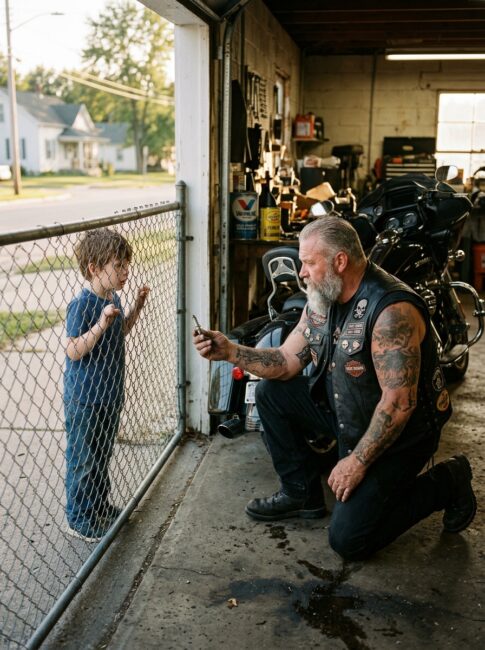
For three weeks, Eli went to Ray’s garage every afternoon.
Not inside the house.
Never behind a closed door.
Just the garage, door open, sun slanting across the concrete, my folding chair by the driveway, Ray’s Harley sitting like a black animal at rest.
They worked in silence most days.
Ray gave instructions in pieces.
“Hand me the ten.”
“Wipe that.”
“Not tight yet.”
“Feel it first.”
Eli learned where the tools belonged before he learned their names. He lined sockets from smallest to largest. He sorted washers by size. He touched everything with two fingers first, as if asking permission.
One afternoon, Ray’s club brothers showed up while Eli was there.
Twelve bikes rolled in together, the V-twins rumbling down our quiet street until curtains moved in every house. I stood up too fast. Eli froze.
Ray lifted one hand.
Every engine cut off.
Just like that.
Silence dropped over the block.
A big man with a shaved head and red beard climbed off first. His vest said PREACHER. Another had a limp and a patch that read DOC, though I later learned he wasn’t a doctor, just the man who kept everyone alive until doctors arrived.
They looked at Eli.
Eli looked at the ground.
I got ready to step between them.
Ray’s voice cracked like a belt.
“Quiet feet.”
And those grown men — tattooed, scarred, road-burned men — walked into that garage like they were entering a hospital room.
No jokes.
No backslaps.
No sudden moves.
Preacher set a paper bag on the workbench.
“Blueberry muffin,” he said to Ray.
Ray glared at him.
Preacher shrugged. “Kid looks like a blueberry man.”
Eli did not look up.
But his hand moved toward the bag.
Ray saw it.
Everybody saw it.
Nobody made a sound.
That was the day I understood brotherhood was not a word to those men. It was discipline. It was twelve men changing how they stood so one child could breathe.
Then came the Friday everything broke.
It was late August. The kind of Iowa heat that sits on your shoulders. Eli had started third grade that week, and it had gone badly. A substitute teacher grabbed his arm during lunch when he wouldn’t move from the noise of the cafeteria.
Eli came home with fingermarks on his wrist.
He didn’t cry.
He went to the fence.
Ray saw the marks.
I watched his face change.
Not rage. Something older than rage.
His jaw tightened. His left hand curled once and opened again.
“Who?” he asked.
I told him.
Ray nodded.
That was all.
The next morning, his Harley was gone before sunrise.
By noon, the principal called me.
“Mrs. Walker,” she said, trying to sound calm, “there’s a group of motorcyclists in our parking lot.”
My stomach dropped.
When I got there, fifteen Road Saints were lined up beside their bikes in the school lot. Engines off. Helmets under arms. No shouting. No threats.
Ray stood at the front with a manila folder in his hand.
The principal looked terrified.
The school resource officer had one hand near his radio.
Ray saw me and nodded once.
“I’m not here to scare anybody,” he said.
Nobody believed him.
Then he opened the folder.
Inside were printed pages about autism accommodations, state restraint policies, and complaint forms. He had highlighted sections in yellow. Clean, straight lines.
His hands shook, but his voice didn’t.
“Child gets touched like that again,” Ray said, “you’ll hear from her lawyer before you hear from me.”
The principal blinked.
“Are you threatening us?”
Ray stared at her.
“No, ma’am. I’m reading.”
Preacher coughed into his fist.
Doc looked at the sky.
I should have been embarrassed.
Instead, I felt my knees weaken.
Because for three years, I had sat in meetings where people smiled at me while explaining why my son was difficult. I had apologized for him in rooms where adults failed him.
Ray didn’t apologize.
He handed the folder to the principal and turned to leave.
That should have been the climax.
That should have been the moment everyone talked about forever — the scary biker standing up for the silent boy.
But it wasn’t.
The real thing happened that afternoon.
Ray came home, parked the Harley, and rolled it into the garage.
Eli was already waiting at the fence.
Ray opened the gate.
No words.
They worked on the bike like always, but something was off. Ray dropped a socket twice. His breathing sounded wrong. He kept rubbing the center of his chest with two fingers.
I noticed.
Eli noticed first.
Ray leaned over the bike and tried to steady himself on the handlebar.
“Ray?” I said.
He waved me off.
“Heat.”
Then his knees hit the concrete.
The sound was small.
Too small for a man that big.
Eli stood frozen with a spark plug wire in his hand.
I ran.
Ray was on one side, eyes open, face gray under his beard. His vest creaked as he tried to push himself up.
“Don’t,” I said. “Don’t move.”
He looked past me at Eli.
“Kid,” he rasped. “Blue phone. Bench.”
Eli didn’t move.
“Eli,” I said, “honey, call 911.”
Nothing.
The world narrowed to the smell of oil and hot rubber, Ray’s breathing, my own panic pounding in my ears.
Then Eli stepped to the workbench.
He picked up Ray’s old blue flip phone.
And for the first time in months, he spoke to someone who wasn’t me.
“Help,” Eli said into the phone. “Ray fell down.”
The ambulance came in seven minutes.
Ray cursed at the EMTs, which they took as a good sign.
Doc arrived before they loaded him, riding so fast he forgot to take off his helmet when he ran up the driveway. Preacher came next, then three others, then six more until the street filled with leather and silence.
Eli stood beside the workbench holding the spark plug wire.
His face had gone blank in that way I knew meant too much had happened.
I tried to take his hand.
He pulled away.
Not from fear.
From focus.
He walked to the Harley.
The EMTs were lifting Ray onto the stretcher when Eli pointed at the engine.
“This one’s in backward,” he said.
Every man stopped.
I mean every man.
The stretcher paused halfway down the driveway.
Ray turned his head.
“What?”
Eli pointed again, more irritated now, like the adults were being slow.
“This one’s in backward.”
Preacher looked at the bike, then at Doc.
Doc leaned down.
He frowned.
Then his face changed.
“Ray,” he said quietly.
Ray closed his eyes.
That was when I saw it.
The small rubber boot on the plug wire had been forced onto the wrong post. Not the spark plug itself, but the wire connection Ray had been using for a lesson. It looked right from above. From Eli’s height, from the side, it was wrong.
Ray had done it on purpose.
I knew because his eyes filled before he turned away.
Not tears falling.
Bikers don’t give them away easy.
Just water held behind a dam.
Doc lifted the seat of the Harley and pulled out a plastic sleeve tucked beneath the leather.
Inside was an old photograph.
A boy about Eli’s age sat on the same garage floor, wearing blue work gloves too big for him, holding a spark plug in both hands.
On the back, in faded marker, were four words:
Noah said it first.
I looked at Ray.
He wouldn’t look at me.
Preacher took off his sunglasses.
Nobody spoke.
The EMT asked if they should continue.
Ray nodded.
As they rolled him toward the ambulance, Eli stepped into the driveway.
He held up the wire.
Ray looked at him from the stretcher.
Eli said, “I fixed it.”
Ray’s mouth trembled once.
Then he gave Eli a thumbs-up.
Small fire.
Right place.
Right time.
Ray didn’t die.
But he came close enough to hear the door.
A mild heart attack, the doctors said. A warning. Lifestyle changes. Medication. Less caffeine. Less stubbornness.
The last one was not on the paperwork, but every nurse implied it.
For three days, the Road Saints took shifts at the hospital.
Preacher sat at night.
Doc argued with doctors.
A prospect named Little Mike mowed Ray’s lawn without being asked.
And Eli stood at our fence every afternoon, staring at a closed garage.
On the fourth day, Preacher came to my porch carrying a cardboard box.
“Ray said you should have this,” he said.
Inside were the blue gloves, the clean rag, the socket wrench, and the photograph.
There was also a folded letter.
Not to me.
To Eli.
I didn’t read it at first. I asked Eli if he wanted me to.
He tapped the table twice.
Yes.
So I opened it.
Ray’s handwriting was blocky and uneven, like every word had been tightened with a wrench.
Kid,
Engines make sense because they don’t lie. People are harder. I had a boy named Noah. He was like you in some ways. Different in others. He didn’t talk much either. Folks thought silence meant empty. They were wrong.
I stopped because my throat closed.
Eli stared at the paper.
I kept reading.
Noah liked blue gloves. He liked spark plugs. He liked finding what grown men missed. First full sentence he ever said to me was, “That wire is wrong.” I kept that wire wrong on purpose sometimes, hoping he’d catch it again.
That explained the gloves.
The blue tape on the tools.
The way Ray spoke in short instructions.
The way the club walked softly.
The yellow school bus patch hidden inside his vest.
Preacher told me the rest later at Millie’s diner, over coffee that tasted burned enough to count as punishment.
Noah had been Ray’s son.
Ray had been a different man then. Drinking hard. Fighting harder. In and out of county jail before the prison stretch that everyone whispered about. Not evil. Not safe either. Complicated in the worst ways.
Noah’s mother left with the boy when Ray went to prison.
Ray didn’t blame her.
“Best decision she ever made,” Preacher said.
But Noah died at eleven from complications after a seizure. Ray was still inside. He didn’t get to the hospital. Didn’t get to the funeral.
When he came out, he had two things waiting for him.
His Harley.
And a shoebox of Noah’s things.
Blue gloves. A spark plug. A school bus patch from Noah’s backpack. One photograph.
Ray joined the Road Saints because they were all trying to stay alive after something. War. Prison. addiction. grief. divorce. You name it, somebody had ridden through it.
They started delivering groceries because Ray said hungry kids made him angry.
They started autism training because Ray paid for it.
That part stunned me.
“What do you mean?” I asked.
Preacher stirred his coffee though he drank it black.
“Brother made us sit in the VFW hall for four Saturdays while a specialist taught us sensory stuff. No revving near kids. No grabbing. No crowding. Quiet feet.”
Quiet feet.
That wasn’t instinct.
That was love turned into rules.
I thought about the school parking lot. The folder. The highlighted state policies. The child-sized chair he had set out for me before Eli ever entered the garage.
Ray hadn’t stumbled into kindness.
He had built it.
Piece by piece.
Like an engine.
When Ray came home a week later, the whole street watched from windows and porches.
No motorcycle this time. Doc drove him in a pickup.
Ray looked smaller getting out. Pale. Angry about it. Wearing a plain gray T-shirt because the hospital had cut his favorite one off him.
Eli was at the fence.
Ray saw him.
He walked slowly, one hand on the truck, then the porch rail, then the garage frame.
The leather vest hung over his arm.
When he reached the gate, he didn’t open it right away.
He held up the vest and turned it inside out.
There was the yellow patch.
A school bus.
Under it, stitched in crooked black thread, was a name.
NOAH
Eli looked at the patch for a long time.
Then he reached through the fence and touched it with one finger.
Ray swallowed.
“Your wire was right,” he said.
Eli answered without looking up.
“Yours was wrong.”
Ray nodded.
“Yeah,” he said. “Mine was wrong a long time.”
That was the longest confession I ever heard from him.
Autumn came early that year.
Cornfields browned at the edges. The highway smelled like dust and diesel. The evenings got cooler, and Ray started wearing flannel under his vest.
Doctor’s orders said no heavy lifting.
Ray treated that like a rumor.
But he did slow down.
Not soft. Just slower.
Every afternoon, Eli still went to the garage.
Only now he didn’t stand at the fence.
He had a stool by the workbench.
Ray painted it blue.
Noah’s gloves stayed on a nail above it. Eli didn’t wear them anymore. Ray bought him his own pair, smaller, with padded palms and a Velcro strap.
The old pair stayed where they belonged.
Some things are not passed down.
Some things are honored.
Every Saturday, the Road Saints still gathered at Ray’s place. Engines rolled in low and steady. Then silence. Boots on concrete. Leather creaking. Coffee poured from a dented thermos. Muffins from Millie’s in a paper bag.
Blueberry, always.
Preacher claimed it was tradition.
Eli claimed the tops only.
The school changed too.
Not magically. Nothing changes magically.
But the principal stopped using that careful voice with me. Eli got a better aide. His sensory plan got updated. Teachers learned not to grab him. Ray never said he caused it.
He didn’t need to.
One winter morning, I found Eli drawing at the kitchen table.
He hated drawing people. Too unpredictable.
But there it was in blue pencil.
A big man beside a motorcycle.
A small boy beside him.
Between them, a spark plug.
Above it, Eli had written two words.
Small fire.
I taped it to the fridge.
When Ray saw it later, he stared for a long time.
Then he cleared his throat and said, “Good lines.”
That was Ray for “I may need to go outside before my face betrays me.”
So he went outside.
Started the Harley.
Let it idle once, low and careful.
Eli stood on the porch without covering his ears.
The V-twin beat against the cold air.
Not loud.
Alive.
Eli is twelve now.
He talks more. Not constantly. Not the way people once demanded. He speaks when words are useful, and keeps them when they are not.
Ray says that’s wisdom.
Every year, on Noah’s birthday, the Road Saints ride out before sunrise.
They take Highway 20 west, past the gas station, past Millie’s, past the fields where fog sits low over the ditches. They don’t ride fast. They don’t make a show.
At 7:10, they pull into a small cemetery outside Waterloo.
Ray parks at the same stone.
The men cut their engines together.
Complete silence.
Then Eli steps off the back of Doc’s touring bike, because Ray still won’t let him ride with anyone who “leans like an idiot.”
He walks to Noah’s grave and sets down one clean spark plug.
Not flowers.
Not a toy.
A spark plug.
Small fire. Right place. Right time.
Ray stands behind him in his leather vest, skull patch on the outside, school bus patch hidden inside, big hands folded in front of him like he still doesn’t know what to do with gentleness.
When they leave, the engines start one by one.
Ray always waits until last.
He looks at Eli.
Eli nods.
And the old biker rides home slowly, with a silent boy watching the road like he understands every part of the machine.
The taillight disappears.
The garage light stays on.
Follow the page for more true-feeling biker stories that change what people see beneath the leather.