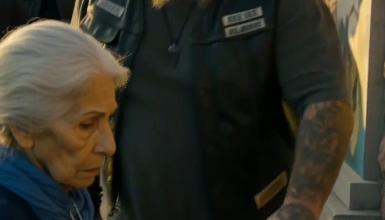
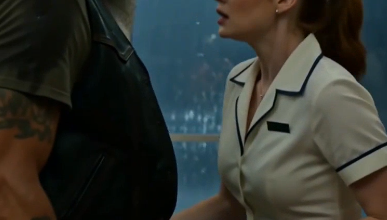
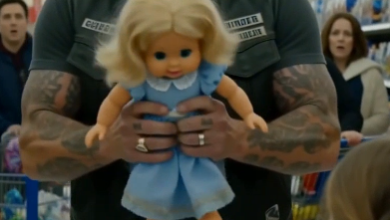
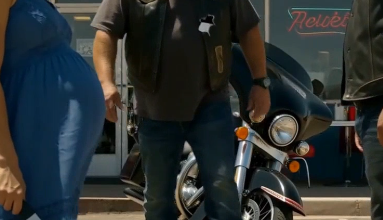
Part 2: Thirty Bikers Entered Her Mother’s Empty Funeral — Then One Knelt Before the Orphaned Girl
Rachel’s Thursday Table
My name is Donna Mercer. I own Mercer’s Roadside Grill on U.S. Route 40, just west of Cumberland, where the hills rise dark around the highway and truckers still stop for meatloaf after midnight.
Rachel Hale worked for me for almost seven years.
She was twenty-eight when I hired her. Skinny. Brown hair tied back with whatever elastic she could find. A little scar near her chin. The kind of tired eyes single mothers get when they are calculating grocery money while pretending to listen to your story.
She never complained about Emma’s father. Not once.
All she ever said was, “He chose a different road.”
Thursday nights belonged to the bikers.
They arrived around seven-thirty, usually in a staggered line of Harley touring bikes and older cruisers. Before they came through the door, you heard the V-twins rolling over the asphalt, exhaust notes bouncing against the diner windows and the low concrete wall beside the parking lot.
The first few times, customers stared.
Some paid early and left.
Rachel never did.
She walked to the long table beside the jukebox with her order pad tucked into her apron and said, “Coffee first, gentlemen. Threatening facial expressions later.”
That was Rachel.
The bikers looked at her.
Then the biggest one laughed.
His road name was Bear, although his driver’s license said Curtis Bell. President patch. Fifty-six years old. Thick black-and-gray beard. Arms covered in faded ink. One knee that clicked when he walked. An old burn scar climbing the left side of his neck.
Bear drank black coffee.
Wade wanted two sugars and enough cream to turn his coffee the color of wet cardboard.
Mills ordered chicken-fried steak but left half the gravy.
Tiny, who weighed close to three hundred pounds, always asked for the grilled chicken salad because his doctor had threatened him with “an early meeting with Jesus.”
Rachel remembered all of it.
Not after a month.
After the second Thursday.
She called them by their names. Not “you guys.” Not “the biker table.” Not “those people.”
Names.
That mattered more than I understood at the time.
Rachel kept a folded piece of paper inside the cabinet near the coffee machine. On it, in her small handwriting, were thirty names and thirty orders. Over time, she no longer needed the paper. Still, she never threw it away.
There were other things she did.
When Wade forgot his wallet one Thursday, she quietly moved his check beneath a stack of receipts and paid it herself before I could say anything.
When Tiny’s old lady died, Rachel set a slice of pecan pie in front of him without asking and said, “You don’t have to eat it. But you don’t have to sit here with nothing.”
When a young prospect came in with bruised knuckles and too much anger in his jaw, Rachel placed his coffee down and told him, “Whatever you’re about to do tonight, sleep first.”
He listened.
The next week, he thanked her.
Rachel had a way of looking at people without stepping backward.
Not challenging them.
Not rescuing them.
Just seeing them.
Emma rarely came to the diner at night. Rachel did not want her awake late on school days. But sometimes, when babysitters canceled, Emma sat in the back booth with crayons and a grilled cheese sandwich.
The bikers never crowded her.
Bear always passed her booth on his way out and placed one folded dollar bill beside her coloring book.
“For the artist,” he would say.
Emma thought he was just another customer.
One night, she drew a crooked motorcycle beneath a yellow sun. Bear folded the picture carefully and slid it inside his vest.
I watched him do it.
The same vest he wore to Rachel’s funeral.
The same vest with the envelope hidden inside.
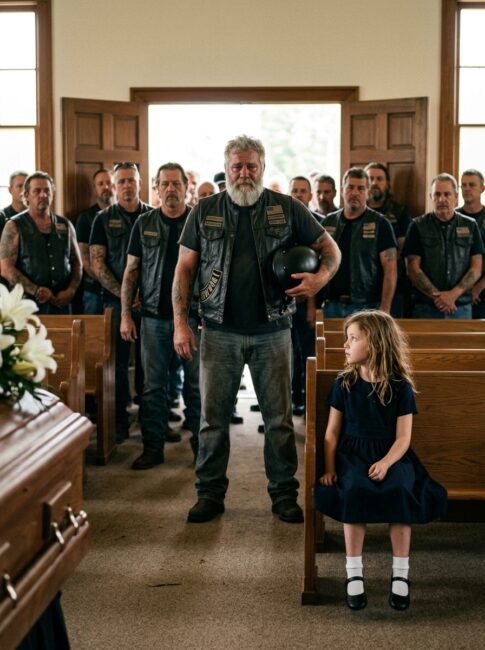
The Funeral With Empty Pews
Rachel died on a Tuesday morning in October.
A delivery truck ran a red light on Industrial Boulevard while she was driving Emma to school.
Emma survived because Rachel’s little Honda took the impact on the driver’s side.
Rachel did not.
There are phone calls that divide your life into before and after.
The hospital called me because my number was listed beneath “Employer” in Rachel’s wallet. I reached the emergency room fifteen minutes after the ambulance. Emma sat beneath a paper blanket with a cut above her eyebrow and dried blood on one sleeve.
She asked me one question.
“Is Mom still asleep?”
I lied for twenty minutes because I could not be the first person to break her world apart.
A social worker eventually sat beside her.
I stood near the vending machines and listened to a child become an orphan in a hospital hallway that smelled like disinfectant and burnt coffee.
The next morning, I taped a handwritten sign to the diner door.
CLOSED UNTIL FRIDAY.
FAMILY EMERGENCY.
On Thursday evening, I opened the diner anyway.
I did not turn on the neon sign. I only needed somewhere familiar to stand.
At seven-thirty, the motorcycles arrived.
Thirty engines rolled into the lot and dropped into silence one by one.
Bear entered first. Wade behind him. The others followed. Their boots sounded heavier than usual against the tile. Nobody took the long table. Nobody asked for coffee.
Bear removed his gloves.
“What happened?” he asked.
I told them.
Nobody interrupted.
The refrigerator compressor clicked on behind the counter. Somewhere near the kitchen, a faucet dripped. Wade lowered his head and pressed both palms flat against the laminate tabletop.
Bear stood still for a long time.
Then he asked, “When’s the service?”
“Monday.”
“Where?”
“Grace Community Church.”
“Who’s handling the arrangements?”
I looked down.
“Handling them?”
“The funeral home. Flowers. Food. Her kid.”
I tried to answer, but I had no answer that sounded decent.
Rachel had no savings. Her landlord had already called about the rent. The county had started asking questions about temporary placement for Emma. I had offered my spare bedroom, but the paperwork would take time.
The funeral director had given me the cheapest possible estimate and spoken softly when he explained it.
Bear looked at Wade.
That was all.
No speech. No dramatic vote.
Bear placed his gloves on the counter and said, “Pass the helmet.”
Tiny removed his black half-helmet and set it on the first table.
One by one, the men moved past it.
Cash. Folded bills. A check. More cash.
Nobody counted until the end.
There was enough for the funeral. Enough for flowers. Enough to cover Rachel’s rent through the end of the month. Enough for a proper dress for Emma and a meal after the service.
I started crying behind the counter.
Bear looked uncomfortable. He always did when emotions had nowhere practical to go.
“Don’t put our names on anything,” he said.
“Why not?”
“Funeral ain’t about us.”
Monday morning came cold and gray.
I reached the church early. The pastor was there. Emma sat in the front pew. I sat behind her. Two women from the county stood near the back doors, speaking in low voices about temporary foster placement.
Ten minutes before the service, the parking lot was empty.
I remember thinking the bikers had changed their minds.
I hated myself for thinking it.
Then the windows began to tremble.
The motorcycles approached from Route 40 in a low, rolling line. Thirty engines. No revving. No showing off. Just the steady mechanical pulse of men arriving together.
The engines shut off.
The silence felt bigger than the noise.
The doors opened.
Wade entered first. Bear came last.
When the pastor invited anyone to speak, Wade stood.
His tattooed hands shook beside his jeans.
“She brought me coffee for six years,” he said. “Two sugars. Too much cream. Never asked if I deserved kindness first.”
He swallowed hard.
“She remembered Mills hated onions. She remembered Tiny needed less salt. She remembered Bear took black coffee even when he pretended he wanted to read the menu.”
A few bikers laughed quietly.
Wade looked at Emma.
“Your mom called us by our names. Not by what people thought we were.”
His voice dropped.
“That don’t sound like much until you’ve spent half your life being called worse things.”
Wade sat down quickly.
Thirty men looked toward the casket.
Some wiped their faces with calloused fingers.
Bear did not cry.
But his jaw tightened until the muscles jumped beneath his beard.
I thought that was the climax.
Thirty feared men filling an empty church for a waitress nobody else had come to bury.
I was wrong.
The real moment happened outside.
Bear’s Promise
After the service, Emma stood beneath the church awning while people carried trays of food into the fellowship hall.
The county social workers were discussing where she would sleep that night.
Emma held a paper cup of hot chocolate in both hands. She had taken one sip. Nothing more.
The bikers gathered near their motorcycles, uncertain in the way big men often become uncertain around children. Their leather cuts shifted and creaked. Keys jingled. Boots scraped against the pavement.
Bear reached inside his vest.
For one second, I thought he was reaching for the folded funeral receipt.
Instead, he pulled out a worn piece of paper protected inside a clear plastic sleeve.
Emma’s drawing.
The crooked motorcycle. The yellow sun. The uneven letters she had written at the bottom two years earlier:
FOR THE BIG MAN WITH THE COFFEE.
Bear looked at the drawing.
Then he walked toward Emma.
Every conversation beneath the awning stopped.
He lowered himself slowly onto one knee. His bad knee clicked loud enough for me to hear it.
Up close, Bear looked even more intimidating. Scarred neck. Thick beard. Inked knuckles. A heavy steel ring on one finger.
But when he spoke to Emma, his voice was quiet.
“Your mama fed us a long time.”
Emma stared at him.
Bear held out the drawing.
“You made this for me once.”
She looked down at the paper and nodded faintly.
Bear continued.
“Every Thursday, we eat at your mama’s table. Starting this week, if you want, there’s a chair for you.”
Emma looked toward me as if she needed help understanding.
Bear rubbed one thumb across the edge of the plastic sleeve.
“Your mama gave me coffee for six years,” he said. “I’ll buy you dinner until you can cook for yourself.”
Emma did not answer.
Bear reached inside his vest again and removed a white envelope. He handed it to me, not to her.
Inside was a cashier’s check.
It was not only enough for dinner.
It was enough to start an education fund.
The amount made my knees weak.
I looked at Bear.
“Where did this come from?”
He nodded toward the thirty men behind him.
“Thursday tips.”
I did not understand.
Wade stepped forward. His hands were still trembling.
“Rachel kept refusing extra money,” he said. “So we started putting it aside.”
For three years, the bikers had been leaving money beneath their plates. Rachel always chased them into the parking lot and returned it.
So they found another way.
They placed the money in a locked metal box at their clubhouse with Rachel’s name written on masking tape across the lid. At first, it was a joke.
A fund for the waitress too stubborn to accept a tip.
Then it grew.
Cash from poker nights. Christmas collections. A percentage from charity rides. Twenty-dollar bills tucked into the box by men who never explained why.
Nobody expected Rachel to die.
But when she did, the box was already there.
Waiting.
Emma looked at the check without understanding the numbers.
Then she looked at Bear.
“Will Mom’s chair be there?”
Bear’s face changed.
Only for a second.
“Yes,” he said. “It will.”
Why Wade’s Hands Shook
Emma’s first Thursday dinner happened four days later.
I expected two or three bikers to show up.
All thirty arrived.
At seven-thirty, the windows rattled softly. Engines dropped into silence across the parking lot. The men entered with their helmets tucked beneath their arms, leaving the same seat empty at the long table beside the jukebox.
Rachel’s seat.
Emma sat beside it.
She wore jeans, sneakers and a purple sweatshirt. Her feet still did not reach the floor.
Bear took the chair across from her. Wade sat at the end of the table. Tiny ordered his grilled chicken salad and complained about it before the plate arrived.
For several minutes, nobody knew what to say.
Then Mills cleared his throat.
“Your mama ever tell you Wade drinks coffee like a preschooler?”
Emma looked toward Wade.
Wade frowned. “I drink coffee like a man who enjoys options.”
“Cream ain’t an option when you pour half a cow in there,” Tiny said.
Emma smiled.
Small. Quick.
But real.
That was how it began.
Not with a dramatic speech.
With an argument about coffee.
Over the next few months, the pieces I had not understood began falling into place.
Wade’s hands shook at the funeral because Rachel had once found him crying in the diner parking lot after closing time.
His daughter, Kayla, had died from an overdose eight years earlier. Wade had not spoken to her during the last six months of her life. Pride. Anger. Bad choices on both sides.
On the anniversary of Kayla’s death, he rode alone until the rain became too heavy to see through. He stopped at Mercer’s after midnight, long after the kitchen closed.
Rachel found him sitting on the curb beside his Harley.
She did not ask him to explain.
She returned with two cups of coffee and sat beside him on the wet pavement until the rain slowed down.
Two sugars. Too much cream.
The folded dollar bills Bear left beside Emma’s coloring books were not random either.
Bear had grown up in a house where food disappeared before the end of the week. His father spent grocery money at bars along the National Road. Bear learned young that hunger made children quiet in ways adults often misread.
He never told Emma that.
He simply made sure her plate arrived first.
Tiny started bringing books.
Mills checked her math homework, although he needed a calculator more often than she did.
A biker called Preacher, who had not entered a church willingly in twenty years before Rachel’s funeral, taught Emma how to change a flat tire in the diner parking lot when she turned thirteen.
Nobody tried to replace Rachel.
That mattered.
They left her chair empty.
Every Thursday.
At first, the empty seat looked painful. A place where grief collected while everybody pretended not to stare.
Then Emma began placing something on it.
A school report card.
A science fair ribbon.
A photograph from a class trip.
A college brochure.
Small updates for the woman who should have been sitting there.
The drawing inside Bear’s vest stayed with him too.
By then, the plastic sleeve had become scratched around the edges. The yellow sun had faded. The motorcycle still leaned impossibly to one side.
One Thursday, when Emma was eleven, she asked why he carried it.
Bear shrugged.
“Good art appreciates in value.”
Emma rolled her eyes.
Bear took a sip of black coffee.
Then he added, “Some days a man needs reminding he ain’t only the worst thing people see.”
That was the longest emotional speech I ever heard him give.
The education fund continued growing.
The bikers refused to discuss it in front of Emma. They referred to it as “the box.” Nothing more.
But I saw the rituals.
A helmet passed around after a club member earned overtime.
A jar near the register during Christmas.
An envelope slid across the table after a benefit ride.
Men who did not have much put in what they could.
Emma was never charity to them.
She was Thursday.
She was Rachel’s girl.
She was the kid who corrected Tiny’s spelling and stole Bear’s French fries even though he pretended to hate it.
The social workers eventually approved Emma to stay with me permanently. At first, it was temporary guardianship. Later, when the paperwork cleared and Emma asked me herself, I adopted her.
Bear came to the courthouse.
He stood in the back wearing a clean black shirt instead of his cut because he worried the judge might misunderstand.
The judge recognized him anyway.
“So,” she said, looking at the row of bikers squeezed into the courtroom, “which one of you is family?”
Bear glanced at Emma.
“All of us,” he said.
The judge looked at Emma.
Emma nodded.
That was enough.
Every Thursday at Seven-Thirty
Years passed in Thursday nights.
Emma grew taller.
Her feet reached the diner floor.
Then they stopped swinging beneath the table entirely.
Her orders changed from grilled cheese to cheeseburgers, from cheeseburgers to salads during a brief health phase Tiny mocked relentlessly, then back to cheeseburgers during finals week.
The bikers changed too.
Beards turned gray. Knees stiffened. Some sold heavier Harleys and bought touring bikes with more comfortable seats. One started arriving in a pickup truck after a back operation, although nobody said a word about it.
The sounds remained.
Engines rolling into the lot.
Boots on tile.
Leather shifting against vinyl seats.
Coffee pouring into thick ceramic mugs.
One winter, Wade died in his sleep.
His funeral filled a larger church than Rachel’s had.
Emma was sixteen.
She stood at the pulpit holding the paper she had rewritten four times and said, “He drank coffee like a preschooler.”
The bikers laughed through tears.
Then Emma told the room about the night Wade had sat beside a grieving waitress on a wet curb, and how that same waitress had later been honored by a shaking man who could barely make his voice work.
After Wade’s funeral, Emma placed his coffee mug on Rachel’s empty chair for one Thursday night.
Two sugars.
Too much cream.
Bear said nothing.
He stared at the mug for a long time, then looked out the diner window toward the line of motorcycles beneath the parking lot lights.
When Emma graduated high school, thirty had become twenty-two.
Some men had moved away.
Some could no longer ride.
Some names had been stitched onto small memorial patches inside Bear’s vest.
Emma graduated near the top of her class.
At the ceremony, I heard the bikers before I saw them. Heavy boots crossed the gymnasium floor beneath the noise of hundreds of families. Parents turned their heads. A few looked uneasy.
The men took their seats quietly.
Bear wore his cut.
Inside the left panel, tucked behind the scratched plastic sleeve containing Emma’s old drawing, were the memorial patches.
Wade.
Mills.
Preacher.
Two others.
The outside of the vest told strangers one story.
The inside told the truth.
After the ceremony, Emma walked toward Bear in her cap and gown.
He held out an envelope.
The box had become a college fund large enough to cover tuition at Allegany College of Maryland and the nursing program she wanted to attend afterward.
Emma opened the envelope.
She cried.
Bear looked toward the parking lot because tears still made him uncomfortable.
“You don’t have to do this,” she said.
Bear grunted.
“Too late.”
“You already fed me for nine years.”
“Still look skinny.”
“I’m not skinny.”
“Thursday. Seven-thirty.”
Emma laughed and wrapped both arms around him.
For a moment, Bear stood stiffly with his hands hanging at his sides.
Then he placed one scarred hand gently against the back of her graduation cap.
Rachel’s Table
Emma is twenty-two now.
She works at the hospital in Cumberland.
On Thursday nights, she still comes to Mercer’s Roadside Grill.
Sometimes she arrives in scrubs after a long shift. Sometimes her hair is tied back the way Rachel wore hers. Sometimes she looks so much like her mother that I have to turn toward the coffee machine until my eyes stop burning.
Bear still comes too.
He walks more slowly now. His knee clicks louder. His beard has turned almost white. The Harley takes longer to start on cold evenings, coughing twice before the engine settles into its familiar pulse.
The club no longer fills the entire table.
But they still leave one chair empty.
Last October, on the anniversary of Rachel’s death, Emma arrived carrying a small frame.
Inside was the old diner order sheet Rachel had kept near the coffee machine.
Thirty names.
Thirty meals.
Coffee instructions written in the margins.
Emma placed the frame on her mother’s chair.
Then she tied on one of our aprons and picked up a pot of coffee.
Bear looked up.
“You working tonight?” he asked.
“Just one table.”
She poured Wade’s old mug first and left it beside the framed order sheet.
Two sugars.
Too much cream.
Then she moved around the table, filling every cup from memory.
Bear watched her reach his place.
“Black coffee,” Emma said.
He nodded.
“No menu?”
“You’ve been ordering the same thing for fifteen years.”
Bear took the mug in both hands.
Outside, headlights swept across the diner windows as the last few motorcycles pulled into the lot from Route 40.
Emma smiled toward the door.
The engines shut off.
The Thursday table was waiting.
Follow the page for more stories from the people behind the leather cuts.