A Lonely Girl Expected Another Empty School Audience—Then 30 Tattooed Bikers Walked In Calling Themselves Her Uncles
Thirty tattooed bikers walked into an elementary-school auditorium during a nine-year-old girl’s solo, and every teacher thought they had entered the wrong building—until the girl saw them and forgot her next line.
I was the first man through the doors.
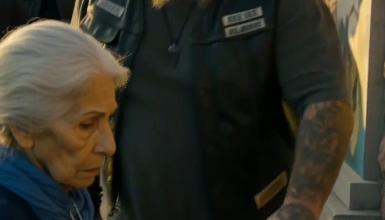
My name is Caleb “Bear” Mercer. I am fifty-three years old, six-foot-five in my boots, and heavy enough to make folding chairs complain before I sit down. A gray beard covers most of my chest, old tattoos climb both sides of my neck, and two crooked fingers remind me of years when I settled problems the wrong way.
The twenty-nine men behind me did not look more reassuring.
Leather cuts creaked. Chain wallets rattled. Heavy boots struck the polished hallway in a slow rhythm while parents turned in their seats and reached for their phones.
Then the engines outside went silent.
That silence frightened people more.
A young teacher hurried toward us with both hands raised. “Gentlemen, this is a children’s performance.”
“We know,” I said.
“You can’t stand in the aisle.”
“Wasn’t planning to.”
I showed her thirty tickets held together with a purple hair tie.
Every ticket carried the same handwritten name: Emily Walker—Guest.
Onstage, Emily stood beneath a cardboard moon wearing a silver paper crown. She was the smallest child in the performance and the only one who had walked into the auditorium without anyone following behind her.
She had no bouquet waiting.
No parent waving.
No friend saving her a seat afterward.
Her father, Daniel “Road Dog” Walker, had been my closest brother for twenty-two years. Eight months earlier, I had stood beside his hospital bed while he made me promise something I did not yet understand.
“Don’t let her search the seats,” he whispered.
I thought he meant the funeral.
I was wrong.
Emily began her solo. Her voice was so quiet that the first row leaned forward, but she kept glancing at the empty section near the back.
That was where Daniel always sat.
Then thirty bikers entered.
A mother pulled her son closer. The principal signaled for the school resource officer, and a man beside the aisle whispered that someone should remove us before we frightened the children.
I kept walking.
Emily saw my beard first. Then she recognized the tiny purple ribbon tied around my wrist—the same ribbon she had placed on her father’s handlebars before his final ride home from the hospital.
Her mouth opened.
The song stopped.
For three terrible seconds, I thought we had ruined everything.
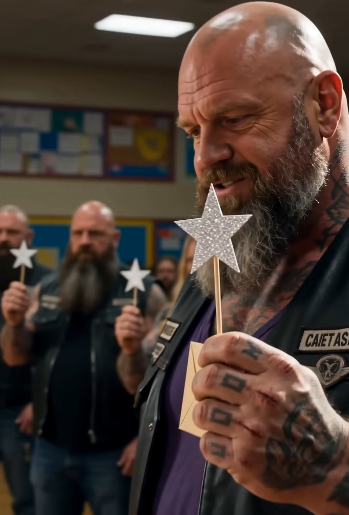
Then twenty-nine bikers raised handmade silver stars above their heads. They were uneven, covered in glue, and looked like they had been cut by men who could rebuild an engine but had never survived elementary-school craft supplies.
I raised the thirtieth.
Emily stared at us.
“Uncle Bear?” she whispered into the microphone.
The entire auditorium heard her.
I nodded.
Behind me, thirty enormous voices answered together.
“We’re here, kid.”
Emily covered her mouth, but the principal was still approaching, and he was holding the sealed letter Daniel had left in his office months before he died.
I had never seen that letter.
Neither had Emily.
Want to know what Daniel wrote to the principal and why thirty hardened bikers had secretly practiced Emily’s song? Drop UNCLES in the comments—I’ll share more soon.
Daniel Walker never asked us to replace him.
That matters.
He did not imagine thirty leather-clad men could become one father, and none of us were foolish enough to believe love worked like spare motorcycle parts. A missing man leaves a shape nobody else can fill.
Daniel asked for something smaller.
“Show up.”
He said it from a hospital bed at Good Samaritan in Cincinnati, his voice worn down to gravel. A clear tube ran beneath his nose, and the knuckles that had rebuilt hundreds of engines could no longer open a bottle of water without help.
I sat beside him with my cut folded over my knees.
“You’ll tell her yourself,” I said.
Daniel looked at me for a long time.
That was his way of refusing nonsense.
He had been diagnosed with pancreatic cancer eleven months earlier. For most of that time, he kept working at Walker Cycle and lied about the pain until he collapsed beside a customer’s Road King.
By the time doctors found it, there was little left to negotiate.
Emily was eight.
She knew her father was sick, but Daniel protected her from the calendar. He still packed her lunch each morning, drew crooked cats on the paper napkins, and drove her to school in his old pickup when the weather was too cold for the motorcycle.
Every Thursday, he attended something.
Spelling contests. Library afternoons. Art displays. Parent lunches serving pizza that tasted like warm cardboard. If Emily stood in a room with other children, Daniel found a chair where she could see him.
He was always loud.
“That’s my girl!”
Emily used to cover her face.
“Dad, stop.”
Daniel never stopped.
After he entered the hospital, Emily’s class held a winter music program. June had the flu and could not attend, so Daniel tried to leave against medical advice.
The nurse called me.
I found him sitting on the edge of his bed with one boot on, sweating through his shirt while he fought with the other boot.
“You’re not going anywhere,” I said.
“She has a song.”
“You can barely stand.”
“I can sit.”
I took the boot from his hand.
He hated me for six minutes.
Then he asked me to record the performance.
I arrived late.
Emily was already singing, and my seat squeaked when I lowered my weight into it. She searched the auditorium, saw my beard instead of her father’s face, and missed half a line.
Afterward, she thanked me politely.
That was Emily. Even disappointed, she protected the adult who had disappointed her.
I showed Daniel the video that night. He watched it twice, then asked me to freeze the image when Emily looked toward the door.
“See that?” he said.
I saw a child looking for her father.
Daniel saw the future.
Two weeks later, he asked the nurses to clear his bedside table. He placed thirty purple fabric strips across it and wrote UNCLE on each one with a black marker.
“You think I’m handing these out?” I asked.
“No.”
“Then what are they?”
“Insurance.”
He opened an old address book. Thirty names filled two pages—men Daniel had ridden with, worked beside, argued with, rescued, forgiven or dragged home.
My name was first.
Beside each name, Daniel had written a date.
Some marked recovery anniversaries. One marked the day a man’s son came home from Afghanistan. Another marked the night Daniel had stopped a brother from driving after too much whiskey.
Every man on that list owed Daniel a moment when he had shown up.
Daniel tapped the page.
“Collect.”
Daniel died on a Tuesday morning while rain tapped against the hospital window.
I was holding his left hand.
June held his right.
Emily had said goodbye the night before. Daniel waited until she left, perhaps because fathers keep protecting their children even when the only thing left to protect them from is the sound of a final breath.
The Iron Lanterns escorted his hearse three days later.
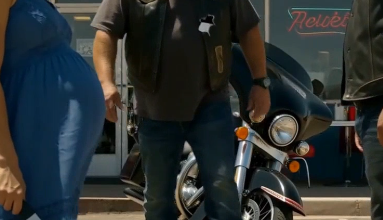
Thirty Harleys rolled through Lebanon beneath a cold gray sky. People stood outside Walker Cycle. Mechanics lowered their tools. The woman at the Route 42 diner removed her apron and pressed both palms against the window.
Emily rode in the car with June.
At the cemetery, I gave her Daniel’s folded leather gloves and the purple ribbon from his handlebars. She pushed the ribbon into my hand.
“You keep it,” she said. “Dad said you lose things.”
He had told the truth.
After the funeral, our brotherhood scattered into grief.
We had promised to help. We repaired June’s leaking porch roof, filled her freezer, changed the oil in her Buick, and paid six months of property taxes without leaving a name.
Those were problems we understood.
Wood rots. Engines leak. Bills arrive.
A lonely child was harder.
I called twice in the first month. Tiny brought groceries. Reverend fixed a broken bedroom window. Moose installed a handrail beside the porch steps.
None of us asked Emily about school.
That failure belonged to all thirty of us, but it began with me.
Daniel had given me his address book and a stack of purple wristbands. I locked them inside the office safe at Walker Cycle because touching them felt like admitting he was not coming back.
I told myself Emily needed space.
The truth was uglier.
Seeing her hurt.
She had Daniel’s brown eyes and his habit of tilting her head when someone lied. Every time I looked at her, I remembered the hospital room and the boot he never managed to pull on.
So I stayed busy.
Emily returned to school three weeks after the funeral. Her teacher placed a sympathy card on her desk, signed by twenty-four children. Most wrote the same sentence because the teacher had placed it on the whiteboard.
Sorry for your loss.
At lunch, nobody sat beside her.
Grief made other children uncomfortable. Emily rarely spoke, declined invitations twice because she worried about leaving June alone, and soon stopped receiving invitations at all.
A rumor began that her father had belonged to a dangerous gang.
Children repeated pieces of conversations overheard at home. They said Daniel had been in prison. That part was true. He had served eighteen months for stealing car parts when he was twenty-one.
They said the club hurt people.
That part was not.
But truth travels slower than fear.
At the spring science fair, Emily built a model showing how roadside rain gardens filtered dirty water. She used gravel from Daniel’s driveway and tiny motorcycles cut from black cardboard.
Every child had an adult beside the display.
Emily stood alone.
June had tried to leave the diner, but another waitress called in sick. Missing the shift would have cost her job, and Emily had insisted she stay.
“I’m fine, Grandma.”
She was not.
The principal, Mr. Harrison, took a photograph of Emily beside her project. In the picture, she wore Daniel’s old purple bandanna around her wrist.
He mailed a copy to Walker Cycle.
It remained unopened beneath invoices for twelve days.
When I finally tore the envelope, something inside me shifted.
Emily stood straight. She even smiled.
But her eyes were looking beyond the camera toward another family.
Behind her, a boy held a blue ribbon while both parents kissed his cheeks.
I opened the safe.
Thirty purple wristbands waited inside.
Under them lay Daniel’s address book and an envelope I had never noticed because it was stuck beneath the lining.
On the front, he had written:
BEAR—WHEN YOU START MAKING EXCUSES.
I sat down.
Daniel knew me too well.
Inside was a list of Emily’s school events for the entire year. Music night. Field Day. Spring reading picnic. Fifth-grade welcome evening. A handwritten note filled the bottom half of the page.
She doesn’t need thirty men fixing everything. She needs one face in the seats. But you boys are terrible at schedules, so I made thirty backups. Don’t let her search an empty room for me.
I read it again.
Then I called the club.
Our meeting began badly.
Tiny said thirty riders would overwhelm the school. Reverend worried parents would complain. Moose argued that Emily hardly knew most of us and might believe a motorcycle club had come to collect a debt.
They were fair concerns.
Then Deke spoke.
“We promised Danny.”
Deke had not attended the funeral. His sobriety had broken two weeks before Daniel died, and shame kept him away from the cemetery.
Now he stood against the clubhouse wall with trembling hands and an untouched cup of coffee.
“I promised him,” he repeated.
The room went quiet.
Brotherhood is easy when the road is clear and everyone agrees about the destination. It becomes real when showing up demands discomfort, humility and the possibility that your presence may not be wanted.
We decided to ask June first.
She opened her door, saw thirty men crowded across the porch and nearly dropped a bag of potatoes.
“What happened?”
“Nothing,” I said.
“That many motorcycles never means nothing.”
I showed her Daniel’s note.
June read it beside the kitchen counter. Her lips moved over every word, but she did not cry. She folded the paper once and handed it back.
“Emily has Field Day Friday.”
“We know.”
“She thinks nobody can come.”
“We know that too.”
June looked through the window toward the line of Harleys.
“Do not frighten the school.”
“We’ll try.”
“That answer frightens me.”
We did more than try.
We called the principal. He refused permission for the motorcycles to enter school grounds, so we agreed to park across Route 123 and walk through the gate. He limited us to six guests because of space.
Then thirty Family Field Day tickets appeared at Walker Cycle.
Mr. Harrison had changed his mind.
That should have warned me.
On Friday morning, we washed our motorcycles, removed anything from our clothing that could be misunderstood, and bought matching purple shirts to wear beneath our leather cuts.
Tiny brought sunscreen.
Moose packed thirty juice boxes and pretended they were for Emily.
Reverend carried a folding chair because his left knee had not respected him since Vietnam. Deke arrived early, sober, shaved, and holding a purple wristband so tightly that the marker stained his palm.
At 9:12 a.m., thirty V-twins rolled toward Franklin Elementary.
The engines echoed off the brick buildings. Parents turned. Teachers stopped setting orange cones across the grass.
We parked exactly where instructed.
Then we walked.
Thirty pairs of boots struck the pavement while Mr. Harrison waited beside the gate. He looked nervous, but he did not move away.
“You understand this is a school,” he said.
“We do.”
“And there are rules.”
“Always are.”
“No revving engines. No smoking. No inappropriate language.”
Tiny hid his coffee cup behind his back as if it contained evidence.
Mr. Harrison looked at the twenty-nine men behind me.
“One more question. Which one is Emily’s uncle?”
Every hand rose.
That was when he brought out his own purple wristband.
Daniel had visited him shortly after receiving the diagnosis. They had sat inside the principal’s office for nearly an hour. Daniel explained that Emily’s mother was gone, June’s work schedule was unpredictable, and his biker brothers would need help becoming the family Emily deserved.
Mr. Harrison had promised to send invitations.
The school had mailed every event notice to Walker Cycle.
We had ignored them.
My stomach dropped.
“How many?” I asked.
“Four.”
Four invitations. Four empty events.
I had failed Daniel four times.
Across the field, Emily sat alone beside his photograph.
Then another child mocked it.
Emily closed the frame.
I started walking.
Mr. Harrison caught my arm. “Give her a moment.”
“She’s had eight months of moments.”
I removed my sunglasses.
Emily saw me.
She stood.
Behind me, leather creaked and boots moved across the grass. Thirty large men spread along the fence, each wearing a purple wristband with the same word.
Uncle.
Emily stared at us as if we were a trick grief had played.
I lifted one hand.
“Need a team, kid?”
Her chin trembled.
“There are only supposed to be two adults.”
“We brought substitutes.”
Tiny raised the juice boxes. Moose lifted a bag of orange slices. Reverend unfolded his chair. Deke held up Daniel’s old stopwatch, which June had given him that morning.
Emily laughed.
It was small.
Then it became bigger.
The first event was a three-legged race. I tied my left ankle to Emily’s right with a purple strip of cloth. She barely reached my waist.
“We’re going to lose,” she said.
“Badly.”
“You’re not supposed to say that.”
“I’m fifty-three and built like a refrigerator.”
We finished last.
Thirty bikers cheered as though we had broken an Olympic record.
Emily stopped at the finish line, breathing hard and staring at them. She was not accustomed to hearing her name shouted by people who meant it.
Again they called.
“Emily! Emily! Emily!”
She lowered her head.
I thought she was embarrassed.
Then I saw tears dropping onto her sneakers.
Family Field Day should have been the ending.
It was not.
The following Monday, Mr. Harrison called me to Franklin Elementary. A parent had complained that the Iron Lanterns created an intimidating environment and that “gang affiliation” did not belong near children.
I understood the fear.
Some of our men had records. Our scars came from different years and different mistakes. Deke still attended recovery meetings. Tiny had spent three years inside for an assault committed before Emily was born.
We did not ask strangers to ignore those facts.
We asked them to judge what we did next.
The school board scheduled a meeting. Thirty bikers arrived without motorcycles and sat in the last three rows wearing clean shirts.
Emily sat beside June in front.
The complaining parent spoke first. She described the noise, the leather, the tattoos and the way children had crowded around our men afterward.
She was not cruel.
She was afraid.
Then Mr. Harrison opened his desk and removed Daniel’s sealed letter.
It was addressed to the school board.
Daniel had written it six weeks before he died.
Mr. Harrison read aloud.
My name is Daniel Walker. Some parents know me as Emily’s father. Others know me as the tattooed mechanic who sits too close to the stage and cheers too loudly. Both descriptions are correct.
Tiny looked down.
I am dying. Emily does not know how soon. She has already lost her mother, and her grandmother is doing everything one person can do. I am writing because there are thirty men who will try to help after I am gone.
Some will look frightening. A few have records. Several were once men I would not have trusted around my own child. But I have watched them choose better lives one ordinary day at a time.
They will not always know how to enter quietly. They may arrive too early, sit in the wrong seats, or applaud when applause is not requested. Please teach them. Do not remove them.
The room became still.
Mr. Harrison continued.
Emily will search every audience for me. She cannot help it. If one of those men is sitting there, perhaps the empty chair beside him will hurt less.
The parent who complained covered her mouth.
I stared at the floor.
The letter ended with one request.
When they tell you they are her uncles, believe them. I gave them the job.
Nobody spoke for several seconds.
Then Emily stood.
She wore a purple dress and Daniel’s bandanna around one wrist. Her knees shook, but her voice did not.
“They don’t scare me.”
The board chair leaned forward. “Do you want all thirty men attending your events?”
Emily looked back at us.
We were too big for the chairs, too rough for the room, and too quiet for men accustomed to defending ourselves.
“All thirty?” she asked.
“If that is what you want.”
Emily considered it.
“Maybe not parent lunch.”
Tiny whispered, “Fair.”
A few people laughed.
Then Emily pointed toward me.
“Uncle Bear comes to music.”
She pointed at Tiny.
“Uncle Tiny can come to art because he colors inside the lines.”
Tiny had not known that about himself.
“Uncle Reverend comes to reading. Uncle Moose comes to sports. Uncle Deke can come to anything he wants.”
Deke closed his eyes.
Emily kept assigning events until every man had a place. Then she stopped and looked at the board.
“But if it’s onstage, I want all of them.”
“Why?” the chair asked.
Emily gave the simplest answer in the room.
“Because they’re loud.”
The board approved us as registered family guests. We submitted identification, passed the required background screenings, followed school rules and attended an orientation led by a twenty-six-year-old teacher who explained visitor badges to men twice her age.
Nobody complained.
Daniel had asked us to learn.
So we learned.
The spring music program came three weeks later.
Emily played the North Star in a short musical about the night sky. She had four lines and one solo lasting forty-three seconds.
We arrived ninety minutes early.
All thirty of us.
The school reserved the last three rows, partly because we needed the space and partly because no parent wanted to sit behind Moose.
Each man carried a handmade silver star.
The afternoon before the performance, we had gathered at Walker Cycle with cardboard, glue, aluminum foil and absolutely no useful experience.
Tiny glued his star to the table.
Deke cut one with nine points.
Reverend produced something resembling a damaged sheriff’s badge.
We kept them all.
When Emily walked onto the stage, she searched the auditorium.
Old habit.
Her eyes moved toward Daniel’s usual section, paused on an empty chair we had deliberately left for him, then traveled across thirty gray beards, bald heads and purple wristbands.
She smiled.
That was the moment from the teaser—the moment she forgot her first line.
The music teacher quietly prompted her.
Emily took a breath.
Then thirty bikers lifted their stars.
She began again.
This time her voice reached the back wall.
At the end, the audience applauded politely.
We did not.
We stood.
“That’s our girl!”
Emily covered her face while the auditorium erupted in laughter and applause. The principal did not ask us to sit down.
Afterward, children gathered around her.
Not around us.
Emily.
They asked about the bikers, the wristbands and whether all thirty were truly her uncles. For the first time, her unusual family did not make her someone to avoid.
It made her interesting.
Friendship did not appear instantly. Real life is rarely that generous.
But a girl named Sophie asked Emily to sit with her at lunch. A boy named Marcus invited her to join a science project. Two children who had mocked Daniel’s photograph apologized after Mr. Harrison spoke privately with their parents.
Emily did not become popular.
She became visible.
We kept showing up.
At the spelling bee, Reverend sat with a pocket dictionary even though he was not allowed to help. Emily finished fourth, and we took her to the Route 42 diner as if she had won the national championship.
At the soccer game, Moose shouted instructions until Emily told him he did not understand soccer.
He studied the rules before the next match.
At the art exhibition, Tiny stared for twenty minutes at Emily’s painting of thirty motorcycles circling a small purple house.
“Which one is mine?” he asked.
“The crooked one.”
“Why is mine crooked?”
“You parked crooked.”
Fair enough.
At the reading picnic, Deke sat beneath an oak tree while Emily read aloud from Charlotte’s Web. His hands shook less when she leaned against his arm.
Daniel had once helped Deke survive the worst night of his life. Now Daniel’s daughter gave him a reason to protect the days that followed.
That was the twist none of us expected.
We believed we were showing up for Emily.
Emily was showing up for us.
She sent Reverend reminders about his medical appointments. She made Tiny a birthday card when his adult children forgot. She asked Moose about his injured knee and carried a second folding chair because she noticed he never admitted when standing hurt.
For Deke’s fifteenth sobriety anniversary, she gave him a purple wristband with a new word.
STAY.
He wears it beside UNCLE.
The club changed around her. Men who once argued through meetings learned to lower their voices when Emily did homework in the office. A jar of sharpened pencils appeared beside the parts catalogues.
Our refrigerator began holding juice boxes.
Someone mounted a school calendar above the workbench.
Every event carried thirty initials.
If one man could not attend, he crossed out his name and found another. Usually, all thirty came anyway.
Not because Daniel demanded it.
Because Emily looked for us now.
Three years have passed.
Emily is twelve and pretends our cheering embarrasses her.
It does.
She also counts us before every performance.
At her sixth-grade awards ceremony, only twenty-nine bikers entered the gym. Deke was missing because his truck had broken down twenty miles away.
Emily noticed before she reached her seat.
“Where’s Uncle Deke?”
I checked my phone.
No answer.
Her face changed.
The old fear returned so quickly that I finally understood what Daniel had seen in that first school video. Emily did not merely notice empty seats.
She believed they meant people were leaving again.
I walked outside and called Deke. His truck sat beside Route 48 with a dead alternator, and his Harley was in the shop.
“Stay there,” I said.
I sent Tiny.
Twenty minutes into the ceremony, the gym doors opened. Deke entered wearing his clean club shirt while Tiny followed behind him holding two helmets.
Emily was already onstage.
She saw them.
Her shoulders relaxed.
Then the principal announced her name for the Community Heart Award, given to a student who made others feel included.
Twenty-nine bikers stood.
Deke became thirty.
We shouted until the basketball banners trembled.
After the ceremony, Emily found us beside the motorcycles. She carried a small wooden box with a silver star painted on the lid.
Inside were thirty pins shaped like folding chairs.
Each carried an uncle’s name.
Mine was first.
“What are these?” I asked.
“So you remember your seats.”
“We know where to sit.”
“You’re old.”
She handed out the pins one at a time.
Deke received his last. He turned it over and found one word scratched into the wood.
STAY.
His jaw tightened.
He pinned it above his purple wristbands.
We still leave one chair empty at every event.
It belongs to Daniel.
At first, I thought the chair would remind Emily of what she had lost. Instead, it became the place where she leaves her flowers, awards or school program after each performance.
She no longer searches the audience hoping he will walk through the door.
She knows where he is.
He is in the crooked silver stars stored at Franklin Elementary. He is in thirty purple wristbands, a school calendar above a mechanic’s workbench, and the roar that rises whenever his daughter’s name is called.
Last Friday, Emily performed her first solo at Lebanon Junior High.
Thirty Harleys filled the far side of the parking lot. We entered quietly, displayed our visitor badges and took three rows near the back.
Emily walked beneath the lights.
She looked toward Daniel’s chair.
Then she looked at us.
“Ready?” she asked from the stage.
Thirty tattooed uncles leaned forward.
“Always, kid.”
She began to sing.
Follow our page for more unforgettable biker stories about rough-looking riders whose quiet promises reveal the family, loyalty and love living beneath the leather.