A Town Called This Biker a Kidnapper When Police Found a Little Girl on His Motorcycle—Then Her Backpack Exposed the Family Everyone Had Been Praising
Dana’s hand stopped halfway to the backpack.
Cal watched the caseworker look from June to Nathan Voss, then back again. Nathan wore a clean work shirt and the exhausted expression of a father whose worst fear had almost happened. Cal knew how convincing that expression could be.
He had seen it in his own mirror.
“June,” Dana said, “I haven’t spoken to Nathan about any book.”
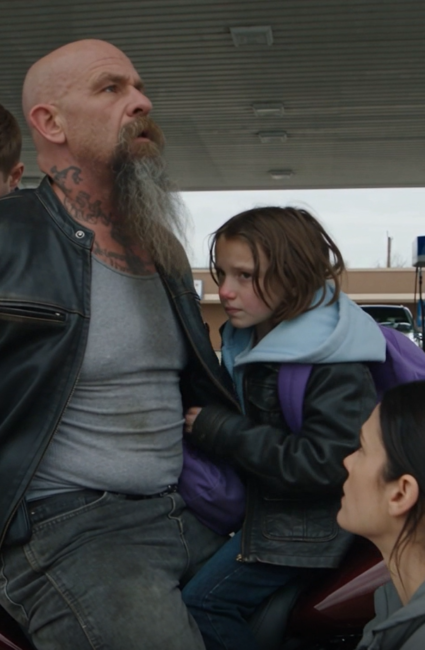
The girl pulled the leather jacket tighter.
Nathan stepped forward. “She’s upset. We should get her home before—”
“Stay there,” the deputy said.
It was the first instruction anyone had given Nathan.
Cal felt a small, dangerous flicker of relief. Then the deputy adjusted his grip on Cal’s arm, and he remembered where he stood.
He was fifty-nine, broad through the shoulders, with a gray beard, tattooed hands, and a motorcycle beside a frightened child. Nathan coached youth baseball and helped organize winter clothing drives.
Cal understood the picture.
He had made one mistake already.
When June climbed onto the stationary motorcycle, he should have stepped farther away instead of helping settle his jacket around her shoulders. The wind had been cold. She was shaking. He had acted before considering what anyone might see.
Now he wondered whether he had misunderstood everything.
Maybe the girl was frightened of something ordinary. Maybe the book contained stories. Maybe his anger at Nathan came from hearing a child say please in a voice he recognized too well.
The cashier interrupted his thoughts.
“My name’s Mara,” she told the deputy. “I’m the one who called dispatch.”
Nathan turned.
“You called?”
“The man asked me to.”
Cal nodded toward the shop window.
“I didn’t want her riding anywhere. I wanted somebody here.”
Mara held out her phone. She had written down the time of the call and the number of the pump.
The deputy looked at his partner.
“Check with dispatch.”
June began tapping her wrist again.
Twice.
Then the slow stroke.
Cal felt the pavement tilt beneath him. He had taught Nora that when she was little, after a thunderstorm left her trembling behind the couch.
Other people could know the same trick.
He told himself that firmly.
Other families had frightened children. Other fathers had learned to count breaths.
“What’s your mother’s name?” he asked again.
Nathan spoke before she could.
“She doesn’t have contact with her.”
“That wasn’t what he asked,” Dana said.
June looked at Cal.
“Nora.”
His daughter’s name landed harder than the handcuffs had.
Dana noticed.
“Do you know someone named Nora?”
“My daughter.”
Nathan’s expression changed so briefly that Cal almost missed it.
Then the foster father turned toward the deputy.
“This is getting inappropriate. He’s feeding her information.”
Cal hadn’t given her a name.
Mara said that aloud.
The deputy’s partner returned from the patrol car. Dispatch had confirmed the call. Cal had requested help before Nathan reported an attempted abduction.
Dana crouched beside the motorcycle.
“June, may I hold the backpack?”
The girl shook her head.
“That’s okay. You can hold it.”
Nathan reached into his pocket for his phone.
June flinched.
And Cal wondered who Nathan was calling before anyone had told him there was a book.
Three years earlier, Cal had spent a Saturday helping his wife unload school supplies at a neighborhood fundraiser.
Rose insisted he wear a clean shirt under his leather vest.
“Children can survive tattoos,” she told him. “They shouldn’t have to survive that shirt.”
He changed it.
Nathan Voss was working at a folding table, checking donated supplies against a list. He greeted Rose by name and carried the heaviest cartons without being asked.
Inside one box were plain blue notebooks.
“Weather books,” Nathan called them.
Rose laughed. “What?”
“That’s what I tell the kids. Write the weather inside your head. Helps them talk.”
Cal remembered liking that.
He also remembered Nathan crossing every handwritten seven with a heavy diagonal slash. Nathan had spent several minutes correcting the inventory totals, leaving those peculiar numbers all over the page.
Rose tucked a notebook beneath Cal’s arm.
“For your thoughts.”
“Won’t need that much paper.”
She kissed his cheek.
He could still hear her laughing.
That was the memory: sunlight on folding tables, his wife’s hand warm against his neck, a respectable man making room for children’s feelings.
Now Rose had been dead eighteen months, and Nathan stood outside a gas station while a child hid a blue notebook beneath her coat.
Cal didn’t know whether the memory was evidence or merely grief trying to make a pattern.
The deputy removed the handcuffs after speaking with Mara and watching the first section of security footage.
Cal rubbed one wrist.
He wasn’t cleared to leave yet. He was told to remain available while officers sorted out what had happened.
He sat on the curb.
It was better than standing over everyone.
Dana arranged for June to sit inside the store with Mara while another worker came to assist. Nathan objected to that too.
“My wife will be worried.”
“Then tell her where you are,” Dana said.
For the first time, her voice lost its softness.
Cal watched her make calls. She requested a supervisor, then asked for someone else when she heard who was available.
That hesitation mattered.
He could see she knew it.
When she finished, he asked about Nora.
Dana didn’t give him a history in the parking lot. She asked for his full name, identification, and a phone number. Then she went quiet while reading something on her tablet.
Cal could hear June inside the shop asking whether the other children were still at the house.
Dana looked up sharply.
“How many other children, June?”
“Six.”
“I know there are six.”
“Then why aren’t you going?”
Nobody answered quickly enough.
Dana made another call.
Cal looked at Nathan, who had moved near his pickup and was speaking into his phone with one hand cupped over his mouth.
The foster father saw him watching.
“You have no idea what that little girl’s been through.”
Cal believed that.
It was the first thing Nathan had said that he believed without effort.
Then Dana turned the tablet slightly away from him, and he caught sight of his own name beside a box that should never have described him.
Why did the county’s record say he was dead?
The record didn’t make Cal June’s grandfather.
Dana said that carefully when he asked to see it.
Names had to be checked. Family connections had to be verified. A child’s words mattered, but nobody was going to settle her future beside a coffee dispenser.
Cal nodded.
He hated the waiting. He respected the sentence.
Inside the store, June sat with both feet tucked beneath her chair. Mara brought her water and a sealed packet of crackers, then asked before opening them.
June saved half.
“For Milo,” she said.
Dana stepped outside to make another call.
Cal waited until she returned.
“Did you tell Nathan about her notebook?”
“No.”
“She thinks you did.”
“I know.”
The caseworker looked toward the store window.
“Three weeks ago, June told me there were nights she wasn’t allowed dinner. I documented it and requested a follow-up.”
“What happened?”
“The concern was reviewed by my supervisor while I was out.”
“Reviewed how?”
Dana pressed her lips together.
“I need the records before I answer that.”
Cal expected her to defend herself.
Instead, she wrote down her supervisor’s name for the officer handling the report.
Paula Mercer.
Nathan had mentioned Paula at fundraisers. Cal had understood her to be a helpful county contact, someone who knew how difficult fostering could be.
Dana explained that the response in June’s file described a misunderstanding about bedtime snacks. It said June had a pattern of inventing punishments when limits were set.
The words had not been Dana’s.
She had returned from leave to a closed concern.
“I should have followed up with her anyway,” she said.
Cal studied her face.
That sounded different from innocence.
It sounded like someone recognizing where her own failure ended and another person’s began.
By late afternoon, another team had gone to the Voss house. Cal wasn’t told details. He saw the relief in June’s shoulders when Dana said the other children were being seen separately by people who would listen.
Nobody promised they would all stay together.
Nobody promised they would never be frightened again.
June asked whether Milo would have his inhaler.
Dana wrote that down and called.
Cal had to turn away.
He thought of all the things a nine-year-old should have been remembering instead.
Then Dana asked him to take a call in a quiet corner.
The woman on the other end identified herself as an advocate working with Nora.
His daughter was alive.
Cal had known that, technically. He had heard fragments through people who still heard from her. But hearing someone say she was safe, receiving treatment, and asking about June made him lean against the wall.
“Nora would like to speak with you,” the woman said.
His daughter came on the line.
“Dad?”
He shut his eyes.
“I’m here.”
A breath. A small broken sound.
Then Nora asked why he had refused the letter she sent about her daughter.
Cal looked through the window at Nathan’s pickup.
“What letter?”
The letter had gone through the Voss household.
Nora explained that much before her voice gave out. She had written it several months earlier, after asking June’s foster parents to help locate her father.
She knew his shop had moved.
She didn’t know where.
Nathan said he would pass it along through people who knew Cal from the motorcycle community.
Later, he told her Cal wanted no involvement.
Cal stood with his phone pressed against his ear.
“Did you hear that from me?”
“No.”
“Then you didn’t hear it.”
Nora began to cry.
He waited.
He had filled too many silences in their lives with anger. This one belonged to her.
Over the next several days, separate pieces began reaching the people authorized to examine them.
Mara preserved the security footage. It showed June leaving Nathan’s pickup while he was inside paying, approaching Cal, and climbing onto the parked motorcycle. It showed Cal moving away from the controls and signaling Mara through the window.
The engine never started.
The dispatch recording preserved his request.
There’s a little girl here saying she can’t go home. Send somebody who can help her.
The circulating phone video began afterward.
Cal’s lawyer, Lena Ortiz, obtained a copy and watched it twice.
“A cropped video can be truthful about what it shows,” she said, “and still leave out the event.”
June’s notebook required a different kind of care.
Cal didn’t read it.
He learned about its contents through the investigation and, later, through what June chose to tell him.
She had recorded dates, meals, punishments, and which child was expected to answer the door when visitors came. Some pages contained drawings. Others held lists of what the younger children liked to eat.
Beside several dates, she had written: Say we were at Aunt Paula’s.
The children had not been at Aunt Paula’s.
Investigators compared those dates with records of paid respite care.
The same children appeared on reimbursement paperwork as receiving care elsewhere while school records and other information placed them at the Voss home.
There were more questions than answers at first.
Then the payment records began answering them.
Nathan had submitted charges for services that hadn’t occurred. Some supporting documents carried the same unusual crossed sevens Cal remembered from the fundraiser.
The handwriting alone proved little.
The dates, recipients, and supporting records mattered more.
Paula’s approvals appeared repeatedly.
Cal learned another fact from Lena a week later.
Paula Mercer was Nathan’s older sister.
Their different surnames had hidden a relationship that should have been disclosed and examined.
Nathan’s house had held June and six other children. Their care generated payments that were supposed to meet their needs.
June had been saving crackers for a little boy.
Cal sat at his kitchen table until the coffee went cold.
Then his phone buzzed.
Someone had posted the address of his repair shop beneath the old arrest photograph.
A second message followed from an unfamiliar number.
Keep digging and Nora loses everything.
Who knew enough about his daughter to make that threat sound believable?
By Monday, three customers had canceled.
One said it was nothing personal.
Cal looked at the empty service bay afterward and tried to imagine what personal would have sounded like.
Someone left a voicemail calling him a child stealer. Another person mailed a newspaper clipping about an unrelated crime committed by a biker in another state.
Cal gave both to Lena.
He wanted to reply publicly.
She asked what he wanted the reply to accomplish.
“Make them stop.”
“Will it?”
He didn’t know.
He had repaired engines for thirty-five years. He could usually tell which sound meant a loose part and which meant something breaking deep inside.
People were harder.
His riding friends offered to park outside the Voss house.
Cal said no.
They offered to ride past Nathan’s workplace.
“No.”
Finally, one of them asked what would help.
Cal pointed toward the unfinished motorcycles.
“People still need their bikes.”
They came back in work clothes.
Two handled collections and deliveries. Another answered the phone when Cal couldn’t listen to one more stranger explain what kind of man he was.
Nobody wore a slogan about June.
Nobody put her face on a fundraiser.
Cal kept the leather jacket folded on a chair in his kitchen. It had been returned after officers documented it. One sleeve still held a pale crumb from the crackers June had saved.
He couldn’t bring himself to shake it out.
Nora visited that Thursday with her advocate.
She was twenty-nine, thinner than he remembered, wearing a clean sweatshirt with one cuff stretched loose. She stopped inside his doorway as if she expected him to reconsider.
He had once told her she couldn’t keep coming home only when everything fell apart.
He remembered the exact words.
He wished remembering them could change them.
“I should’ve asked what help looked like,” he said.
Nora stared at the floor.
“I should’ve told you about June.”
“Yes.”
The word hurt both of them.
It also left room for the rest.
They sat at the kitchen table. Nora explained that her daughter had entered care during a period when Nora could not provide a safe, stable home. Recovery had not followed a straight line.
Cal listened without turning each admission into a question about why she hadn’t called.
Then she asked whether June was angry.
“I haven’t been told everything she feels.”
“You sound like a lawyer.”
“I’m practicing not guessing.”
Nora gave a short laugh.
It disappeared quickly, but he was glad to hear it.
That evening, the threatening number sent a photograph of Nora outside his house.
Lena told them to preserve it and contact the investigator.
Cal checked the lock twice.
For the first time since the gas station, he was frightened for himself in a way he could name. Somebody wanted him isolated enough to quit.
At ten that night, his phone rang.
Beth Voss spoke so softly he almost couldn’t hear her.
“Nathan says I need to remember things differently.”
Cal sat down.
“What things?”
“The notebook. The letter. Where the children were.”
She began to cry.
Then she said something that stopped him from offering easy reassurance.
“I signed the papers too.”
Cal didn’t promise Beth protection.
He gave her Lena’s number and told her to speak with her own lawyer. He would not meet her alone or accept a bag of papers in a parking lot.
By morning, she had contacted the investigator.
What Beth eventually disclosed did not make her innocent.
She knew Nathan restricted food as punishment. She had seen children rehearse answers before visits. She had signed forms without checking the dates, then continued signing after she knew some dates were false.
Sometimes she had taken food upstairs after Nathan went to bed.
Cal heard that detail and felt no gratitude.
A child should not have needed secret sandwiches in a house being paid to feed her.
Beth said she had been frightened of Nathan’s temper, frightened of debt, and ashamed of what people would think if the home everyone praised was investigated.
Those fears explained choices.
They didn’t undo them.
She also surrendered a household ledger she had kept separately from the official records. It listed grocery spending, deposits, transfers, and payments Nathan described as family expenses.
Investigators could compare it with the reimbursement claims.
There was no dramatic hidden fortune.
There were car payments, overdue bills, money moved between accounts, and repeated decisions to protect the adults’ comfort at the children’s expense.
Then Beth acknowledged the letter.
She had read Nora’s request to contact Cal.
Nathan told her involving a grandparent would disrupt June’s placement.
“He said we were finally getting her settled,” Beth recalled.
But he had also complained about losing payments when children left.
Both statements had lived in the same house.
Beth placed Nora’s letter in a kitchen drawer instead of mailing it.
Later, Nathan told her to get rid of it.
She didn’t.
Keeping it had felt, to Beth, like leaving herself a way out.
For Nora and June, it had remained a closed drawer.
Cal learned the distinction slowly.
He had wanted one clear villain and everyone else safely on the other side.
Instead, he found people who had known different amounts, excused different things, and waited for somebody else to act.
Nora had something else to admit.
When she first entered treatment, she had not listed Cal as a possible family contact. She believed their relationship was beyond repair and feared he would judge her as a mother.
“I made that decision before Nathan ever had the letter,” she said.
Cal looked at her.
“You didn’t make him lie.”
“I know. But I made it easier for nobody to ask.”
They sat with that.
Later, during an approved visit with support nearby, June told Cal about the sentence in her notebook that worried her most.
She had written that Milo spilled cereal.
He hadn’t.
She had.
She thought admitting it now might mean nobody believed the rest.
Cal wanted to tell her it didn’t matter.
But it mattered to her.
“Then you tell the person helping you exactly that,” he said. “You don’t have to make yourself perfect.”
June picked at the cuff of her borrowed sweater.
“Will they still believe me?”
“They can check things.”
“Even if somebody smiles?”
“Even then.”
Months later, when Nathan insisted he had never read her private notebook, Cal wondered which of the things people could check would finally make him stop smiling.
The financial case reached a public courtroom long after the internet had found something else to be angry about.
June did not sit in the gallery.
Her name and private history were handled separately from the public accounting of money, documents, and adult decisions. Cal had been told where he could sit and what he could discuss.
He followed those instructions.
His friends came without leather vests bearing statements about the case. Nora sat beside her advocate. Dana waited outside until she was called.
Nathan wore a gray suit.
He looked like a man who knew how to be believed.
Cal noticed that first and hated that he still noticed it.
The evidence came in pieces that were less dramatic than the rumors and much harder to dismiss.
Dates.
Invoices.
School attendance.
Messages.
A payment claimed for one place while the children were documented somewhere else.
Beth testified about the ledger. She answered questions about her own signatures. She did not call herself the person who saved them.
Dana described her original concern, the follow-up she requested, and the changed disposition entered during her leave.
The records preserved the difference.
Paula’s family relationship to Nathan was no longer an incidental fact hidden behind different names. It sat beside her approvals, messages, and explanations.
Cal listened with his hands flat on his knees.
When Nathan testified, his lawyer led him through the familiar account: difficult children, misunderstood household rules, exhausted foster parents, paperwork mistakes.
He spoke warmly about giving children a place to express themselves.
Then he denied knowing that June had kept a private record of punishments.
The prosecutor asked about the blue notebook.
Nathan called it a school notebook.
Asked whether he had read it before June left the house, he said no.
Asked whether he had ever restricted her access to it, he shook his head.
Cal remembered the fundraiser.
Weather books.
The prosecutor turned to a message Beth had preserved. It referred to keeping notebooks downstairs after bedtime.
Nathan leaned toward the microphone.
“I told her no weather books after lights-out. That doesn’t mean—”
He stopped.
The prosecutor waited.
“Whom did you tell?”
“June.”
“What did you mean by weather books?”
“Just a name.”
“For what?”
Nathan shifted in his chair.
For the first time, he looked toward Beth instead of the jurors.
The phrase alone did not decide the case. Neither did the way he crossed a seven.
But both belonged to a pattern supported by records he could not explain away.
The prosecutor showed a reimbursement sheet.
Nathan had attributed its handwritten corrections to Beth.
Beside it was one of his inventory lists from the fundraiser, preserved with the donation records. The same slashed sevens appeared in both.
Then came messages discussing the amounts.
Cal watched Nathan stop calling them mistakes.
The last document was Nora’s letter.
Nathan said he had been trying to spare June further disappointment.
“By telling her grandfather refused contact?” the prosecutor asked.
“He wasn’t part of her life.”
“Did you contact him?”
“No.”
“Did you know the file described him as deceased?”
Nathan’s jaw tightened.
Cal leaned forward before he could stop himself.
The judge instructed everyone to remain still.
Nathan looked directly at him.
“She was better off without another Reed making promises.”
It was the first time he had said the family name with anything like honesty.
Cal sat back.
What would June need from him when the courtroom finally stopped asking questions?
The answer was smaller than he expected.
Not a speech.
Not a motorcycle ride.
A promise that Thursday would still be Thursday.
June had been moved to a carefully assessed placement while decisions about her family were made. The other six children had their own arrangements, relatives, needs, and losses. Some could see one another regularly. Others needed adults to work hard to make that happen.
Cal did not get seven children and a happy ending delivered to his door.
He got forms.
Interviews.
Appointments.
Long stretches of being told to wait.
He showed up for those too.
Nathan was convicted on the financial charges proved against him. Other findings and consequences came through separate proceedings. Paula lost her role and faced her own case. Beth’s cooperation was considered alongside the things she had done, rather than used to erase them.
Cal stopped following every rumor about their sentences.
He kept the official updates in a folder.
The folder stayed in a drawer.
Nora continued treatment and built the routines she had once struggled to keep. She found steady work with hours that allowed appointments. She learned to say when she needed help before everything collapsed.
There were difficult weeks.
Cal learned that a difficult week was not permission to take over her life.
During visits, June sometimes wanted Nora beside her and sometimes sat closer to the door. Nora let her choose.
Trust returned unevenly.
Cal understood that better than he wanted to.
One afternoon, June asked whether he had known she was his granddaughter at the gas station.
“No.”
“Then why’d you help?”
“You asked.”
She considered that.
Outside the room, somebody dropped a stack of plastic cups. June jumped, then pressed her thumb against her wrist.
Two taps.
One slow stroke.
Cal waited for her breathing to settle.
He did not take her hand without asking.
Months later, after more assessments and steady progress, Nora and June began living together again. Cal lived nearby. He had a spare room, but he did not describe it as where June belonged.
Her room was her room.
His was available.
On Thursdays, he collected her after school when the arrangement called for it. He kept a booster seat in his truck until she no longer needed it and never offered the motorcycle as a shortcut around anyone’s rules.
The jacket hung by his front door.
June asked for it one rainy evening.
It dragged almost to her knees.
“You’ll trip,” he said.
“Then walk slower.”
He did.
At home, she sat at the kitchen table and opened a new notebook. This one had a yellow cover she had chosen herself.
Cal put down a plate of toast.
She took one piece, then paused.
“Can I have another?”
“Of course.”
She stared at the plate.
He moved the whole thing within reach.
Nora arrived a few minutes later, wet hair tucked behind her ears. She saw the notebook and asked whether June wanted privacy.
June shook her head.
“I’m writing Thursday.”
Cal turned toward the kettle so she wouldn’t have to watch his face.
Behind him, a pencil moved across paper.
Then she called his name.
“Grandpa?”
He looked back.
“Can tomorrow be boring too?”