Part 2: A Biker Held a Little Girl on His Harley — Then Her Mother Screamed “Kidnapper”
I didn’t know Cal well before that day.
Nobody really did.
Flagstaff is a funny town. We get tourists on Route 66, college kids from NAU, hikers with clean boots, truckers with tired eyes, and bikers passing through like thunder that forgot where it was headed. People notice a man like Cal. They build a whole story around him before he ever says a word.
I had done it too.
The first time he came to my snow-cone cart, I almost closed the window.
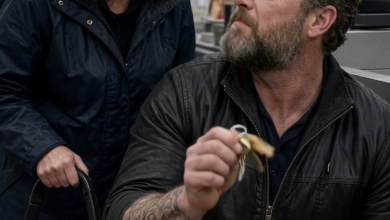
He stood there under the noon sun with chains on his wallet, oil under his fingernails, and a scar running from the corner of his right eye down into his beard. His cut creaked when he leaned on the counter.
“Cherry,” he said.
His voice sounded like gravel in a coffee can.
“For you?” I asked.
He looked at me like I’d asked a dumb question.
“For the kid.”
I looked past him and saw a little boy sitting on the curb with a scraped knee, trying hard not to cry while his father yelled into a phone. Cal bought him a cherry snow-cone, set it beside him, and walked away before the boy could say thank you.
That was Cal.
He did soft things with no announcement.
He fixed the chain on a teenager’s bicycle outside the gas station and told the kid, “Learn your tools. World charges less when you can fix your own mess.”
He brought coffee to the night-shift nurses at the urgent care during snowstorms.
He kept a bag of clean socks in his saddlebag and handed them to men sleeping behind the laundromat.
But he never stayed long enough to be thanked.
His club, the Iron Saints, wasn’t some movie gang. They were mostly older men with bad knees, worse backs, and enough mistakes behind them to fill a cemetery. Veterans. Mechanics. Recovering addicts. One retired firefighter. One school bus driver. They rode together because some men can only keep breathing if another man beside them hears the engine too.
Cal was their road captain.
That meant he rode in front.
That meant everyone trusted him to see danger first.
His wife, Jenny, ran a small thrift shop near South San Francisco Street. She was tiny, silver-haired, and the only person I ever saw make Cal lower his voice without raising hers. She called him “bear” when she was annoyed and “Calvin” when he was in real trouble.
They had no children.
At least, that’s what everybody thought.
Once, in winter, I saw Cal standing alone outside Jenny’s shop while she arranged baby clothes in the window. He had one tiny yellow sock in his hand. His thumb kept rubbing the fabric like it was a worry stone.
When he saw me looking, he stuffed it inside his vest.
Not his outside pocket.
Inside.
Right against his chest.
That was the first seed, though I didn’t know it then.
The second was the patch.
Most of his vest looked like you’d expect. Road dust. Club colors. Memorial strips for men named Dutch, Preacher, and Little John. A faded American flag. A small black patch that read: “NO CHILD RIDES ALONE.”
But inside the left panel, hidden unless the cut swung open, was something that didn’t match him at all.
A tiny pink patch.
Hand-stitched.
One word on it.
Maddie.
I only saw it once when he bent down to pick up a dropped teddy bear outside the diner. He caught me seeing it and closed the vest fast.
“Some names stay inside,” he said.
Then he walked away.
That was all.
Cal never explained himself unless he had to.
Brotherhood did the explaining for him.
His brothers knew the rules. If a kid was stranded, they stopped. If a woman looked scared at a gas station, two bikers stayed near the pumps until she was gone. If a man hit a child in public, nobody touched him unless they had to, but somebody called it in and stayed until the uniforms came.
“Don’t be the storm,” Cal once told a younger prospect outside the diner. “Be the wall.”
The prospect asked, “Wall for who?”
Cal looked at him like the answer should have hurt.
“For whoever’s smaller.”
That was why, when the little girl ran through Pioneer Park barefoot on one side, nobody understood what Cal understood before the rest of us even saw the danger.
He wasn’t watching the mother.
He was watching the child.
And there is a difference.
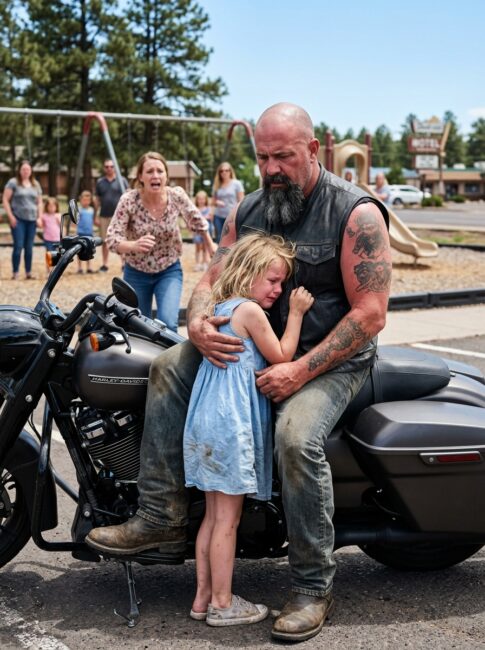
It was a Saturday in July, hot enough to make the playground slide burn little legs.
The park sat just off old Route 66, close enough that you could hear semis downshifting near the light. My snow-cone cart was parked by the basketball court. Kids were everywhere. Plastic buckets. Juice boxes. Little sandals. Parents half-watching from benches, phones glowing in their hands.
Cal came in around 2:17.
I remember because I checked the time after the engine stopped. The sound of his Harley had rolled in low and heavy, then cut off so suddenly the park seemed to hold its breath.
He parked near the curb but didn’t take off his helmet right away.
That was odd.
Usually he swung off, stretched his bad knee, and walked straight toward me for black coffee, even though I only sold snow-cones and bottled water. He always said asking annoyed people kept him young.
But that day he stayed seated.
His head turned slowly toward the far side of the playground.
I followed his gaze.
At first, I saw nothing unusual. Kids climbing. A toddler throwing mulch. A woman in white jeans and sunglasses standing near a bench, talking sharply into her phone. Pretty woman. Early thirties. White American. Blonde hair pulled tight. Gold watch. Expensive purse. The kind of mother people assume is safe because she looks clean.
Then I saw the girl.
She came out from behind the restroom building like a rabbit flushed from brush.
Small. Shaking. One shoe gone. Hair tangled. Torn sleeve.
She looked at the road.
Not the playground.
The road.
That detail still wakes me up.
A five-year-old girl was so afraid of what was behind her that Route 66 looked safer.
A pickup was coming through the lot too fast. Not highway fast, just parking-lot careless. Cal moved before anyone screamed.
His boots hit the pavement hard.
He crossed the lane in three strides, not running exactly, just moving with that terrible calm big men get when panic would be too slow. He stepped between the child and the truck, one hand out toward the driver, the other low toward the girl.
The truck stopped.
The driver yelled something.
Cal never looked at him.
He crouched.
That giant tattooed man folded himself down until his knees cracked. He took off one glove and placed his bare hand on the pavement between them, palm up.
“Hey, little bird,” he said.
I was close enough by then to hear him.
The girl froze.
Her eyes flicked to his beard, his vest, his tattoos, then to the woman near the bench.
The woman had ended her call.
Her face changed.
Not worried.
Angry.
The girl saw that face and made a sound I hope I never hear again.
Cal heard it too.
His jaw tightened.
But his voice stayed low.
“Nobody touches you unless you say,” he told her. “Not even me.”
The girl stared at his open hand.
Then she whispered, “Don’t let her do the sleepy shots.”
The world narrowed down to that sentence.
Cal’s fingers trembled once.
Just once.
Then he said, “Okay.”
Not loud. Not dramatic.
Just okay.
The girl stepped forward and collapsed into him.
Cal lifted her like she weighed nothing, but he did it slow, one arm under her knees, one behind her back, telling her every movement before he made it.
“I’m picking you up now. We’re going to sit by the bike. I am not riding. Engine stays off.”
That mattered.
I didn’t know why yet.
He carried her to the Harley and sat sideways on the seat, putting her between himself and the fuel tank, both feet planted on the ground so everyone could see he wasn’t leaving.
Then the mother started screaming.
“That man has my daughter!”
People reacted the way people react when they only see the surface.
A biker holding a little girl.
A mother screaming.
A playground full of witnesses who thought the story had already been written.
Two fathers moved toward Cal. One had a baseball cap and a red face. The other kept saying, “Put her down, man. Put the kid down.”
Cal did not move.
The girl buried her face into his vest so hard her little fingers twisted in the leather. That was when his cut opened slightly, and I saw the pink patch inside.
Maddie.
Cal’s phone was already in his hand.
“911,” he said when the operator answered. “Pioneer Park. Possible child abuse. Minor female, five years old. Visible bruising, torn clothing, extreme fear response. Adult female claiming custody is escalating. I am seated on my motorcycle. Engine off. I am not leaving.”
The mother came closer.
Her voice turned sweet in a way that made my skin crawl.
“Baby, come to Mommy.”
The child shook so hard Cal’s whole vest moved.
Then the mother looked at Cal and hissed, “You have no idea what kind of trouble you’re in.”
Cal looked up at her.
His eyes were flat and wet but not crying.
“I been in trouble,” he said. “This ain’t it.”
Everyone thought that was the climax.
A scary biker accused in public. A mother demanding her child. A crowd ready to decide with their eyes instead of their brains.
But the real story was still hidden under a torn blue sleeve.
The first officer arrived in four minutes.
Officer Ramirez. Young guy. Hispanic American. Mid-thirties. He came in fast but not careless, one hand near his radio, the other held out to keep the crowd back.
“Sir,” he called to Cal, “I need you to put the child down.”
Cal didn’t argue.
He didn’t puff up.
He didn’t say one word about rights or respect.
He looked down at the girl.
“Little bird,” he said, “police are here. I’m going to stand up slow. You can keep holding my vest if you want.”
She did.
When Cal stood, she clung to him with both fists.
The mother rushed forward.
The girl screamed.
Not a tantrum scream.
A body-memory scream.
Officer Ramirez stopped the mother with one arm.
“Ma’am, step back.”
“That animal took my daughter!”
Cal turned slightly so his own body became a door between them. Not a weapon. A door.
Then the second twist happened.
Ramirez looked at Cal’s face.
Recognition moved across him.
“Cal?”
Cal kept his eyes on the child.
“Not now, Miguel.”
I found out later that Miguel Ramirez had been sixteen when Cal found him sleeping behind a closed auto shop in winter. Miguel’s father had thrown him out. Cal and Jenny fed him for three months, got him back into school, and made him apply for a police explorer program instead of prospecting for the club.
So when everyone else saw a biker, Officer Ramirez saw the first man who had ever stood between him and the street.
Still, he did his job.
He asked questions.
He separated people.
He called child services.
He asked the mother for identification, then asked the child her name.
The girl whispered something into Cal’s vest.
“What was that, sweetheart?” Ramirez asked.
Cal looked down.
“She said her name is Emily,” he said.
The mother snapped, “Her name is Emma. She gets confused.”
The girl shook her head hard.
“No.”
One word.
Small but sharp.
A female paramedic arrived and asked to examine the child. Cal crouched again.
“This lady checks kids,” he said. “You say stop, she stops.”
The paramedic rolled up the torn sleeve.
That was when the crowd changed.
You could feel it.
People stopped whispering.
A woman near the swings covered her mouth.
The marks weren’t dramatic like television. They were worse because they were quiet. Finger-shaped bruises. Old yellowing ones under new purple ones. Tiny bandages near the upper arm. A child too thin for her age.
The mother’s face went pale, then hard.
“She has medical issues,” she said. “You people don’t understand.”
Ramirez asked for the doctor’s name.
She gave one.
Dispatch found no record.
The paramedic asked when the child had last eaten.
Emily held up one little hand.
“Yesterday,” she whispered.
That was the main twist.
The dangerous stranger hadn’t been stealing a child.
He had been refusing to return her to danger.
The mother tried one more time.
“She lies,” she said.
Cal’s head lifted.
The air changed around him. His brothers would later say that was the moment they were glad they weren’t there, because the hardest thing Cal ever did was nothing.
His hands curled once.
Opened.
Curled again.
He looked at Ramirez.
“You got her?” Cal asked.
Ramirez nodded.
“I got her.”
Only then did Cal let go.
Not of the girl.
Of the anger.
He stepped back three feet. Boots scraping pavement. Leather creaking. Breath coming through his nose like an engine trying not to start.
The girl reached for him.
He didn’t reach back until the paramedic nodded.
Then he gave her two fingers to hold.
Just two.
Enough to stay.
Not enough to own.
That was Cal’s way.
The mother was arrested before sunset.
Not loudly. Not like a movie.
No speech. No big takedown.
Just cuffs, a patrol car door, and her sunglasses lying broken in the dust near the bench.
The investigation that followed uncovered enough to make grown people go quiet. Neighbors had suspected things. A preschool teacher had filed concerns. A clinic had questions. But every system had moved at system speed.
Cal moved at human speed.
That was the difference.
For the first two hours, Emily would not let go of his vest.
Child services tried to place a blanket around her shoulders. She pulled away until Cal took the blanket first, rubbed it between his rough hands, and said, “Smells like laundry. Not bad.”
Then she accepted it.
A woman from CPS asked Cal how he knew.
He didn’t answer right away.
He stared at the blue dress sleeve, torn at the seam.
“My little sister used to tear the same side,” he said.
Nobody spoke.
“She’d pull away when our stepfather grabbed her. Always the left sleeve. Fabric remembers.”
That was seed one coming back.
The sleeve.
The road.
The way the girl looked behind her before she ran.
Cal hadn’t seen a random scared kid.
He had seen a pattern.
The pink patch inside his vest came back next.
A week later, after Emily had been placed in emergency foster care, Jenny told me the story because Cal wouldn’t.
Maddie had been their daughter.
She lived nine days.
Born too early after a crash caused by a drunk driver outside Winslow. Cal had been riding behind Jenny’s car that night. He heard the metal before he saw the wreck. He carried Jenny out. He couldn’t carry the baby long enough.
For years after, Cal kept Maddie’s hospital bracelet braided into a strip of leather inside his vest, behind that pink patch.
The tiny yellow sock I had seen him holding outside the thrift shop had been hers.
That was seed two.
He wasn’t a man with no children.
He was a father with empty hands.
The third twist was something nobody expected.
Cal had been a paramedic once.
Before the club. Before the beard went gray. Before the prison-blue tattoos. He spent fourteen years pulling people out of wrecks on I-40 and Route 66. Then came the night of Jenny’s crash. He couldn’t ride in an ambulance after that. The sirens made him shake. The smell of antiseptic made him sick.
So he quit.
He joined the Iron Saints because bikes made noise loud enough to drown out the sounds he couldn’t survive.
But training doesn’t leave the body.
When Emily came through that playground, Cal read her the way he used to read crash scenes.
One shoe missing: flight.
Torn left sleeve: grabbed.
Flat crying: exhaustion.
Fear of the woman: not confusion, recognition.
Needle marks: not a public conversation, but an emergency.
That was why he did not ride away.
People later asked why he didn’t put her on the Harley and take her somewhere safe.
Cal would get angry at that question.
“You don’t rescue a scared kid by making yourself another abductor,” he said. “You plant your feet. You call the law. You become a landmark.”
That line stayed with me.
Become a landmark.
For Emily, that black Harley became the first safe place that didn’t move.
A court process followed. Family hearings. Medical evaluations. Interviews. Paperwork. Temporary placements. The kind of slow grinding machine that makes everyone feel helpless.
Cal and Jenny visited when allowed.
Not with presents at first.
With routine.
Every Tuesday, Jenny brought a peanut butter sandwich cut into four squares because Emily didn’t like triangles. Every Thursday, Cal brought a small toy motorcycle he carved from scrap pine at his workbench. He never asked for hugs. He sat on the floor near the door, back against the wall, where she could see him and leave if she wanted.
For three months, she didn’t speak above a whisper.
Then one afternoon she looked at his vest and pointed.
“What’s Maddie?”
Cal went still.
Jenny’s hand went to her mouth.
Cal opened the inside of his cut and showed her the patch.
“My daughter,” he said.
“Where is she?”
Cal swallowed.
“Gone.”
Emily touched the pink stitching.
“Did you keep her safe?”
His face broke, but only around the eyes.
“Not long enough.”
Emily considered that.
Then she climbed into his lap, put both hands on his beard, and said, “You kept me.”
That was the reverse role.
Everyone thought Cal was saving Emily.
Maybe he was.
But that little girl reached into the one room of his heart he had locked for years and turned the light on.
The adoption took two years.
Two years of hearings.
Two years of background checks.
Two years of people looking at Cal’s tattoos before they looked at his record of showing up.
Some questioned the club.
Some questioned his past.
Some questioned whether a man who looked like him could give a child a gentle home.
Jenny answered with folders. Medical reports. School notes. Therapist letters. Photos of Emily asleep on their couch with a dog named Biscuit curled at her feet.
Cal answered by showing up in a clean shirt, covering most of his tattoos, and saying as little as possible.
One judge asked him why he wanted to adopt this child.
Cal looked at Emily sitting beside Jenny, her small hand wrapped around a stuffed rabbit.
“I don’t want to own her,” he said. “I want her to know where home is.”
That was all.
The judge looked at him for a long time.
Then she signed the order.
Emily chose her own new name.
Hope.
Not because anybody told her it was pretty.
Because during therapy, when asked what she wanted to feel when someone called her, she said, “Like tomorrow is allowed.”
So Emily became Hope Mercer.
Every July, on the Saturday closest to that day in Pioneer Park, Cal rides the same route.
He starts at the gas station off Route 66. He passes the old playground. He parks the Harley in the same spot. Engine off.
No ceremony.
No speeches.
Sometimes Hope goes with him. Sometimes she doesn’t.
When she was seven, she sat on the Harley seat between Cal and the tank, just like that first day, and said, “I’m not scared of the bike anymore.”
Cal nodded.
“Good.”
“But I still like when it’s off.”
He smiled then.
A small one.
“Me too, little bird.”
That nickname stayed.
Little bird.
At home, the Harley sits in the garage under a gray cover. Hope’s bicycle leans beside it. Pink streamers on the handlebars. A sticker on the frame that says “NO CHILD RIDES ALONE,” because the Iron Saints had one made in her size.
The club changed too.
They started a fund quietly, no press, no big social media push. Gas cards for foster families. Backpacks for kids removed from homes with nothing but a trash bag. Emergency motel rooms for mothers running from men with loud voices.
Cal refused to put his name on it.
Jenny named it anyway.
The Maddie Fund.
Every Christmas, bikers who look like trouble walk into county offices carrying stuffed animals, blankets, socks, and grocery cards. Receptionists still tense up the first time. Then they learn.
Leather can hold a lot of things.
Knives. Keys. Road dust.
And sometimes grief that finally found somewhere useful to go.
I saw Hope last month.
She’s seven now. Almost eight. Taller. Stronger. Hair in two messy braids. Missing a front tooth. She came to my snow-cone cart with Cal walking three steps behind her, close enough to guard, far enough to let her lead.
She ordered cherry.
Then she turned to Cal and said, “You want coffee?”
I laughed because I still don’t sell coffee.
Cal looked at me with that same scarred face, that same black vest, that same old thunder parked by the curb.
“Worth asking,” he said.
Hope paid with two crumpled dollars from her own pocket. Cal stood behind her, hands loose, eyes scanning the park without making a show of it. That is what guardians do. They don’t stop watching just because the danger is gone.
A little boy nearby pointed at him and whispered to his mother, “That man is scary.”
Hope heard him.
She turned around, red snow-cone staining her lips, and looked at the boy like he had missed the whole world.
“He’s not scary,” she said. “He’s my dad.”
Cal looked away fast.
The Harley’s chrome caught the late sun. Somewhere down Route 66, a semi hit its brakes and sighed. Cal’s vest creaked when Hope slipped her small hand into his giant one.
They crossed the parking lot slowly.
No rush.
No roar.
Just boots, little sneakers, and the soft click of a Harley key turning.
The engine stayed off.
For Hope.
Follow the page for more true-feeling biker stories about the people behind the leather, the scars, and the road.