Part 2: Twenty Bikers Came to Preschool — For One Little Girl’s Tea Party
Her father’s name was Daniel Reeves.
To Emma, he was Daddy.
To the Road Saints Motorcycle Club, he was Rookie, even though he had stopped being one a year before he died. Bikers have strange rules about names. Sometimes they give you one as a joke and it sticks harder than your real one. Daniel had earned “Rookie” because on his first club ride, he put his rain gear on backward at a gas station outside Grants, New Mexico, and nobody let him forget it.
He was thirty-two, Black American, tall and lean, with kind eyes and a laugh that came before the punchline. He rode a black Harley-Davidson Street Glide, worked construction during the week, and brought Emma to preschool every morning with her backpack in one hand and her lunchbox in the other.
He never looked like the other fathers.
Not in a bad way.
Other dads came in polos, work shirts, scrubs, uniforms. Daniel came in a leather cut over a hoodie, boots dusty from job sites, helmet tucked under his arm, one hand always holding Emma’s. He would kneel at her cubby every morning, check her lunch, kiss her forehead, and say, “You be royal today.”
Emma would answer, “Yes, Daddy.”
That was their thing.
Royal.
Her mother, Alana, had died when Emma was two. A sudden aneurysm. One phone call. One hospital hallway. One little girl too young to understand why every adult started whispering. Daniel became a single father overnight. He learned ponytails, bedtime stories, fever medicine, princess voices, and how to cut sandwiches into triangles because Emma said squares tasted sad.
The club helped, but not in a picture-perfect way.
At first, they were awkward. Twenty men who could ride through hail without flinching did not know what to do with a toddler asking them to be dragons. The club president, Virgil Knox, once held Emma at a barbecue like she was an unexploded device. Otis, the treasurer, tried to give her beef jerky when she asked for a snack. Diesel, a huge white biker with a shaved head and hands like fence posts, bought her a toy truck because he panicked in the doll aisle.
Daniel laughed at all of them.
“She’s not glass,” he told them. “She’s a boss.”
Slowly, they learned.
Emma started showing up at the clubhouse on Sundays after church. The Road Saints clubhouse was nothing fancy. A converted auto shop near I-40, with oil stains on the floor, mismatched chairs, a coffee pot that had seen better years, and a soda machine that only worked when kicked on the left side.
Daniel would bring crayons and a little plastic tea set.
At first, the brothers pretended not to notice.
Then one day Emma walked up to Virgil, the president, and handed him a tiny cup.
“Tea?”
Virgil looked at Daniel.
Daniel shrugged. “President’s call.”
Virgil was sixty-three, white, a Vietnam vet’s son, barrel-chested, tattooed from wrist to shoulder, with a voice that could stop arguments across a parking lot. He looked down at the cup like it had challenged his authority.
Then he took it with two fingers.
“Much obliged, ma’am.”
Emma nodded like that was the correct answer.
From then on, every Sunday, she served tea at the clubhouse.
Imaginary tea.
Plastic cups.
No one laughed at her.
That was the first rule Daniel made clear without saying it. Anyone could joke about anything at the clubhouse except Emma’s tea party. You held the cup. You said thank you. You drank air like it mattered.
Because to her, it did.
Then Daniel died on a wet Tuesday morning on Highway 491 when a pickup hydroplaned across the lane. No chase. No stunt. No dramatic road legend. Just rain, bad timing, and a little girl waiting at preschool with a paper crown in her cubby.
The club went quiet after that.
The kind of quiet that does not heal.
It just sits.
The first week after Daniel’s funeral, Emma did not speak much.
Children grieve in strange little pieces. Adults expect big crying. Sometimes children just stop asking for certain snacks. Sometimes they carry the same toy all day. Sometimes they look toward a door every time it opens and then go back to coloring like their heart did not just fall six inches.
Emma kept looking toward the classroom door at 3:00 p.m.
That was Daniel’s pickup time.
Every day, 3:00 came.
Every day, he did not.
Her grandmother picked her up instead. Mrs. Reeves was a small Black woman in her late sixties with church gloves in her purse and grief folded into every movement. She thanked us too much. People in pain do that. They keep manners polished because everything else feels broken.
The preschool tried to help. We made cards. We gave Emma space. We let her keep Daniel’s old bandana in her cubby. It was black with white skulls on it, washed soft, smelling faintly of leather and his cologne. She pressed it to her cheek during nap time.
Two weeks after the funeral, we had our classroom “Royal Tea Afternoon.”
It had been on the calendar for a month. Parents and grandparents were invited. Children had made paper crowns and decorated cardboard cookies with glitter. We had plastic teacups, tiny plates, napkins with flowers, and a big sign that said WELCOME ROYAL GUESTS.
Emma had been excited about it before the accident.
Daniel had promised he would come.
He told me so himself the Friday before he died. He stood at the classroom door in his leather vest, holding Emma’s backpack, and said, “Miss Claire, I need to know what the dress code is for this royal tea situation.”
I told him, “Something fancy.”
He looked down at his boots. “These are my fancy boots.”
Emma said, “Daddy, you have to wear your crown.”
Daniel gave me a look. “Apparently I’m wearing a crown.”
That was the last conversation I had with him.
On tea party day, Emma came in wearing a purple dress and light-up sneakers. Her grandmother had brushed her pigtails smooth and tied white ribbons around them. She carried a small paper crown in both hands.
“Is Daddy coming?” she asked me.
It was a question she already knew the answer to. Those are the hardest.
I knelt in front of her. “Daddy can’t come, sweetheart.”
She looked down at the crown.
“I know.”
Her voice was flat.
I thought that was the worst of it.
It wasn’t.
At 1:45, parents began arriving. Mothers with cameras. Fathers in work shirts. Grandmas in floral blouses. One grandfather in a cowboy hat. Chairs scraped. Children squealed. Plastic cups clattered. The classroom filled with a kind of happy noise that made Emma smaller.
She sat at her table alone.
Her place card said Princess Emma.
Across from her was an empty chair.
She set Daniel’s paper crown on it.
Then she whispered, not to me, not to anyone exactly, “Nobody comes to my tea anymore.”
I felt something break in my chest.
I walked to the hallway and called her grandmother. No answer. I called the emergency contact list. Her aunt was at work in Albuquerque. Her grandmother was at a doctor’s appointment and thought the school tea had been canceled because Emma had stopped talking about it.
I stood in the office holding the phone, watching Emma through the small window.
That was when our receptionist said, “There are motorcycles outside.”
I looked toward the front doors.
The sound came next.
Low.
Many engines.
A whole road full of grief arriving together.
I thought the bikers were there for Daniel.
That would have made sense. Maybe they had planned a memorial ride. Maybe they were stopping by the school because this was the last place he had been happy before the accident. Maybe they wanted to bring flowers or a card.
I was wrong.
They were there for Emma.
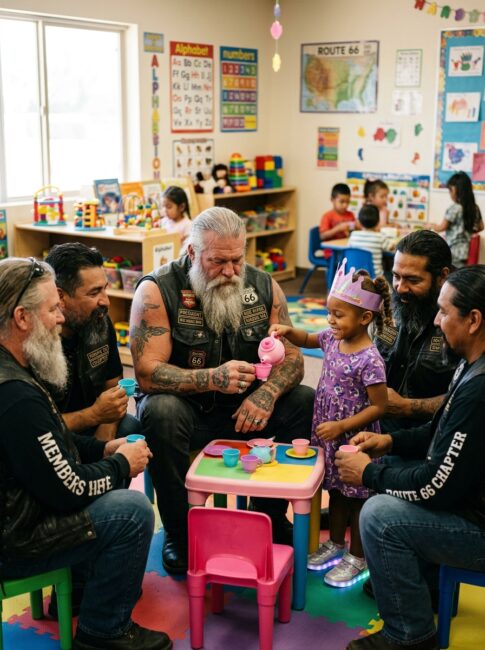
Virgil Knox came through the front door first, moving slowly, sunglasses in one hand, helmet in the other. Behind him came nineteen riders, American men of different ages and backgrounds, white, Black, Latino, Native, some in their thirties, some in their sixties, every one of them wearing a leather cut and the awkward expression of a man entering a preschool classroom with no idea where to put his hands.
Our receptionist stood up so fast her chair rolled backward.
Virgil stopped at the desk.
“Ma’am,” he said, voice low and careful, “we’re here for the tea party.”
She stared.
He lifted the tiny pink cup.
“Got an invitation.”
That was when he showed me the paper.
It was folded in his vest pocket, creased and smudged. A child’s drawing. Purple crayon. A round table. Stick figures with beards. Emma had made it weeks earlier at the clubhouse and given it to Daniel.
Daniel had kept it in his saddlebag.
After the accident, the club packed up his bike and found the drawing inside a plastic bag, protected from rain. Across the top, in crooked letters, Emma had written:
DADDY AND UNCLES TEA.
Virgil had brought the invitation.
That was twist one.
Daniel had not forgotten.
He had been carrying the tea party with him.
I led them to the classroom.
The parents went silent when twenty bikers filled the doorway. I saw fear first. I saw judgment. I saw one father stand halfway from his chair like he might need to protect someone from men who had done nothing but arrive.
Then Emma saw them.
She stood so fast her paper crown slipped over one eye.
“Uncle Virgil?”
Virgil removed his sunglasses completely.
His face changed.
Not much. Men like him do not rearrange easily in public. But his eyes softened in a way that made him look suddenly old.
“Princess,” he said.
Emma looked past him at the others.
“All of you came?”
Diesel, the huge biker who once bought her the wrong toy, held up a tiny blue teacup.
“Wouldn’t miss it.”
Emma looked at Daniel’s empty chair.
Then at the bikers.
Then at the crown.
For one terrifying second, I thought she was going to cry.
Instead, she pointed at the child-sized table.
“Tea is over there.”
And twenty bikers obeyed a four-year-old.
That was twist two.
The men everyone feared did not take over the room.
They followed her rules.
They folded themselves into tiny chairs with knees up near their chests. Leather creaked. Boots stuck out in every direction. One chair made a warning sound under Otis, and he froze like the chair had a gun on him. Diesel sat cross-legged on the floor because no chair had earned that kind of punishment.
Emma moved from man to man with her plastic teapot.
“Tea?”
“Yes, ma’am.”
“Sugar?”
“Two, please.”
“It’s pretend.”
Virgil accepted his cup with both hands.
“Still the best tea in town.”
Every biker said thank you.
Not joking.
Not mocking.
Like they had been invited to a palace and she was the queen.
The parents watched with their mouths slightly open.
So did I.
The classroom changed because of how seriously they took her.
That is the only way I know how to say it.
At first, people stared at the leather. The tattoos. The beards. The chains. The skull patches. The boots too big for a room full of nap mats. They saw the outside first. Everyone does. But then the men started sipping pretend tea from plastic cups the size of shot glasses, pinkies accidentally sticking out because their fingers were too large for the handles, and something shifted.
Fear became confusion.
Confusion became silence.
Silence became something softer.
Emma served Diesel first because he was on the floor and easiest to reach.
He took the cup from her with two tattooed hands.
“Thank you, Princess Emma.”
She nodded. “It’s blueberry.”
Diesel looked into the empty cup. “Smells like it.”
There was no smell. No tea. Nothing but air.
He drank anyway.
A little boy at the next table giggled.
Diesel looked at him seriously. “You laugh because you ain’t got none.”
The boy immediately held out his cup.
Emma poured him imaginary tea too.
Soon, the whole room was playing along.
The fancy parents. The grandmothers. The father who had stood up protectively. Me. The receptionist. Everyone held plastic cups and drank nothing as if thirst had never been more important.
Virgil sat across from Emma in Daniel’s empty chair.
That was not an accident.
I noticed because Emma noticed.
She looked at the chair, then at him.
“That’s Daddy’s seat.”
The room tightened.
Virgil’s big hands closed around the tiny cup. His knuckles were tattooed. One said ROAD. The other said HOME. His eyes were wet, but no tear fell.
“Want me to move?”
Emma thought about it.
Then she shook her head.
“You can keep it warm.”
Virgil lowered his head.
“Yes, ma’am.”
That was twist three.
She was not replacing her father.
She was protecting his chair.
Later, I learned what had happened before the bikers arrived.
The club had gathered at their clubhouse that morning, planning a memorial ride for Daniel. Twenty Harleys lined up outside. They were going to ride from Gallup to Grants, stop at the gas station where Daniel once wore his rain gear backward, then end at the cemetery.
Before they left, Virgil opened Daniel’s saddlebag one last time.
He found the tea party invitation.
He read it once.
Then again.
Nobody spoke.
Otis said, “Ride can wait.”
Diesel said, “We got cups?”
They did not.
So twenty bikers rode to a dollar store on Route 66 and bought every plastic tea set on the shelf. The cashier thought it was a joke until Virgil asked, dead serious, which set looked most royal. They chose pink, purple, and gold. They bought napkins with butterflies. One brother bought a tiara and refused to say why.
Then they rode to Little Acorn Preschool.
Not to make a scene.
Not to go viral.
To keep a promise Daniel did not live long enough to keep.
That was the part that undid me.
Because brotherhood is easy to say when the road is clear and everybody is alive. Ride or die sounds strong on a patch. It sounds good across a bar table. It sounds good shouted over engines.
But what does brotherhood do after someone actually dies?
That day, it put on leather, bought plastic cups, and showed up at preschool.
Emma did not know all of that. Not yet.
She only knew the empty chair was not empty anymore.
Near the end of the tea party, she placed Daniel’s paper crown on Virgil’s head.
It was too small. It sat crooked on his silver hair.
Nobody laughed.
Virgil looked like a man being given a medal he did not deserve and would guard anyway.
Emma patted his arm.
“Daddy would like that.”
Virgil’s jaw worked once.
“Yes,” he said. “He would.”
Then he reached into his vest pocket.
The room went still again.
He pulled out a small black patch.
Not big. Not one of the club’s official back patches. Just a little rectangle with white stitching around the edge.
On it were three words:
PRINCESS EMMA’S CREW.
He placed it on the tiny table beside her plastic teapot.
“This ain’t to replace your daddy,” he said. “Nobody can.”
Emma looked at the patch.
Virgil’s voice got rougher.
“But today, you didn’t lose your tea party. You gained twenty uncles.”
Emma touched the patch with one finger.
“Can girls have patches?”
Virgil looked around at every biker in the room.
Every one of them nodded.
He turned back to Emma.
“Best ones do.”
After that day, the tea party did not end.
Not really.
Every first Sunday of the month, the Road Saints held tea at the clubhouse.
They still did cookouts. Still fixed bikes. Still argued about routes and weather and whose turn it was to clean the coffee pot. The place still smelled like oil, leather, old wood, and burnt coffee. But on first Sundays, a small table appeared near the back wall with a purple cloth over it.
Emma’s table.
The plastic tea set stayed in a locked cabinet beside the club records. Virgil kept the key. Nobody teased him about that. Nobody dared.
At 3:00 p.m., Emma arrived with her grandmother. Sometimes she wore a dress. Sometimes jeans. Sometimes a princess crown. Sometimes Daniel’s old bandana tied around her wrist. The bikers would already be waiting, cleaned up as much as men like that ever got cleaned up, boots under the table, hands washed, voices lower.
She served tea.
They said thank you.
Every time.
If a new prospect joined the club, he had to attend tea before his first ride. That became an unofficial rule. A man could talk tough all he wanted, but if he could not accept pretend tea from a grieving little girl with respect, the Road Saints had no use for him.
Once, a prospect smirked.
Not even laughed. Just smirked.
Virgil saw it.
The whole room felt colder.
The prospect was gone by dinner.
Brotherhood had standards.
Every year on Daniel’s birthday, the club rode to the cemetery first. Not loud. Not rowdy. Just twenty bikes moving as one down the road, engines low, headlights on. They parked in a clean line near the grass. Emma would place a plastic teacup on Daniel’s headstone, filled with nothing, because that was how he liked it.
Then she would sit beside the stone and tell him who came to tea.
Virgil always stood a few feet back.
Never too close.
Never too far.
One afternoon, when Emma was five, she asked him, “Are you sad too?”
Virgil took a long time to answer.
The wind moved across the cemetery. A semi groaned somewhere on the highway. Leather creaked when he shifted his weight.
“Every day,” he said.
Emma nodded like that made sense.
“Me too.”
He held out his hand.
She took one finger because his whole hand was too big.
They stood like that until her grandmother said it was time to go.
By the time Emma turned six, she had learned every biker’s tea preference.
Otis liked blueberry.
Diesel liked “whatever doesn’t make the cup break.”
Caleb wanted extra sugar.
Virgil always said, “Surprise me.”
And every time, she poured him nothing with great ceremony.
The patch stayed with her.
Her grandmother sewed PRINCESS EMMA’S CREW onto a little denim vest. Not leather. Not yet. Denim, with a purple lining and a small embroidered teacup on the inside. Emma wore it to the clubhouse, to the cemetery, and once to preschool picture day.
The photographer asked her to smile.
She said, “I have twenty uncles.”
The photographer said, “Lucky girl.”
Emma answered, “They drink tea.”
I still teach at Little Acorn.
The classroom has been painted since then. The carpet is new. The snack table is different. The children who watched that first tea party have moved on to bigger schools, bigger backpacks, bigger problems.
But I kept one picture.
It is in my desk drawer, behind emergency stickers and bandages.
Twenty bikers squeezed around preschool tables. Boots sticking out. Leather shoulders hunched small. Plastic cups in tattooed hands. A paper crown on Virgil Knox’s silver head. Emma standing in the middle with her teapot, serious as a queen.
People who see that picture always ask the same thing.
“Were you scared when they showed up?”
I tell them the truth.
Yes.
For about thirty seconds.
Then I watched the biggest men in the room let a little girl pour them imaginary tea, and I understood something no lecture could have taught me.
Not a lesson.
A picture.
A plastic cup in a scarred hand.
Years later, I still hear them sometimes. Not every day. But on first Sundays, when the wind is right and the traffic thins along Route 66, the Harley engines roll past the preschool on their way to the clubhouse.
Twenty bikes.
Sometimes more.
They do not honk. They do not stop. They just ride by slow, engines low and steady, like thunder trying to be gentle.
And somewhere down the road, a little girl sets the table.
Follow the page for more biker stories that change the way you see people.