Part 2: The Biker Braided Crooked Ponytails — Until His Daughter Told the Truth
I deleted the video before the bell rang.
I wish I could say it was because I was immediately a better person. It wasn’t that clean. Shame takes a few seconds to get through your skin.
One moment I was holding my phone at chest level, smiling like I had found something funny enough for a mom group chat. The next moment Lily said what she said, and Wade Mercer’s rough hand froze halfway through tying a ribbon.
The whole drop-off line changed.
Engines idled. A crossing guard lowered her stop sign. A little boy stopped dragging his lunchbox wheels over the concrete. Even the wind seemed to pull back from the flagpole.
Wade didn’t look at any of us.
That was the part that hurt.
He didn’t defend himself. Didn’t explain. Didn’t glare at the parents who had been whispering. He just looked down at Lily’s hair, then at the crooked ribbon, then at the little pink comb in his palm.
“Sorry, bug,” he said.
His voice was low, gravelly, almost swallowed by his beard.
Lily touched the messy ponytail and shrugged. “It’s okay, Daddy. You’re getting better.”
He nodded once like she had handed him orders.
“Yes, ma’am.”
Then he kissed the top of her head, stood up with a soft creak of leather, and watched her walk inside.
I later learned Wade had been riding since he was nineteen, back when he was more anger than man. He had run with hard crowds, slept behind repair shops, fought more than he should have, and spent one year in county jail for a bar fight that nearly ruined the rest of his life. He didn’t brag about it. Men like Wade don’t need to polish their scars. Some scars already shine too much.
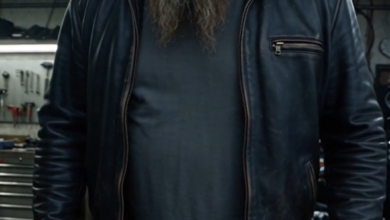
The bike came later as a way to stay moving without disappearing completely. His brothers at the club called him “Grinder” because he could fix anything metal and because he had a way of grinding through pain without making noise. He worked out of a small garage near Route 66, fixing Harleys, old pickups, ranch equipment, anything with bolts and bad timing.
His wife, Marcy, used to bring Lily to the garage after preschool. She was the opposite of Wade in every visible way. Small. Bright. Laughing before the joke ended. Half Mexican, half Irish, with black curls and a habit of calling every big biker “sweetheart” until they blushed or left the room.
She was the one who tied Lily’s hair every morning.
French braids. Side braids. Two perfect pigtails with bows. Little buns for picture day. Marcy could turn a six-year-old’s morning hair into something that looked like care itself had hands.
Wade used to watch from the kitchen table, drinking coffee from a mug with a cracked handle, pretending he wasn’t watching.
“Pay attention,” Marcy would tell him.
“To hair?” he’d grunt.
“To your daughter.”
He would hold up both hands. Thick fingers. Scarred knuckles. Grease under the nails no matter how much he scrubbed.
“These hands ain’t built for ribbons.”
Marcy would smile. “Then teach them.”
He never thought he would have to.
Cancer gave them nine months from diagnosis to funeral. Nine months of hospital rooms, insurance calls, casseroles from neighbors, club brothers standing in the driveway because they didn’t know what else to do. Wade sold two bikes, one lift, and half his tools to pay bills Marcy never got to see paid off.
At the funeral, Lily wore two perfect braids.
Wade didn’t do them.
Marcy had taught her sister the night before she died.
But after the funeral, school still happened. Monday still came. Lunch still had to be packed. Socks still had to match close enough. Hair still had to be brushed.
So Wade put the pink comb in his vest.
And he started learning.
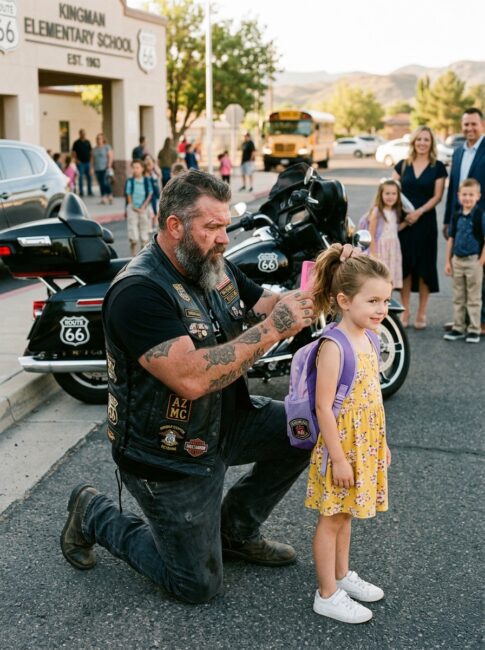
For two weeks after Lily’s sentence at the school gate, nobody knew what to do with Wade Mercer.
That sounds stupid, but it is true. People can handle a stereotype. They can handle a villain. They can handle a joke. What makes them uncomfortable is finding out the joke had a grave behind it.
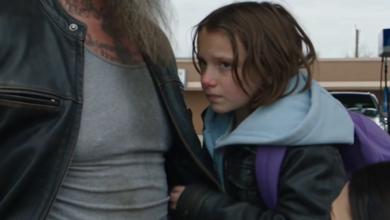
Every morning, he still came rumbling into the parking lot at 7:38. The Harley would cough once, settle, then die into silence. Wade would swing one leg over, stand with that stiff biker posture, and help Lily off the back. She wore a pink helmet with scratched unicorn stickers and a purple backpack nearly as wide as her shoulders.
He would kneel near the low brick wall by the front gate and take out the comb.
The parents got quiet when he did.
That somehow made it worse.
Before, they whispered because they judged him. After, they whispered because they pitied him. Wade seemed to feel both the same way. He kept his head down. He worked on Lily’s hair like he was defusing something delicate.
The ponytails improved a little.
Then got worse.
One Wednesday, the rubber band snapped and shot across the sidewalk. Wade stared at his empty fingers like the hair tie had betrayed him personally. Lily giggled. He didn’t. He dug in his vest pocket and pulled out three more.
Another morning, the ribbon fell into the parking lot and got blown under an SUV. Wade dropped to one knee and reached beneath the vehicle, his leather cut scraping the concrete, while a man in a pressed blue shirt watched like Wade might steal the tire.
I hated that man for watching.
Then I hated myself because two weeks earlier, I had been watching the same way.
The false climax came on picture day.
Every parent knows picture day has a strange power over people. Mothers who normally don’t care suddenly care. Fathers who can barely remember the teacher’s name somehow remember envelopes and packages. Children arrive with gelled hair, ironed collars, dresses that itch, and warnings not to spill milk before the camera.
Lily arrived in a yellow dress.
It had little white flowers on it and a sash tied in the back. Her shoes were shiny. Her socks had lace. She looked like sunshine trying not to cry.
Her hair was the problem.
Wade had attempted a braid.
Attempted is a generous word.
It started as a braid near the top, became something like a rope in the middle, and gave up completely near the bottom. One side of Lily’s hair puffed out. The other side was pulled too tight. The pink ribbon hung at an angle that made it look injured.
Wade knew.
You could see it in his face.
His jaw was locked. His eyes were wet but not crying. Bikers don’t cry easy in public. Not because they don’t feel. Because somewhere along the line, they learn feelings are safer when kept behind teeth.
Lily touched the braid and whispered, “Is it okay?”
Wade cleared his throat.
“You look beautiful.”
That part was true.
But a girl from another class walked by and said, “Your hair looks weird.”
Lily’s face changed.
Not much. Just enough.
Wade heard it.
So did I.
His hands closed once at his sides. Big hands. Tattooed hands. Hands that could tear apart rusted machinery and probably had. Every parent around him got tense, waiting for the scary biker to become the thing they had expected him to be.
He didn’t.
He bent down slowly and looked Lily in the eye.
“Bug,” he said, voice rough. “You want me to try again?”
She swallowed. “Mommy did it better.”
There it was.
The sentence no rubber band could hold.
Wade’s face went still.
He nodded.
“Yeah,” he said. “She did.”
He took the ribbon out. Tried to loosen the braid. His fingers shook. Not a lot. Enough that I saw it. Enough that Lily saw it too.
The bell rang.
Children started moving inside.
Wade was still kneeling on the concrete with his daughter’s hair half undone and a pink comb trapped between his fingers like a little piece of evidence.
That was when I stepped forward.
And four other mothers stepped with me.
I thought I was going to rescue him.
That was my mistake.
I knelt beside Lily and said, “Would you let me fix it?”
Wade looked at me like he wasn’t sure if help was a trap.
I deserved that.
“I’m sorry,” I said.
He didn’t ask for what.
That made it worse.
One of the other mothers, Dana, held out a brush. Another, Rebecca, had a little bag of hair ties from her own daughter’s backpack. Mrs. Alvarez, who had three girls and the calmest hands I had ever seen, stepped in front of Lily and smiled.
“Your daddy is learning,” she said.
Lily nodded proudly. “Every day.”
Wade looked away fast.
We fixed the braid in under three minutes. It wasn’t Marcy-level beautiful, though none of us knew Marcy’s name yet. But it was neat. Soft. Picture-day safe. We tied the pink ribbon straight and turned Lily toward her father.
“What do you think?” I asked.
Wade stared.
For a second, I thought he might say thank you.
Instead he reached inside his vest and pulled out a folded piece of paper.
It was worn soft at the creases. Opened and closed too many times. He didn’t hand it to us. He just looked at it, then at Lily’s hair.
Mrs. Alvarez saw the writing first.
“Is that a diagram?” she asked gently.
Wade looked embarrassed, which was strange on a man his size.
“My wife drew it,” he said.
Four words.
That was all.
He turned the paper so we could see. On it were little hand-drawn steps. A child’s head from behind. Three sections of hair. Cross left over middle. Cross right over middle. Hold tight, but not too tight. At the bottom, in looping handwriting, it said: You’re going to swear. Don’t do it in front of Lily.
Nobody laughed.
Not because it wasn’t funny.
Because it was too alive.
Wade folded the paper again with care I had only seen people give old photographs and flags from coffins.
That was the twist.
The man wasn’t just trying.
He was following instructions from a dead woman who knew exactly how he would fail, and loved him enough to teach him anyway.
The second twist came the following Monday.
We expected Wade to accept help at the gate again. Maybe let one of us fix Lily’s hair each morning. That would have been easy. Clean. Comfortable for everyone except him.
But Wade arrived ten minutes early.
The Harley shut off before most parents got there. He stood beside it holding a cardboard coffee tray from the Route 66 diner and a paper bag of donuts.
When the five of us walked up, he nodded.
“Need lessons,” he said.
Dana blinked. “Hair lessons?”
Wade held out the coffee.
“Yes, ma’am.”
Mrs. Alvarez smiled first.
Then Rebecca.
Then me.
We met by the brick wall every Monday, Wednesday, and Friday for fifteen minutes before school. Five mothers, one six-year-old, and one enormous biker kneeling on the sidewalk with a pink comb while the morning traffic moved around us.
The other parents stared.
Let them.
Teaching Wade Mercer to braid hair was like teaching a bear to thread a needle.
He had patience for engines. That was different. Engines had logic. If a part didn’t fit, the part was wrong, the angle was wrong, or the man holding the wrench was wrong. Hair had moods. Hair slipped. Hair frizzed. Hair tangled around fingers and punished the overconfident.
Wade was not overconfident.
That helped.
The first lesson, Mrs. Alvarez made him practice on yarn tied to the fence.
He looked at the yarn, then at us.
“This a test?”
“Yes,” she said.
He nodded. “Fair.”
The second lesson, he learned not to pull too hard.
Lily said, “Ow.”
Wade dropped the braid like it was burning.
“Sorry, bug.”
“It’s okay,” she said. “Mommy pulled sometimes too.”
That sentence loosened something in him. I saw it happen. Until then, Wade had been treating Marcy like a perfect ghost, the kind no living person can touch. Lily made her real again. A mother who pulled too hard sometimes. A woman who laughed. A woman who drew braid diagrams and warned her husband not to swear.
The pink comb mattered too.
It wasn’t just some cute thing he bought after Marcy died. It had been Marcy’s. She kept it in the glove box of their old pickup, the one they used before the Harley got a child seat and Lily got brave enough to ride around the block. When Marcy got too sick to do Lily’s hair, she gave the comb to Wade.
“Put it in your vest,” she told him.
He said, “Why?”
“Because you never lose that vest.”
She was right.
He had lost bills, keys, phone chargers, one wedding ring for six hours, and half a dozen pairs of sunglasses. But he never lost the cut. The vest hung on the same chair every night. It smelled like leather, oil, highway heat, and him.
After picture day, that pink comb became something else. It was no longer proof that he didn’t know what he was doing. It was proof that he was still showing up.
His club brothers found out about the lessons in the way men find out things they pretend not to care about.
One Friday, three Harleys rolled into the school lot behind Wade. Their engines didn’t roar. They idled low, respectful, almost embarrassed. Three big men parked near the fence and stayed on their bikes until Wade glared at them.
“What?”
Otis, an older Black American biker with a white beard and a mechanic’s hands, lifted a plastic bag.
“Brought supplies.”
Inside were hair ties, clips, ribbons, and a small spray bottle.
Wade stared at the bag.
Diego, a Latino biker in his late forties with tattooed hands and a gold cross, said, “My granddaughter likes the detangler spray.”
The third brother, Hank, a white retired Marine with a shaved head, looked straight ahead and muttered, “My old lady said you’re using the wrong bands.”
Wade took the bag.
His mouth tightened.
For one second, I thought he was angry.
Then I realized he was trying not to break.
Brotherhood had arrived at an elementary school gate carrying ponytail holders.
Nobody joked.
That was the rule.
Over the next month, Wade got better. Not fast. Not magically. This wasn’t a movie montage where grief becomes skill in three sunny mornings. He practiced. He messed up. He started over. He learned to wet the hair slightly. Learned to divide it with the tail of a comb. Learned that Lily hated tight braids behind her ears. Learned that ribbons needed to be tied twice if recess was involved.
The parents changed too.
The same fathers who had avoided him started nodding. One asked about a strange sound in his truck. Wade listened for ten seconds and said, “Belt.” He was right. One mother who had once pulled her child closer asked if he could recommend a fair mechanic. Wade gave her Hank’s number, not his own, because he didn’t want anybody thinking kindness was a sales pitch.
And me?
I told him about the video.
We were standing by the fence after Lily had gone inside. The pink comb was still in his hand.
“I recorded you that first morning,” I said.
He looked at me.
I forced myself not to look away. “I deleted it. But I did record. I thought it was funny.”
For a long moment, all I heard was a school bus breathing diesel behind us.
Then Wade put the comb back inside his vest.
“People laugh when they don’t know where to put what they’re seeing,” he said.
That was not forgiveness.
Not exactly.
It was something harder.
It was mercy without pretending the wound hadn’t happened.
“I’m sorry,” I said.
He nodded once.
“Teach me the fishtail thing next week?”
I laughed because he allowed me to.
“Yes,” I said. “But you’re going to hate it.”
He looked toward the classroom doors.
“For her,” he said. “I’ll hate it.”
By October, Wade Mercer became a school landmark.
Not officially. Nobody put up a sign. Nobody made a speech. But every morning at 7:38, the Harley would roll in from Hualapai Mountain Road, low and steady, its engine echoing off the brick walls before Wade shut it down. Parents would glance over, not with fear anymore, but with the strange comfort people get from a ritual they didn’t know they needed.
Lily would hop down with her backpack bouncing.
Wade would remove his gloves finger by finger, tuck them under his arm, and pull the pink comb from his vest like a man drawing a sacred tool. Some mornings he did a simple braid. Some mornings twin ponytails. On Fridays, if Lily asked nicely and he had enough coffee, he attempted a crown braid.
He complained every time.
“Hair’s got no respect,” he would mutter.
Lily would grin. “You say that every day.”
“Because it’s true every day.”
The five of us still hovered nearby, but less and less. At first we corrected him. Then we advised him. Then we just drank coffee and watched.
One morning, Lily came to school with a braid so clean that Dana actually gasped.
“Wade,” she said, “that’s beautiful.”
He looked offended.
“It’s functional.”
Mrs. Alvarez touched the ribbon. “It’s beautiful.”
Wade grunted.
But his ears turned red above his beard.
The kids started calling him Mr. Braid. He hated it. Then Lily called him that once, and suddenly he tolerated it from everyone.
On the anniversary of Marcy’s death, he did not come to the gate on the Harley. He came in the old pickup. Lily wore her hair down.
Nobody asked why.
After drop-off, the club brothers rode in one by one and parked near the curb. They didn’t go inside. They didn’t crowd him. They just stood there with coffee cups from the Route 66 diner, five rough men in leather cuts forming a quiet wall between Wade and the rest of the morning.
That was brotherhood tested.
Not a fight. Not a chase. Not some loud road legend.
Just men standing still at an elementary school because one of their brothers had to walk his daughter through a day his wife should have been there to see.
Wade came out ten minutes later.
His eyes were red.
Nobody mentioned it.
Otis handed him coffee.
Diego said, “Ride after?”
Wade nodded.
“After I buy hair ties.”
So they did.
Five Harleys pulled out of the school lot and stopped at a pharmacy two miles away, where five bikers in leather stood in aisle three debating ribbon colors like national policy.
The cashier told me later she thought she was hallucinating.
A month after picture day, retakes came around.
That morning, Lily wore the same yellow dress. Same shiny shoes. Same lace socks. But her hair was different.
Wade had braided it himself.
One long, clean braid down her back, pink ribbon tied straight at the end. Not perfect the way Marcy would have done it. Not quite. A few soft hairs escaped near Lily’s ears. The part wasn’t ruler-straight. But it looked loved.
That matters more than perfect.
Lily walked through the school gate like a queen.
Her teacher bent down and said, “Your hair looks beautiful.”
Lily turned and pointed at Wade.
“My daddy did it.”
Wade stood by the Harley with his arms crossed, trying to look like a man who didn’t care.
He failed.
After Lily went inside, he reached into his vest and touched the pink comb. Then he touched the folded paper with Marcy’s instructions, still kept in the inside pocket, worn softer now from use.
I was close enough to hear him say something.
Not to me.
Not to the other mothers.
Maybe to Marcy.
“Got it today.”
Then he put on his gloves, swung onto the Harley, and started the engine. The V-twin rolled low across the parking lot, not loud, not angry, just present. Parents paused. Children turned. The crossing guard lifted one hand.
Wade rode out toward Route 66, leather creaking, braid lesson done, pink comb over his heart.
The ribbon stayed straight.
Follow the page for more biker stories that change the way you see people.