Part 2: A Biker Rode to Prison for a Little Girl’s Christmas Letter — But the Call He Brought Home Made 25 Men Cry
Part 2
I was only a patch member then, five years into the club and still young enough to think loyalty meant showing up when engines were running.
Ray had taught me it meant showing up when nobody could hear you.
He was not the kind of VP who gave speeches. Boone handled the room, the charity photos, the tense calls with other clubs, the old rules that kept men from mistaking brotherhood for permission. Ray handled the things that happened after everyone went home.
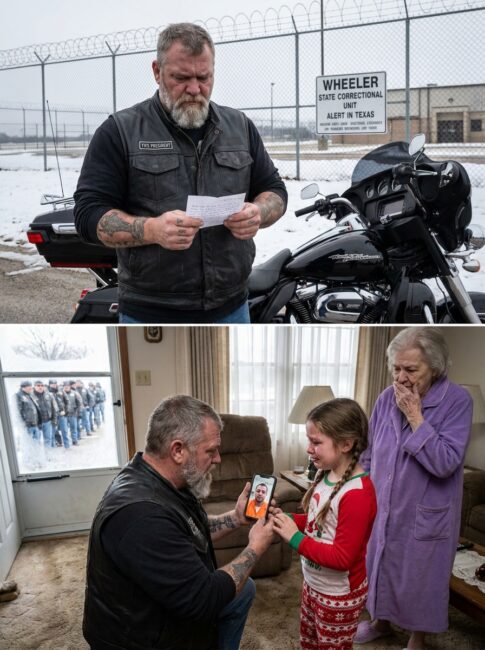
If a brother got drunk and scared his wife, Ray drove over and slept on the porch until morning, not to threaten him, but to make sure nobody inside had to be afraid.
If a prospect’s mother needed her roof patched, Ray showed up with shingles, coffee, and three men who knew better than to complain.
If a kid at the toy drive cried because the engines were too loud, Ray was the first one to cut his Harley and kneel down like the concrete belonged to him.
He had two daughters, Grace and Maddie.
Grace was seventeen, smart and sharp, with Ray’s eyes and her mother’s ability to make him apologize with one look. Maddie was nine, still small enough to climb into his lap during club cookouts and braid bright plastic beads into his beard while twenty grown men pretended not to see.
Ray let her.
Every time.
He had been married to Carla for twenty-three years. She called him Raymond when she was mad, baby when she was tired, and Vice only when the club needed reminding that the man in the leather was still somebody’s husband.
Before the Iron Shepherds, Ray had been a different kind of man.
Not evil.
Not clean, either.
He had done eighteen months in county lockup when he was twenty-four, after a bar fight turned into a felony because somebody hit their head on the curb and nearly did not get back up. Ray never hid it. He never decorated it, either.
“Worst thing about prison,” he told me once, “ain’t the bars.”
We were changing oil in the clubhouse garage, both of us smelling like gasoline and winter dust.
“What is it?” I asked.
He wiped his hands with a red shop rag and looked toward the open bay door, where Maddie was drawing chalk hearts around his motorcycle tires.
“It’s when your kid gets used to asking somebody else for what you should be there to give.”
At the time, I thought he meant regret.
Later, I understood he meant fear.
Ray had not been in prison when his daughters were born. But he had missed enough before them, and carried enough after, that fatherhood never became casual to him. He did school pickups in his cut. He attended dance recitals with oil under his fingernails. He kept every Father’s Day card in a metal ammo box under his bed, wrapped in a shirt Maddie outgrew when she was six.
That was the seed none of us noticed that night.
The pink unicorn sticker on his helmet.
The clean nails.
The way his hand covered Lily’s letter like wind might steal it.
He was not riding to Wheeler State because he thought rules would bend for leather and chrome.
He was riding because one little girl had asked for the only gift that ever scared him.
A father present.
Not perfect.
Present.
Wheeler State sat east of Lubbock, beyond cotton fields gone brown and flat roads that made distance feel honest. Ray rode alone that afternoon, a cold north wind pushing dust across Route 114, his Harley’s engine beating steady under him like a second heart that did not know how to quit.
The rest of us wanted to go.
Boone said no.
“One man asking for mercy is a request,” Boone told us. “Twenty-five bikers at a prison is a problem.”
So Ray went by himself.
He carried no gift bag.
No toy.
No check.
Just Lily’s letter, folded inside his vest, against his chest where the leather stayed warm.
Part 3
The first guard at Wheeler State did not let Ray finish his sentence.
That was how he told it later, though Ray telling a story was like pulling barbed wire through a fence. You got it in pieces, and only if you were willing to bleed a little.
He parked outside the visitor processing building just after noon. A cold sun sat over the razor wire, bright and useless. Trucks rolled past on the access road, throwing gravel dust against his boots.
Ray took off his helmet and stood for a moment with Lily’s letter in his hand.
He had dressed carefully.
Clean black jeans. Plain gray shirt. Leather cut with only club patches, no joke patches, no old trouble. Beard combed. Boots wiped down. He even took the chain off his wallet and left it in the saddlebag because Carla told him, “You are asking for kindness, Raymond. Don’t walk in sounding like a threat.”
Inside, the fluorescent lights hummed hard enough to make the room feel sick.
A woman behind the glass looked at his cut, then at his beard, then back at the cut.
“Visitation list?” she asked.
“I’m not on one,” Ray said. “I need to speak to someone about an inmate. Marcus Bell.”
“You family?”
“No, ma’am.”
“Attorney?”
“No.”
“Clergy?”
“No.”
She slid the paper tray back without looking at the letter. “Then you can’t visit.”
“I don’t need a visit for me,” Ray said. “I need five minutes for his daughter.”
The woman sighed the way people sigh when they have been asked to care too many times in one day.
“Sir, that’s not how this works.”
Ray unfolded Lily’s letter and placed it flat against the glass.
The woman did not read it.
“Sir.”
“She’s eight,” Ray said.
“Sir, step aside.”
“She wrote Santa.”
That made her eyes flicker.
Only for a second.
Then the glass came back between them harder than before.
“I said step aside.”
A younger guard moved closer. His hand rested near his belt, not on anything dramatic, but close enough for Ray to understand the shape of the room. A big man in leather does not get the benefit of softness in a prison lobby.
Ray stepped aside.
He did not argue.
That surprised the guard more than anger would have.
Outside, Ray sat on the curb beside his Harley with the letter in his lap. The wind snapped at the edges of the paper. Beyond the fence, men in white uniforms moved between buildings like small pale marks on a page nobody wanted to read.
He could have left.
Most men would have.
Nobody would have blamed him. We would have said he tried. We would have delivered Lily a coat, a doll, maybe one of those stuffed bears with a recorder inside where someone can put a message. We would have softened failure until it sounded like effort.
Ray did not leave.
He called Boone once.
“No luck?” Boone asked.
“Not yet.”
“You want me to send the club?”
“No.”
“You want me to call that lawyer from Odessa?”
“No.”
“What do you want?”
Ray looked at the prison gate, then at the letter.
“Coffee,” he said.
Boone sent me.
I rode out with two gas station coffees tucked in a cardboard tray and found him just before three, sitting in the same place, shoulders hunched against the wind, helmet beside him like a black stone.
His face had gone red from cold.
“You look stupid,” I told him.
He took one coffee. “That’s why Boone sent you? Emotional support?”
“Pretty much.”
He almost smiled.
Almost.
I sat beside him on the curb. The concrete was cold enough to bite through denim. For a while, neither of us spoke. Trucks passed. A flag cracked in the wind. Somewhere inside the walls, a metal door slammed, and the sound rolled across the parking lot like a verdict.
“She won’t know if you can’t do it,” I said.
Ray stared at the letter.
“That’s the problem.”
I did not understand.
He took a slow drink of coffee, winced because it was too hot, and looked toward the entrance.
“Kids always know,” he said. “They just learn to stop asking.”
Around four-thirty, a different guard came out for a smoke.
Older man. Thick around the middle. Mustache gray at the ends. His name tag said Harlan.
He stood near the staff entrance, watching Ray with the cautious boredom of someone who had seen every version of trouble arrive on two wheels.
Ray stood.
I stood too.
He gave me one look.
Stay.
So I stayed.
Ray walked over with the letter in his hand and stopped a respectful distance away.
“Sir,” he said. “I’m trying to reach Warden Ellis.”
The guard snorted. “Everybody’s trying to reach Warden Ellis.”
“It’s about a child.”
“Everything is, one way or another.”
Ray held out the letter.
Harlan looked at it, then at Ray’s hand.
Maybe it was the paper.
Maybe it was the way Ray held it, careful as a hospital bracelet.
Maybe it was Christmas Eve, and even guards have daughters, nieces, ghosts.
Harlan took the letter.
He read it once.
Then again.
When he looked up, his mouth had changed.
Not softer.
Just less locked.
“You wait here,” he said.
Ray nodded.
Harlan flicked his cigarette into the gravel and went back inside.
That was the false hope.
We both felt it.
The small lift in the chest. The dangerous thought that maybe the world had a hidden door if you waited long enough and did not act like a fool.
But hope at a prison gate is a hard thing.
It gets searched too.
An hour later, Harlan came back out and said the warden would see Ray for five minutes.
Only Ray.
No phone inside.
No recording.
No promises.
Ray handed me his helmet, his wallet, his keys, even his pocketknife without being asked. Then he took off his cut.
That stopped me.
I had never seen Ray enter a hard room without it.
Underneath, his gray shirt pulled tight across his shoulders, and the MERCY tattoo looked bare in the cold.
He folded the cut once and handed it to me.
Inside the lining, for just a second, I saw a patch I had never noticed before.
Small.
Pink.
Hand-stitched.
Two names: Grace and Maddie.
Then Ray walked into the prison without his armor.
Part 4
Warden Ellis was not what Ray expected.
He expected a hard man with a hard desk and a clock that ended conversations before they began. Instead, Ellis was a narrow Black man in his early sixties with tired eyes, silver hair cut close, and a Santa mug sitting beside a stack of incident reports.
The office smelled like old paper, disinfectant, and coffee that had given up hours ago.
Ray stood in front of the desk.
He did not sit.
Ellis held Lily’s letter in both hands, reading it as if the words might change if he gave them enough attention.
“You understand why this is difficult,” Ellis said.
“Yes, sir.”
“You are not a relative. You are not on the approved call list. This facility cannot open communication between inmates and random outside parties because a motorcycle club asks nicely on Christmas Eve.”
Ray nodded.
“I know.”
“And Marcus Bell has disciplinary history.”
Ray’s jaw shifted once.
“Violent?”
“No. Contraband phone. Fighting. Refusal to obey orders.” Ellis looked up. “None of which helps your request.”
Ray did not defend Marcus. That mattered.
He did not say the man was good. He did not say prison was unfair. He did not say fathers deserve mercy because they are fathers.
He said, “His daughter asked Santa for him.”
Ellis leaned back.
The chair creaked.
“I have three daughters,” the warden said.
Ray’s eyes moved to the framed photo on the desk. Three grown women in church clothes, standing beside Ellis in front of a Christmas tree.
Ray saw it then.
The crack.
Not weakness.
Humanity.
“My youngest still calls me every Christmas morning,” Ellis said. “She is thirty-one years old and has two children of her own. Still calls before breakfast.”
Ray said nothing.
“That is not a policy argument,” Ellis added.
“No, sir.”
“It is just a thing I know.”
Ray swallowed. “Yes, sir.”
Ellis set Lily’s letter on the desk. “What exactly are you asking?”
“Five minutes on video,” Ray said. “Christmas morning. I’ll hold the phone. She can see him. He can see her. No talk about cases. No codes. No nonsense. Just a father and his kid.”
“You prepared that answer.”
“I’ve been sitting outside six hours.”
Ellis almost smiled.
Then he looked at the letter again.
“Why you?” he asked.
Ray’s face changed.
Just a little.
That was the question he had been avoiding since he folded Lily’s letter in the clubhouse. Not why the club. Not why Christmas. Not why a child.
Why him.
He looked at the warden’s Santa mug.
Then at the photograph.
Then at his own hands.
“I did time when I was young,” Ray said.
Ellis waited.
“County, not state. Eighteen months.” Ray’s voice stayed flat, but it had gravel under it. “I had a daughter after that. Then another. I got lucky. Luckier than I deserved.”
The warden did not interrupt.
Ray kept going because the room required payment, and truth was the only currency he had.
“My girls never had to ask Santa to get me home.” He looked at the letter. “This one did.”
Ellis looked at him for a long time.
Outside the office window, floodlights were turning on over the yard, bright and cold. Somewhere down the hall, radios hissed. Doors opened and shut with heavy electric clicks.
“Mr. Mercer,” Ellis said, “do you know what men in here do with little kindnesses?”
Ray nodded once. “Some waste them.”
“Some weaponize them.”
“I know.”
“Some break because of them.”
Ray’s eyes lifted.
Ellis tapped the letter.
“If I allow this, and Bell says something wrong, I end it. If the child becomes distressed, I end it. If you use this for publicity, I end it, and I make sure your club never comes near any family program connected to this department again.”
“No cameras,” Ray said.
“You say that now.”
Ray reached into his shirt pocket and pulled out his phone. He placed it on the desk.
“Check it. Delete what you want. I don’t need proof.”
Ellis looked at the phone, then at him.
“You ride with an outlaw club?”
Ray’s face did not move.
“We are not angels,” he said. “We are not what people think, either.”
That answer sat in the room longer than a clean one would have.
Ellis stood.
He walked to the window and looked toward the yard. For a minute, Ray thought the answer was no. He had already started preparing himself to take the failure back to Lily’s house in some shape that would not crush her.
Then the warden said, “Marcus Bell has not had an approved family video call in eleven months.”
Ray closed his eyes once.
Not relief.
Pain.
“Why?”
“Mother changed numbers. Grandmother works nights and misses call windows. Daughter not approved to initiate.” Ellis turned back. “Systems do not bend toward children unless somebody pushes.”
Ray did not speak.
Ellis picked up the phone on his desk.
“Harlan,” he said when the call connected, “find Bell. Tell him he has a Christmas call tomorrow morning. Five minutes. My authorization.”
A pause.
“No, I am not joking.”
Another pause.
“Yes. That Bell.”
Ellis hung up and looked at Ray.
“Seven-thirty tomorrow morning. You will be at the child’s home. Officer Harlan will place the institutional video call from here. I want the grandmother present. No recording.”
Ray nodded slowly.
“Thank you.”
“Do not thank me yet,” Ellis said. “Bell still has to agree.”
That was the second twist.
Nobody had considered that Marcus might refuse.
A man can love his child and still be too ashamed to let her see him in prison clothes. A man can want forgiveness and still fear the face he disappointed. A man can ache for home and still believe staying absent is the last decent thing he can do.
Ray understood that better than any of us.
He picked up his phone, but before he left, Ellis stopped him.
“Mr. Mercer.”
Ray turned.
“Why does your tattoo say Mercy?”
Ray looked at his forearm.
The old ink had blurred at the edges, but the word still held.
“My first daughter’s middle name,” he said. “Grace Mercy Mercer.”
Ellis looked down at Lily’s letter again.
Then he nodded.
Outside, I was leaning against Ray’s Harley, pretending I had not been worried.
He came out without his cut, shoulders squared against the cold, face unreadable.
“Well?” I asked.
He took the leather from my hands and put it on slowly.
The pink patch disappeared inside.
“Christmas morning,” he said.
I let out a breath I did not know I was holding.
“Hell yeah.”
Ray looked at the prison walls.
“Maybe.”
“What do you mean maybe?”
He zipped his jacket.
“Her daddy still has to pick up.”
Part 5
We met at the clubhouse before dawn on Christmas morning.
Twenty-five men, two prospects, Boone’s wife with a thermos of coffee, and Carla standing beside Ray’s bike in a red coat, arms folded tight against the cold. The sky over Lubbock had that pale winter darkness that makes streetlights look tired.
Nobody joked much.
Usually, Christmas delivery morning was loud. Men revved engines for kids. Someone wore antlers on a helmet. Somebody else taped a plastic Rudolph nose to Boone’s Road King until he threatened violence he did not mean.
That morning was different.
The gifts were stacked in labeled bags.
The Harleys waited in two rows, chrome dull under frost.
Ray stood apart, staring at his phone.
At 7:12, a message came from Harlan.
Bell agreed.
Ray read it twice.
Then he put the phone against his chest for one second, right over the inside pocket where Lily’s letter had ridden the day before.
Carla saw.
She always saw.
She walked over and fixed the collar of his cut though it did not need fixing.
“You okay?” she asked.
“No.”
“You can still let Boone do this.”
Ray shook his head.
Carla touched the pink unicorn sticker on his helmet.
“Then bring that baby her daddy.”
He nodded once.
That was their whole conversation.
Biker marriages are not always soft, but the good ones are built like old bridges. They do not need many words to carry weight.
Lily lived with her grandmother in a small rental house south of town, near a two-lane road lined with chain-link fences, mesquite trees, and yards full of things people meant to fix when money stopped being a storm.
The house was pale yellow with peeling trim.
A plastic angel leaned sideways in the yard.
One strand of Christmas lights hung over the porch, half-working, blinking like it was trying its best.
We parked at the end of the block and killed the engines together.
That silence hit hard.
No thunder.
No show.
Just twenty-five bikers walking up a quiet street with helmets tucked under their arms and gift bags in their hands.
Curtains moved in neighboring houses.
A dog barked once, then stopped.
Lily’s grandmother opened the door before we knocked. She was a small woman in a purple housecoat with tired shoulders and hair wrapped in a scarf. Her eyes went straight to Ray, then to the men behind him.
For one second, fear crossed her face.
Ray saw it.
He stepped back off the porch.
“Ma’am,” he said. “We can leave the gifts right here if that feels better.”
That changed her.
Not completely.
Enough.
“You the man from the phone?” she asked.
“Yes, ma’am.”
“Warden called me.”
Ray nodded.
She looked at the row of bikers standing in her yard like a jury nobody had summoned.
“They all here for my grandbaby?”
Boone removed his beanie.
“Yes, ma’am.”
The old woman pressed her lips together. Then she opened the door wider.
“Wipe your boots.”
Every man did.
I have seen bikers walk into bars where people had knives under tables and not look as careful as they did stepping onto that woman’s clean linoleum.
The house smelled like cinnamon toast, old heat, and pine-scented cleaner. A small Christmas tree stood in the corner, decorated with paper snowflakes and three red ornaments. Under it were a few wrapped boxes, the kind done neatly to make less look like enough.
Lily sat on the couch in a nightgown with reindeer on it.
She was smaller than I expected.
Eight years old, thin arms, serious eyes, hair in two braids tied with green ribbon. She held a stuffed rabbit that had been loved past shape.
When she saw Ray, she did not smile.
She looked at his beard, his tattoos, the leather cut, the heavy boots.
Then she asked, “Are you Santa’s motorcycle man?”
Ray’s face broke just enough.
“Yes, ma’am,” he said.
That was the third twist, small but sharp.
To adults, Ray looked like danger.
To Lily, he looked like an answer in work boots.
He knelt slowly so his eyes were lower than hers. His knees cracked. His leather creaked. The room held its breath.
“I could not bring your daddy home,” Ray said.
Lily’s fingers tightened around the rabbit.
Her grandmother closed her eyes.
Ray reached into his inside pocket and pulled out his phone.
“But if you still want to see him,” he said, “he’s waiting.”
Nobody moved.
The phone rang once.
Twice.
On the third ring, the screen lit.
Marcus Bell appeared wearing white prison clothes under harsh fluorescent light. He was younger than I expected, maybe thirty-two, with close-cropped hair, hollow cheeks, and eyes already red before his daughter said a word.
Behind him stood Officer Harlan, looking away like he was guarding the wall.
Lily stared at the screen.
Her mouth opened, but no sound came out.
Marcus lifted one hand slowly.
“Hey, baby girl.”
That was all it took.
The rabbit fell from Lily’s lap.
She slid off the couch and came toward the phone like the screen might become a door if she loved hard enough.
“Daddy?”
Marcus pressed his lips together.
His face twisted once, and he fought it like men fight pain when they think pain is punishment.
“Yeah,” he said. “It’s Daddy.”
Ray held the phone steady with both hands.
I watched his fingers.
They did not shake when engines backfired, when drunk men swung pool cues, when cops asked questions at two in the morning.
They shook then.
Lily touched the edge of the phone.
“Santa found you,” she whispered.
Marcus looked away.
Only for a second.
When he looked back, tears had broken loose.
“No, baby,” he said. “Somebody kind did.”
Ray lowered his eyes.
Five minutes is nothing.
Five minutes is a cigarette outside a diner, a red light on Avenue Q, a song on the radio you barely notice.
Five minutes can also become a whole childhood if it is the first time your father looks you in the face on Christmas morning and says what he should have said every day.
Marcus told Lily he loved her.
He told her school mattered.
He told her to listen to Grandma.
He told her he still had the drawing she mailed him, the one with the purple sun and the dog that looked like a potato.
Lily laughed through tears.
Marcus laughed too, and the sound cracked in the middle.
Then Officer Harlan stepped closer.
“One minute.”
Marcus heard it.
So did Lily.
Her face changed from wonder to panic.
“No,” she said. “No, I just got him.”
Her grandmother covered her mouth.
Ray’s shoulders rose once, like something inside him had been hit.
Marcus leaned toward the camera.
“Lily Mae Bell, you listen to me,” he said, voice rough. “This ain’t your fault. You hear me? Not one piece of it.”
Lily cried harder.
“I want you home.”
“I know.” Marcus pressed his hand flat to his side of the screen. “I’m working on coming home better than I left.”
Ray’s eyes closed.
Marcus looked from his daughter to Ray.
“Sir,” he said, “thank you for carrying me there.”
Ray could not answer.
The call ended with Lily’s small hand pressed against Ray’s phone and Marcus’s hand pressed against prison glass on the other side of a state camera.
Then the screen went dark.
For a moment, the whole room stayed frozen.
Ray still knelt in front of the couch, holding a dead phone between himself and a child whose Christmas had become both miracle and wound.
Then Lily climbed into his arms.
Not carefully.
Not politely.
She threw herself at him with the desperate trust of a child who had nowhere else to put all that feeling.
Ray caught her.
His eyes filled.
He turned his face away from us, but not fast enough.
Twenty-five bikers stood in that little living room, helmets against their chests, and pretended not to see their vice president cry.
We failed.
Every one of us saw.
Part 6
The gifts came after that, but they felt almost secondary.
Lily got the pink winter coat Boone’s wife had picked out, a set of art pencils, two books, warm socks, and a bicycle helmet because Ray said every kid deserved a helmet before they deserved speed.
Her grandmother got grocery cards tucked inside a Christmas card with no names signed, just the Iron Shepherds patch stamped on the envelope.
We stayed less than twenty minutes.
Ray knew better than to turn kindness into occupation.
Before we left, Lily ran to the tree and came back with a paper ornament shaped like a star. It had glitter on one side and too much glue on the other.
She handed it to Ray.
“For Santa’s motorcycle man,” she said.
Ray took it like she had given him something breakable and holy.
“Thank you, ma’am.”
Outside, the cold had sharpened. The neighbors were on porches now, pretending to check mail or smoke or shake rugs that did not need shaking.
Boone gave the signal.
One by one, engines turned over.
The street filled with that low Harley thunder, but nobody revved. Nobody showed off. The sound stayed controlled, respectful, like a hymn played through exhaust pipes.
Ray sat on his bike at the curb, Lily’s paper star tucked inside his windshield.
I rode behind him on the way back.
He did not take the direct route.
Instead, he led us north along the frontage road, past closed diners, dark pawn shops, empty lots, and a gas station where a tired clerk in a Santa hat watched us roll by with both hands around a paper cup.
The sky opened into pale blue.
Christmas morning moved around us in quiet houses.
Somewhere, kids were tearing wrapping paper.
Somewhere, fathers were pretending not to enjoy toys they had bought “for the children.”
Somewhere, men like Marcus were counting hours under fluorescent lights.
Ray rode slower than usual.
Not weak.
Just present.
That night, the club held its usual Christmas potluck at Boone’s place. There was brisket, casseroles, cheap pie, too much coffee, and men telling the same lies they told every year because tradition is just repetition with affection.
Ray showed up late.
Carla came first with the girls. Grace brought cookies. Maddie wore a red sweater and carried a stuffed reindeer under one arm.
When Ray walked in, he looked normal.
That is to say, he looked like a man built from leather, old mistakes, road dust, and stubbornness.
But Carla saw him.
She watched how he hugged Grace too long when she came over to show him something on her phone. She watched how he lifted Maddie clear off the floor when she ran to him, then pressed his face into her hair and stayed there.
Maddie giggled.
“Dad, you’re squishing me.”
Ray put her down.
Then he pulled her back in.
Grace looked embarrassed at first, the way seventeen-year-olds do when love gets too visible. Then she saw his face.
Her own softened.
“What happened?” she asked.
Ray shook his head.
“Nothing.”
Carla stepped closer.
“Raymond.”
That one word did what prison guards, cold wind, and twenty-five bikers could not.
It made him stop pretending.
He walked out to Boone’s back porch with Carla beside him. I did not mean to hear. I had gone out for air and stood near the corner, hidden by the porch light glare and the smoke from Boone’s old grill.
Carla asked again.
“What happened?”
Ray leaned both hands on the railing.
For a while, he only breathed.
Inside, men laughed. A chair scraped. Maddie shouted that somebody was cheating at cards.
Ray stared into Boone’s dark backyard.
Then he said, “Today I figured out the best thing I own.”
Carla waited.
“It ain’t my Harley,” he said.
His voice broke on the next part, and I had to look away.
“It’s that I get to be home on Christmas night,” he said. “And somebody here calls me Dad.”
Carla did not answer with words.
She put one hand on the back of his neck, pulled his forehead down to hers, and stood there with him until his shoulders stopped moving.
That was the real twist.
Not the prison call.
Not the warden bending a rule.
Not Marcus appearing on a phone when Lily thought Santa had done the impossible.
The real twist was that Ray had not gone to save a little girl’s Christmas.
Not only that.
He had gone because her letter found the softest wound in the hardest man we knew, and instead of covering it, he used it to carry somebody else.
After that year, Adopt a Letter changed.
We still bought toys. We still delivered coats and groceries and dolls that closed their eyes. We still rode Christmas morning, though Boone finally banned antlers after one flew off a helmet and hit a mailbox.
But Ray added one rule.
Read every letter twice.
Once for what the child asked for.
Once for what the child was afraid to say.
That rule became our ritual.
Every December, the clubhouse table filled with envelopes. Men who could barely spell read slowly under yellow lights, lips moving, coffee going cold. Prospects learned that the most important work in the club did not happen during rides or meetings or arguments over patches.
It happened when a grown man sat still long enough to hear a child.
The paper star from Lily stayed in Ray’s windshield for three months, until the glitter washed off and the glue gave up.
Then Carla sealed it in a clear plastic sleeve and stitched it inside his cut, beneath the patch with Grace and Maddie’s names.
Ray pretended to complain.
He wore it anyway.
The next Christmas, Lily sent another letter.
This one was addressed not to Santa, but to “The Motorcycle Men.”
Inside was a drawing of twenty-five bikers standing outside a yellow house. They all had giant beards, even the women, and every motorcycle had wings.
At the bottom, in careful pencil, she had written:
“Thank you for not being scared of my wish.”
Ray kept that letter too.
Part 7
I still ride with the Iron Shepherds.
Ray is older now. His beard is more white than gray, his knees complain louder than his pipes, and Maddie is tall enough to steal his hoodies without asking.
Every Christmas Eve, he rides out alone before the toy run.
Same road.
Same prison gate.
He does not go inside.
He parks across from Wheeler State, cuts the engine, and sits there for five minutes with both boots on the ground and both hands resting on the bars.
No speech.
No prayer anyone can hear.
Just a man in a leather cut, looking at a place where fathers disappear from breakfast tables and children learn to ask Santa for impossible things.
Then he starts the Harley again and rides back to town.
By sunrise, he is at the front of the pack, paper letters in his saddlebag, Lily’s star hidden against his heart, and a line of motorcycles behind him carrying gifts through the cold.
People still stare when we pull up.
Some still lock doors.
Some still pull children close.
Ray never argues with their fear.
He just takes off his helmet, wipes his boots, and knocks softly.
The engine dies.
The man remains.
Follow the page for more stories about the people you almost judged too soon.