A Biker With Prison Tattoos Became His Daughter’s Only Fashion Model for Three Hours—Then His Brothers Saw the Pink Dress
I had prison ink crawling up my neck, twelve years of hard road behind my eyes, and a pink curtain wrapped around my waist when my daughter ordered me to walk the living-room runway again.
So I walked.
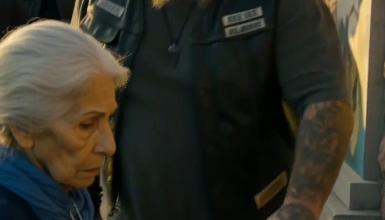
My name is Mason “Rivet” Cole. I am six-foot-four, weigh 285 pounds before breakfast, and have enough faded tattoos on my arms to make strangers move their children to the other side of a grocery aisle.
Some of that ink came from a studio.
Some of it didn’t.
The crooked black bars around my left wrist were put there with a sewing needle and burned plastic during my fourth year inside McAlester. The raven on my throat covered a number I stopped wanting to see after I came home.
People notice those first.
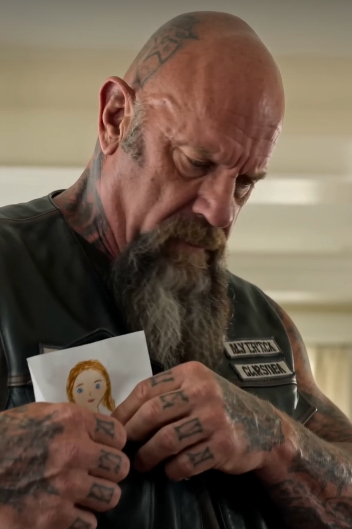
They usually do not notice the tiny yellow thread caught beneath my skull ring or the purple glitter that has lived permanently in the seams of my leather cut since my daughter, Lucy, turned seven.
That Saturday, I was supposed to meet my club at Red’s Diner outside Tulsa before a charity ride down Route 66. Instead, I was sitting on a folding chair while Lucy circled me with a measuring tape and the serious expression of a surgeon.
“Shoulders back, Mr. Model.”
“Yes, ma’am.”
“Models don’t say ma’am.”
“What do they say?”
She considered this.
“Nothing. They look mysterious.”
I folded my tattooed hands in my lap and tried to look mysterious while wearing a scarf covered in cartoon strawberries.
Lucy was nine years old, missing one front tooth, and barely tall enough to reach the top of my shoulders when I sat down. She had transformed our living room into what she called the Cole House of Fashion.
A strip of gray bedsheets formed the runway. Two lamps pointed toward it. Twelve stuffed animals occupied the front row, including a rabbit wearing my old riding glasses.
Lucy had also made tickets.
Mine said: MODEL.
There was only one.
The first outfit was easy—my black jeans, a white shirt, and a red scarf she had cut from an old tablecloth. I walked slowly while she announced me in a fake French accent.
The second included three belts, one of her mother’s old cardigans, and silver Christmas garland around my boots.
By the sixth, dignity had left the building.
Lucy put me in a pink dress made from a bedsheet, fastened a green feather boa around my shoulders, and lowered a wide straw hat covered in plastic sunflowers over my shaved head.
Then she stepped back and frowned.
“Something is missing.”
“There ain’t much left to add, sweetheart.”
She clipped two sparkling butterflies into my gray beard.
“Perfect.”
I heard motorcycles outside just as she turned on the little speaker beside the couch.
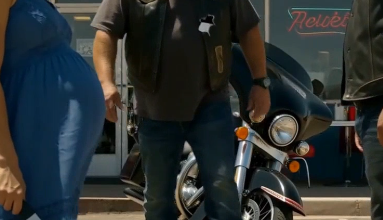
The unmistakable rumble of six Harley-Davidsons rolled up our street, stopped in front of the house, and went silent one engine at a time.
My brothers had come looking for me.
Lucy heard the boots on the porch. Her smile disappeared.
She stared at my flower hat, then at the prison tattoos covering my arms.
“Daddy, are they going to laugh?”
Before I could answer, the front door opened—and the first man through it stopped so suddenly that five bikers nearly crashed into his back.
Want to know what my brothers did when they saw the pink dress and why Lucy had secretly created that three-hour fashion show? Drop RUNWAY in the comments—I’ll share more soon.
I was twenty-two when I entered McAlester and thirty-one when I came back out.
The charge was armed robbery. I was the driver, which was the coward’s version of telling myself I had not truly participated, but the judge did not care about the lies I used to sleep at night.
He was right not to.
I lost nine years, my mother’s funeral, my younger brother’s wedding, and nearly every person who had once answered when I called. By the time the gate opened, my whole life fit inside a cardboard box.
Wade Mercer was waiting beside an old blue Harley.
He had known my father and had visited me twice a year without ever promising that everything would be fine. Wade did not believe in fine. He believed in the next necessary thing.
“Got work for you,” he said.
That was how I became a mechanic at Mercer Motor Works on East Eleventh Street, not far from the old stretch of Route 66 running through Tulsa.
Wade taught me that damaged machines did not need speeches. They needed patience, clean hands, the correct tool, and someone willing to stay until the broken sound disappeared.
People were harder.
The Iron Lanterns were not saints, and we never pretended otherwise. Some of us had records. Some carried grief. Some had tempers we worked every day to control.
But every month we fixed motorcycles for veterans who could not afford repairs, delivered groceries to elderly riders, or raised money for families who had received the kind of hospital bill that emptied a room of conversation.
Brotherhood was not the patch.
It was showing up.
I met Lucy’s mother, Rachel, at Red’s Diner two years after I came home. She was a night-shift nurse with tired green eyes and absolutely no interest in being impressed by a motorcycle.
She saw the prison bars on my wrist during our first conversation.
“What do those mean?” she asked.
“That I made bad choices.”
“And the rest?”
“That I kept living afterward.”
Rachel looked at me for a long moment, then refilled my coffee.
“That answer was almost honest.”
She made me work for the rest.
We married eighteen months later. Lucy was born on a stormy Tuesday, small enough to fit from my elbow to my palm and loud enough to silence every fear I had about holding her.
Rachel died six years later when a driver looking at his phone crossed the center line on Highway 51.
There was no dramatic goodbye. No final wisdom. One ordinary morning she reminded me to buy milk, kissed Lucy near the front door, and never walked back through it.
For several months, I operated like a machine missing half its parts. I packed lunches, washed clothes, fixed motorcycles, attended school meetings, and answered questions about heaven with a vocabulary built mostly from wrenches and regret.
Lucy saved me through ordinary demands.
She needed cereal.
She needed her hair brushed.
She needed somebody to check beneath the bed even though we both knew there was nothing there.
She needed me tomorrow.
So I stayed today.
The first time she showed me one of her designs, she was seven. She had drawn a jacket with enormous blue shoulders, silver stars, and a cape that looked capable of stopping traffic.
“That me?” I asked.
“No. You’re too wide.”
“Fair.”
She laughed and taped the picture beside my toolbox. I assumed it was another childhood phase, like collecting rocks or declaring that ketchup counted as soup.
But the drawings multiplied.
She designed dresses on grocery receipts, jackets on paper napkins, and elaborate hats across the backs of old repair invoices. She could look at a curtain and see a skirt, or study a torn glove and imagine an evening gown.
I did what fathers sometimes do when they are proud but do not understand the thing making them proud.
I bought supplies.
Thread. Fabric scissors. Chalk. A small secondhand sewing machine that frightened me more than any engine I had rebuilt.
Then I went back to the garage and assumed that was enough.
A month before the fashion show, Lucy came home unusually quiet. Her notebook remained inside her backpack through dinner.
When I asked what was wrong, she shrugged.
“Nobody wants to wear my clothes.”
I thought she meant the other children had been busy.
I did not yet know about the classroom presentation, the laughter, or the boy who had held up her drawing of a pink dress and asked whether she planned to put it on her giant criminal father.
Lucy had torn the page in half.
Then she had carefully taped it back together.
That was the page beneath her mattress.
The fashion show began at ten on Saturday morning.
Lucy gave me a handwritten schedule and explained that a professional model would need to complete twelve looks, two rehearsals, one intermission, and a grand finale.
“Three hours?” I asked.
“Real fashion takes time.”
I checked my phone. Wade had sent the charity-ride meeting point, but I had not answered yet because Lucy had been planning something all week and had refused to tell me what.
I typed that I might be late.
Then I put the phone facedown.
The first outfit was called Roadside Royalty. It used my black jeans, Rachel’s red scarf, and a paper crown painted silver.
I walked the bedsheet runway too quickly.
“Again,” Lucy said.
“What was wrong?”
“You look like you’re going to the bathroom.”
I returned to the kitchen entrance and tried again, slower this time, shoulders straight and chin raised.
Lucy nodded.
“Better.”
The second look, Midnight Picnic, consisted of a checkered tablecloth worn like a cape and plastic grapes hanging from my belt. The third required yellow dishwashing gloves and a cowboy hat.
By the fourth, sweat ran beneath my beard.
By the fifth, I had learned how to turn without stepping on a cape.
By the sixth, I was taking the job seriously.
Lucy played instrumental music through an old speaker and announced every outfit in a voice that sounded half Paris, half Oklahoma. The stuffed animals watched from dining chairs arranged along both sides of the runway.
I gave each one eye contact.
A model has standards.
During intermission, Lucy brought me lemonade in a teacup and adjusted the butterfly clipped near my left ear.
“Daddy?”
“Yeah?”
“Do you think these are real clothes?”
“They’re touching my body, so I reckon they’re real.”
“That’s not what I mean.”
I lowered the teacup.
She looked toward the kitchen table, where her sketches were stacked beneath a piece of cardboard. On top was an envelope I had not noticed before.
“You made them,” I said. “That makes them real.”
“What if people laugh?”
“People laugh when they don’t understand something.”
“They laughed at you before.”
Kids always know more than adults think. Lucy had heard comments at grocery stores and seen parents studying my tattoos at school pickup.
She knew I had been in prison. I had told her in words a child could carry: I helped people do something wrong, I went away, and I have spent every day since trying to become someone safer.
“They still laugh sometimes,” I said.
“What do you do?”
“Keep walking.”
She thought about that, then picked up the pink fabric.
Outfit nine was the dress.
It had been made from a bedsheet we once used in the guest room, with one shoulder higher than the other and a waist held together by six safety pins. Lucy had drawn black flames along the bottom using fabric markers.
She had also copied shapes from my tattoos.
The crooked bars around my wrist became a pattern across one sleeve. The raven’s wings formed the outline of the collar. Even the little scar above my elbow appeared as a silver stitched line.
I suddenly understood why she had been studying my arms.
“This is me,” I said.
“This is after,” she corrected.
“After what?”
“After the dark part.”
Her answer hit harder than it should have.
I stepped into the dress.
It was too tight across the shoulders, too loose around the waist, and short enough to reveal the striped socks she insisted I wear over my boots.
Then came the feather boa.
Then the sunflower hat.
Then the glittering butterflies in my beard.
Lucy stepped back, narrowed her eyes, and added a pair of Rachel’s white gloves.
“Now walk.”
I walked.
Not as a joke. Not with an exaggerated swing meant to make her laugh at the sight of a large tattooed man in a dress.
I walked slowly, turned beneath the living-room light, and let the fabric move exactly as she had imagined it.
Lucy’s face changed.
Until that moment, I had thought the show was about keeping her entertained. But she watched the dress with the concentration I used when listening to a troubled engine.
She was not playing.
She was working.
My phone vibrated on the table. Wade. Then Crusher. Then Boone.
The charity ride was leaving.
Lucy noticed the screen.
“You can go.”
“The show isn’t finished.”
“They’re waiting.”
“So is my designer.”
She looked down quickly, pretending to straighten a ribbon. I saw the smile anyway.
We began outfit ten.
Outside, thunder rolled up the street.
Except it was not thunder.
It was six V-twins.
The Harleys stopped outside our house, and the silence afterward felt much louder.
The Iron Lanterns had seen me bruised, furious, exhausted, and once so sick from bad diner chili that I slept beside my motorcycle because I could not ride home.
They had never seen my knees beneath pink fabric.
Crusher entered first. He was six-foot-five, bald, and had a beard thick enough to hide a sandwich. Boone nearly walked into him.
Deacon looked over Crusher’s shoulder.
Mouse leaned around Boone.
Reverend quietly removed his sunglasses.
Wade came last.
Nobody spoke.
Lucy stood beside the speaker, gripping her notebook against her chest. The confidence she had carried for three hours drained from her face.
I could almost hear the words from her classroom returning.
Ridiculous.
Baby clothes.
Your criminal dad.
I placed one gloved hand on my hip.
“What?” I asked.
Crusher’s mouth opened.
I stared at him.
He closed it.
Wade studied the flower hat, the butterflies in my beard, and the black flames along the pink hem. Then he looked at Lucy.
“Show running late?” he asked.
“Yes, sir,” she whispered.
“How many looks left?”
“Three.”
Wade nodded as though this were a completely ordinary scheduling problem.
“We can wait.”
Relief moved through her face, but only for a second. Then Boone made a choking sound.
Lucy heard it.
Her shoulders folded inward.
I stepped off the runway.
The room changed.
My boots struck the wooden floor. The chain at my waist rattled. Beneath the makeup and flowers, the man who had survived nine years inside looked directly at a brother who should have known better.
“You got something to say?”
Boone raised both hands.
“Brother, I swear—I swallowed wrong.”
Crusher’s cheeks were turning red.
“You too?”
“No.”
His voice squeaked.
The room broke.
Mouse turned toward the wall. Deacon covered his mouth. Even Wade looked down, shoulders shaking.
Lucy closed her notebook.
“All right,” she said softly. “The show is over.”
That hurt more than the laughter.
I had spent years learning not to react when people laughed at me. But watching her small hands begin gathering ribbons from the floor made something old and ugly rise inside my chest.
I could not fight laughter.
I could do something harder.
“Sit down,” I told the club.
They stopped.
I pointed toward the stuffed animals.
“Front row.”
Six adult bikers, together weighing well over fifteen hundred pounds, squeezed into tiny chairs beside a rabbit wearing sunglasses and a bear in a purple bow tie.
One chair creaked under Crusher.
“Break it and you buy her a new set.”
“Yes, sir.”
I returned to the kitchen entrance, adjusted my sunflower hat, and looked at Lucy.
“Announce the next outfit.”
She hesitated.
“Daddy—”
“We’ve got an audience now.”
Wade started clapping. Slow at first.
Deacon joined him. Then Mouse. Then Crusher, Boone, and Reverend.
The applause filled our little living room.
Lucy opened the notebook again.
“Look number ten,” she announced, her voice trembling before it grew stronger, “is called The Man Who Kept Walking.”
I came down the runway.
Nobody laughed.
At the end, I turned the way she had taught me. Crusher whistled. Mouse shouted, “Work that hat, Rivet,” and received a look from me that made Lucy giggle.
Outfit eleven involved a silver curtain, one motorcycle glove, and a necklace made from painted washers. I wore it like formal attire.
The brothers applauded again.
Then we reached the finale.
Lucy picked up the taped drawing of the pink dress, the one damaged at school. She held it beside the outfit I was wearing.
“The last look is called Second Chance,” she said.
Her finger touched the dark marks copied from my prison tattoos.
“This part is before.”
Then she pointed to the silver stitching spreading outward from them like rays.
“This is after.”
The room became still.
Wade’s hands stopped clapping.
Crusher removed his sunglasses even though we were indoors. Boone looked toward the window.
Bikers know when not to speak.
Lucy reached for the envelope on the table.
“I was going to throw this away,” she said.
She handed it to me.
The return address belonged to the Tulsa Youth Arts Center. Inside was an application for its Young Designers Showcase, a weekend program for children ages nine through thirteen.
Applicants needed photographs of three original outfits modeled by a person.
The deadline was Monday.
I looked at the stuffed animals, the makeshift runway, and the camera Lucy had propped against a stack of books.
That was the reason for everything.
She had not asked me to play dress-up.
She had asked me to help build her future.
“Why didn’t you tell me?” I asked.
“Because they said nobody would want to see clothes made by a kid like me.”
“What kind of kid are you?”
Her eyes dropped to the prison bars tattooed on my wrist.
“A criminal’s kid.”
The words emptied the room.
I knelt, pink fabric gathering around my boots, and lifted her chin with two scarred fingers.
“You’re a designer.”
She blinked.
“You understand?”
“A designer,” I repeated. “And I’m your model.”
Behind me, Wade stood.
“We’ve got a problem,” he said.
I looked back.
He glanced at the application. “Three original outfits. One model won’t show the judges whether the designs work on different people.”
Lucy shook her head. “I don’t have anyone else.”
Wade removed his leather cut and placed it over the back of the chair.
“You do now.”
The charity ride left without us.
Not one brother complained.
Lucy stared at Wade’s barrel chest, gray beard, and heavily tattooed arms as if someone had delivered a second mountain to her living room.
“You’ll model?” she asked.
“I’ll stand there,” he said. “What you make me wear is between you and your conscience.”
Crusher stood next.
Then Deacon.
Mouse was already removing his boots.
Boone looked around at the others. “I’m not wearing anything with fruit.”
Lucy smiled for the first time since they had arrived.
“I have lemons.”
“Of course you do.”
Within fifteen minutes, the Cole House of Fashion had seven models and a backstage area stretching from the kitchen to the hallway.
Lucy worked fast.
She put Wade in a blue shower-curtain cape with silver stars. Crusher received a purple sash, a wreath of artificial roses, and a skirt made from two plaid blankets clipped together at his waist.
Mouse wore a green tablecloth, yellow gloves, and three strands of Christmas beads. Deacon modeled a long black coat decorated with paper feathers.
Boone got the lemons.
Reverend, who had not said a word, accepted a white lace curtain draped over one shoulder and asked whether the belt should sit higher.
Lucy adjusted it.
“Much higher.”
He obeyed.
I photographed each outfit against the gray bedsheet runway while Lucy directed the men with sudden professional authority.
“Crusher, stop smiling.”
“I’m trying.”
“You look like you smelled something bad.”
“That’s Boone.”
“Focus.”
She repositioned Crusher’s shoulders and tilted the rose wreath on his bald head. He stood perfectly still, though one artificial flower kept brushing his nose.
Wade walked with the same stern expression he used during club meetings. His cape caught the fan’s breeze and opened behind him.
Lucy gasped.
“Do it again.”
Wade did it four more times.
Soon, the room smelled of leather, motor oil, coffee, and the strawberry body spray Lucy used because she believed every fashion show needed perfume.
The men learned to wait for her signal.
They learned the difference between turning and posing. They learned that a cape needed momentum, a scarf needed air, and a designer who barely reached your chest could still order you back to the starting mark.
Something happened during those hours.
The ridiculous clothes stopped being ridiculous.
Each outfit carried part of Lucy’s world. The washers on my necklace came from the garage where she had spent evenings beside me. The stars on Wade’s cape matched the ceiling stickers Rachel had placed above Lucy’s bed.
The black feathers on Deacon’s coat echoed the raven covering the number on my throat.
She had not copied our darkness.
She had rearranged it.
When the final photographs were finished, Lucy spread them across the kitchen table. Seven enormous bikers stared back from the prints in ribbons, flowers, curtains, blankets, and bright homemade accessories.
No two photographs looked alike.
But every man looked serious.
That mattered to her.
“I don’t want it to look like you’re making fun of me,” she explained.
“We ain’t,” Crusher said.
His voice came out rough.
He cleared his throat and began studying a plastic sunflower with great interest.
Wade picked up the application.
“There’s an essay.”
Lucy groaned.
The prompt asked why she wanted to become a designer.
She sat at the table with a pencil while we tried not to watch. After several minutes, she wrote four sentences, erased three, and pushed the paper away.
“I don’t know how to say it.”
“What do clothes do?” I asked.
“They cover people.”
“Only that?”
She looked at my pink dress.
“No.”
“What else?”
She touched the silver stitching beside the copied prison bars.
“They can change what people see.”
Nobody offered another word.
Lucy pulled the paper back.
She wrote:
I want to design clothes because people decide what someone is before they know them. My father’s tattoos make people see a criminal. I see the person who packs my lunch, fixes my toys, and never misses bedtime. I made his dark marks into something bright because both things are true. Good design does not hide a person. It helps other people look again.
She signed her name.
I read it twice.
Then I went to the garage because my eyes had begun doing something that did not belong in a room full of club brothers.
Crusher followed with the photographs.
“You all right?”
“Need an envelope.”
“Right.”
He stood beside me while I searched through a cabinet already containing three envelopes in plain sight.
After a moment, he said, “My boy won’t talk to me.”
I stopped searching.
Crusher’s son was seventeen. I knew they argued, but I had never heard more.
“He says everything I care about happened before he was born,” Crusher continued. “Motorcycles. Club. Old stories. Says there ain’t room for him.”
I looked through the doorway at Lucy adjusting the paper roses around Wade’s neck.
“Maybe ask him what he’s building.”
Crusher nodded slowly.
Brotherhood gets tested in loud ways on the road.
Sometimes it gets tested by whether six hardened men can sit quietly while a child shows them a world they do not understand.
That afternoon, they passed.
We submitted Lucy’s application on Sunday.
For nine days, nothing happened.
Lucy pretended she had forgotten. Every afternoon, however, she checked the mailbox before taking off her backpack.
On the tenth day, a white envelope arrived.
She carried it into the garage without opening it.
“You do it.”
“I thought designers were in charge.”
“Designers can delegate.”
I wiped my hands and opened the envelope carefully.
Lucy had been selected as one of twelve young designers invited to present three looks at the Tulsa Youth Arts Center.
She made a sound I had never heard before—somewhere between a gasp and a squeal—then jumped hard enough to wrap both arms around my neck.
The showcase was six weeks away.
Her invitation included a complication.
Each designer needed three models.
The Iron Lanterns volunteered before I finished reading the sentence.
Lucy chose me, Wade, and Crusher.
She spent the next month improving the outfits. I learned to operate the sewing machine. Wade built adjustable display stands from scrap wood, while Crusher brought his estranged son, Aaron, to help with photography.
Aaron arrived expecting motorcycles.
Instead, his father was wearing a blanket skirt while Lucy marked the hem.
The boy stared.
Crusher stared back.
“You say one word, I’ll make you wear the lemon necklace.”
Aaron laughed so hard he had to sit down.
Then he picked up the camera.
He returned the next weekend.
The showcase took place in a renovated warehouse near downtown Tulsa. White curtains divided the dressing areas, folding chairs faced a real runway, and bright lights hung overhead.
The other children arrived with matching garment bags, polished shoes, and parents who seemed to know words such as silhouette and textile.
We arrived on three Harleys with Lucy’s creations packed carefully in protective bags.
Conversations stopped when we entered.
Wade’s boots sounded against the concrete. Crusher’s chain wallet tapped his leg. My raven tattoo rose above the collar of my black shirt.
A woman near the registration desk looked at the patches on our cuts, then at Lucy.
“Are these your—”
“Models,” Lucy said.
The woman blinked.
“All three?”
“All three.”
Backstage, one of the organizers saw my tattoos and quietly asked whether we understood this was a children’s event.
I knew that tone.
I had heard it at schools, birthday venues, clinics, and any place where my past arrived five minutes before my character.
Before I could answer, Lucy stepped between us.
“He’s my father.”
The organizer’s face changed.
Lucy did not stop.
“He is also wearing Look Number Three.”
Wade coughed into his fist to hide a smile.
The woman apologized and showed us to the dressing area.
Lucy’s hands began trembling fifteen minutes before the show. She dropped three safety pins, forgot where she had placed the gloves, and pulled the flower hat apart while trying to straighten it.
I crouched in front of her.
“Look at me.”
“I can’t do this.”
“You already did.”
“That was at home.”
“Runway’s still a floor.”
“There are judges.”
“Stuffed rabbit judged harder.”
She almost smiled.
I held out my scarred hand.
“What do we do when people laugh?”
“Keep walking.”
“What are you?”
“A designer.”
“And me?”
“My model.”
“Then dress me.”
The first look belonged to Wade. Lucy called it Night Rider, a deep blue cape lined with silver stars and structured shoulders inspired by his leather cut.
He walked slowly.
The cape opened behind him.
People leaned forward.
Crusher presented Roadside Garden, still built around the blanket skirt and rose wreath but now tailored into a layered plaid coat with red flowers stitched across one shoulder.
Nobody laughed.
Then my turn came.
Second Chance had changed.
The pink bedsheet had become a fitted long coat worn over black jeans, but Lucy kept the uneven shoulder, the silver stitching, and the patterns taken from my prison tattoos.
She also kept the flower hat.
“Ready?” she whispered.
“No.”
Her eyes widened.
I adjusted the butterflies clipped into my beard.
“Supermodels like tension.”
She shoved me toward the curtain.
I walked beneath the lights with my shoulders back, one hand at my side and the other resting against the silver stitching running outward from the black bars.
For nine years, those bars had announced the worst thing I had done.
That night, my daughter made them part of something new.
At the end of the runway, I turned.
The room stood.
Not everyone. Not all at once. But enough.
The applause reached backstage, where Lucy covered her mouth with both hands.
I could not hear the Harleys outside.
I could only hear her name.
Lucy did not win first place.
A twelve-year-old named Naomi won with a collection inspired by her grandmother’s quilts, and the work deserved every clap it received.
Lucy won something called the New Voice Award.
The judges praised her use of personal history, unconventional models, and the way she transformed symbols of judgment into details of resilience.
Lucy heard only one word.
“Designer,” she whispered when they introduced her.
She walked onto the stage holding my hand.
One judge asked why she had selected bikers as her models.
Lucy looked at Wade and Crusher, then up at me.
“They were available.”
The audience laughed.
“So they were simply convenient?” the judge asked.
Lucy shook her head.
“No. They know how to wear things people misunderstand.”
That silenced the room.
After the ceremony, parents asked for photographs. Children wanted to touch Wade’s star-lined cape and count the flowers on Crusher’s coat.
The organizer who had questioned me backstage approached with tears in her eyes.
I did not need her tears.
But I accepted her apology.
On Monday, I mounted Lucy’s award beside the old drawing taped above my toolbox. The paper remains torn through the middle, though the tape holds.
Crusher began taking photography classes with Aaron. Wade still insists his cape was “just a curtain,” but it hangs inside the clubhouse in a garment bag with strict instructions that nobody touch it.
Boone continues to refuse fruit-themed accessories.
He owns the lemon necklace now.
As for me, I became Lucy’s permanent model.
Birthdays. School projects. Practice fittings. A library fundraiser where she put me in a green velvet coat that made me look like an angry Christmas tree.
I walk every runway seriously.
When strangers stare at the prison tattoos, the flower hats, or the enormous biker waiting patiently while a little girl adjusts his scarf, I let them stare.
My daughter is a designer.
I am her model.
I have walked in a pink dress, a silver curtain, butterfly clips, three feather boas, and more plastic flowers than I can count.
If that is what makes her shine, then I am a supermodel.
Last Saturday, Lucy carried another garment bag into the garage while I was tuning my Harley.
“What is it?” I asked.
She smiled.
“Your spring collection.”
I shut off the engine.
The V-twin faded into silence, and a tiny sewing machine began humming inside the house.
I followed the sound.
Follow our page for more unforgettable biker stories about the hard-looking men whose quiet acts of love reveal what truly lives beneath the leather and ink.