Part 2: A Biker’s Son Wore His Vest to School — His Father Heard Every Word Outside
My name is Sarah Bennett, and I have taught third grade for fourteen years.
That is long enough to recognize the difference between a child repeating something he has been coached to say and a child telling the truth in the only words he has.
Eli was not performing.
He was reporting.
His father made oatmeal.
His father brushed his hair badly.
His father read slowly.
His father removed his vest before hugs.
Those were facts in Eli’s world, as ordinary and dependable as the bell that rang at 8:10 every morning.
My first impression of Mason had been less generous.
He came to parent night in work boots marked with black grease. He wore a faded gray T-shirt under his leather cut and carried a helmet beneath one arm. His beard was thick. His knuckles were scarred. A chain hung from his wallet and tapped softly against his jeans when he walked.
The hallway smelled briefly of gasoline and cold air after he entered.
I had been standing beside Eli’s desk, sorting worksheets.
Mason stopped several feet away from me.
“Ma’am,” he said.
His voice was rough, but quiet.
Then he removed the vest.
He folded it carefully over one arm before stepping farther into the classroom.
I remember noticing the strange courtesy of that gesture.
He did not explain it.
He simply looked around the room as if he were entering a place where he did not know the rules.
When I handed him Eli’s reading folder, Mason turned it over twice before opening it. He studied the instructions longer than most parents did.
“If I get something wrong,” he said, “you tell me straight.”
“There is nothing complicated,” I said.
He nodded.
“Still.”
He did not smile much. But when Eli came running down the hallway and hit him around the waist, Mason immediately set the helmet on the floor and crouched.
The vest was already off.
At the time, I thought he removed it because he did not want the metal snaps scratching his son’s face.
That was true.
It just was not the whole truth.
Over the next few months, I learned pieces of Mason Reed the way teachers often learn parents: through small details children carry into class.
Eli’s lunch always had apple slices in a plastic container because his father cut them before sunrise.
His spelling words were practiced on the backs of repair invoices.
His library books sometimes came back with fingerprints along the edges that smelled faintly of motor oil.
Once, Eli brought in a toy fire truck with a newly repaired wheel.
“My dad fixed it after work,” he told me.
“How late?”
Eli shrugged.
“I woke up because he dropped the screwdriver. It was eleven-something.”
Mason worked at a motorcycle repair shop near the old Route 66 strip, beside a diner with a flickering red sign and a gas station that still sold coffee in foam cups. He had started sweeping floors there when he was fourteen. By sixteen, he could rebuild an engine. By seventeen, he had stopped going to school.
“He was not stupid,” Eli’s mother, Claire, told me later. “Nobody ever convinced him there was a difference between struggling and being stupid.”
Mason’s club knew better.
They were not an outlaw club. No mythology. No pretending.
Mostly mechanics, warehouse workers, two veterans, a nurse, and a retired mail carrier named June who rode a dark touring Harley and corrected everybody’s grammar in the group chat.
They rode together. They fixed things for people who could not afford repairs. They delivered groceries when a club brother broke his leg. They argued about football and borrowed tools they forgot to return.
Brotherhood, in Mason’s world, was not a speech.
It was showing up with jumper cables at 2:00 a.m.
It was reading the instructions twice.
It was taking off the vest before the hug.
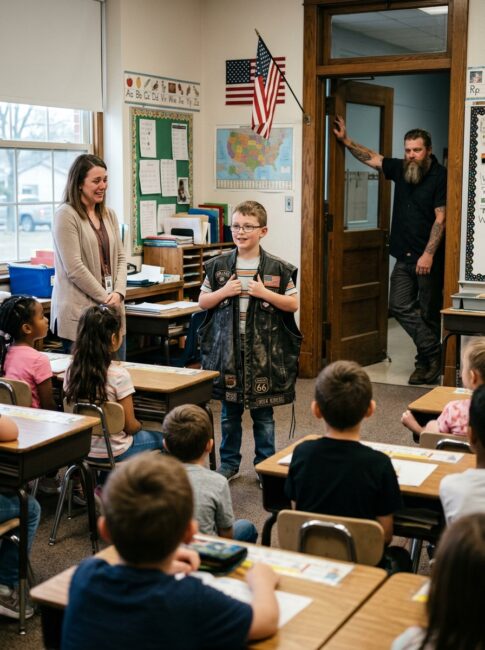
Show-and-tell happened on a Friday morning in early November.
The day began cold. Wind pushed dry leaves along the curb outside the school. From the classroom windows, I could see sunlight flash across passing cars on Route 66.
Eli arrived carrying the vest in a grocery bag.
He looked unusually serious.
“What did you bring?” I asked.
“My dad.”
Then he corrected himself.
“Something from my dad.”
When he pulled the leather cut from the bag, the weight of it nearly dragged his arms downward. It was too large for him in every possible way. The shoulders sagged. The bottom edge hung near his knees. The patches looked enormous on his narrow frame.
I hesitated.
A few years earlier, we had asked a student not to bring a realistic toy weapon for show-and-tell. Since then, I had become careful about objects that might shift the mood of a room.
But this was only leather.
And Eli was proud.
I helped him slide his arms through the openings.
The vest settled around him with a soft rasp.
His classmates stared.
Eli cleared his throat.
“This belongs to my dad,” he began.
He told them about the oatmeal first.
Then the hair brushing.
A girl named Sophie laughed gently when Eli said his father sometimes pulled his hair into a crooked side part because his fingers were too large for the comb.
“He tries again,” Eli said. “Unless we are late.”
The children laughed with him, not at him.
Then Eli told them about the books.
“My dad did not finish ninth grade,” he said. “He reads slow. Sometimes he gets stuck on words. I wait.”
He pushed his glasses up.
“He says waiting for somebody is part of reading together.”
That sentence stopped me.
I had spent years teaching children how to read faster, more fluently, with better expression. Mason had discovered something I had not written on any worksheet.
Sometimes love sounds like someone refusing to skip the hard word.
Eli reached into the vest pocket and removed a paperback copy of Charlotte’s Web. The cover was worn at the corners.
“We are reading this now,” he said. “Dad does the pig voice bad.”
The classroom erupted.
Even I laughed.
Then Eli grew serious again.
“Some people think bikers are mean. My dad says some are. Some people in every kind of clothes are mean.”
That sounded like Mason.
Simple. Accurate. No speechifying.
“My dad says a vest does not tell you if somebody is good. You have to watch what they do when nobody claps.”
That was when I noticed movement beyond the door.
A man stood in the hallway.
Only part of him was visible through the narrow rectangular window: one shoulder, a brown beard, the sleeve of a gray work shirt, the curve of a tattooed forearm.
Mason.
Claire stood farther back with her phone raised, recording quietly.
She met my eyes and touched one finger to her lips.
Eli did not know his father had come.
He kept talking.
“My dad fixes bikes all day. His hands get black even when he washes them. But when my toy robot broke, he sat at the kitchen table until the arm moved again.”
Eli smiled.
“He said robots deserve second chances.”
Outside the classroom, Mason lowered his head.
I could not hear him breathing through the closed door, but I saw his shoulders move.
I thought the story had reached its emotional peak.
Then Eli reached inside the lining of the vest.
He pulled out a small embroidered patch.
And everything got quieter.
The patch was not part of the club colors.
It was small enough to fit in Eli’s palm.
A yellow dinosaur stood crookedly against a blue background. One leg was longer than the other. The stitching wandered slightly at the edges. Beneath the dinosaur, in uneven letters, was one word:
DAD.
“My dad keeps this inside,” Eli said.
He held it carefully between two fingers.
“I made it when I was six.”
The children leaned forward.
“He said the outside patches are for people on the road. This one is for him.”
Eli looked at the vest as though he were trying to remember the exact words.
“He says when he gets mad, or tired, or thinks he cannot do something, he puts his hand inside and touches it.”
A chair squeaked somewhere near the back of the room.
Nobody spoke.
“He says it reminds him what job comes first.”
Outside the door, Mason sat down hard against the hallway wall.
Not dramatically.
His knees simply seemed to stop holding him.
He slid to the floor with his back against the painted cinder block and pulled one leg toward his chest. His tattooed hand covered his mouth. The other rested open on his knee.
Claire lowered the phone.
For a second, she looked like she might go to him.
Then she stayed where she was.
She understood that some moments need room.
Inside the classroom, Eli turned the patch over.
“I asked my dad why he takes the vest off before hugs,” he said.
He smiled a little.
“He said, ‘Hugs are supposed to be soft. Leather is hard. Those two things do not go together.’”
The children smiled too.
But Eli was not finished.
“He also says he takes it off because he wants me to know he is my dad before he is anything else.”
Through the window, I watched Mason close his eyes.
I had seen grown men cry before.
At funerals. At hospital beds. At graduation ceremonies.
This looked different.
Mason cried like a man hearing evidence in a trial he had spent his entire life assuming he had already lost.
He had entered the school through the side hallway because Claire had texted him that morning.
She had planned to send him a video.
He had come straight from the repair shop instead, still wearing work boots, still carrying the smell of oil and cold air, because he could not wait until evening to hear what Eli wanted to say.
He never intended to enter the classroom.
He did not want to embarrass his son.
He only wanted to stand outside the door and listen.
But Mason had not expected the dinosaur patch.
He had not expected Eli to know what it meant.
And he had never expected his son to describe him as a good man.
After show-and-tell, I asked the children to begin their writing assignment.
Eli removed the vest carefully and folded it across his desk. It took up nearly the entire surface.
I stepped into the hallway.
Mason was still sitting against the wall.
He wiped his face quickly with the heel of one hand when he saw me. His eyes were red. His beard was damp near the corners of his mouth.
“Sorry,” he said.
“For what?”
He glanced toward the classroom door.
“Making a scene.”
“You were silent.”
He gave a small nod.
“That is usually safer.”
Claire stood beside him now. She did not speak. She placed one hand on his shoulder.
Mason looked down at his scarred knuckles.
“I was fourteen when I started at Ray’s shop,” he said. “My old man was gone. My mom needed rent money. School did not stick.”
He rubbed one thumb against the side of his hand.
“I can fix most things with an engine. Words are different.”
I thought about Charlotte’s Web. About the difficult words he refused to skip.
“You read with him every night,” I said.
“Slow.”
“He did not describe that as a problem.”
Mason looked through the classroom window.
Eli was laughing quietly at something Sophie had written.
“I thought he noticed every time I got it wrong,” Mason said.
“He noticed that you stayed.”
That landed.
He looked away.
Later, Claire told me the rest.
Mason had grown up outside Carthage, not far from Joplin. His father drifted in and out of the house, usually loud, usually angry, always carrying the sour smell of cheap beer and road dust.
When Mason was nine, he stopped asking whether his father would attend school events.
By twelve, he had stopped bringing forms home for signatures.
By fourteen, he was sweeping floors at the repair shop after class.
By sixteen, school had become a place where he felt behind before the bell rang.
He left.
Work made sense.
Engines made sense.
A stripped bolt did not laugh when you asked for help.
For years, Mason believed being useful was the same as being worthy. He fixed motorcycles. He fixed furnaces for neighbors. He patched drywall. He showed up when a club brother needed a ride home from the emergency room.
But fatherhood frightened him in a way mechanical failure never did.
When Eli was born, Mason held him as though someone had placed a glass object in his grease-darkened hands.
“I am going to mess him up,” he whispered.
Claire told him the truth.
“Then keep showing up.”
That became the rule.
Not perfection.
Presence.
When Eli struggled to sleep as a toddler, Mason sat beside the crib after late shifts and read picture books one careful sentence at a time.
When Eli started school, Mason practiced spelling words beside repair invoices.
When Eli made the dinosaur patch at six, he expected his father to pin it on the outside of the vest.
Mason hesitated.
The club colors carried their own history. Patches meant something.
Then June, the retired mail carrier, handed Mason a needle and heavy thread.
“Inside,” she said. “Closest layer.”
Mason stitched the dinosaur into the lining himself.
Badly.
The crooked seams were his.
That was why the edges wandered.
That was why one side sagged.
He had never repaired the stitching because Eli made him promise not to.
“It is supposed to look like us,” Eli had said.
“Not perfect. Still good.”
A week after show-and-tell, Mason came back to school.
This time, he entered the classroom.
No helmet.
No vest.
He carried a cardboard box filled with broken household objects the students had brought from home: a flashlight with a loose switch, a toy truck missing one wheel, a music box that no longer turned, and a small desk fan that rattled when plugged in.
I had invited him to speak about repairs.
Mason stood at the front of the room and looked more nervous than any guest speaker I had ever hosted.
His hands, which could handle stubborn bolts and hot metal, did not know what to do with themselves.
He shoved them into his pockets.
Then removed them.
Then folded them across his chest.
Eli sat in the front row, grinning.
Mason picked up the toy truck.
“Most broken things tell you what happened,” he said.
His voice was rough but steady.
“You listen first.”
The children leaned closer.
He showed them the bent axle. He explained that forcing a new wheel onto the wrong angle would only break something else.
“You do not start by pushing harder,” he said. “You find out what needs help.”
I wrote that sentence down after school.
Mason fixed the truck.
Then the flashlight.
The music box took longer. He opened the underside carefully, placing each screw in a straight line on a paper towel so none would roll away.
The children watched his tattooed fingers work.
Sophie raised her hand.
“Do you fix everything?”
Mason glanced at Eli.
“No, ma’am.”
“What do you do when you cannot fix something?”
He thought for a moment.
“Stay with it anyway.”
The classroom became quiet again.
Afterward, Eli ran to him.
Mason instinctively opened both arms, then stopped.
He was not wearing the vest, but the ritual remained.
Eli stepped into the hug.
Mason lifted him briefly from the floor.
His hands were still larger than his son’s head.
They probably always would be.
Outside, his Harley waited near the curb. When he started it, the V-twin settled into its low uneven rhythm, vibrating gently against the school windows.
He pulled away slowly toward Route 66.
Eli stood beside me and listened until the engine faded.
By spring, Eli had outgrown the toy robot but not the bedtime stories.
Mason finished Charlotte’s Web.
Then they started The Lion, the Witch and the Wardrobe.
Claire told me it took them months.
Some nights, Mason came home too tired to read more than two pages. Some nights, he stumbled over words and asked Eli for help.
They kept going.
At the end of the school year, our class held a small family afternoon in the gym. Parents brought cookies. Children displayed writing projects and science posters beneath the basketball hoops.
Eli’s project was a single page mounted on blue construction paper.
The title was written in large pencil letters:
WHAT MY DAD FIXES
Beneath it, Eli had drawn a motorcycle, a toy robot, a bowl of oatmeal, and an open book.
At the bottom of the page, he had drawn two figures.
One was large, with a beard and tattooed arms.
The other was small, wearing glasses.
The large figure was holding a black vest in one hand.
Not wearing it.
Holding it.
With the other arm, he hugged the boy.
Mason stood in front of the drawing for a long time.
His cut hung over one arm. The leather was creased and weathered. Near the inner lining, the small blue dinosaur patch was barely visible.
He touched it once with two fingers.
Then Eli ran toward him.
Mason set the vest over the back of a folding chair before he crouched.
The gym was loud. Chairs scraped. Children shouted across the room. Somewhere outside, a motorcycle rolled along Route 66 and disappeared into the afternoon traffic.
But Mason did what he always did.
He opened his arms.
The leather stayed behind.
The hug came first.
Follow the page for more stories about the people behind the leather.