A Dad Tattooed His Daughter’s Cochlear Implant on His Head—Then Made Her a Quiet Promise
A Dad Tattooed His Daughter’s Cochlear Implant on His Head—Then Made Her a Quiet Promise
When six-year-old Charlotte Campbell saw the new tattoo above her father’s ear, she giggled, touched his head, and called it “cool.”
The design resembled the cochlear implant she wore herself.
Her father, Alistair, had shaved his head so the tattoo could be placed where she could see it. He wanted to show his daughter that she had someone beside her, willing to make a visible gesture of support.
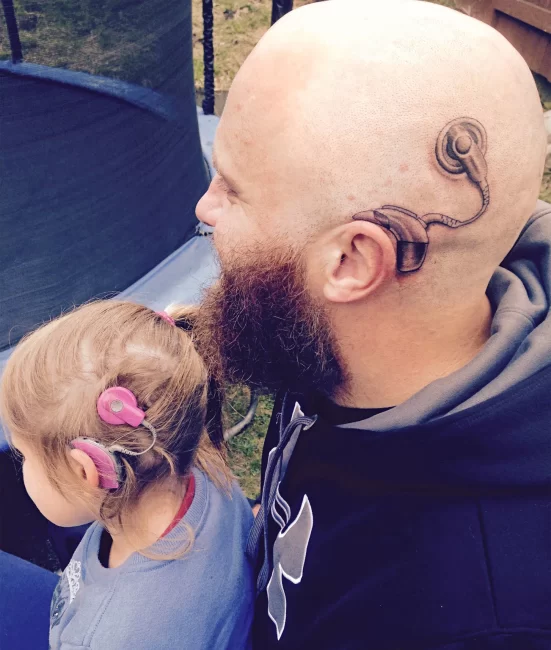
Then came the detail that made the story especially tender. He planned to let his hair grow back, but said he would shave it again whenever Charlotte wanted to see the tattoo.
The image that spread around the world in August 2015 belonged to a family from Taupo, New Zealand. Charlotte had severe hearing loss and was receiving her second cochlear implant, having received her first when she was four.
Alistair’s tattoo followed the appearance of the device: a circular shape on his scalp, connected to a section outlined behind his ear. In photographs of father and daughter together, the resemblance was immediately clear.
The equipment Charlotte wore had become the inspiration for something her father chose to put permanently on his own skin.
Her family’s experience had begun long before the photograph.
In a later interview with Woman’s Day, Charlotte’s parents described a childhood involving hearing assessments, hearing aids, and changes in the support she needed as she grew.
She had passed her newborn hearing test. Hearing difficulties were identified afterward, and her parents continued seeking answers when her speech did not develop as they expected.
By the time the tattoo brought public attention to their family, Charlotte had already been through years of appointments and adjustments. Her parents described progress following her first implant, alongside support for her speech.
Those years matter to the meaning of the photograph. The tattoo was one visible moment within a much longer relationship between a child and the parents helping her through unfamiliar experiences.
As Charlotte prepared for another implant procedure, Alistair decided to make his support visible in a different way.
He could not undergo the same experience as his daughter. His tattoo would not make their experiences identical. But he wanted to make a gesture she could understand and recognize whenever she looked at him.
He also wanted to show that he was willing to endure a little discomfort for her.
The result was striking enough to stop people scrolling, but Charlotte’s own response was wonderfully simple. She liked it.
She touched the design and smiled at what her father had done. Later family reporting described her enthusiasm for the idea of another matching tattoo on his other side.
At six years old, she did not need to explain the gesture to an audience. Her reaction belonged to her and her dad.
Charlotte’s mother, Anita, shared a photograph on Facebook. The picture soon traveled beyond their friends and family, attracting messages from people around the world.
In the family’s interview with Woman’s Day, Anita described the sudden flood of notifications, messages, and friend requests. A personal decision had become a story strangers wanted to share.
It is easy to understand the photograph’s appeal. The resemblance between Charlotte’s device and her father’s tattoo gives a viewer an immediate reason to look closely. Learning why he chose the design gives the image its emotional weight.
Alistair explained that the tattoo was a dedication to his daughter. In comments reported by the Irish Examiner, he emphasized that the tribute centered on her.
That is an important distinction within a story that brought so much attention to him. The shaved head was his. The tattoo was on his skin. But the reason for it was the child standing beside him.
His promise about growing his hair back kept that reason close to the surface.
Eventually, the design could be covered. It would still remain there, and if Charlotte wanted to see it, he was prepared to uncover it again.
The promise made room for what she wanted. The gesture did not have to stay on display for other people in order to retain its meaning for his daughter.
Photographs can sometimes narrow a child’s life to the detail that first draws attention. Charlotte’s family described a much fuller little girl: someone who enjoyed family bike rides and helping on her grandparents’ farm.
Her hearing devices were part of her life. So were her interests, her relationships, and the everyday experiences she shared with her family.
Her father’s tattoo became memorable because it acknowledged something specific to her while expressing a feeling many parents recognize: the wish to help a child feel supported through experiences they cannot take over for them.
The design could not answer every challenge Charlotte might face. What it could do was give her a visible reminder of her father’s affection.
Years later, the image still carries that meaning without needing an elaborate explanation. A little girl wears her cochlear implant. Her father has chosen a matching outline above his ear.
And behind the photograph is the small promise that gives the gesture its lasting warmth.
If she wanted to see it again, he would make sure she could.