Part 2: A Night-Shift Mother Fell Asleep on the Bus — The Driver’s Quiet Gesture Silenced Every Passenger
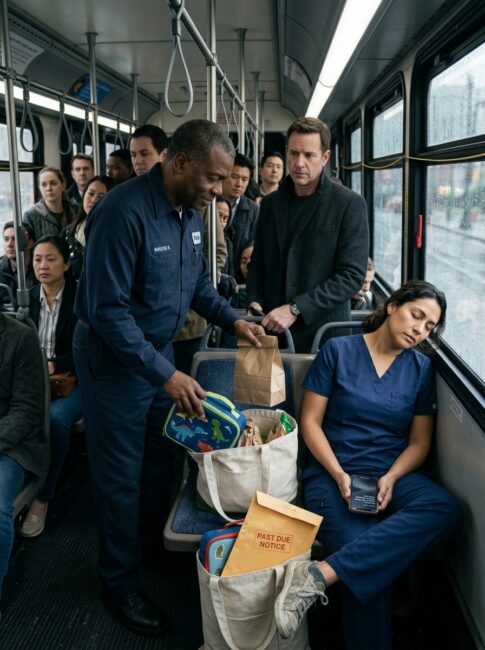
Elena woke suddenly when the bus turned onto Maple Avenue.
Her eyes opened wide.
For one confused second, she stared through the rain-streaked window. Then she sat upright and grabbed her tote bag.
“Did we pass Franklin Street?” she asked.
Marcus glanced at her through the mirror.
“Only by a few blocks.”
Elena looked at the dashboard clock.
Her face went pale.
“I am sorry,” she said quickly. “I did not mean to fall asleep.”
Nobody answered.
The same passengers who had complained moments earlier now avoided her eyes.
Elena noticed the brown paper lunch bag inside her tote.
“This is not mine.”
Marcus kept both hands on the wheel.
“You can return the favor another morning.”
Elena looked confused, but she did not argue.
She was too busy checking her phone.
Three missed messages appeared on the screen.
The first came from her eleven-year-old daughter, Sofia.
Mom, Noah is awake. I gave him the juice box like you said.
The second message arrived four minutes later.
His number is going back up. Do not worry.
The final message said:
We are okay. Please do not run. The sidewalk is wet.
Elena closed her eyes briefly.
When Marcus reached the next safe stop, he opened the doors.
“I can walk back,” Elena said.
Marcus pointed through the windshield.
“Take the crosswalk. It is safer.”
She nodded, clutching the lunch bag and child’s lunchbox against her chest.
Before stepping off the bus, Elena turned.
“I really am sorry.”
Marcus gave a small nod.
“I know.”
The doors closed behind her.
Through the window, the passengers watched Elena hurry along the sidewalk beneath a broken umbrella.
She did not head toward an apartment building.
She crossed the street and entered a laundromat.
The man in the overcoat laughed once, without humor.
“She works at the hospital and the laundromat?”
Marcus pulled back into traffic.
“She cleans offices upstairs before the laundromat opens,” he said.
Nobody asked how he knew.
The answer was not simple.
Elena worked overnight in the environmental-services department at St. Catherine’s Hospital.
She emptied trash bins, wiped down waiting rooms, disinfected door handles, and changed linens in rooms where families sometimes cried after doctors stepped into the hallway.
She was not a nurse.
She did not give medication.
She did not appear in photographs beside recovering patients.
But she noticed things.
She noticed when an elderly man stared at a cold dinner tray because his hands shook too badly to open the plastic containers.
She noticed when a young father fell asleep beside his daughter’s hospital bed without eating.
She noticed when frightened people needed someone to stand in the doorway for one extra minute.
After her hospital shift ended at 5:15 each morning, Elena cleaned the small office above the laundromat three days a week.
The extra money covered Noah’s insulin copays and the portion of rent her hospital wages no longer stretched far enough to reach.
Her husband, Luis, had died two years earlier after a construction accident.
Since then, Elena measured each day carefully.
Bus fare.
Groceries.
Medication.
School lunches.
Rent.
The numbers rarely fit together without something being postponed.
Elena hated falling asleep on the bus.
She worried people would think she was careless.
She worried someone might steal the grocery money folded inside her wallet.
Mostly, she worried about missing the morning routine at home.
Sofia was only eleven.
She had learned too quickly how to help Noah check his blood sugar.
Elena knew her daughter was capable.
That did not mean Sofia should have to be.
At the laundromat, Elena finished cleaning the office in twenty-seven minutes.
Then she walked home carrying Marcus’s lunch bag.
Inside were two turkey sandwiches, an apple, a small bag of pretzels, and a folded napkin.
There was also a packet of crackers.
Elena stared at the crackers for a long moment.
The brand was familiar.
Months earlier, she had offered the same kind to an older woman sitting alone in a hospital room.
The woman’s name had been Evelyn Brooks.
Evelyn Brooks had been admitted to St. Catherine’s during the final winter of her life.
She was sixty-three, with silver-streaked hair, gentle brown eyes, and a habit of apologizing whenever anyone helped her.
Cancer had taken away her strength slowly.
Her husband, Marcus, drove the early Route 18 bus and visited every afternoon after his shift.
He brought crossword puzzles Evelyn rarely completed and coffee she was no longer allowed to drink.
Some days, Marcus sat beside her bed and talked.
Other days, he sat quietly and held her hand.
One Thursday evening, a snowstorm delayed his bus route.
By the time Marcus reached the hospital, visiting hours had ended.
He called Evelyn from the parking lot.
She tried to sound cheerful.
“I am fine,” she told him. “Go home before the roads get worse.”
Marcus knew she was not fine.
Evelyn hated storms.
They reminded her of the night their youngest son crashed his car on an icy highway decades earlier.
Marcus stood inside the hospital entrance, arguing gently with a security guard who could not bend the rules.
Upstairs, Elena entered Evelyn’s room to empty the trash.
She noticed the untouched dinner tray.
She noticed the television was on, but Evelyn was not watching it.
She noticed the phone resting in Evelyn’s lap.
“You do not like the storm?” Elena asked.
Evelyn smiled faintly.
“I am too old to be afraid of weather.”
Elena did not contradict her.
She finished wiping the counter, then reached inside the pocket of her scrubs.
She carried crackers during overnight shifts because she sometimes missed dinner.
“Would you like these?” Elena asked.
Evelyn looked at the packet.
“Only if you sit for a minute.”
Elena was already behind schedule.
She still had six rooms to clean, a waiting area to disinfect, and a bus she could not afford to miss.
But she pulled the visitor’s chair closer to the bed.
She sat with Evelyn for eleven minutes.
They shared crackers and talked about ordinary things.
Evelyn asked about Elena’s children.
Elena described Sofia’s love of drawing and Noah’s obsession with dinosaurs.
When Evelyn mentioned Marcus, her voice softened.
“He pretends not to worry,” she said. “He has never been convincing.”
The storm continued outside.
Before Elena left, she adjusted the blanket around Evelyn’s shoulders.
“Your husband is downstairs,” she said. “He called the desk twice.”
Evelyn closed her eyes.
“That sounds like him.”
“I can stay until your next nurse comes in.”
Evelyn reached for Elena’s hand.
“You have children waiting for you.”
Elena smiled.
“They are sleeping. I can spare another minute.”
Evelyn died three weeks later.
Marcus found the packet of crackers inside the drawer beside her hospital bed.
A nurse told him about the woman in navy scrubs who sometimes sat with Evelyn after cleaning the room.
Marcus asked for her name.
The nurse did not know.
Months passed.
Then one morning, Elena boarded Route 18 wearing the same hospital uniform.
Marcus recognized the dinosaur keychain hanging from her tote bag.
Evelyn had mentioned it during one of their final conversations.
“The woman who sits with me has a little boy who loves dinosaurs,” she had said. “She looks tired, Marcus. Be kind to tired people.”
Marcus did not introduce himself.
He did not tell Elena that she had comforted his wife on a night when he could not reach her.
He simply noticed her routine.
He noticed that Elena boarded at 5:41.
He noticed she carried two lunchboxes but rarely ate anything herself.
He noticed she got off near the laundromat, then boarded again later with a mop bucket sometimes visible through the office window.
He noticed she rubbed her eyes before each stop, afraid of falling asleep.
On that rainy Tuesday morning, Marcus saw Elena lose the fight against exhaustion.
He also saw the hospital badge clipped to her scrubs.
He knew she would be embarrassed if he made an announcement.
He knew she would apologize even though her body had simply reached its limit.
So he did not wake her immediately.
The schedule gave him a seven-minute cushion before the busiest transfer point.
He used five of them.
That was all.
Five minutes of sleep.
Two sandwiches.
A packet of crackers.
Nothing dramatic enough to make the local news.
But enough to make an entire bus reconsider what it had assumed.
The man in the charcoal overcoat approached Marcus before stepping off at the downtown stop.
His name was Robert Hale.
He worked in insurance and had spent the morning answering emails before sunrise.
He stood beside the driver’s seat awkwardly.
“I was out of line,” Robert said.
Marcus kept his eyes on the road.
“You were in a hurry.”
“That does not excuse it.”
Marcus did not answer.
Robert reached into his wallet and removed a twenty-dollar bill.
“Can you give this to her tomorrow?”
Marcus shook his head.
“She will not take it.”
Robert glanced toward the empty seat where Elena had been sleeping.
“What will she take?”
Marcus thought for a moment.
“Maybe a little patience.”
The following morning, Elena boarded Route 18 at 5:41.
She carried Marcus’s clean lunch bag, carefully folded.
Inside were two homemade breakfast burritos wrapped in foil.
A note rested on top.
Thank you for the five minutes. My children ate your sandwiches before I could argue with them.
Marcus smiled.
Then he noticed another item inside the bag.
A packet of crackers.
The same brand Elena had shared with Evelyn months earlier.
Marcus looked toward Elena.
She was standing near the front, holding the rail.
“Did you know my wife?” he asked.
Elena froze.
For a moment, neither of them spoke.
Then Elena looked at the crackers and understood.
“Evelyn,” she whispered.
Marcus nodded.
“She remembered you.”
Elena pressed one hand against her mouth.
“I did not do much.”
Marcus looked through the windshield as the traffic light changed.
“You stayed.”
Elena lowered her eyes.
Behind them, the bus remained unusually quiet.
Robert sat several rows back.
He had brought a grocery-store gift card inside a blank envelope.
He did not hand it to Elena.
Instead, he slipped it into a community donation box at the hospital later that morning, with a short note.
For families who are carrying more than strangers can see.
The days grew warmer.
Elena continued riding the early Route 18 bus.
Some mornings, she stood near the front and talked with Marcus about Sofia’s drawings or Noah’s latest dinosaur facts.
Other mornings, she sat beside the window and closed her eyes.
Nobody complained.
A few passengers began lowering their voices when they noticed her sleeping.
One woman moved her umbrella so rainwater would not drip near Elena’s shoes.
Robert started carrying an extra granola bar.
He never made a speech about it.
He simply left it on the seat beside Elena’s tote bag one morning and walked toward the back of the bus.
Elena found it later.
She turned around, searching for whoever had placed it there.
Nobody looked up.
Several weeks after the rainy morning, Noah’s medical costs changed.
A hospital social worker helped Elena apply for a patient-assistance program she had not known existed.
The savings were not life-changing.
They did not erase the past-due envelope inside her tote.
They did not reduce the number of hours in a day.
But Elena was able to stop cleaning the laundromat office every Tuesday.
For the first time in months, she arrived home before Sofia needed to check Noah’s blood sugar alone.
On her first free Tuesday morning, Elena made pancakes.
The kitchen was small and crowded.
Noah spilled syrup across the table.
Sofia complained that his dinosaur pajamas smelled like laundry detergent.
Elena sat between them with a mug of coffee growing cold in her hands.
She did not rush.
At 7:15, Noah asked why she kept smiling.
Elena looked at the clock.
“No reason,” she said.
That afternoon, Sofia drew a picture at the kitchen table.
She used colored pencils worn almost too short to hold.
The picture showed a blue city bus beneath a yellow sun.
Inside the bus, she drew rows of passengers with round heads and small smiles.
At the front, Marcus sat behind the wheel.
Near the window, Elena slept beneath an oversized coat.
Above the bus, Sofia wrote:
Sometimes helping someone means letting them rest.
The next morning, Elena brought the drawing with her.
She waited until the final passengers stepped off downtown before handing it to Marcus.
“My daughter made this for you.”
Marcus studied the picture.
His eyes rested on the coat Sofia had drawn across Elena’s shoulders.
“I did not give you my coat,” he said.
Elena smiled.
“She added that part.”
Marcus looked at the drawing again.
“Evelyn used to do that,” he said. “She always added the part she thought should have happened.”
He taped Sofia’s drawing beside the Route 18 schedule.
Months later, the paper began to curl at the corners.
The yellow sun faded slightly.
But the message remained visible each morning as passengers stepped onto the bus carrying coffee cups, grocery bags, work uniforms, and private worries.
One rainy Tuesday, Elena boarded wearing her navy scrubs.
Every seat was occupied except one near the front.
Robert silently lifted his briefcase from the empty spot.
Elena sat beside the window.
She set her alarm for Franklin Street and tucked her tote bag beneath her feet.
Inside the bag were two lunchboxes, a dinosaur keychain, and an extra packet of crackers.
Marcus checked the mirror.
Elena’s eyes had already closed.
He lowered the volume of the morning news playing through the bus speakers.
Then he drove carefully through the rain.
Follow our page for more heartfelt stories about the quiet acts of kindness that stay with people long after the moment has passed.