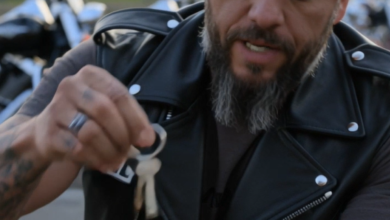
A PAWN SHOP OWNER THREATENED TO CALL THE POLICE ON A BIKER. THEN THE BIKER LIFTED THE MOTORCYCLE SEAT, AND THE OWNER LOWERED HIS PHONE.
Part 2
Cole slid two fingers under the strap and drew the photograph out by its white border. He turned it so Ruth could see it first.
June left her spot by the window to see. A man on a red motorcycle had his chin tucked into his collar like he was laughing at something the girl over his shoulder had said. One of her white canvas shoes was hooked around the passenger peg. June didn’t recognize her until she saw that the girl had the same gap between her front teeth that Ruth did.
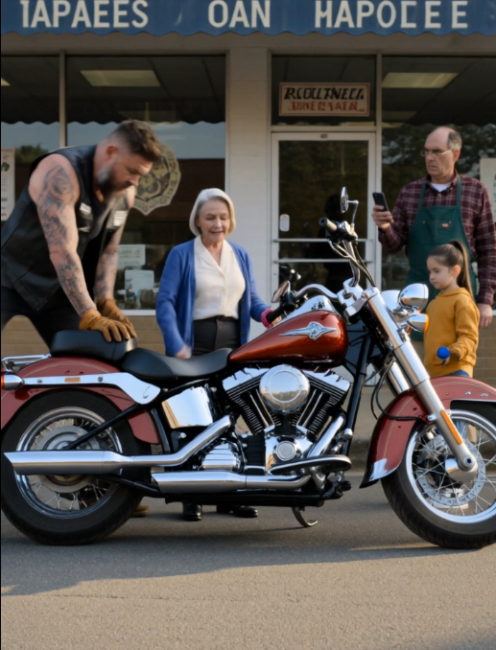
“That’s me,” Ruth said. “I was twenty. Your Aunt Linda was taking the picture. She took so long Henry told me to put both feet down. I told him he could put them down himself.”
“Those are your shoes?”
“I had white ones once.”
“Where’d you get them?”
“Same place I got the ones I’m wearing now. They used to sell a lot more white shoes.”
“Somebody could have left a picture in any bike,” Howard said.
“Yes,” Ruth said. “Put your hand under the left side of the tank.”
Cole bent until his beard brushed his vest. There was an uneven little heart on the lower lip of the tank. June had to get down on her knees to see it.
“Twenty-fifth anniversary,” Ruth said. “He used a scribe from the toolbox. He thought he’d make a nice neat heart. See where he slipped on the right? I used to put my thumb there when I was waiting for him to come out of the house.”
“Your husband?” Cole asked.
“He’s been gone two years.”
He gave her the picture. She held it by the edges the way he had. Her wrist moved and the toy cuff gave a hollow rattle against the handlebar.
June fished a plastic key out of her jeans. “Can I get you off now?”
Ruth kept her eyes on the picture. June tried to fit the plastic key into the lock and her hand wobbled until the key rattled against the cuff.
“Yes, honey,” Ruth said. “Please.”
When her wrist was free, Ruth could see the shape of the cuff in her skin. Cole put his glove between the back of her hand and the rough sidewalk so she could push herself up. The woman by the window asked if she needed a chair. Ruth said she would in a minute. She wanted to keep looking straight at Howard while she could.
“How much?” she asked him.
“Ruth.”
“Just tell me what I’d need.”
Cole answered. “Forty-two hundred.”
“I brought a hundred and eighty,” Ruth said. “And my grocery card.”
June knew the card. Ruth kept it in a little plastic sleeve with a list of which cereal June’s dad would actually eat. She closed her cardigan pocket over it. Howard folded his phone against his chest.
“I can show you where that number came from,” he said. “Come inside a minute.”
“Who brought it in?”
Howard looked straight at June. She had never seen him look that way at her. It was how her teacher looked at a kid she had to send to the office while the rest of the class watched.
“Your grandson,” he said. “And he told me you sent him.”
Part 3
There was a gray bench inside the shop, worn lighter at one end. Howard brought a chair from behind the counter. Ruth went straight to the bench and made a little space for June.
“His mother used to sit right here and wait for him to finish counting the drawer,” she said. “I’d bring her zucchini bread. She always brought my pan back the same day.”
“Let me see what he signed.”
Howard took out a folder. June could read her father’s name through the glass.
“Grandpa left it to your dad,” Ruth told her. “Your dad used to come early on Saturdays to help him drain the oil. He filled out that paper at my kitchen table, right after the funeral.”
“Did Grandpa say he could sell it?”
“Your dad said it was staying right where Grandpa put it for as long as I was in the house. I asked for a key. He put the blue one right down between our coffee cups.”
Ruth spoke the way she did when she showed June how to use the old mixer. She left space between each thing she said, like she expected June to need time to figure out where it went.
“This is the loan ticket,” Howard said. “The bike sat in my back room until the date on the paperwork passed. I put it out this morning.”
“How long have you had it?”
“Since August.”
“You had it when Eli got the canning jars for me,” Ruth said. “He told me the light switch was acting up and he was keeping the garage locked till he could fix it.”
“How’d you find it today?” Howard asked.
“Marcie from across the street saw it on her way for coffee. I thought she’d sent me a picture of where to meet her for lunch.”
June moved a finger along a worn groove in the glass. She’d forgotten about the canning jars. She remembered the truck.
“Daddy said the truck came for a tire,” she said.
Ruth looked at her. “You saw a truck?”
“Through the kitchen window. He told me to go get my shoes, and when I got back it was gone.”
Howard picked up the folder like he meant to put it away. Cole set his receipt on the glass, keeping one hand on it.
“Did she send him?” he asked.
“That’s what he told me.”
“Did you ask her?”
Howard kept his eyes on the receipt. “I knew him. He’d been coming here with Henry since he was about her age. When somebody walks in with a title in his own name and tells you the family talked it over, you don’t expect to be holding court in your shop two months later.”
June remembered how Henry used to bring her dad into the shop to look at tools. She’d been allowed to look at the marbles, and Howard always set a stool by the case so she could see. She had expected him to say something about that just now. He looked down and picked at a corner of his folder.
“Let me call your dad,” Ruth said.
Howard’s phone rang first. He looked at the screen and offered it to Ruth across the counter.
“It’s Eli.”
Part 4
“Did Howard get the bike back inside?” Eli asked before Ruth had said a word.
“No.”
The shop was quiet enough that June, still leaning against Ruth, could hear a little spring squeak on the other end. Her dad’s truck made that noise when he sat back.
“Grandma. I was going to tell you.”
“How’d you hear?”
“Somebody sent me a picture. Is June still there?”
“She is.”
“Can you step away a second?”
“She’s already heard enough. You have ten minutes to come get her.”
Eli got there in seven. He wore the gray sweatshirt he used when he cut Ruth’s grass, and there was a piece of yellow straw caught in the cuff. June went to him as soon as he came through the door. He put a hand on the back of her head. He usually asked if she’d eaten. June wished he’d ask her that now, so she could say she’d only had cereal and he’d have something simple to do for her.
“I said it was mine to deal with,” he told Howard. “That’s all I said.”
Howard studied him. “You want me to play it?”
Eli’s hand fell away from June’s hair.
Howard opened a saved voicemail and set his phone on the counter. Eli’s voice came out softer than the one they had just heard. “Grandma said go ahead. She’d come herself, but her knee’s acting up. You can call me back when you’ve got a number.”
“You drove me to the pharmacy that week,” Ruth said. “I couldn’t make it from the car. You went all the way back inside to get my walker.”
“I remember,” Eli said.
“You knew exactly how much trouble I was having. That’s why I believed you when you said you’d get the jars yourself.”
“Where did the money go?” she asked him.
“Bills.”
“Which ones?”
He looked toward the window. The woman who had been filming was gone. June had wanted to ask her where the pictures would go. She was glad she’d never seen her press anything on the screen.
“An app,” he said. “Games. I was behind, and I figured I could get back to even before you needed the bike.”
“Needed it for what?” June asked.
Eli rubbed the straw off his cuff. It fell on the pawnshop floor. “Your great-grandma liked to sit by it.”
“I know,” June said. “She put Grandpa’s garage sweater on it.”
“You saw that?” Ruth asked.
“I came out to tell you the show was over. You were fixing the sleeves so they wouldn’t touch the ground.”
Ruth pulled one cuff of her cardigan down over her hand. “I took it back inside before supper. It was cold out there and I forgot for a second.”
Howard gathered the loan ticket and the title together. “I can call somebody to sort out what’s in my paperwork. I can’t decide what each of you promised the other.”
Cole had been at the end of the counter all this time. He picked up the receipt and looked out through the window at the red motorcycle. June thought he was about to say he wanted to go home. If he’d asked her to get out of the way so he could, she would have done it.
“Is there a blank sheet of paper back there?” he asked Howard.
Part 5
Howard handed him a piece of yellow legal paper. Cole borrowed a pen and wrote standing up, with one forearm against the counter. June watched the muscles in that forearm move beneath a tattoo shaped like the metal triangle Henry used to draw straight lines on wood. Cole’s handwriting was small and neat. His beard had caught a strand of lint from somewhere.
He turned the sheet around. It had his name at the top, Ruth’s underneath, and the motorcycle identified by the same number as the receipt. The line where the price would go said gift.
“Howard, make sure the shop can put it in her name,” he said. “If there’s something else to sign, bring it over.”
Ruth touched the pocket of her cardigan. “I can give you part now.”
“Keep it.”
“I get paid on the third.”
“I heard you,” he said. “You don’t owe me the money.”
Howard read the sheet. “I’ll make the calls Monday and get the right papers drawn up. I can keep the bike locked here until then.”
Ruth looked at Cole. “You were halfway to the street.”
“I’ve got a truck,” he said. “I’ll get home.”
“I meant you wanted it,” Ruth said. “It was yours for about twenty minutes.”
Cole picked up his glove and smoothed it on the counter. “I had money put by for a second lift at the shop. I decided I’d let myself get a motorcycle instead when I saw this one. The shop’s managed with one lift all this time. We can keep doing that.”
“What’s a lift?” June asked.
“It’s what lets you work underneath a car without lying on the floor.”
“Do you have to lie on the floor now?”
“Sometimes.” He looked at her and smiled. “I could stand to spend less time down there.”
Cole slid the brass key across the counter. Ruth stared at it for a long time.
“I can’t drive one,” she said. “Henry tried to teach me once. I let the clutch out in our own yard and went straight into a lilac bush.”
“Good bush?”
“Came back better than I did.”
June laughed first. It was such an ordinary little sound that Ruth reached for the key while it was still in the air. The brass was warm from Cole’s hand. On Monday, Howard got the transfer paperwork sorted out and Cole came back to sign it. A few days later, he brought the red motorcycle to Ruth’s garage on a trailer and waited while she picked the spot herself.
June watched her choose the place beside the workbench. Henry had traced his tools on a sheet of pegboard there, and there was an empty outline where a socket wrench belonged. June had tried to put scissors there once and they’d slipped through the two hooks.
Cole looked at the spare helmet on the shelf. “Do you still like to ride on the back?”
Ruth nodded. “I just don’t have anybody to get on in front.”
“Would Sunday work?”
“Which Sunday?”
“This one.” He glanced at the motorcycle, then back at her. “And the one after, if you want.”
Ruth put the pawnshop key on Henry’s workbench and told Cole what time she got home from church. Before he left, he pointed to the second helmet.
“That one’s too old,” he said. “We’ll have to find you one that fits.”
Part 6
On the first Sunday, Ruth came to the garage in the shoes she’d worn to the pawnshop. Cole asked if she had boots. June went to fetch the pair in the hall closet. She remembered Ruth saying she’d worn them the winter the furnace quit and Henry spent two mornings carrying wood to the stove. One boot still had a burr caught in the lace. Ruth worked it loose while Cole checked that she could get onto the passenger seat comfortably.
June stood at the driveway in her mustard sweatshirt. “Where are you going?”
“We haven’t decided,” Ruth said.
“How will you know when to come back?”
“I’ll wave if I see you.”
June watched them leave from the driveway. Later, her dad took her out in the truck, and she spotted the motorcycle coming out the far side of the low railroad bridge. Back at the garage, Ruth told her the wind had found a gap where she’d missed a button at the back of her neck.
“Your grandpa used to tip his head at every bend,” she said. “I’d look the way he tipped it and there’d be a horse in a field or somebody standing by a mailbox in slippers. Today I had to pick my own side. There was a heron by the river. I saw a man walking a dog with three legs. And I saw you, in the truck.”
“I waved.”
“I know. I told Cole to keep his eyes on the road. I was doing the waving for both of us.”
Eli was sitting on the porch step when they pulled in. He had brought a new garage lock in a hardware-store bag.
“I can put it on,” he said.
“You can leave it there,” Ruth told him.
He set the bag on the step. June came out of the house with one grape in each cheek. “Did you get a look at the top of the bridge?” Ruth asked her, and June swallowed so fast she coughed. Eli went inside for water. The lock was still in the bag when he left.
The next week, June’s dad brought her to Ruth’s house to drop off a book. At the back door he told Ruth he’d asked Cole about work. Cole had sent him home with the shop’s address and the name of a support group that met across town. June stayed at the door while the two of them talked.
“He said I’m welcome to learn,” Eli told her. “He said I have to take care of the gambling part first. I thought I’d just go in on Saturdays.”
“What did you say?”
“I asked him how long he thought that would take.”
Ruth waited.
“He said he didn’t know. He offered to drive me Thursday if I didn’t want to walk in by myself.”
Ruth folded the dish towel in her hands and set it down.
“Do you two want dinner?” Ruth asked.
“We ought to get home,” her dad said. “June’s got a spelling test.”
“That’s next week,” June said. She would have stayed for dinner. Ruth wrapped two pieces of cornbread in foil and tucked them under June’s library book.
Six Sundays after the pawnshop, Cole arrived with Eli in his truck. Eli had new work gloves, the cheap canvas kind with blue stripes. He kept taking them out of his pocket and putting them back in.
“He’s going to start sweeping at the shop tomorrow,” Cole said.
Eli held out a long white envelope to Ruth. “Before I do, I need you to see what I wrote down.”
Part 7
Inside the envelope was a list of dates and amounts in Eli’s handwriting. The first figure was forty dollars. Beside it he had written the date of his first Friday on the payroll. “Forty dollars is half my groceries some weeks,” Ruth said. She ran her finger down the page. June saw where her dad had left some of the boxes empty.
“Why’d you leave those blank?” June asked him.
“I don’t know what I can do that far ahead.”
“You could use pencil.”
“I know. I’m going to wait till I can put it in pen.”
“Cole told me the motorcycle was a gift,” she said.
“It is. I’m asking you to keep this so I don’t lose track of what I said I’d do.”
“Did he ask you to pay him?”
“He told me I could quit talking about the money and show up on time. I figured I could do both.”
Ruth let June put the list in the recipe box behind the cards for Christmas cookies. When the first payment cleared, June watched Ruth check it off. There were Fridays when her dad brought a smaller number than he’d planned. Once, before Ruth asked, he said, “It’s twenty-five this week. June needed a new pair of shoes.” June looked down. They were the white ones she had asked for. On Sundays, once the road had been salted, Cole still stopped by. They drank coffee in the garage, and he showed June how to tell a box wrench from an open-end wrench without looking.
In spring, Ruth started leaving the routes to June. The girl drew them on the backs of grocery circulars and gave every crossing a name. The railroad bridge became Duck Your Head, even though there was plenty of clearance. The corner where a couple sold sweet corn in August was called Three Dogs, after the animals that slept under their table. One Sunday June watched Ruth tuck a route into the seat compartment, behind the photograph. By the third year the stack was thick enough to lift the rubber strap.
That last fall, Eli asked Ruth to watch him set the idle. He bent over the tank, his thumb finding the crooked heart by habit. “How’d you know where to find that?” Ruth asked.
“Grandpa gave me the scribe to hold while he took the cover off. Then he asked me to watch the kitchen window while he did it.”
“You were there?”
“I was seven. He said we were both going to be in trouble if you caught us.”
Ruth laughed so hard June thought she might drop the mug she was holding. Her dad laughed with her. The next morning Ruth sent June out to the driveway with the blue-capped key. “Tell him we need another for the garage,” she said. June had carried the key for Ruth a few times since the pawnshop. This was the first time she’d been asked to give it to her dad.
Late that October, after three years of Sundays, June watched Ruth try to lift her foot onto the passenger peg. Her boot stayed an inch short. Cole waited until she lowered it. Then he asked whether she’d rather sit on the front steps. June brought out their coffees and sat on the walkway below them. Cole moved down one step so Ruth could put her feet down where it was level.
“I’ll ask you something now,” she told him. “It’ll be easier for both of us if I do.”
“Okay.”
“When they take me out to Henry, I want you up front on that motorcycle.”
Cole turned his cup in both hands. “I can do that.”
“And under the seat,” Ruth said, looking at the garage. “There’s something else I want you to take out.”
Part 8
For the funeral, June wore black shoes with white soles. She was twelve by then and nearly tall enough to look down at the passenger seat the way Ruth used to. She stood beside the garage with the old photograph in one hand. Ruth had shown her how to clip it to the handlebar inside a clear sleeve, facing outward where anybody walking up to the red motorcycle could see it.
Cole held the sleeve steady while June fed the picture through the opening.
“Can you see her?” June asked.
“All of her,” he said.
Cole wore the same black vest he had worn to the pawnshop. A few riders from his club waited at the end of the drive, their engines off, the silver bird on each back catching the pale November sun. June had asked Ruth about that bird once. Ruth told her to ask Cole. He said wrens were the first things he heard when he opened the shop on bad mornings, because there was a nest above the old outside light. They used to build there before he ever owned the building.
Howard came down the sidewalk in a brown suit that fit him like something he’d last worn to his own wedding. He stopped short of the driveway. June could see him looking at the photograph. Eli saw him, too, and laid his hand flat against the workbench he’d just walked away from.
“Somebody at the church asked me if Grandma pawned it herself and changed her mind,” he said. “Did that come from you?”
Howard took a breath. “I told people she changed her mind. I didn’t want to tell them I never asked her.”
“I told you she said yes.”
“You did.”
“I knew she’d say no. I took it anyway.”
June held the edge of the plastic sleeve so it wouldn’t tap against the chrome. She could remember the phone Howard had held up at the pawnshop. She could also remember how much she had wanted the people by the window to go away. The riders at the curb stayed where they were. Nobody lifted a phone.
“If they ask again,” Eli said, “tell them I took it to cover my betting. Tell them she only found out when a neighbor saw it in the window.”
Howard’s eyes went to June first, just as they had when he said Eli’s name in front of the pawnshop. This time he looked back at Eli.
“I’ll tell them I had her number,” he said. “I could’ve used it.”
Eli had been taking extra Saturday shifts for months. He pulled a folded shop envelope from his inside pocket and gave it to Cole. “Last one,” he said. “She checked it off before I had it. I told her I’d have it by Friday.”
Cole took it. He put it in his vest without looking inside.
“Your grandma left me something else,” he said to June.
He unlatched the seat and pulled a bundle of folded paper from under the rubber strap. June saw a grocery price at the edge and recognized her crooked map of the river road. There was a fresh one tucked around all the others. The writing on it was Ruth’s.
Part 9
At the top, Ruth had printed the address of the cemetery. She’d added three turns in pencil, including one she could have left out if she’d sent them the quickest way. The extra turn took them under Duck Your Head. At the bottom, in writing so faint June almost missed it, she’d put, “I’ll have time.”
Cole gave the page to June and asked if she wanted to lead him through the turns from her dad’s truck. June said she wanted to see him go first. She stood beside the driveway with the paper in both hands until Cole swung his leg over the red motorcycle and waited for the hearse to come up from the church. He started the engine when the driver nodded. The picture on the handlebar trembled in its sleeve. Henry was still laughing, and Ruth’s white shoe was still hooked around the passenger peg.
They went under the railroad bridge at thirty miles an hour. June looked up through the windshield. Her father ducked his head a little even though he was driving a truck.
At the cemetery, Howard walked up to two people who had known Ruth from church. June heard him tell them he’d called her a thief in front of his shop and that she had been telling the truth. He had to stop and clear his throat between those two things. One of the women moved her purse to make room for him beside her on the folding bench.
It was cold by the time everybody left. Cole and June went back to Ruth’s to put the motorcycle away. Eli came in after them.
“What time do you want supper Thursday?” June asked.
“Seven. I’m going back to the meeting this week.”
“That’s what I meant. I’ll save you a plate.”
He looked at her for a second before he said thank you. He’d missed two meetings when Ruth got sick. The first time he’d gone, he’d said he was working late. Now he told her where he was going.
In the garage, she watched him hold the blue-capped key out to her. She could hardly get her fingers around it in the pawnshop. Now it fit in her palm with room to spare.
“Want to put it up?” he asked.
The pegboard had an empty hook below the socket wrench Henry had traced. June had always thought a bigger wrench belonged there. She hung the key on it anyway. Cole took the photograph out of the clear sleeve, and she helped him slide it back under the seat strap with Ruth’s map on top.
June found the pink toy cuffs in the pocket of Ruth’s cardigan when they cleaned out the hall closet. She took them to the garage the next Sunday. Cole had come over with coffee for Eli and a hot chocolate for her. His gloves were on the workbench. June closed one cuff around the loop on his right glove, left the other dangling, and waited for him to notice.
He lifted the glove. “You coming with me?”
“Only as far as the bridge.”
He set his cup down to find her a helmet. June had thought the leather vest and the tattoos would be the things she remembered about him from that Saturday. What she remembered best was the space he’d left between his bare hand and hers when he’d held out his key.
If Ruth and Cole’s Sundays stayed with you, follow the page for more biker stories about the people who show up and keep their word.