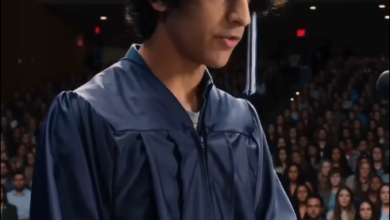
Part 2: A Student Handed the Microphone to His Mother at the Awards Ceremony — Her Story Made the Whole Hall Break Down
For a moment, the microphone looked too heavy for Maria Brooks.
She held it with both hands, her fingers wrapped around the black handle as if it might fall and shatter. Under the auditorium lights, every tired line in her face seemed sharper. Every whisper in the room seemed crueler than before.
Ethan stood beside her, not smiling.
That was the first thing people noticed.
A boy receiving the highest academic honor in school should have been proud. He should have posed for pictures, held his medal high, and let his mother cry quietly from her seat.
Instead, Ethan looked almost guilty.
Principal Harris paused halfway down the steps.
“Mrs. Brooks,” he said carefully, “you don’t have to speak.”
Maria looked at him, then at Ethan.
“I know,” she said.
Her voice trembled, but it did not break.
From the second row, Mrs. Caldwell, mother of the salutatorian, leaned toward her husband and whispered, “Why would he do this to her?”
Maria heard that too.
Her eyes lowered to the medal in her lap, gold against the faded blue fabric of her waitress apron. She brushed it once with her thumb, not like she wanted it, but like she was checking whether it was real.
Ethan bent down slightly. “You can sit back down.”
Maria shook her head.
That was the second thing people noticed.
She had begged him not to start this, yet now that the room had turned against them, she refused to let him stand alone.
“My son was not always the student you see tonight,” she said.
A few teachers shifted in their seats.
Some remembered.
Freshman year, Ethan Brooks had been the boy who slept through first period, never brought lunch, and once walked out of an algebra test after turning in a blank paper. He had not been dangerous. He had simply seemed unreachable.
Maria swallowed.
“When Ethan was fourteen, people thought he was lazy.”
Ethan looked down.
His guidance counselor, Ms. Whitaker, closed her eyes briefly.
“They thought he was rude because he did not answer questions,” Maria continued. “They thought he did not care because his homework came in wrinkled, late, or not at all.”
She looked at the medal again.
“But he cared.”
The hall grew quieter.
A phone stopped recording.
Maria’s hand moved to the hospital band on her wrist. It was white, cheap plastic, and painfully out of place beside the formal dresses and pressed suits around her.
Ethan saw her touch it and whispered, “Mom, you don’t have to.”
“I do,” she said.
That was the third thing people noticed.
Whatever was happening, it was no longer Ethan forcing his mother into shame. It was a mother stepping into it before the crowd could put it back on her son.
Maria took a breath.
“I have kidney disease,” she said.
The words landed softly, but the room changed.
A few heads turned. A few parents sat straighter. Someone in the back whispered, “Oh, my God.”
“I have had it for years,” Maria continued. “Most days, I could hide it. Some days, I could not.”
Ethan’s jaw tightened.
“When Ethan was a freshman, I got worse. I was working two jobs, taking buses between the diner and the laundromat, and pretending I was just tired.”
Her eyes found Ms. Whitaker in the teachers’ row.
“Some teachers knew something was wrong. Most did not. Ethan asked me not to tell anyone because he did not want pity.”
Ethan gave a small, humorless laugh.
“That was not the only reason,” Maria said, turning slightly toward him.
He looked startled.
The audience leaned in.
“You also asked me not to tell them because you were afraid they would call social services.”
Ethan’s face went pale.
Maria reached for his hand.
“I was angry when you said it,” she admitted. “But you were a child trying to keep us together with hands too small for the job.”
The sentence moved through the auditorium like a held breath.
A teacher in the back wiped her eyes.
Maria continued slowly, revealing only one piece at a time.
“Every morning, Ethan woke up at five. He packed my medicine. He checked whether I had eaten. He put my work shoes by the door because some mornings I could not bend down.”
Ethan stared at the floor.
The honor student who looked so disciplined had not learned discipline from ambition.
He had learned it from fear.
“He missed breakfast so I could have toast with my pills,” Maria said. “He told people he forgot lunch because he did not want them to know he had given me his.”
Mrs. Caldwell looked down at her folded program.
Maria’s voice softened.
“And when he fell asleep in class, it was not because he stayed up playing games.”
She paused.
“It was because he stayed awake to make sure I was still breathing.”
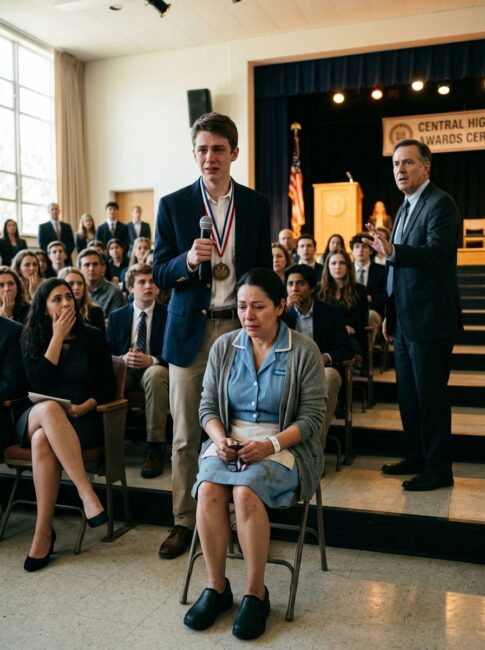
The auditorium no longer felt like a ceremony.
The banners still hung from the walls. The certificates still waited on the side table. But every shiny surface seemed dimmer beside the plain truth standing in the front row.
Maria held the microphone closer.
“Ethan got his first detention for leaving school without permission,” she said. “That is what the record says.”
Principal Harris looked toward the floor.
Ethan’s fingers curled into his palms.
“But the record does not say he left because I collapsed outside the laundromat,” Maria continued. “It does not say the owner called the school because Ethan was the only number I had written on my emergency card.”
A murmur spread through the teachers.
Ms. Whitaker covered her mouth.
“He ran six blocks in dress shoes he had borrowed for picture day,” Maria said. “He found me on the sidewalk with strangers standing around me. Then he rode in the ambulance and told me not to be scared.”
She looked at Ethan, and her face broke into the saddest smile.
“He was fourteen.”
Ethan whispered, “Please.”
But Maria shook her head.
“You carried this too quietly.”
That was the fourth twist.
The boy who appeared cold and private had not been protecting his pride. He had been protecting his mother from becoming a school rumor.
Maria turned back toward the audience.
“When I was put on the transplant list, Ethan changed again. Not all at once. Quietly. He started studying in waiting rooms. He wrote essays beside vending machines. He took online practice tests while I slept during dialysis.”
A man in the third row removed his glasses and wiped them with his sleeve.
“Sometimes he got perfect scores,” Maria said. “Sometimes he cried in the bathroom and came back pretending he had allergies.”
Ethan closed his eyes.
“He applied for scholarships without telling me because he thought college was selfish when I was sick.”
Ms. Whitaker stood then.
Not fully, just enough for the room to see her.
“He tried to withdraw his applications,” she said.
Ethan looked at her sharply.
The counselor’s voice trembled. “Two months ago, he came to my office with a folder. Every acceptance letter was inside. He told me he needed help finding full-time work instead.”
Maria turned toward her son.
This part she had not known.
“What?” she whispered.
Ethan looked trapped.
The main twist began to surface, slow and painful.
“I was going to defer,” he said quietly.
Maria shook her head. “You told me everything was handled.”
“It was.”
“With what?”
He did not answer.
Ms. Whitaker did.
“He had been offered a full scholarship to Northwestern.”
The room reacted before Maria could.
A gasp moved through the auditorium.
Maria’s hand flew to her chest. “Ethan.”
“He refused to sign the final form,” Ms. Whitaker said, tears in her eyes. “He said he couldn’t leave you.”
The medal slipped slightly in Maria’s lap.
All the years she had thought he was pushing himself toward freedom, he had been preparing to give it back.
Maria turned to him, stunned and heartbroken.
“You promised me you would go.”
“I promised you I would take care of you,” Ethan said.
“I never asked you to pay for my life with yours.”
He flinched.
The hall was silent enough to hear the stage lights hum.
Then Principal Harris spoke, softly.
“There is more.”
Ethan looked up, warning in his eyes.
The principal held up one hand. “I think your mother should know.”
Maria stared at him.
Principal Harris walked to the podium and lifted a small envelope from beside the award folder.
“This came last week,” he said. “Ethan asked me not to mention it tonight.”
Ethan’s face went rigid.
Maria whispered, “What is it?”
The principal opened the envelope and unfolded a letter.
“Ethan wrote an essay for the Sterling Medal application,” he said. “Not about grades. Not about leadership titles. He wrote about measuring his mother’s medicine with a plastic diner spoon because the pharmacy cup had cracked.”
Maria began crying before he finished.
“He wrote that love sounded like a bus braking outside at 11:47 p.m., because that meant his mother had made it home from work.”
Someone in the audience sobbed.
“He wrote that he learned courage from a woman who apologized to him every time she needed help standing up.”
Maria covered her face with one hand.
“But that is not why I have this envelope,” the principal said.
He turned the letter toward the room.
“The scholarship committee read his essay. They contacted the hospital foundation named in it. And yesterday, Ethan was awarded an emergency family support grant that will cover in-home care during his first year of college.”
Maria stopped breathing for a moment.
Ethan looked at the floor as if he had been caught doing something wrong.
“He did not want this announced,” Principal Harris said. “He said his mother deserved dignity, not applause.”
That sentence changed everything.
Every parent who had judged Maria’s uniform saw it differently now. It was not a failure to dress properly. It was proof she had come straight from work, sick and exhausted, because she refused to miss her son’s moment.
Every teacher who had remembered Ethan as difficult saw the boy behind the behavior.
Every student who had envied his achievements saw the cost hidden under them.
Maria turned toward her son.
“You handed me the microphone because you thought they gave the award to the wrong person,” she said.
Ethan’s eyes filled.
“I handed it to you because nobody here knows what you survived.”
Maria stood fully now.
She placed the medal back into his hands.
“No,” she said softly. “Nobody here knows what we survived.”
He broke then.
Not dramatically. Not loudly.
Just enough for his shoulders to fold and for the boy beneath the blazer to show through.
Maria pulled him into her arms in front of everyone. The microphone dropped slightly between them, catching the sound of her whisper.
“You are going to college,” she said. “And I am going to be here when you come home.”
The applause did not begin right away.
The room was too busy crying.
Then Ms. Whitaker stood.
Then one teacher after another.
Soon the whole auditorium rose, not for a perfect student with a perfect record, but for a mother and son who had spent four years refusing to let hardship have the final word.
After the applause faded, nobody seemed eager to return to the printed program.
Principal Harris looked at the remaining awards on the table and then at Ethan and Maria in the front row. Something in his expression had softened, as if the evening had stopped being about achievement and started being about people.
He cleared his throat.
“I think,” he said, “we can take a moment.”
No one objected.
Maria sat back down slowly, the hospital band still visible at her wrist. She did not try to hide it anymore. Ethan sat beside her, the Sterling Medal resting across both their hands.
For the rest of the ceremony, people looked at them differently.
Not with pity.
That would have hurt.
They looked with the quiet respect people give when they finally understand how much they did not see.
Mrs. Caldwell approached during the reception afterward, holding a plate with a slice of cake she had not eaten.
She stopped in front of Maria and seemed to search for the right words.
“I’m sorry,” she said.
Maria looked tired, but kind. “For what?”
Mrs. Caldwell glanced at the uniform, then at the floor. “For thinking I knew anything.”
Maria nodded once.
It was not forgiveness made for display.
It was simply enough.
Ms. Whitaker came next, hugging Ethan with the careful strength of someone who had wanted to do more for years. Principal Harris promised to help arrange the home-care paperwork. A local father who owned a small medical supply company quietly offered to deliver a better pill organizer and a shower chair before the weekend.
Maria kept saying, “You don’t have to.”
And each time, someone answered, “We know.”
Near the end of the night, Ethan found his mother alone by the auditorium doors. She was looking at the framed photos of past award winners, rows of smiling students under glass.
“Do you think they’ll put mine up there?” he asked.
Maria smiled faintly. “They better. I wore my best uniform for this.”
He laughed, and the sound surprised them both.
For a few seconds, they stood together without fear rushing in to fill the space.
Outside, evening had settled over the school parking lot. The last sunlight rested on the tops of cars, soft and golden. Maria shifted her weight, trying to hide the pain in her legs.
Ethan noticed, as always.
This time, before he could reach for her elbow, she reached for his.
“Walk with me,” she said.
Not help me.
Not hold me up.
Walk with me.
He nodded.
As they stepped outside, Maria paused and touched the medal hanging around his neck.
“You were wrong about one thing,” she said.
Ethan looked at her.
“They did not give it to the wrong person.”
He swallowed.
Then she added, “But I am glad you let me hold it first.”
They crossed the parking lot slowly, mother and son under the fading light, neither of them carrying the whole story alone anymore.
Follow the page for more emotional stories that stay with you long after the last line.