A Terrifying Biker Forced Me Off an Ohio Interstate — Then the Tire Technician Pointed at What He Had Seen Behind Me
The giant biker boxed my car against the shoulder, hammered his tattooed palm on my window, and shouted so fiercely that I started recording what I believed might be my final moments.
My name is Claire Bennett. I was thirty-seven years old, driving alone from Columbus to Indianapolis for a job interview when Wade “Gravel” Mercer appeared in my rearview mirror on Interstate 70.
I noticed his motorcycle first.
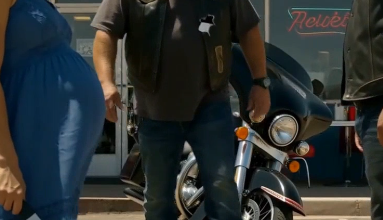
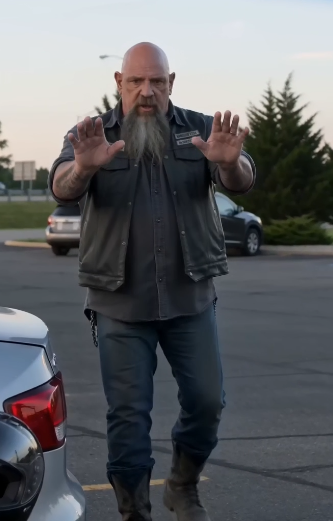
The black Harley rode behind my left taillight, its V-twin engine vibrating through the summer traffic. Then I saw the man controlling it—six-foot-five, broad-shouldered, shaved head, long gray beard, tattooed arms, black leather vest, faded jeans and heavy boots.
He looked furious.
Wade pulled beside me and pointed downward. I could not hear him through the glass, but his mouth formed words that looked like commands.
I tightened both hands around the steering wheel.
When I accelerated, he accelerated.
When I changed lanes, he followed.
I grabbed my phone and called my sister through the car speakers. I told her a biker was chasing me and asked her to write down my location.
Mile marker 41.
Westbound.
A few miles outside Springfield, Ohio.
Wade moved ahead of me, turned on his hazard lights and began slowing. I tried to pass, but another motorcycle appeared beside my rear quarter panel.
There were three of them now.
My fear became certainty.
They were trapping me.
The first biker guided me toward a wide emergency turnout near an old service station. When I stopped, Wade planted his boots, shut off the Harley and came straight toward my driver’s door.
I locked it.
His fist struck the glass.
Once.
Twice.
“Turn it off!” he shouted. “Don’t move!”
I raised my phone and began filming.
“Stay away from me!”
A family beside the service station turned toward us. A truck driver started walking across the lot. Someone lifted another phone as Wade struck the window again with his open palm.
He did not look at my camera.
He kept looking behind me.
“Get away from the car,” I screamed.
“Not until you shut it down.”
His voice sounded rough enough to scrape paint. His beard moved with every word, and the tendons in his tattooed neck tightened as strangers gathered.
One of Wade’s riding brothers approached slowly.
“Gravel, back off. You’re scaring her.”
Wade never moved.
The truck driver shouted that the police were coming. Wade raised both hands, stepped away from my window and pointed toward the rear passenger side of my car.
“Don’t drive another foot.”
I thought it was another threat.
Then something happened that did not fit.
Wade removed his leather vest, folded it over the seat of his Harley and sat down on the pavement with his hands visible. He allowed the crowd to surround him while one of his brothers stood between us.
No one touched my car.
No one demanded money.
No one tried to open the door.
Wade simply watched my rear wheel as though it were counting down toward something only he could see.
A state trooper arrived eleven minutes later. I gave him my video and said the biker had forced me off the interstate.
Wade did not argue.
“He can arrest me after somebody checks that tire,” he said.
The trooper crouched beside my car. His expression changed before he even touched the rubber.
Then he stood and ordered everyone farther back.
A roadside technician arrived soon afterward. He shone a light across the sidewall, slowly ran one gloved finger around an egg-shaped swelling and looked toward the highway I had just left.
“How fast were you driving?”
“Seventy-two.”
The technician stared at me.
Then at Wade.
“You were not taking this car another mile.”
Only then did I understand why the biker had been watching my wheel instead of my face—and why his hands began shaking after the danger had already passed.
Wade had seen something pulsing in my tire at highway speed, but the worn photograph inside his vest explained why he refused to let me keep driving.
Want to know what the technician found and whose photograph Wade carried beside his heart? Drop TIRE in the comments — I’ll share more soon.
My anger did not disappear when the technician condemned the tire.
Fear rarely leaves that cleanly.
It changes shape.
One moment, I was afraid of Wade Mercer. The next, I was staring at an ugly swelling in my tire and wondering what might have happened if he had watched me continue west.
The state trooper introduced himself as Daniel Ruiz. He took my statement first, then spoke with Wade beside the motorcycles.
Wade was fifty-five, a former fleet mechanic from Dayton and president of a small veterans’ riding club called the Iron Lanterns. The club had no criminal record, but Wade did.
Eighteen years earlier, he had served fourteen months for aggravated assault.
That fact spread through the parking lot faster than the truth about my tire.
The truck driver who had confronted him stepped closer to me. “You still need to press charges. A bad tire doesn’t give him the right to terrorize you.”
I looked at the red mark his palm had left on my dusty window.
Then I looked at the ruined tire.
Both things were real.
Trooper Ruiz asked whether Wade had touched me, damaged my car or attempted to enter it. I said no. He had struck the glass with his open hand and shouted until I turned off the engine.
“Why didn’t he call the police?” I asked.
“He did,” Ruiz replied.
Wade had called 911 through the communication unit in his helmet. Traffic noise and a weak connection made the dispatcher struggle to understand him, but the call had been logged eight minutes before I stopped.
He had given my license plate.
My location.
My direction of travel.
He had said the words “possible tire separation” three times.
That did not make his method gentle.
It made his motive harder to dismiss.
The roadside technician’s name was Marcus Hill, a forty-four-year-old Black mechanic who had spent two decades responding to breakdowns along I-70. He refused to predict exactly when the tire might have failed.
“No honest technician can give you a countdown,” he said. “But a bulge means the internal structure is compromised. This car goes on a tow truck.”
He photographed the tire before removing it. Under the shop light, the swelling looked like an egg pushing outward beneath the rubber.
I had checked the car that morning.
At least, I believed I had.
I had walked around it with a travel mug in one hand, glanced at all four tires and decided they looked fine. I had not crouched down. I had not examined the inner sidewalls.
The bulge faced partially inward.
Wade had seen it because the tire wobbled under load and the deformation appeared during rotation.
He noticed what I could not.
Bear, the older biker who had told Wade to back away from me, came over while Marcus prepared the tow.
His real name was Thomas Keegan. He had white hair tied beneath a black bandanna, a trimmed beard and the patient expression of a man accustomed to translating Wade into complete sentences.
“He shouldn’t have hit your window like that,” Bear said.
“I know.”
“So does he.”
Wade was sitting alone beside the service station wall. Without his vest, he looked less like the figure in my video and more like an exhausted mechanic in a charcoal T-shirt.
A blue tattoo covered part of his right forearm.
Not a skull.
A small monarch butterfly.
“Why did he do it that way?” I asked.
Bear watched him for a long moment.
“Because once, he waited.”
That was all he would tell me.
My car was towed to a tire shop in Springfield. Wade and the Iron Lanterns followed, their engines rolling behind the truck in a low mechanical thunder.
I did not ask them to come.
I did not ask them to leave.
Wade parked at the far end of the lot and stayed there while Marcus removed the damaged wheel. The other bikers stood near the service bays, leather creaking whenever they shifted their weight.
A younger rider named Calvin examined the tire.
“Could’ve been road damage,” he said.
Marcus nodded. “Pothole, curb strike, internal defect, underinflation. We can’t know from looking at it.”
The distinction mattered.
The biker had recognized danger, but no one could prove what caused it or exactly when it would have failed. This was not a story in which one man possessed supernatural knowledge.
He had experience.
He had seen a warning.
He acted.
Marcus placed the tire behind a safety barrier and told me it would be retained for documentation. My remaining tires were the same age, so he recommended a complete inspection before the car returned to the road.
The job interview was gone.
I called the company and explained that I had been forced off the interstate by a stranger before learning my tire was unsafe. The receptionist paused for several seconds.
“That is not an excuse we hear often.”
Neither of us laughed.
While I waited, the video escaped my phone.
I had sent it to my sister during the confrontation. She forwarded it to our family group, and my cousin posted part of it online without asking me.
The clip stopped before Trooper Ruiz inspected the tire.
Within an hour, strangers were sharing the image of Wade pounding on my window. They called him a predator, a road-rage criminal and a violent biker chasing a woman traveling alone.
Someone identified him.
Someone found his employer.
Someone uncovered his conviction.
The internet arranged those facts into a story before I had even understood them myself.
Wade’s phone rang repeatedly. He never answered.
Calvin wanted the club to publish a statement. Another rider, Stitch, said their helmet cameras might show Wade pointing toward the wheel. Bear insisted they speak to a lawyer first.
Wade remained silent.
Finally, Calvin confronted him.
“You made us look like we were hunting her.”
“I know.”
“You could have backed off.”
“No.”
“You could have waited for the trooper.”
Wade looked toward the damaged tire.
“No.”
Calvin threw his gloves onto a workbench. “Brotherhood doesn’t mean following you into every bad decision.”
Wade’s face did not change.
“Shouldn’t.”
That answer quieted the room.
He did not ask the club to defend him. He told them to release any recording that showed the full event, including his mistakes.
“If I crossed a line, show the line.”
Bear stared at him. “And if people still come after you?”
Wade pulled the pressure gauge from his pocket and rolled it between his scarred fingers.
“Then they come.”
Marcus called me over.
The bulge was not the only concern. A section of the inner sidewall showed rippling and discoloration consistent with internal stress.
He could not tell me whether the tire had ten minutes or ten days.
He could tell me one thing.
I had been right to stop.
I looked through the open bay door. Wade stood beside his Harley, surrounded by men willing to ride through storms with him but unwilling to lie for him.
That was when I walked outside.
“You could have killed yourself cutting in front of my car,” I said.
“Yeah.”
“You could have caused a crash.”
“Kept distance.”
“You scared me.”
“I know.”
I waited for an apology.
It did not come immediately.
Wade looked at my hands, still clenched around my phone.
“I’m sorry for the fear,” he said. “Not for stopping you.”
The words angered me because they were honest.
“Why were you shaking after we stopped?”
His eyes moved toward the monarch tattoo.
Bear answered from behind us.
“Her name was Hannah.”
Wade closed his hand over the butterfly.
And walked away.
Hannah Mercer was Wade’s wife.
She had been thirty-two years old when a tire failed on their Ford station wagon seventeen years earlier. Their eight-year-old daughter, Emily, was asleep in the back seat.
Wade was driving.
They were returning to Dayton after visiting Hannah’s mother near Cincinnati. The road was dry. Traffic was light. Wade later told investigators he heard three sounds.
A vibration.
A slap beneath the floor.
Then Hannah shouting his name.
The rear tire failed, and the station wagon left the roadway. Wade survived with a fractured shoulder and a deep cut beside his ear. Emily survived because Hannah had checked her seat belt minutes earlier.
Hannah did not come home.
The investigation found severe internal damage in the tire. Whether a road impact, low pressure or another factor initiated it could not be determined with certainty.
Wade wanted certainty.
Grief did not provide it.
He blamed the tire manufacturer, the shop, the highway and finally himself. He had noticed a faint vibration earlier but decided to continue until the next exit.
Fourteen miles.
That decision became the distance he could never stop measuring.
Months later, Wade attacked a drunk driver outside a bar after hearing the man joke about crashing his truck. The driver suffered a broken jaw and permanent damage to one eye.
Wade went to prison.
He did not become a saint inside. He fought twice during the first month and spent weeks in segregation.
Then an envelope arrived from Emily.
She was nine years old. Her handwriting leaned downhill across the page.
Dad, Mom told me people are more than their worst day. Please don’t make your worst day longer.
Wade still carried that letter.
The photograph inside his vest showed Hannah kneeling beside a motorcycle she had helped him rebuild. She wore grease on her cheek and held a tire-pressure gauge like a tiny microphone.
The monarch tattoo came from her favorite necklace.
After prison, Wade stopped drinking and returned to mechanical work. No large dealership wanted a mechanic with an assault conviction, so an older veteran named Frank Keegan—Bear’s father—gave him a job maintaining delivery vans.
Wade studied tire failures at night.
He learned to recognize sidewall deformation, irregular wear, heat damage and the faint rhythmic movement of a tire no longer running true. He took roadside-safety courses and volunteered at community vehicle inspections.
Every summer, the Iron Lanterns inspected cars for single parents, veterans and elderly drivers before holiday trips.
Wade never told them why.
Bear knew.
Emily knew.
Most of the club did not.
The pressure gauge in Wade’s vest had belonged to Hannah. Its brass surface was worn smooth where her thumb had rested.
That was the object Wade had been rolling between his fingers at the shop.
He had not seen only my tire on Interstate 70.
For several seconds, he had seen the back of a station wagon disappearing toward an exit seventeen years earlier.
This time, he did not wait.
The revelation did not erase my terror beside the service station. Wade’s past explained his urgency, but pain does not automatically make every decision correct.
Emily Mercer understood that better than anyone.
She arrived at the tire shop shortly before sunset in blue hospital scrubs, driving an old pickup with a child’s booster seat in the back.
She was twenty-five now, an emergency-room nurse and mother of a four-year-old boy.
She walked directly to Wade.
“You hit her window?”
“Open hand.”
“That isn’t the part I asked about.”
Wade lowered his eyes.
Emily turned to me. “Did he frighten you?”
“Yes.”
“I’m sorry.”
Wade flinched as though the apology belonged to him.
Emily faced her father again. “You saw Mom’s car.”
He said nothing.
“You were back there, weren’t you?”
A muscle moved in his jaw.
“Yeah.”
Emily took the old pressure gauge from his hand.
“You saved her from the danger you recognized,” she said. “But you cannot turn every warning into the crash we survived.”
Wade nodded once.
It was the smallest movement in the room.
And the hardest.
The complete story emerged through three recordings.
My video showed Wade striking the glass and shouting.
His helmet camera showed what happened first: the repeating distortion in my rear tire, his attempts to point, my acceleration and his call to emergency services.
Stitch’s camera showed Wade moving ahead with his hazard lights on, creating distance and reducing speed before guiding me toward the turnout.
None of the recordings made him look perfect.
Together, they made him understandable.
I posted a second video that evening.
I described the tire, the technician’s findings and Wade’s warning. I also said he had terrified me and that motorists should contact emergency services whenever possible instead of using aggressive roadside gestures.
“I thought he was attacking me,” I said. “He believed I was seconds or miles from a tire failure. Both of us acted from fear.”
The correction spread more slowly than the accusation.
It always does.
The next morning, however, Marcus uploaded photographs of the tire with my permission. Trooper Ruiz confirmed that Wade had called 911 before forcing the stop.
Local news stations requested interviews.
Wade refused all of them.
When a reporter asked why, he gave Bear six words to deliver.
“Make the tire famous. Not me.”
Calvin apologized to Wade for confronting him at the shop.
Wade shook his head.
“You were right.”
“About what?”
“Brothers don’t follow blind.”
The Iron Lanterns released their footage without dramatic music, slogans or threats. The full sequence showed their uncertainty as clearly as Wade’s determination.
That mattered to him.
Brotherhood had been tested, but loyalty did not require rewriting the truth. Bear had warned Wade to back away. Calvin had questioned his judgment. Stitch had preserved the evidence.
Each man had done something different.
All of them stayed.
The tire company that inspected the damaged wheel found evidence of an internal separation, though the exact initiating cause remained uncertain. There was no magical proof that it would have failed on the next curve.
There was only a tire that should not have remained in service.
That was enough.
My employer rescheduled the interview for the following week. Before I left Springfield in a rental car, I found Wade checking the straps securing my vehicle to a transport trailer.
“You don’t trust the tow driver?” I asked.
“Trust straps more.”
I almost smiled.
Then I asked the question that had remained between us.
“What would you have done if the police arrested you?”
“Gone with them.”
“And if I pressed charges?”
“Faced them.”
“You really believed the tire was that dangerous?”
Wade looked at the westbound traffic beyond the shop.
“I believed waiting was worse.”
He returned Hannah’s pressure gauge to the inner pocket of his vest.
Then he spoke the sentence reporters would later repeat across the country.
“I hit her window so she wouldn’t die from a blowout on the highway.”
His voice carried no pride.
Only memory.
Before leaving, Emily handed me a folded photocopy of her childhood letter.
People are more than their worst day.
She had underlined the sentence with a purple pen.
“My father spent years thinking those words excused him,” she said. “They don’t. They give him another day to choose better.”
Across the lot, Wade crouched beside a stranger’s minivan and pointed out a worn tire to an elderly couple.
He spoke quietly this time.
The couple listened.
Rosie’s Tire and Auto hired Wade to lead a free monthly safety inspection the following spring. He refused payment and insisted the shop provide printed checklists so drivers could remember what to examine.
He never promised to predict a failure.
He never told people a quick glance made a car safe.
He checked pressure according to vehicle guidance, examined tread and sidewalls, and told drivers to seek qualified help whenever they found a bulge, vibration or visible damage.
Then he stepped away.
The Iron Lanterns attended every event.
Bear made coffee. Calvin directed traffic. Stitch helped older drivers remove heavy items from their trunks so technicians could reach spare tires.
Emily ran a small first-aid table beside the service bay.
Wade’s station was closest to the road.
He said very little, but he always crouched low enough to inspect the inner sidewalls.
My video remained online. So did the correction.
Some viewers continued calling him dangerous. Others turned him into a flawless hero he did not recognize.
Wade disliked both versions.
Whenever someone asked for a photograph, he pointed toward the inspection line.
“Check your car first.”
I accepted the new job and began driving between Columbus and Indianapolis twice each month. For a while, every vibration frightened me.
I checked the mirrors.
Reduced the radio volume.
Listened.
Gradually, fear became attention instead of panic.
On the anniversary of the roadside confrontation, I returned to Springfield. Wade was beneath a pickup truck when I arrived, his boots extending beyond the lift.
He rolled out, looked at me and wiped his hands on a rag.
“Window okay?”
“It still has your handprint in my imagination.”
“Sorry.”
This time, the apology came without a defense.
I handed him a new tire-pressure gauge. It was plain brass, nearly identical to Hannah’s.
He turned it over once and tried to return it.
I closed his fingers around it.
“The old one belongs with the photograph,” I said. “Use this one for the living.”
Wade looked toward Emily.
She nodded.
He placed the new gauge in his outer pocket.
The old one remained beside Hannah’s heart.
Three years have passed since Wade Mercer forced me off Interstate 70.
He still rides the same black Harley. His beard is whiter now, and Emily says his knees complain louder than the engine on cold mornings.
The Iron Lanterns continue their monthly inspections.
Hundreds of drivers have passed through the service bays. Most vehicles need nothing more than reassurance. Some need pressure corrected or professional attention.
A few arrive with visible sidewall bulges.
Whenever that happens, Wade becomes quiet.
He does not strike windows.
He does not shout.
He points, explains what he sees and asks the driver to keep the vehicle parked until a technician can assess it.
Learning did not make him slower.
It made his urgency clearer.
Last July, I watched a young mother pull into the shop with two children arguing in the back seat. Wade crouched beside her front tire, spotted a swelling and motioned for Marcus.
The woman saw his tattoos and pulled her children closer.
I recognized the movement.
Wade recognized it too.
He removed his sunglasses, stepped back and kept both hands visible.
“Ma’am,” he said, “I don’t want to scare you. But this car needs to stay here.”
She studied his face.
Then she looked at me.
I nodded.
Ten minutes later, the car was on a lift. The children watched Wade inflate two balloons in the waiting room while Marcus showed their mother the damaged tire.
Wade tied the balloons badly.
One escaped to the ceiling.
The children laughed.
Outside, late sunlight stretched across the row of motorcycles. Bear started his Harley, and the deep V-twin rumble rolled through the open service bays.
Wade pulled on his leather vest. Before mounting, he touched the inner pocket containing Hannah’s photograph and the old brass gauge.
Then he checked the tires on my car.
All four.
He tapped the roof once, gently this time.
“Good to go.”
The Iron Lanterns rode west toward the interstate, their taillights shrinking beneath the Ohio evening until only the engines remained.
Then even those faded.
Follow our page for more unforgettable biker stories about frightening first impressions, hidden wounds, hard-earned redemption and the humanity riding beneath leather and roaring engines.