Part 2: The Mother Who Lost Her Son Returned to His School With a Scholarship in His Name — and the Whole Auditorium Stood in Silence
Evan Miller did not move at first.
He was seventeen, white, thin from a year of looking like he never slept enough, with dark blond hair that fell into his eyes. He sat in the last row of seniors, where students sat when they did not expect their names to be called.
His mother was not there.
No one was surprised by that.
Evan had missed twenty-eight days of school that year. He had been sent to the office for walking out of class, sleeping through tests, and once for yelling at a substitute teacher who mispronounced his last name.
Most people knew him as the boy who had stopped trying.
Some knew more.
They knew Evan had been with Daniel the night of the accident.
That was enough for Maple Ridge.
A town did not always need facts to decide where grief should go.
When Margaret said his name, the auditorium became restless. A woman in the third row whispered, “Why him?” A father near the aisle shook his head. One senior turned around and stared at Evan like he had stolen something.
Evan’s face went pale.
Principal Alden leaned slightly toward Margaret.
“Mrs. Hayes,” he said softly, away from the microphone, “are you sure?”
The microphone caught enough.
That made the room even quieter.
Margaret looked at him.
“I have been sure for eleven months,” she said.
Evan stood slowly.
His graduation robe hung open over a faded black shirt. One of his shoes was untied. His hands were stuffed into his pockets, but everyone could see they were shaking.
He walked down the aisle as if every step had a witness.
Margaret watched him come forward.
Her face did not change.
That was what made people uncomfortable.
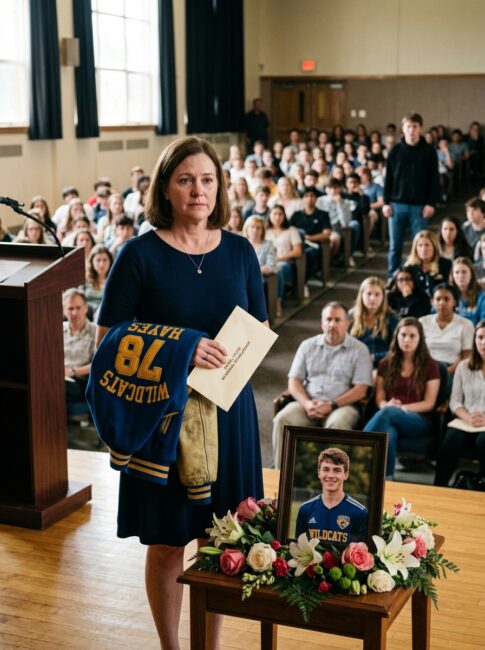
At the memorial last year, some had wanted a mother who collapsed. Now they wanted a mother who softened. Margaret gave them neither. She stood straight, Daniel’s jacket folded over her arm, and waited.
Evan stopped three feet from her.
He did not look at the check.
He looked at the jacket.
For one second, something passed across his face that did not look like greed or guilt.
It looked like recognition.
Margaret saw it.
Her hand tightened around the sleeve.
“I asked to present this myself,” she said to the auditorium. “Not because it is easy to stand here. It is not.”
Her voice was calm, but the hand holding the checkbook trembled.
“The school board suggested the scholarship be awarded for leadership, academic excellence, or community service.”
A few people nodded. That was how memorial scholarships usually worked. Clean words. Safe words. Words that kept grief polished.
Margaret glanced at Daniel’s photo on the table.
“My son had good grades,” she said. “Not perfect ones. He was kind, but not saintly. He left wet towels on the bathroom floor. He drank orange juice from the carton. He told me he was five minutes away when he had not left yet.”
A small, painful laugh moved through the room.
“For a year, people have talked about Daniel like he was made of light,” she continued. “I understand why. It is easier to miss someone if we make them better than human.”
Evan looked down.
Margaret turned toward him.
“But Daniel was human. And the last thing he did was human too.”
That sentence changed the air.
A teacher near the stage wiped her eyes. Daniel’s former football coach lowered his head. Principal Alden looked at the floor as if he already knew what was coming and still dreaded it.
Margaret opened Daniel’s jacket.
Inside the pocket, pinned carefully to the lining, was a small folded paper sealed in a plastic sleeve.
Several students leaned forward.
“This was found in Daniel’s jacket after the accident,” she said.
Evan’s breath caught.
Margaret noticed.
“I did not read it for a month,” she said. “At first, I hated the jacket. Then I slept with it. Then I put it in a box. Then I took it back out because the house was too quiet without something of him in the room.”
Her composure cracked for half a second.
The auditorium shifted, but no one spoke.
“When I finally opened this note, I found Evan’s name.”
Evan closed his eyes.
The first tear slipped down his cheek before anyone heard the rest.
Margaret unfolded the paper.
“I will not read all of it,” she said. “Some of it belongs to my son. Some of it belongs to Evan.”
Then she read one line.
“‘If something happens and I don’t make it home, please do not blame Evan. I was the one who asked him to get in the truck.’”
The auditorium went completely silent.
Evan covered his mouth.
Margaret lowered the note.
And suddenly, the boy everyone had been blaming looked less like the reason Daniel was gone and more like the only one left carrying what really happened.
For eleven months, the story had been simple.
Daniel Hayes and Evan Miller had been seen leaving the gas station together at 9:17 p.m. Daniel was driving his old red pickup. Evan was in the passenger seat. Forty minutes later, the truck left a wet county road near Briar Creek Bridge.
Daniel died before the ambulance arrived.
Evan survived with a broken collarbone, a concussion, and a silence that grew heavier every week.
No one said Evan caused the accident in an official report.
They did not need to.
People said smaller things.
They said Evan had always been reckless. They said Daniel had started skipping youth group after spending time with him. They said good boys sometimes followed troubled boys into bad endings.
Margaret had heard all of it.
She had heard it in grocery aisles. In church bathrooms. At the cemetery when people did not know she was behind the oak tree.
And for a while, she had let them talk.
Not because she agreed.
Because she could not speak without falling apart.
She looked at Evan now, standing beside her onstage, his shoulders bent under a year of borrowed blame.
“When Daniel was thirteen,” Margaret said, “he came home with a black eye.”
Students turned to one another, surprised. Daniel had been the golden boy of Maple Ridge. Golden boys were not supposed to have stories like that.
“He told me he walked into a door,” Margaret said. “I believed him for exactly six minutes.”
A few adults smiled sadly.
“Then I found Evan Miller sitting on our porch steps with frozen peas wrapped in a towel.”
Evan looked up.
Margaret’s voice softened.
“Evan was twelve. He had a split lip and mud on his jeans. He told me Daniel had stepped between him and three eighth graders behind the baseball field.”
She looked out at the room.
“That was the first time my son brought Evan home.”
Evan’s face folded with memory.
“They were not best friends right away,” Margaret said. “Daniel was loud. Evan was suspicious of loud people. Daniel loved group projects. Evan would rather eat paper. But Daniel kept showing up.”
She touched the jacket.
“He saved a seat for Evan at lunch. He invited him to practice even though Evan hated football. He left granola bars in Evan’s locker and pretended they were extras.”
A girl near the front began crying.
“By sophomore year, Evan was at our house every Friday night. He helped Daniel fix that red truck, though neither of them knew what they were doing.”
Margaret allowed herself a small smile.
“They once replaced a working battery because a video online told them to. My husband said Daniel had mechanical confidence, not mechanical skill.”
The laugh that moved through the room was tender and brief.
Then Margaret’s voice changed.
“Last year, Evan stopped coming over.”
Evan stared at the floor.
“I thought they had argued. Daniel said it was complicated. I asked too many questions, as mothers do, and he gave too few answers, as sons do.”
She took a breath.
“What I did not know was that Evan’s mother had lost her job. I did not know his lights had been turned off twice. I did not know he was sleeping in a house with no heat some nights because he was too ashamed to tell anyone.”
Several teachers looked stunned.
Evan shook his head faintly, as if he still wanted to stop her.
Margaret turned toward him.
“I am not saying this to expose you,” she said gently. “I am saying it because my son did not die protecting your pride so the whole town could bury you with it.”
Evan began to cry openly then.
Margaret faced the auditorium again.
“On the night of the accident, Daniel did not go out because Evan dragged him somewhere. Daniel went out because he found a message.”
She reached into the jacket pocket again and pulled out Daniel’s phone, sealed now in a clear evidence bag. The screen was dark.
“I asked for this back from the police after the investigation closed,” she said. “I could not turn it on for months. When I finally did, I found the last message Evan sent him.”
She did not read it from the phone. She knew it by heart.
“‘Don’t come. I’m fine.’”
Evan’s shoulders shook.
Margaret looked at him.
“You were not fine.”
“No,” Evan whispered.
His voice carried because the room was so still.
Margaret nodded.
“Daniel knew that. He drove to the closed laundromat on Route 6 because Evan was sitting outside with two garbage bags of clothes, waiting for a cousin who never came.”
A soft cry came from the teachers’ section.
“Daniel picked him up. He gave him his jacket. This jacket.”
She lifted it slightly.
“The note was written at the gas station, on the back of a receipt. Daniel must have known I would hear rumors. He must have known people would wonder why he was out so late, why Evan was with him, why the road was slick, why life did not give us someone easy to blame.”
Margaret’s voice finally broke.
“My son was seventeen, and he was still trying to protect someone from a story people would tell wrong.”
Evan whispered, “I told him not to come.”
Margaret turned to him fully.
“I know.”
“I told him I was fine.”
“I know.”
“I lied.”
She looked at him for a long moment.
“So did he,” she said. “Every time he told me nothing was wrong.”
That was the twist the room had not expected.
Daniel had not been pulled into Evan’s trouble. He had been carrying it quietly, the way teenagers sometimes carry what adults should have been strong enough to notice.
Margaret opened the checkbook, then closed it again.
“For months, people asked me why I did not say anything when they blamed Evan,” she said. “The truth is ugly. I was angry.”
Evan looked at her, startled.
“I was angry that he survived,” she said.
No one moved.
“I was angry that his mother still had a son to worry about. I was angry that my Daniel’s room stayed clean because no one was there to make it messy. I was angry at God, at rain, at county roads, at every parent who complained about their child leaving dishes in the sink.”
Her tears came now, but her voice stayed clear.
“And I was angry at Evan because grief looks for a face when it cannot find an answer.”
Evan whispered, “You had a right.”
Margaret shook her head.
“I had pain. That is not the same thing.”
Mrs. Alden, the principal’s wife, began crying in the second row.
Margaret reached for the scholarship envelope on the table.
“This scholarship is not a prize for perfection,” she said. “Daniel would have hated that. He hated when people pretended life was a clean hallway with straight lines.”
She smiled through tears.
“This scholarship is for a student who is still here, though staying has been hard. It is for someone who knows what it means to be helped and has quietly begun helping others.”
Evan looked confused.
Margaret nodded toward the side of the auditorium.
A younger girl stood there, maybe fourteen, with dark hair and a school counselor’s hand on her shoulder.
“This is Maya Rodriguez,” Margaret said. “Her family lost their apartment in February. Evan found out because she was washing clothes in the school bathroom before first period.”
Maya wiped her cheeks.
“He gave her Daniel’s old backpack,” Margaret said. “The blue one with the torn zipper. He filled it with granola bars, socks, and a laundromat card.”
Evan stared at her.
“How did you know?”
Maya answered before Margaret could.
“You wrote D.H. on the card,” she said. “I asked Coach what it meant.”
The football coach covered his face.
Margaret looked back at Evan.
“You thought no one saw you. Daniel would have loved that.”
Evan pressed both hands over his eyes.
Margaret stepped closer to him.
“So I am giving the Daniel Hayes Memorial Scholarship to Evan Miller. Not because he had the easiest year. Not because he made no mistakes. But because Daniel saw something in him long before the rest of us were willing to look.”
Then she handed Evan the envelope.
He did not take it.
His hands stayed at his sides.
“I can’t,” he whispered.
Margaret held it there.
“Yes, you can.”
“I was there.”
“So was my son.”
“I lived.”
Her face crumpled.
“Yes,” she said. “And I need you to keep doing that.”
That was when the auditorium stood.
Not with applause.
Not with cheering.
One by one, then row by row, people rose to their feet in complete silence.
Teachers. Seniors. Parents who had whispered. Students who had believed a half-story because it was easier than asking a whole question.
No one clapped because clapping would have made it about performance.
They simply stood.
For Daniel.
For Evan.
For the mother who had come back to the place where her son’s name still hurt to hear and chose not revenge, but mercy with trembling hands.
Evan finally took the envelope.
Then Margaret opened Daniel’s jacket and placed it around his shoulders.
Evan bent forward like the weight of it might break him.
Margaret held his face between both hands.
“My son brought you home once,” she whispered. “Let this help you go forward.”
And in the silence of that standing auditorium, Evan Miller cried like someone who had finally been given permission to stop drowning.
After the ceremony, no one rushed to leave.
Programs remained folded in laps. Flowers sat untouched near the stage. Parents spoke in low voices, as though the auditorium had become a place where ordinary noise would be disrespectful.
Evan stood near the stage steps with Daniel’s jacket still around his shoulders.
It was too broad for him.
Daniel had been bigger, stronger, the kind of boy who filled doorways without trying. Evan looked almost swallowed by the jacket, but he did not take it off.
Margaret watched him from beside the scholarship table.
For a moment, she saw both boys.
Daniel at fifteen, laughing with a screwdriver in his mouth while Evan held a flashlight the wrong way. Daniel at sixteen, leaving muddy shoes by the back door. Daniel at seventeen, calling, “I’ll be home soon,” from the kitchen.
Then only Evan remained.
Thin. Shaking. Alive.
That word still hurt.
Alive.
But it no longer felt like an accusation.
Principal Alden approached Margaret carefully.
“I’m sorry,” he said.
She knew he meant more than one thing.
She nodded.
“I am too.”
Across the room, Tyler Brooks, Daniel’s former teammate, walked up to Evan. Tyler had been one of the boys who turned away from him after the accident. He had not been cruel, exactly. He had simply made distance look accidental.
Now he held out his hand.
Evan stared at it for a second before shaking it.
Neither boy said much.
Sometimes apologies arrived without enough language to carry them.
Maya Rodriguez came next. She hugged Evan quickly, then stepped back like she did not want to embarrass him.
“You gave me the good granola bars,” she said.
Evan wiped his face with his sleeve.
“They were Daniel’s favorite.”
“I know,” she said. “You wrote that too.”
Margaret heard it and looked away.
The smallest details always found the softest places.
Later, when the auditorium had nearly emptied, Margaret walked to the framed photo of Daniel near the stage.
He was smiling in it, sunburned and windblown, wearing the same jacket now resting on Evan’s shoulders. His hair needed cutting. His eyes looked full of some joke he was about to tell.
Margaret touched the edge of the frame.
For a year, people had told her Daniel would want her to move on.
She hated that phrase.
You did not move on from a child.
You moved with him, somehow. You carried him into rooms he should have entered himself. You said his name when it trembled. You let his kindness finish what his life could not.
Evan came to stand beside her.
“I don’t deserve it,” he said.
Margaret did not answer right away.
Outside the auditorium windows, late afternoon light spread across the football field. The white ribbons on the fence had been replaced by spring leaves. Life had done what life did, not asking permission from anyone’s grief.
Finally, Margaret said, “Neither did I.”
Evan looked at her.
“I did not deserve Daniel either,” she said softly. “But I got to love him.”
His eyes filled again.
She reached into her purse and pulled out a small key on a red keychain.
“Daniel’s truck is gone,” she said. “But his toolbox is still in my garage. He would want someone to use it badly and with too much confidence.”
A broken laugh escaped Evan.
“I’m not good at fixing things.”
“Neither was he.”
They stood there together, smiling through the ache.
When they reached the parking lot, the sky had turned the color of warm honey. Families were leaving in slow clusters. A few stopped to look at Margaret, but this time their faces were different.
Less certain.
More careful.
Margaret opened her car door, then paused.
Evan stood by the curb with Daniel’s jacket folded over his arm now, holding it like something sacred.
“You can keep it tonight,” she said.
His face changed.
“Are you sure?”
“No,” she said. “But I’m trying.”
He nodded, understanding that some gifts were not clean or easy.
Margaret got into her car and looked once more toward the school.
For the first time in a year, she did not see only the place where Daniel’s absence lived. She saw the stage where his name had given someone else a door.
Evan lifted one hand.
Margaret lifted hers back.
Then she drove away slowly, past the football fence, past the auditorium doors, past the road that would eventually lead home to a quiet house and a room she still was not ready to change.
On the passenger seat lay the empty scholarship folder.
For a moment, it looked like loss.
Then the sunlight touched it, and it looked like something had been handed forward.
Follow the page for more heartfelt stories about the quiet moments that change how we see one another.