Six Bikers Arrived With A Birthday Cupcake Just As A City Bus Driver Was Pulling In After Her Final Route
After her last bus route, a Des Moines driver found six bikers with a cupcake and paper tickets. The last man still remembered his stop.
An original fictional story.
Part 1
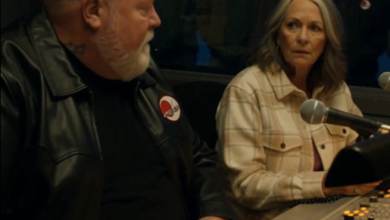
SIX BIKERS WAITED AT THE DEPOT WITH A BIRTHDAY CUPCAKE AND TOLD THE RETIRING BUS DRIVER THEY’D MISSED HER STOP.
“We missed your stop.”
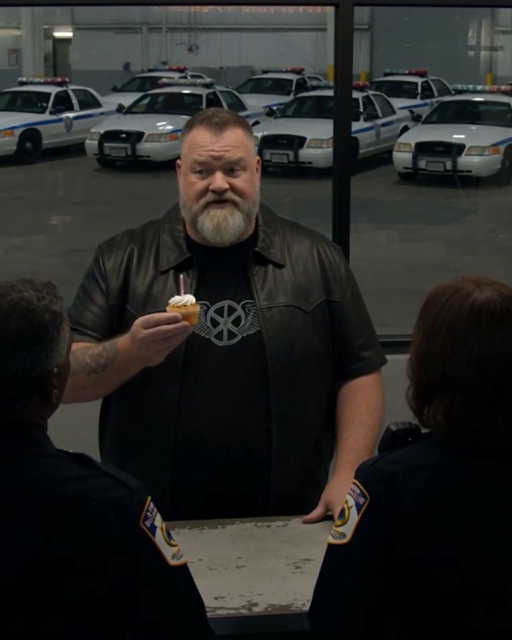
The man with the cupcake held it at the height of Rita’s name badge when she stepped off her bus. He couldn’t have meant a stop on the route. The vehicle was empty, parked in the bay, and Rita had watched the last passenger walk down the sidewalk with a bag of oranges swinging at her side.
“You’re welcome to come back on Monday,” Rita said. “You’ll have to tell the next driver where you want to go.”
The other five riders stood clear of the doors. Their motorcycles were parked in the visitor section rather than the bay, one red and the rest dark enough to disappear between the overhead lights. The man with the cupcake had thick arms and a winged wheel tattoo. Rita had met plenty of people who could tell you where they wanted a party. She wasn’t used to them setting up part of one where she’d come to drop off her time sheet.
“I hope it’s somebody else’s birthday,” she said.
With the pad of one finger, the man pressed the crooked candle straight. He left it unlit and set the cupcake on the counter by the dispatch window. Beside it, a woman in a dark leather jacket put down a little paper bus ticket with an old punched hole in it.
Rita watched five more tickets land on the counter. Two had squares punched through the corners. One still had a pencil mark near the edge where its owner used to add up her fares for the week. Rita had seen that girl do arithmetic on the number eleven bus so many times that she could still see the pencil moving, even though she couldn’t see the girl’s name tag from where she stood now.
They’d passed a cupcake forward to Rita on her birthday once, down a row of cold hands. The next year she’d taken a different route. There was a boy who used to stand at the final stop under a yellow plastic raincoat. At the end of every trip he had looked into her wastebasket to see if he’d missed a party or something else worth knowing about.
The rider at the back kept his second ticket in his hand. He pointed to the cupcake with it and met her gaze over the dispatch counter.
“You remembered mine.”
Rita’s eyes traveled from his outstretched hand to his face. Her fingers closed on the badge she’d worn to drive every route that week, as though it could tell her what to call him.
Part 2
“Ricky?” Rita asked.
The man shook his head. “Ricky’s my brother. He didn’t make it until the year after I did.”
The difference came back as soon as he said it. Ricky had been tall enough to look almost straight at her in the overhead mirror when she checked the rear of the bus. The last rider in line had sat near the front. In winter his legs didn’t quite get to the floor. He’d kept a small grocery bag with him no matter how far a person asked him to move over, as though he had one place on that bus where anything he might drop would be safe.
“Sam?” she said.
He gave a quick little nod. Martin Hale, the rider who’d brought the cupcake, had his hands in the pockets of his black jacket. The woman by the counter set her ticket down and straightened the corner, giving Rita another moment to look at Sam without needing everybody to see she’d recognized him. He’d had a round pink face underneath the plastic hood in those days. He’d complained that the elastic left him with a mark on his forehead. Rita remembered how he’d swipe at his face with the flat of his palm after walking around the front of the bus instead of thinking she wouldn’t be able to see him if he used the back door.
“Show me the other ticket,” Rita said.
Sam turned it around with one thumb. The corners were punched. One edge had been wet for long enough that it wasn’t straight anymore. Rita could recognize the color they had used to sell a two-way set with a single fare and one punched transfer. She used to give the children a full one to get across town to the better library, even if she thought the half they’d used at the stop had enough time left on it. The point was that if they had to get behind a counter and ask, they could do it without a grown person making them think someone was doing them a favor.
“What happened to your brother?” she asked.
“He’s working. I knew he’d want to know if you remembered where we got off before he did.” Sam took the ticket out of her reach for a second. He looked at the man holding the cake, who gave him a nod so small Rita wondered if she was imagining it. “You can have it if you want. I thought I had your real one and should get it to you as long as I knew you were going to be here.”
“Why do you think it’s mine?”
“I never saw you ride a bus until the first morning you wanted to get out to the river before the sun came up. I thought you were waiting to go someplace you didn’t go every day. Once you found out what we thought was going to happen, you gave the next rider a ride up to the doors and then you walked all the way past me.”
The evening dispatcher turned the blinds so they’d be able to see into the bay without the cab lights shining back at them. Rita could see her own bus lifting a fraction as the air moved around it in the cold. She’d never been so close to her own window without knowing who was coming up to use it next.
“Did you need me to stop that morning?” she asked.
“I did, but I hadn’t figured out I could ask yet,” Sam said. “My brother found out why you’d gone all the way up there. The word he used for it was Birthday.”
Part 3
Most years the transit authority had given Rita the same day off just before the start of a school term. She took it without arguing because by the end of the summer she had to check mirrors too often to think she’d still be awake halfway through a day with a forty-minute lunch. On the Wednesday before the morning Sam meant, she put a note up in a kitchen whose chairs hadn’t stayed in the same places since she’d started getting out of work early enough to be gone by sundown. She wanted to be at the park before school started. Her sister Alice used to tell her there’d be no time to see who else got there if she took her first bus south.
Sam was twelve or thirteen then. He knew there were two things he could do if his mother said she hadn’t gotten home in time to take him someplace he wanted to go. He could call his brother, who had his own bed at their grandmother’s and was good at getting back to meet him when he could take enough hours off. Or he could take the bus all the way from one house to the other and go to bed in the room behind the kitchen without a person awake to tell him he’d put his shoes in the way.
Rita came up the river road at the end of a Sunday route that had started a little too late for her. She didn’t think of herself as doing the opposite of her job just because she was in the first seat. Every bus she got on, she counted how many bare spots were along the handrail. She knew how far you could lower a knee before your shoes hit the thing under the window that would hold them there. She got down from the river steps with her gloves on her hands and walked past a boy in a yellow coat sitting in a section of empty bleacher. Once she’d taken the time to recognize him, she turned around.
“You asked me where I’d got my ticket,” Sam said. “I thought you wanted me to give it back because I’d bought it for a trip and thought it would carry over to a second one. I told you I was saving half for Ricky. Then you asked if he was going to be there at the end or if I was saving the part of the ride where I’d meet him.”
“You didn’t know which one?”
“I knew I had enough for one of us to go home.”
Rita could remember a stiff little cake box at the far end of the bench. She’d thought it was somebody’s lunch, because at that time of morning lots of children missed breakfast. She used to ask whether they had a place to eat before leaving for school. That morning there was a lid that somebody had lowered over a single candle. She wasn’t completely sure whose cake it was. A line of icing along its paper was the bluntest pink she’d seen in a while.
“Why did he think it was my birthday?” Rita said.
“I told him about the candle.”
At the dispatch counter, Martin reached behind the cupcake and lifted a bus ticket with a tear in its middle. He handed it to Rita before she knew he was paying attention to the other one.
“He’s starting later in the story than I would,” Martin said. “Can I show you the one I brought that I thought you’d be glad to see?”
Part 4
The ticket in Martin’s hand wasn’t torn. It was folded so one end of it went out diagonally and the other end was folded under a narrow strip of tape. Rita had seen a child do that one day when another person on the bus thought loose paper in a hand meant a fare still had to get paid in coins. The little tape shape made it possible to slide the ticket out once it got into a jacket, and made it hard to put back in any of the usual ways. She’d watched Martin sort three dollars in coins on his palm and find a place where his cousin would see her fare had already been taken out.
“Were you the one by the bakery?” she said.
“Dad dropped me after school. I got off the early bus so I could see the bakery window while it was open. He told me to hold my cousin’s spot and check what time the next bus came, which was pretty funny because she’d never see the whole sign until Jimmy had found a way to get up on the rail.”
Rita knew the bakery. On the other side of it stood a health-club advertisement with a woman lifting a bicycle as high as her hair. The glass had glares in it from both directions when the sun was low. You could see the bus schedule best if you put your hand over one side and waited for another person to tell you when the light changed. Martin had spent the last six weeks of a school year trying to do it without asking anyone. Rita stopped farther back at the bakery whenever she could fit both doors in beside the curb. He thought it was because he stood close to the part of the wall where he used to wait before he learned to climb up.
“What did you tell your dad about me?” Rita asked.
“I told him somebody at the bakery wanted to know if we’d go by the river to see a pair of cousins the next day. There was an envelope with a bus fare in it. So he knew what day I could invite everybody to go up and see the seats where the buses went by off the highway. I tried to get him to come, but he said I’d have a better time if I learned which way it was without finding somebody with a car first.”
Rita leaned back against the wall. She had brought extra fare to the river that morning. It gave her another thing to do with her hands while her mother called to say she had a ride arranged and wouldn’t be seeing Rita there until a little later. A classmate from church had asked if she had enough in her pocket for a second trip after supper. She didn’t understand how Martin had decided the thing she put into an envelope could be used to bring people to that spot without making some of them wait for other people to be finished first.
“You were going to be watching for buses?” Rita asked him.
“Had a paper list. Gina wanted to hear how far they went without being able to see them. We’d practice the times and I would put the little list by the phone so people could call and find out who had heard a door open at an exact minute. It got us all there. I brought your ticket because I thought you would get candy on the return trip and I could keep it from getting wet while you paid.”
“Who did the watching if you were waiting to come back?”
Martin glanced at Sam. “There’s something on the other side of that pair of tickets. I took a copy so nobody gets to put an age on when you read it.”
Part 5
There was part of a stamp from the old depot on the far edge of the paper. It was a picture of a clock that would read almost six if you looked straight at it. Rita had never really looked at it straight. It was always tilted about an inch past the part of the counter where you could lay a bus ticket down so the dispatcher could still see whose trip it belonged to.
She turned it over. There were two letters and a straight line near the tear. R and S, large and narrow. Between them, where there was just enough space for the length of a name, ran pencil much darker than the lines around it. She put the ticket down, shaded the edge with her other hand and tried it in the brighter side of her light. A slash went through the second set of letters. Then a new line came back across the tear, lined up after somebody tried to fix it with the piece they were saving.
“Who put me there with you?” she asked.
“Gina, I think.” Sam looked over at the woman who’d brought the first ticket. “She had pencils in her bag so I wanted to take one when I was making it and give her the rest after.”
Gina was about six inches taller than Rita remembered, with the same look of realization in her face she used to get when she let somebody’s umbrella go over on the bus and found out there was a place to put it that would keep the fabric clear of all the feet. “I was the one who put that little notch there,” Gina said. “Do you remember when you told Martin I could choose a place to go without making him think somebody’s paying him to look after me?”
Rita did. Gina had been the youngest child by quite a little while. Her brother was old enough to take a night job stocking shelves, and most nights he was the person who knew where she was so she would be able to get there with her hair wet if nobody mentioned there was more than one place for her to dry it. She’d asked whether there was a driver who got her all the way to the end if she didn’t know whether to get off with the others. Rita said she was there when she wanted to find out. Gina took the bus three stops past home and came back with an extra pair of dry mittens. They stayed on the dashboard in an empty candy box for a week. Rita let the next child take them during a storm.
“Gina told us we should ask the other person before getting up to look at a ticket,” Martin said. “It was a big rule for us for a while. I thought it’d have some shape to it if you knew enough of it to sit near the door and see where we put the date.”
Rita looked from him to Sam. “What’s that got to do with my birthday?”
Sam held the last of his ticket at the edge. One letter began to show on the other side. He said, “You were trying to tell somebody they could use your birthday, right? I thought I was the only one who knew that until Gina put both of our initials on it.”
She was beginning to remember a name she had not had occasion to say aloud since that spring. Her fingers loosened around the badge.
“What did you think I was giving away?” she asked.
Part 6
Gina pulled a little silver folding knife out of her purse, then set it down when Martin asked whether she’d rather use the blunt end of a key to get the fold open. She found a narrow key he hadn’t expected her still to have and ran it under the tape, keeping the ends of the paper in her other hand. The ticket had a date visible sideways, August 24. That was the date Rita’s father made a big breakfast after he heard her sister was moving back across town from a friend she said was taking good care of her. She’d have a place nearer the bus if she came back. The questions he’d have to ask her were still close enough for him to make sure it was a Tuesday before he asked them.
Rita’s mother had died in August, later in the month, the year Rita was Sam’s age. Her mother was the first adult she could remember letting her have a turn to push a bus button after the driver said he was going to stop anyway. He let her hold it for long enough to put a shape to the sound. On the other side of town her mother would buy an orange and peel it to the middle before asking if Rita wanted to finish. Now that she was driving for work, her sister kept asking if she’d got a ride to the park. That summer Rita decided to go by bus with the things her mother used to bring when they had a chance to sit for two hours without telling anybody what they felt like doing. She heard how early her sister might get there and tried to get to the bench first.
At the counter, Sam laid his spare ticket down. “You sat with me about twenty minutes. I thought you were waiting for somebody like me. Then you asked if I would tell you when I’d hurried to get there and why I hadn’t been able to find somebody to ask about the candle.”
“Didn’t you have a birthday?” Rita asked.
“That day I did. I didn’t want to make my brother come just for it if I didn’t know whether Mom was going to be there. I hoped we might each remember my birthday without the other one telling us we had to have it. I got there early so they could see me when they went past. Then after you came over you said you’d be sitting there because it was your mother’s birthday.”
That was why she’d been willing to guess the long time when she could have a second rider. She had the little wrapped cupcake under her clean napkin. She had brought one candle because there was more than one way to sit there and let yourself think of somebody. Sam said he hadn’t asked about it until his brother called on the pay phone by the park entrance. The candle was still on the paper by then. Rita remembered using both hands to hold the box when she saw the yellow hood lift in the wind.
“I thought my sister might want me to leave the whole thing with her,” she said.
“She got out before Ricky and put half an orange on the bus stop for both of us.” Sam pushed his hands farther apart on the counter. “She put the other half near the box to ask if we were going to try to get it home in one piece. That’s how we found out whose birthday it was.”
Rita watched Martin put the upright cupcake between the penciled boxes. “How come you said you missed my stop?” she asked him.
“Because you saw Sam after that,” he said. “You still had one bus ticket with your mother’s name on it.”
Part 7
Rita thought he was talking about Alice. She had written her sister’s name after the ticket got wet. They’d agreed not to leave it in the car anywhere they couldn’t reach without calling a third person. It might turn up in the slot for the small glove compartment where her father used to keep a small tin of tire valves. She had folded it into a little box with enough of the unused portion hanging out to give them a place to start opening it if they wanted to ride together another day.
“Don’t you remember what came out of your pocket before you put our first ones away?” Sam said.
Rita put the badge down and leaned closer. He had found a little strip of leather the color of a bus wheel well just after it was cleaned. It was narrow enough to fit inside a paper ticket folded twice. Sam had used it to move the end of the cord off his sleeves when he needed to put a backpack on over the yellow coat. Over the middle there was a cut that looked straight if you could see the whole shape at once. Alice had cut that little piece from the purse their mom left in the hall. Their mother never used the last inch of the strap, because she kept it looped around her arm so both hands were free.
“Was it with the cake?” Rita asked.
“It was under the candle,” Gina said. “After you showed us whose name you wanted to keep, I thought Sam would tell us whether he wanted us to come back the next summer and do the same thing where his brother could see. I waited till Saint Paul and asked him where he’d have both hands free so I could tell him we all had a little piece of whatever happened here.”
Sam had come back six years in a row, and eventually he started buying cake for children who showed up because they heard they’d be there anyway. The winter before Rita retired, one of the children he knew moved out of town and asked if they still got written up in the list they used to count the trips to the river. He showed the child where he had put Rita’s route number so she could send him a picture of it at the new stop. That’s how they learned that Rita’s old number eleven was being changed. The notice said they would keep a bus going to the park on a different route number. No one knew the best time to see her come off it.
“That’s why we brought the tickets,” Martin said. “I got a call from a friend who knew what we were trying to tell you. We never got you to the right part of the depot so we could ask you one time without stopping early. If you have somewhere else to go from here, we’ll make this quick.”
“Ask about what?”
“You said when you moved to an earlier route we could write on the side where it was blank. I thought maybe you’d see on the back there how long we took to find out if we’d know you when you weren’t working.”
“Did you?”
“We asked Alice how she’d get hold of you. She said you might want to learn the new bus if we waited at the end of the route. We put our names on the new schedule so you could give it to somebody who might get their first ride on it after Monday.”
Rita kept her hands close to the badge. The name they had put first was her mother’s. It had the letters she’d learned to spell on receipts, the long one at the end, followed by a question mark somebody had only half finished. She pointed to the blank spot. “May I have a pen?” she said.
Part 8
Rita didn’t write her name where they left the question mark. She wrote September 1, which was the first weekday since she was twenty-two she’d be able to tell herself she needed to go somewhere in the morning without somebody wishing she’d leave thirty minutes early and open the side door of a bus that shook in the cold. She gave the pen to the dispatcher afterward. “Could you tell me which driver opens the door on Monday?” she asked. “I’d like to take that bus once. I won’t stand by the steps with any of my bags.”
The dispatcher gave her the timetable and the new route name. The next bus to the park would come a little later. There were two ways she could get a ticket for the return, which changed a route she’d been making for longer than some of her regulars had lived in town. She read both ways before putting the new timetable with the old tickets. If you were looking down the wider step at the park, you would get off a little farther away from the dirt. It wasn’t all that much farther to the park if you knew where the sun went through the trees before lunch.
She asked Sam how late Ricky would be. He called his brother. In ten minutes a man in a gray sweater came to the depot’s front window and waved at her by knocking lightly with one finger. Sam brought him in and set the cupcake beside his plate. The candle didn’t have to wait for a birthday. Rita had a plastic fork that would divide the cake into more pieces than it looked like there ought to be. She asked the dispatcher if he’d give her a second one. Then she washed her hands and tried to make the pieces clean enough for everyone to take one without picking a favorite.
When she left the depot, the motorcycles were parked beyond the bus and she could see Martin thinking about how long he ought to wait for her to get to her car. She held her keys up so he would know she could do it alone. By the time she reached the visitor section, Sam had caught up, still holding the pair of tickets in his left hand. She told him he could take both and bring her a copy if they had to use them someplace she wasn’t going to be. He slid them along the palm of her hand instead. “I don’t know where yours goes yet,” he said. “Mine’s in there if you get to the park without me.”
Rita had learned how to ride a bus from a woman who was usually willing to wait for the next one before making up her mind whether she felt more like being in the front of it or the back. On the first Monday she went to meet the new route at the stop beyond her house. Alice had said she’d get there late, but when Rita walked up, she was sitting in the only good end of the bench. Sam got on two stops later and took the seat beside them. He had an orange in his coat pocket. It caught a small glint of light on the short part of his ride when he finally peeled it toward the middle. Rita held out a napkin, then let him do the rest of the work when she saw he still had somewhere else to put his hands.