Fourteen Bikers Parked Outside A Small Town Radio Station And Asked The Host To Leave Her Microphone Open
Fourteen bikers arrived at a Michigan radio station in its final hour. The host put on their headphones and heard a voice she knew by heart.
An original fictional story.
Part 1
FOURTEEN BIKERS PARKED OUTSIDE THE RADIO STATION DURING ITS LAST HOUR AND ASKED THE HOST TO LEAVE HER MICROPHONE OPEN.
“Leave the mic open.”
A man named Boyd put headphones beside the console, carefully enough that Lena could hear the padding settle on the laminate. She lowered the sound in her own headphones and looked through the control-room glass at the riders the receptionist had let into the hall. They stood against the wall in black leather, leaving room for the coffee cart and for anybody who wanted to get past.
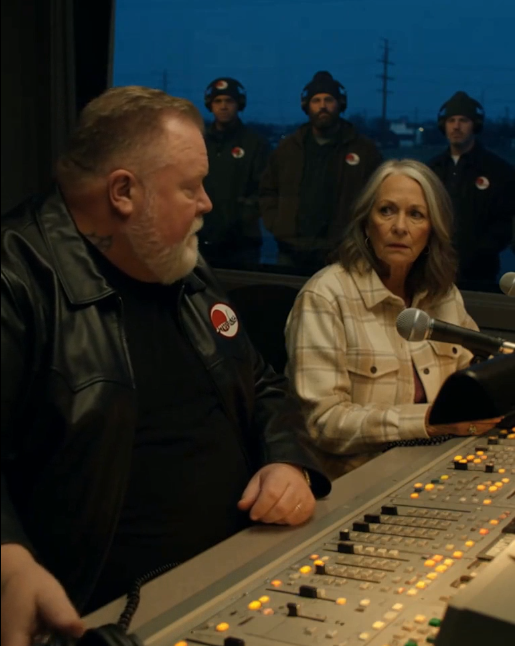
“I can’t put all of you on,” she said.
Boyd glanced toward the window. Out there, a cold light washed over the parked motorcycles. He had told the receptionist the bikes didn’t need to be heard and asked her to show him where the phone line came in. Lena had assumed he wanted to complain about the station closing. The owners had decided six months ago. There wasn’t anybody in the building tonight who could change it.
“The song’s got fifteen seconds,” Lena said. “Tell me what you want.”
She heard the receptionist touch the edge of the open door. Boyd stepped back, leaving Lena plenty of room to turn to the console. He’d brought a stack of index cards held flat with the strap from an old pair of goggles. Each had an empty box in the top corner. She could see check marks in green on the first six. The riders looked through the glass like people who knew when to be quiet around a sick relative.
The phone-line light blinked.
Lena had meant to end with a story about the man who taught her where to sit so her chair wouldn’t squeak on the air. She’d prepared it twice. The copy was still in a drawer two inches from her knee. If she took commercially paid spots right up to the half hour, she could fit three minutes of her own voice at the end. That’s what she had planned to do.
She lifted the spare headphones and brought one ear cup to the side of her head. Boyd pointed to the top card. The voice on the caller line took a breath before it said anything, a habit Lena knew the way she knew where her father’s house key was when she walked up the steps in the dark.
“Your turn, kid.”
Her older brother used to say that when she took over after the overnight shift. She had forgotten how far away he could make something feel with three words, until suddenly there was no distance at all.
Lena looked down at the microphone button. Her hand stayed where it was.
Part 2
Lena kept the microphone off. “Is that you, Dan?”
The caller answered, “If it’s anybody else, they did a good job getting the room right.”
She knew the sound of the room. One of the fluorescent lights had been bad enough to make a sound you could hear once the automatic fan went off. Dan used to sit at the kitchen telephone with the bad light directly above him because the cord couldn’t reach the end of the table from the place their father screwed it in. The neighbor’s radio could be heard through a wall if both their doors were shut. Dan would hold the phone there and sometimes not say anything, while Lena was in a different room with its own bare sound. Right now he was in a room that sounded thin enough to have nothing in it except the light.
“Where are you calling from?”
“Out by the lake.”
The first answer she’d expected was that he’d called from the company truck. The two of them had spent enough time imagining who was out there in the dark after he left that she used to think she’d be able to recognize a room he was in by which side of his hand caught the light when he came back. Instead she recognized him by the good second he always left before he went past a place where an interruption ought to be.
She put a hand flat on the console. “Can you stay on for a little?”
“If you can wait for the next song. I called early because our friend thought you might not be able to get me in afterward.”
Boyd was still looking at the first index card. Lena saw the point where some of the marks went through to the next one. She could have asked him what the card said, or have put attention into going back to the sound he pointed to in her own ear.
“Are you still doing nights?” she said to Dan.
“Only the regular kind, mostly. People go to bed earlier out where I’m living.” He cleared his throat halfway through the long sentence. She remembered he never cleared it after making his point, in case somebody had only been waiting for him to think of the next thing so they could come in.
She used the level indicator to see how close the music was to fading out. There was less time to the end than she’d told herself. At the next break there were going to be two commercials, both very familiar to people who listened in from the places where the street lights were far apart. She could let both of those start on time and still keep the line free for Dan before the final news. She’d turn her head a little if he wanted her to go back and ask him whether to let the public hear anything.
“Would you pass me the first card?” she asked Boyd.
He did it without trying to look over her shoulder. It was blank except for a green check near the hole in the corner. In the light from the console she saw four digits she could make out on the next card. The ink showed through the paper. It looked like a phone number she knew too well to ask why she remembered it.
“Before you give me an answer,” Dan said, “do you want to know who found the list?”
Part 3
The receptionist knocked twice on the studio glass. Lena held up one finger. She had spent a long time telling people it meant there would be a minute and then letting them decide for themselves when to start counting it. This time she put the spots on and covered her microphone with the pad of one hand so the person she had just asked to wait could see she had put it where she wanted it.
“Who found it?” she asked into the private cue line.
“Pat at the hardware store. She knew which binder it would be in. I don’t think she knew I’d left my number at the front with yours, either.” There was a moment in which Lena could hear him turn around in his chair. “You had one for storm nights. Folks who asked to call and get back in touch with a neighbor whose phone cut out.”
Lena had inherited the binder from a woman who could lean forward and click off a caller without putting her voice up another notch when somebody said it was an emergency. It held phone numbers for places you could find a dry room. Some people she called from it talked only to each other during daylight hours. At the back of it was a page with one story Dan used to tell about being the person who had to stop a record because his mother called in to hear the report about whether the dock closed. A man wanted him to announce the warehouse would open an hour early to take people in out of the rain. He checked with the woman who still had the key and made sure she had a ride to get there.
“You gave it to someone at the hardware store?” Lena asked.
“I thought you’d get it back when they went down there to change the padlock. I was on a road job and I didn’t want anyone to tell me as they were getting into their car that they knew when you’d be able to find out if I changed my address again.”
“You could just call me.”
“I could’ve called you.” She heard him decide whether to stop there. “I told somebody I wanted to sit with the radio on and take the back roads for a while. Then I stayed a while longer than I said.”
“So why do you have the list if she never brought it back?” Lena said to Boyd.
“Pat rang me from the hardware store. I’m the one who used to drive him after his second shift if they still had a box he could bring back in the morning. She said I could have the card with my name on it. It looked like everybody else might want theirs.” Boyd moved one hand from the strap on the index cards. The far edge of the stack spread out a little. Lena thought there were twelve or fifteen of them before she saw the one at the bottom, where the strap was holding a section that had been turned sideways.
“Did you call people and get them to let you bring it around?”
“We asked if anybody was going to listen tonight. I figured if somebody wanted to put one thing on a new card, we’d wait for you to ask before we showed you which one.”
Out in the hall, the other riders stood with a few shoulders turned toward the control room rather than in a crowd right up against the glass. Lena could pick Boyd’s wife out by the sleeve of her sweater under her jacket. Beside her was a tall woman from the post office who used to hand Lena the same misdirected mail once every month.
“Did you write something on yours?” Lena asked him.
Boyd put his square palm on the table. “When I went to look for it, I found out my name wasn’t in it. It was the only one you took out while I was there to see.”
Part 4
Lena took the headset off one ear again. They had less than a minute to fill after the spot ran and before the studio clock would tell the transmitter to take a news program. The last two people in the building who could help her watch the level had given up trying to keep their eyes on different clocks. One of them held up a note through the glass. In black marker she’d written that the midnight takeover would run from the other station. Lena pushed her chair away from the desk. She could mean to talk for half the next song, or look into the line for a little while longer and have time to ask a real question.
“What did I take out?” she asked Boyd.
“Guy used to call late to see if a line from the county could be forwarded to a place where there would be people awake if he got out of a meeting. I put my number down the night I waited for him. You took it out after I came back and said I had to wait a couple of hours longer than I planned.”
“I don’t remember taking anybody’s number out.”
“It was the morning you stayed here until Dan had stopped putting records back in the sleeves. I told you I couldn’t expect my wife to pick the phone up if somebody rang at two wanting a ride. She didn’t know she was down for one. You crossed it out and gave me the card to keep. After that you asked people what hour they wanted you to stop trying them. She started listening to you just to see if the part of the storm list she knew how to help with would come up.”
“We didn’t figure that out fast enough,” Lena said.
“You figured out the thing people could ask you to do about it. I thought we’d write that part down if you said you were interested. My card’s got an empty box in the corner. I put little ones there for anybody else so they could check it when they decided they’d be willing to talk on the air.”
At first she thought the blank cards were people who hadn’t been able to come. It took her another minute of seeing the marks in those places to begin to understand how little Boyd expected from the people who chose not to let their voices go out. He had put their names inside. He wanted to give them a little longer to decide what changes they thought she could make before the first call ended.
“What’d Dan write if there isn’t anything on the first card?” Lena asked.
Boyd picked up the phone again. “He asked me not to put what he said anywhere until you heard him.”
She saw the minute hand on the clock above the little speakers. She could answer the note with a mark at the bottom that would let the last person out front know she wasn’t going to make them take any more calls they couldn’t hang onto if something went wrong with the line. Instead she took a fat pencil and asked her to keep another private line free. Boyd had brought headphones from home. The padding had been replaced recently. There were two marks on the left, where another person holding the same set had taken an ear cup off and put it on the wrong end in a hurry. She thought the second one might have belonged to her brother.
“Was this your idea?” she asked through the cue.
“Some of it. I meant to leave you one minute. The other thing was the box of tapes Mom asked me to find last month.”
Part 5
Lena had been looking for a cassette player that would work in their mother’s room for almost six weeks. The first one had put the fast-forward sound through the right speaker even after she managed to stop it. The second one looked all right until she went around to try the lid. There was a hinge where a spring ought to be. She thought of letting their mother have an old record player until she had the time to work on it. Their mother had said the record player wouldn’t let her hear the part of the room she’d been trying to remember. A few people had said they knew what she meant, which Lena took as proof they hadn’t listened long enough to ask an obvious question.
“What did she ask you to find?” Lena said.
“There were a lot of different labels. She wanted the ones with a line across the middle. I could narrow it down from there to the blank ones with the same short date on the bottom in pencil.”
“Are you with her?”
“I’ve got her on the other phone. She told me she was still trying to get to a place where she could see both your names when she asked for a little more time.”
Lena took one hand off the console. “Did you hear the tapes?”
“First one had the sound of her walking into the kitchen and closing the front door. A pot was simmering a little farther from the phone. She’d said there was some part of her family’s life she wanted to hear again that she couldn’t fit into something she thought she’d be allowed to ask a news reader to play at the end of the night.”
When she was younger, Lena liked things with a voice in them. Her brother wasn’t always home. His quiet had required less from her than their mother’s quiet. The first time somebody brought her the little remote recorder, she remembered wanting to put a clean tape into it and bring it to school so children who knew a good song could sing it to her after they finished most of their math. Instead their mother took the recorder out one morning and fitted it to the wall using two strips of tape. She had never seemed interested in setting the level very high before. Her point was to get it far enough away from their faces that somebody watching television after supper wouldn’t be able to tell they were talking.
“Which year was it?” Lena asked.
“First one had the station’s legal ID on it. The old one.”
“Our first year together?”
“One of those. I thought I knew what Mom was doing if I could hear you through the door when you didn’t know anybody out here did.” He left a pause. “The station’s pretty far inland if you think about what happens when somebody turns the radio up high enough to get the voices through a storm. That’s the thing Mom wanted to get out of the first box. I didn’t look through much more until I asked her if she wanted to tell me what part of the tape she meant for you to hear tonight.”
Lena set a hotkey for the next song. Each of the last ten things she’d said in this room was easy to get off her chest, as long as the listeners didn’t ask which address she was driving to afterward. She looked at her microphone button. “How long did she say you’d need, if you wanted to play a piece of it through the phone when she was ready?”
“I was thinking one minute,” Dan said. “Would be enough to let people hear what dead air sounds like if everything inside the house is still there.”
Part 6
Lena walked out into the hall for the first time that hour. It was cooler on the studio side of the glass when you held your hand up. Someone had sent out for pizza. One of the riders in a gray leather vest was reading the napkin his slice came on because its corner had been folded down and somebody left a note there. He turned his head when she came through the door and asked if she still knew his sister’s number from a call a long time ago. He said she didn’t live anywhere he could expect to find her after this hour, and he had a two-line note he could write out while she was free if she wanted to see it.
She said she’d have to let him make the next decision by himself. He folded the napkin and set it down near the window. The other riders just waited. Before she stepped into the hall she could have sworn there were enough of them in work clothes to make it look as if everybody who worked in a shop and had ever heard her read a forecast had shown up. Now she saw two people she’d known from her mother’s block. One had a little wooden radio he’d wanted to see play without a new cord and had started to think he’d put it too near a wall. Another had come with the original handle from a weather radio she kept going through three AA batteries in the shed at the end of her house.
“What was your name?” Lena asked the man in the gray vest. She had had to turn her head more than she expected to let it come out softly.
“Nick.” He gave enough of his last name to let her remember where he fit in. His mother had lived in the same apartment complex as theirs before the roof started to leak. She used to come out of it to tell Dan where to call up the street if he wanted to find the paper after the delivery came. At night she’d been the person who went from one porch to the other to tell people whose lights were on.
“Have you got a card in that stack?” Lena asked.
“Boyd said I could have mine if I thought of something first. I’d like to ride with him over there next week if it isn’t too cold. I’ve got a box of tapes to get back to somebody he knows.”
Lena went back to the studio. She could hear the end of the song through the cushion of her regular headphones even when she hadn’t put them on a second time. She pressed the cue channel hard enough for her hand to feel the button move. The first line was still open. The other end didn’t sound any closer. Her mother’s voice was there talking to Dan, so quietly that it would have been possible to misunderstand her if Lena went on with what she thought was about to make the most sense.
“Can you tell me what you want me to play?” she said, waiting to hear if her mother took it as a question for her.
“I thought I wanted you to use the first minute,” her mother said. “Then I listened to what we did last time. There’s a good bit with your brother at the end. I thought I owed you something before you try to see what it comes from.”
“You could tell me right now if it’s private,” Lena said.
“Play me one of the old ones first. I’ll tell you whether it’s the right one even if I can hear you stopping it. Did you know I made part of the first one at the station?” she asked.
Part 7
Lena got the receptionist to put a finger on the other side of the accent floor lamp before either one of them could lose their grip on it. They moved it just far enough from the door that two people could come in without a chair hitting the glass. Her mother used to sit outside there during the early Saturdays. She wasn’t happy with the seating in the hall, where everybody ended up looking into the closest workroom to see whether a person they knew was getting ready to come out. Her mother had borrowed a lamp to have enough light for a book. She’d take the top off her tea while somebody else was finishing, then stay long enough to ask both children how they’d meant to answer an ordinary question about when they were planning to eat.
Lena cued the first sound Dan played. She could make out the soft opening rattle of their mother’s key chain, then a dull noise when a cup got set down on the sill. Halfway through, Dan said he had a riding assignment after school that he’d been promising to take from a reporter they’d just hired, and he thought the next day would be easier if he could trade Lena his whole evening. He’d made those trades before to get somebody to come look at the door without having to wait for a technician. Here he was giving it up so he could go home sit through something with their mother. Lena didn’t hear herself say anything on the other side of the recording. She had thought he always made the call when there was nobody left who could have asked for the quiet chair.
“It was after your father’s funeral,” her mother said. “I asked if we could all go home and have a bite to eat. He took the night so you’d have a place to come if you got stuck. You were going to come back to do the late shift. I thought you could put the phone through the door and listen to what I did for the night if you still wanted to stay. I tried to tape it with your recorder so you could hear it later.”
Lena hadn’t known why her brother stopped talking about the program after their father died. She remembered arguing that Dan’s name ought to be on the notice when she actually wanted him to keep coming back with the same name and wait until she could take the look he’d give her when she waited outside the room. He had picked up a road job that paid better. Once he called from a place whose name she put between the numbers on a list because he didn’t know whether he would send a second address. By the time she worked her way back to the line where it was written, all she could see was the number of weeks she had made him think she didn’t intend to go visit.
“Mom, can I play the last thirty seconds to everybody?” she asked, before she let the first half of what she was feeling give her something else more urgent to say.
“What would they hear?”
“Your key on the table. Dad’s chair moving. Then Dan says he’ll stay where he is, and I think that’s me sitting down beside him. It was before anybody got up to play a different thing.”
Her mother thought a moment. “I remembered your coat that morning,” she said. “Tell people they can stay where they are too. Can you leave some space after the tape so I can ask him what happened before he said he’d wait?”
Part 8
When the last song faded, Lena checked the little marker beside her microphone. Boyd watched her move the fader. He’d given her some time knowing exactly how much of it she’d need before she said anything about who could hear. The hall had been left as quiet as the room she was sitting in. The red light at the end of the console came on. Lena used her own name, said this would be the last local program they heard from this room and asked the people listening to wait through one short recording. It was from the first year she and her brother took their turns here. He was on the other line and would let them hear it after she gave him a cue. Some of the riders were still standing behind the window. She could see them lower their heads a fraction when she said the length of it and left some room before handing it over.
A key. A cup. The movement of an old kitchen chair, along with another harder little sound from the case around the tape. Dan had asked whether Lena was done over at the desk. She knew that sound was him looking up a second time when he realized she had come in through the kitchen with her coat still on. He said he could stay a little longer. Then there was less than a second in which the voice that started to answer him didn’t know where in the sentence it wanted to come in.
She could have gone right over it. She left the fader where it had been. People heard half a minute go by if they kept listening. In that time somebody out in the hall folded a napkin. A person’s sleeve passed the console glass and went out of the light. Lena thought of her mother putting away the nicest cup after the first person left it in the room where the chairs had moved. She could hear Dan’s breath coming back on the private side of the phone.
At the end of the minute Lena said thank you and let the next station do its handoff. She put both the studio headphones down on the console. Then she picked up the spare set so her mother could ask Dan the question she’d been waiting to ask in a place where only the three of them could listen. Dan said there was one reason he’d left the spare chair near her the first time. He believed if a person sat near enough he could let them hold the key but didn’t have to get up until he was ready. He pulled it toward him that night because he’d seen his sister look for it all the way to the edge of the tape. He wanted her to have a chance to stay until she was the one who got to choose.
Boyd came up to take the index cards after Lena took the microphone off the air. He left the top one for next time. There was no time in the week written on it. She used the fat pencil to write a Saturday morning in the corner and marked a box a little smaller than the one he’d made. She could call Dan early from her own kitchen and ask if he wanted breakfast. In the front room the riders helped the receptionist carry her umbrella out without getting anything tangled in its strap. The lobby went quiet while Lena and her mother found dates that worked. When Lena was ready to go, she moved the spare headphones over so the next person through the room could tell one thing of hers had been left on purpose.