Part 2: Her Birth Mother Came to Graduation After Years in Recovery — Her Daughter’s First Words on Stage Broke the Room
Ava Bennett had practiced her speech eleven times in front of the bathroom mirror.
She had timed every pause. She had crossed out three jokes. She had written a safe opening about gratitude, community, and the strange miracle of surviving high school cafeteria lasagna.
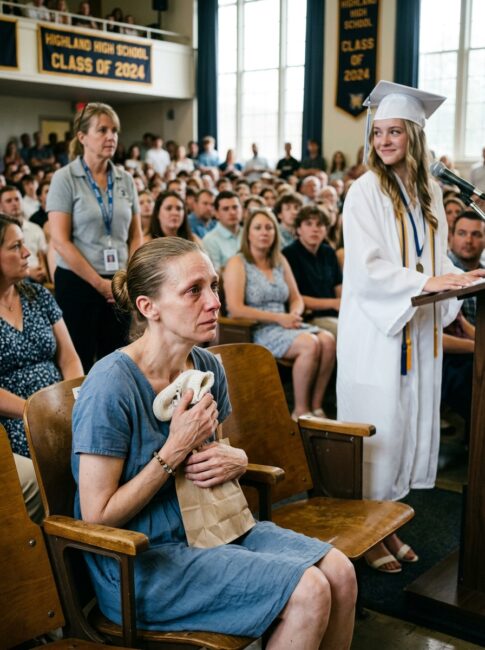
But when she reached the microphone, she did not unfold the paper right away.
Instead, she looked past the principal, past the teachers, past the proud parents holding phones in the air.
She looked at the last row.
At the woman in the blue dress.
The room seemed to lean with her.
Marlene lowered her eyes first.
That was the first thing nobody expected.
A woman with a reputation like hers should have looked defensive. She should have lifted her chin, dared people to judge her, or walked in with some loud claim about second chances.
But she folded into herself.
Like every stare was a bill she had been waiting years to pay.
Ava’s adoptive parents, Paul and Diane Mercer, sat in the third row. Diane had raised Ava since she was four years old. She had packed lunches, waited through fevers, signed permission slips, and sat beside Ava during every science fair disaster.
Paul’s hand tightened around Diane’s.
“Is she going to say something about her?” he whispered.
Diane did not answer.
She was watching Marlene too.
The second strange thing happened when a toddler in the row beside Marlene dropped a plastic dinosaur under the chair. His father reached for it, but Marlene had already bent down, slow and careful, and placed it back in the child’s hand.
The toddler smiled.
Marlene smiled back, but only for a second.
Then she returned both hands to the paper gift bag in her lap.
Inside the bag was not money. Not jewelry. Not anything that could make up for thirteen birthdays, ten Christmas mornings, and a thousand school nights.
It was a pair of white baby shoes, yellowed with time.
One was in her hand.
The other was still in the bag, wrapped in tissue paper with a torn edge.
Marlene had kept them through shelters, treatment centers, halfway houses, and one winter when everything she owned fit into a grocery sack.
She had lost coats. She had lost photographs. She had lost her driver’s license twice.
But she had not lost the shoes.
Ava knew none of that.
At least, that was what everyone believed.
The principal leaned toward the microphone. “Ava, whenever you’re ready.”
Ava nodded.
Her hands were steady, but her face had gone pale.
The audience waited for polished words from a perfect girl. Ava had always looked perfect from a distance. Perfect grades. Perfect smile. Perfect scholarship to the University of Michigan. Perfect daughter of two kind people who had given her a new name, a clean bedroom, and a life without sirens outside the window.
But perfection is often just pain that learned manners.
Ava unfolded her speech.
Then she folded it again.
Marlene’s lips parted slightly, as if she knew what was coming and deserved it.
“I was told my mother did not love me,” Ava said.
The auditorium went still.
Diane closed her eyes.
Paul stared at the stage, stunned.
Marlene’s hand flew to her mouth.
Ava continued, her voice quiet enough that people had to listen carefully.
“I believed that for a long time.”
No one coughed. No one shifted. Even the graduates turned in their chairs.
Near the aisle, the same volunteer who had stopped Marlene from moving forward looked down at her clipboard.
Ava glanced at her adoptive parents.
Then she looked back at Marlene.
“But this morning,” she said, “I found a box in my closet.”
Diane’s face changed.
That was the third twist.
She knew about the box.
For years, it had been hidden on the highest shelf behind winter blankets. Not because Diane was cruel, but because she feared what old things could do to a child who had fought so hard to feel safe.
Ava had found it while searching for a missing earring before graduation.
Inside were letters.
Dozens of them.
Some still sealed.
Some opened and refolded by adult hands.
Each one had the same careful handwriting on the front.
For Ava, when she is ready.
Ava swallowed.
“In that box,” she said, “there were letters from a woman I thought forgot my name.”
Marlene began shaking her head, almost imperceptibly.
Not denying it.
Begging Ava not to keep going.
The room misunderstood that too.
Some thought Marlene was ashamed of being exposed.
Only Diane understood the look.
It was the look of a mother who did not want her child to bleed in public just to defend her.
Ava placed both hands on the podium.
“And there was one more thing,” she said.
The audience waited.
Ava’s voice broke for the first time.
“There was a court paper.”
Marlene closed her eyes.
Paul turned toward Diane. “What paper?”
Diane’s mouth trembled.
On the stage, Ava looked younger than she had moments before.
“It said my mother asked to visit me every year until I turned twelve.”
A low murmur moved through the auditorium.
Marlene bent over the baby shoe like the air had left her.
Ava let the murmur fade.
“She was denied every time,” she said.
And suddenly, the woman in the last row no longer looked like an intruder.
She looked like someone who had been kept outside a door and still brought a gift.
The truth did not arrive like lightning.
It came slowly, through faces changing one at a time.
Diane Mercer stood first.
That surprised everyone most.
She was not angry, not defensive, not rushing toward the stage to stop the speech. She stood with one hand pressed against her heart and the other still holding Paul’s.
Ava looked at her, and for one terrible second, she looked like a child waiting to be scolded.
Diane shook her head gently.
Keep going.
That was the fourth twist.
Diane had not hidden the letters out of hatred. She had hidden them out of fear.
Ava had come to the Mercers with nightmares so violent she slept with her shoes on. She cried when doors slammed. She hoarded crackers under her pillow. She once asked Diane if good mothers always came back before dark.
The therapist had said, “Not yet.”
So Diane had waited.
Then years slipped by, and waiting became easier than reopening a wound.
But love can still make mistakes while trying to protect.
Ava took a breath.
“I also found out my mother came to every hearing sober,” she said. “Every single one.”
Marlene’s shoulders shook.
The town remembered her lowest days.
They remembered the mugshot in the county paper. They remembered the day police found Ava sitting on Mrs. Kelly’s porch in a winter coat two sizes too small. They remembered Marlene screaming in the rain as officers took her away.
What they did not remember was what happened after.
They did not see the church basement where Marlene sat in a folding chair every Thursday night, gripping cold coffee and saying her daughter’s name instead of making excuses.
They did not see her cleaning motel rooms with withdrawal tremors in her hands.
They did not see the first birthday card she mailed after ninety days clean, only to have it returned unopened.
They did not see her turn down rides, men, shortcuts, and every small escape that once dragged her back into the dark.
Because redemption often happens where nobody is clapping.
Marlene had been sober nine years.
Not perfect.
Not magically healed.
But sober.
Every year, on Ava’s birthday, she walked to the mailbox with a letter and came home empty-handed. She never knew whether Ava received them. She only knew she had to keep writing.
The fifth twist came when Mrs. Kelly, the elderly neighbor from Ava’s childhood, rose from the middle rows.
She was eighty-one now, silver-haired and leaning on a cane.
“That porch story,” she said, her voice thin but clear. “People never told it right.”
The principal looked nervous, but did not stop her.
Mrs. Kelly turned slowly toward the auditorium.
“Marlene did not leave that child in the cold and vanish. She knocked on my door because she knew she was sick, and she begged me to call someone safe.”
A sharp hush fell.
Marlene covered her face.
Mrs. Kelly’s eyes filled with tears.
“She was shaking so hard she could barely stand. She said, ‘Please don’t let Ava see me like this.’ Then she waited for the ambulance on the curb because she was afraid to go back inside.”
Ava gripped the podium.
For seventeen years, the town had remembered an abandoned child.
Not a desperate mother choosing the only safe door she knew.
Ava’s voice changed after that.
Less like a speech.
More like a daughter trying to reach across years.
“I don’t know how to fit all of this into one morning,” she said. “I don’t know how to be grateful and angry and confused at the same time.”
No one moved.
“I love my parents,” Ava said, looking at Paul and Diane. “They saved my life in ways I understand now and ways I probably never will.”
Paul wiped his face with the heel of his hand.
Diane nodded through tears.
“And I am not standing here to erase what happened,” Ava continued. “I remember some of it. I remember being scared. I remember hunger. I remember waiting by windows.”
Marlene looked like every word physically hurt her.
“But I also found a letter from when I was eight,” Ava said. “My mother wrote that she would not knock on the door until the court said it was safe, because she did not want to confuse me or hurt the people raising me.”
Diane covered her mouth.
Ava looked toward the back row.
“So she stayed away,” Ava said. “Not because she stopped loving me.”
Her voice trembled.
“Because for once, loving me meant not taking what she wanted.”
That was the main twist, and it moved through the room like a wave.
Marlene had accepted being the villain in Ava’s story because it meant Ava could grow up stable. She did not fight Diane in parking lots. She did not show up at school demanding attention. She did not turn birthdays into battles.
She sent letters.
She stayed sober.
She watched from the far edge of life, where mothers are not supposed to stand.
At freshman orientation, Marlene had been across the street, pretending to wait for a bus.
At Ava’s first choir concert, she sat in her car with the windows cracked, listening to music she could not see.
At the state debate finals, she watched the livestream from the public library because she did not own a computer.
When Ava won her scholarship, Marlene printed the announcement and taped it above the kitchen sink in the apartment she rented alone.
She had never told anyone.
Not even her sponsor.
The principal stepped back from the podium, no longer managing the ceremony. The ceremony had become something else.
Ava reached beneath her graduation gown and pulled out one of the letters.
The envelope was worn at the corners.
“This was the last one,” she said. “Written on my seventeenth birthday.”
Marlene shook her head again, tears spilling now.
Ava did not read the whole thing.
She read only one line.
“I will not ask her to forgive me before she is ready, but I hope someone tells her I became the kind of woman who would have kept her.”
The sound that came from the audience was not applause.
It was grief.
Diane stepped into the aisle.
Paul followed her.
For a moment, everyone thought they were going to Marlene.
But Diane walked to the stage steps first.
Ava came down.
The woman who had raised her wrapped both arms around her, and Ava folded into her like she had at five years old, eight years old, twelve years old.
“I was scared,” Diane whispered.
“I know,” Ava said.
“I should have told you sooner.”
Ava held on tighter.
“I know that too.”
Then Diane turned toward the back row.
The room seemed to stop again.
Marlene stood slowly, still holding the baby shoe.
She looked ready to leave, as if the most merciful thing she could do was disappear before anyone changed their mind.
Diane shook her head.
“No,” she said, her voice carrying. “Please don’t go.”
Marlene froze.
Ava walked down the aisle.
Not running. Not dramatic. Just one careful step after another, crossing the distance that adults, courts, addiction, fear, and shame had built between them.
When she reached Marlene, she looked at the baby shoe.
“Is that mine?” Ava asked.
Marlene nodded.
“I kept both,” she said. “I didn’t have much else from before.”
Ava touched the tiny shoe with one finger.
Then she looked at her mother’s face.
“I don’t know what we are yet,” Ava said.
Marlene’s lips trembled.
“That’s okay.”
Ava breathed in.
“But I know what I want my first sentence to be.”
Marlene waited, terrified of hope.
Ava took the second baby shoe from the bag and held it beside the first.
Then she said, loud enough for the room to hear, “Hi, Mom.”
The auditorium broke quietly.
Not with cheers.
With hands over mouths. With shoulders bending. With old judgments cracking in places no one expected.
Marlene did not grab her. She did not demand the hug she had wanted for more than a decade.
She only opened her hands slightly.
Ava stepped into them.
And the woman everyone had called too late held her daughter like someone afraid to wake from mercy.
The graduation ceremony continued, though nothing about the room felt the same afterward.
Names were called. Diplomas were handed out. Cameras flashed. Families cheered in uneven voices, still carrying the weight of what they had seen.
Marlene returned to the last row.
Ava returned to the stage.
Neither woman looked fully steady.
But this time, when Ava sat among the graduates, she kept one baby shoe tucked beneath her chair and one folded letter inside her sleeve.
Diane noticed.
She did not ask for either one.
After the ceremony, families spilled into the courtyard under a soft June sky. Balloons bobbed over heads. Grandparents posed for pictures. Fathers adjusted crooked caps. Mothers cried into napkins from the refreshment table.
Marlene stood near the brick wall, unsure where to place herself.
Too close felt greedy.
Too far felt like the old life.
Paul approached her first.
For years, he had imagined this woman as a shadow at the edge of his daughter’s peace. Now she stood before him, smaller than his anger had made her.
“I don’t know what to say,” he admitted.
Marlene nodded. “I earned that.”
Paul looked at the recovery bracelet on her wrist.
“How long?”
“Nine years, four months, and six days.”
He absorbed that.
Then he said, “Ava likes coffee with too much cream. She pretends she doesn’t need help carrying things. She sings when she thinks nobody can hear her.”
Marlene’s eyes filled again.
Paul’s voice grew rough.
“I guess you should know some things.”
Diane came next.
The two mothers stood facing each other while the courtyard noise softened around them.
“I thought keeping the letters hidden was protecting her,” Diane said.
Marlene shook her head. “You did protect her.”
“Not from everything.”
“No one can.”
Diane looked at the woman she had feared for so long.
Then she reached into her purse and pulled out a small stack of envelopes tied with ribbon.
“The rest are at home,” she said. “These are the ones I brought in case today went badly.”
Marlene let out a broken laugh.
“In case?”
Diane smiled through tears. “I’m a mother. I prepare for disaster.”
For the first time, Marlene smiled like someone who remembered being young.
Across the courtyard, Ava stood with her cap tucked under her arm while classmates congratulated her. She looked toward the two women, then toward Paul.
A family picture was forming without anyone knowing how to stand in it.
Finally, Ava walked over.
She did not ask for a perfect ending.
She asked for a photograph.
The first one was awkward. Marlene stood too far to the side. Diane pulled her closer. Paul blinked. Ava laughed, and the photographer took the picture too soon.
It became everyone’s favorite.
In the image, nobody looked polished.
But nobody was leaving.
That evening, after the cap and gown were hung over Ava’s desk chair, she sat at the kitchen table with the letters spread in front of her. Diane made tea. Paul pretended to fix a loose cabinet handle so he could stay nearby.
Marlene sat across from Ava, both hands wrapped around a mug she had not touched.
They did not read all the letters.
Not that night.
Some doors open slowly because the people walking through them are still limping.
Ava opened one envelope and found a pressed daisy inside.
“I picked that outside the courthouse,” Marlene said. “I thought it was silly.”
Ava held it carefully.
“It isn’t.”
Near midnight, Marlene stood to leave.
Ava walked her to the porch.
The air smelled like cut grass and summer rain. Crickets called from the dark lawn. For a moment, neither knew how to say goodbye without making it sound like another abandonment.
Marlene reached into her purse and pulled out a small notebook.
“My number,” she said. “But only when you want.”
Ava took it.
Then she handed Marlene one of the baby shoes.
Marlene looked startled.
Ava held the other against her chest.
“You kept both long enough,” Ava said. “Maybe we each keep one for now.”
Marlene nodded, unable to speak.
At the end of the driveway, she turned back once.
Ava lifted the tiny shoe in her hand.
Marlene lifted hers too.
No speech could have said more.
The porch light stayed on until Marlene’s car disappeared around the corner.
And inside the house, on the kitchen table between unopened letters and cooling tea, there was finally a little space where the past could sit without owning the whole room.
Follow this page for more heartfelt stories about forgiveness, family, and the quiet moments that change everything.