Part 2: Garbage Collector Was Looked Down On by His Neighbors — Until the Day He Saved the Entire Block From a Fire
Denise followed him through the doorway.
“Evan!” she shouted. “Come downstairs!”
There was no answer.
Her fourteen-year-old son often wore headphones while getting ready for school. His bedroom was above the garage, at the far end of the second-floor hallway.
Luis stopped near the kitchen.
The smell was stronger inside.
It was not the familiar odor of burned toast or overheated wiring. It was sharp and chemical, with a faint metallic edge beneath it.
Luis looked toward the interior door leading into the garage.
Smoke had begun seeping around the frame.
“Do not open that,” he said.
Denise stared at him.
“My son is upstairs.”
“I know.”
Luis pointed toward the front porch.
“Go outside. Call his phone. Tell him to use the front stairs.”
She did not move.
“Now,” Luis said.
Something in his voice changed her mind.
Denise ran outside with trembling hands and dialed Evan repeatedly.
Luis moved toward the staircase.
The smoke alarm had not sounded.
At the second-floor landing, the hallway was still clear, but a dull crackling noise came from below the bedroom floor.
Luis pounded on the door.
“Evan! Open up!”
Nothing happened.
He knocked again, harder.
A second later, the door swung open.
Evan stood there wearing a sweatshirt and large headphones around his neck.
“What is going on?”
Luis pointed toward the stairs.
“Leave your backpack. Move quickly.”
Evan glanced past him and saw the first strand of smoke drifting into the hallway.
His face changed.
Luis kept one hand on the boy’s shoulder as they descended.
Outside, Denise pulled Evan toward her so tightly that he nearly stumbled.
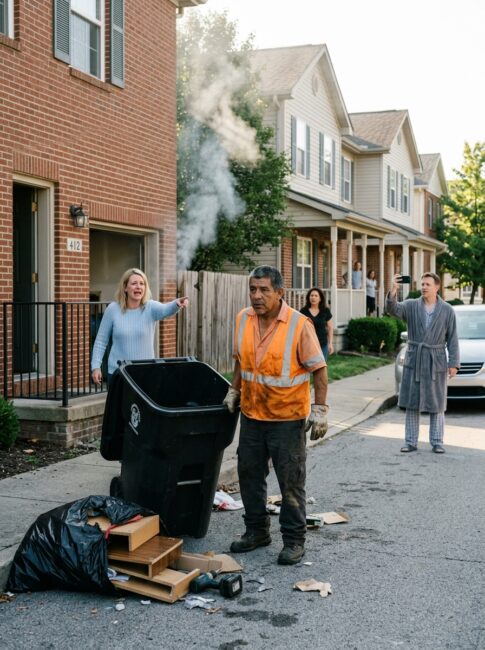
A neighbor across the street was still filming.
Another man stood near the curb in slippers and a robe, watching Luis return to the driveway.
The trash bin lay on its side.
Inside the torn garbage bag were pieces of old shelving, cardboard packaging, and a cracked cordless-tool battery from a weekend renovation project.
A narrow flame flickered beneath the debris.
Luis grabbed the handle of the bin and pulled it farther into the street.
“Stay back,” he said.
The fire department arrived within minutes.
By then, smoke was rising from the roofline above Denise’s garage.
Firefighters moved quickly between the connected townhouses, knocking on doors and ordering residents outside. A crew entered through the neighboring garage while another unrolled hoses across the street.
The residents watched from the sidewalk as the quiet morning changed around them.
Children stood beside parents in pajamas. Dogs pulled nervously against leashes. A woman wrapped a bathrobe around an elderly neighbor who had left her house without a coat.
Luis remained near his truck.
His right glove had darkened near the palm. The edge of the material had begun to curl from the heat.
Denise walked toward him.
“You knew it was burning before there was smoke inside,” she said.
Luis looked at the row of townhouses.
“I smelled it when the truck turned the corner.”
“How?”
He did not answer immediately.
A firefighter emerged from the garage and removed his helmet.
“The fire traveled behind the shared wall,” he told Denise. “Another few minutes, and it could have reached the attic line.”
Denise looked toward the adjoining homes.
Eight families lived along that side of Maple Court.
The firefighter turned toward Luis.
“You moved the bins away from the garages?”
Luis nodded.
“That slowed it down,” the firefighter said.
The man with the phone lowered his arm.
Luis glanced toward the cracked battery inside the bin.
Then he said quietly, “I have smelled that kind of fire before.”
The fire was contained before it reached the living spaces of the neighboring homes.
Denise’s garage suffered heavy damage. Part of the shared wall had to be removed. Smoke drifted through the upstairs hallway, leaving a dark haze across the ceiling.
But the houses were still standing.
Nobody was hurt.
By nine o’clock, the fire engines remained along Maple Court while residents gathered near the sidewalk with coffee cups and folded blankets.
Luis should have continued his route.
Instead, he stayed until the firefighters finished checking the connected homes.
Denise watched him from several feet away.
For six years, she had considered him irritating.
He moved her bins when she placed them too close to the garage. He once knocked on her door to tell her that cardboard boxes were blocking access to the outdoor water valve. He left a note beneath the lid of her recycling bin after she discarded broken glass without wrapping it safely.
She had complained about every one of those things.
The previous summer, she had posted a photograph of Luis standing beside a neighbor’s trash can with the caption:
Why is our garbage collector always inspecting everything?
The post received laughing reactions.
Someone called him “the neighborhood detective.”
Luis never responded.
He continued collecting trash every Thursday morning.
Denise approached him near the truck.
“I owe you an apology,” she said.
Luis shook his head.
“You do not owe me anything.”
“I thought you were going through our bins because you were looking for things to take.”
“I know.”
The answer was simple. There was no anger in it.
That made Denise feel worse.
An elderly woman named Ruth Palmer stepped forward from the sidewalk.
Ruth lived two houses away. She was seventy-nine and walked with a cane. She had left her home wearing a nightgown beneath a winter coat one neighbor had given her.
“Luis has never taken anything from anyone,” Ruth said.
The group became quiet.
Ruth looked toward Denise.
“Last year, he noticed my smoke alarm chirping when I opened the door. My son was out of town. Luis changed the battery before he finished his route.”
Luis lowered his eyes.
Ruth continued.
“He moves my trash can closer to the porch after pickup because my knees are not what they used to be.”
Another neighbor, Marcus Bell, cleared his throat.
“I thought he moved mine because he was being picky,” Marcus said.
Luis looked toward him.
“Your driveway slopes toward the street,” he replied. “The bin rolls when the lid is open.”
Marcus glanced at the intersection where children waited for the school bus each morning.
A younger mother named Erin stepped closer.
“You left me a note about the propane tank beside my garage.”
Luis nodded.
“I moved it after reading the note,” she said. “I thought you were overreacting.”
Luis rubbed one gloved hand against the side of his vest.
“I would rather leave a note that annoys someone than pass a house and wonder later whether I should have said something.”
The firefighter who had spoken earlier walked toward them.
His name tag read CAPTAIN HARRIS.
He looked at Luis for several seconds.
“Ramirez,” he said. “Station Twelve?”
Luis nodded.
Denise turned toward him.
“You were a firefighter?”
Luis glanced toward the ground.
“Volunteer,” he said. “A long time ago.”
Captain Harris removed one glove.
“Luis served with my father,” he explained. “He knew more about residential fires than most people twice his age.”
The neighbors waited.
Luis seemed reluctant to continue, but Ruth touched his arm gently.
He finally spoke.
Twenty-three years earlier, Luis had been a volunteer firefighter in a rural township outside Dayton. He worked full-time at a warehouse and trained at the station in the evenings.
His younger brother, Mateo, lived in an apartment complex nearby.
One winter night, a fire started in a storage room at the rear of the building. The flames moved into the shared attic before anyone understood how quickly the danger was spreading.
By the time Luis arrived with his crew, smoke had filled the second floor.
They rescued six residents.
Mateo was not among them.
Luis stopped volunteering several months later.
He rarely spoke about the fire.
For years, he worked wherever he could find steady hours. When the city sanitation department offered him a route, he accepted it because the job was reliable and allowed him to raise his daughter after his wife became ill.
“I did not choose this work because I stopped caring about safety,” Luis said.
His voice remained calm.
“I chose it because my family needed me home at night.”
Captain Harris looked toward the row of garages.
“He noticed what most people would have missed,” he said. “These battery fires can build quickly. Once the heat moved through the wall, the attic spaces could have connected the rest.”
Denise turned toward Evan.
Her son stood beside a neighbor’s car, holding his backpack against his chest.
He had left the house wearing only one shoe.
She imagined another five minutes.
Another cup of coffee before stepping outside.
Another unanswered call through the headphones.
Her face tightened.
Luis noticed.
“He is okay,” he said.
Denise looked at him.
“You went inside when you knew there was a fire.”
“I knew where his room was.”
“How?”
Luis seemed surprised by the question.
“His window is above the garage,” he said. “He waves sometimes when we pick up trash before school.”
Evan looked down.
“I did not know you could see me,” he said.
Luis smiled faintly.
“I always wave back.”
The man who had filmed the incident walked forward.
His name was Greg Wallace.
He held his phone at his side now.
“I recorded you tearing open the bag,” Greg said. “I thought you were causing trouble.”
Luis looked toward the phone.
Greg deleted the video without being asked.
Then he slipped the phone into his pocket.
“I am sorry,” he said.
Luis nodded.
Across the sidewalk, residents began carrying bottles of water toward the firefighters. Someone brought Luis a fresh pair of work gloves from a garage that had not been damaged.
He accepted them quietly.
Before climbing back into his truck, he picked up the blackened remains of his old glove.
Denise noticed a small spiral notebook tucked into his vest pocket.
Its pages were bent and stained from years of use.
“What is that?” she asked.
Luis opened it reluctantly.
Inside were handwritten notes organized by street.
Ruth Palmer — return bin near porch.
Maple Court hydrant — keep curb clear.
Walker garage — remind about cardboard.
Bell driveway — bin rolls downhill.
The pages contained no gossip.
No private details.
Only small reminders about people and places most residents passed every day without noticing.
Luis closed the notebook.
“I forget things if I do not write them down,” he said.
Then he climbed into the truck and returned to work.
The fire changed Maple Court in ways that were visible and ways that were not.
For several weeks, contractors worked inside Denise’s garage. Sheets of plywood covered part of the damaged wall. The smell of smoke lingered whenever rain made the air heavy.
Evan stopped wearing headphones while getting ready for school.
The residents replaced expired smoke alarms and cleared clutter away from their garages. They checked on Ruth more often. Someone repainted the curb around the hydrant near the corner.
Nobody made a ceremony out of it.
Life returned gradually.
Children rode bicycles along the sidewalk. Packages appeared on porches. Lawns needed mowing again.
Every Thursday morning, Luis drove the sanitation truck down Maple Court at the same slow pace as before.
The first week after the fire, several residents stood outside waiting for him.
Greg carried two cups of coffee.
Marcus brought a box of work gloves.
Erin had written a thank-you card signed by her children.
Luis looked uncomfortable with the attention.
“You do not have to do this,” he said.
“We know,” Denise replied.
She stood beside her repaired driveway with Evan.
In her hands was the original note Luis had left months earlier about moving cardboard boxes away from the garage wall.
The paper was wrinkled. One corner had become smudged with ash.
She had found it beneath a stack of mail after the fire.
At the time, she had considered it annoying.
Now she had placed it inside a small wooden frame.
Luis noticed the frame but said nothing.
Evan walked toward him holding a paper bag.
“My mom made breakfast sandwiches,” he said. “There is an extra one.”
Luis accepted the bag.
“Thank you.”
Evan glanced toward the truck.
“Do you still wave when you drive past my window?”
Luis smiled.
“Every Thursday.”
The following month, a new sign appeared near the entrance to Maple Court.
It did not contain Luis’s name.
He would not allow that.
The sign simply read:
KEEP GARAGES CLEAR. KEEP HYDRANTS OPEN. LOOK OUT FOR ONE ANOTHER.
Beneath the sign was a small metal box filled with spare smoke-alarm batteries and handwritten emergency contact cards for elderly residents.
Ruth added the first card.
Denise added the second.
By the end of the week, every household had added something.
On a cool autumn morning, Luis stopped his truck beside Denise’s driveway and noticed her trash bin sitting too close to the garage again.
He stepped down from the cab and moved it several feet toward the curb.
Denise opened the front door just as he finished.
For a moment, they looked at each other.
Months earlier, she might have rolled her eyes.
This time, she smiled.
“Thank you, Luis.”
He nodded and adjusted the lid.
Then he returned to the truck.
As the vehicle moved slowly down the street, Evan appeared in the upstairs window and raised one hand.
Luis lifted his gloved hand from the steering wheel and waved back.
Near the curb, Denise’s framed note caught the morning light through the front window.
The handwriting was ordinary.
The message was brief.
But she kept it where she could see it every day.
Follow this page for more heartfelt stories about the people we overlook until one quiet moment reveals who they have always been.