Part 2: He Forgot Every Name in Our Family — But Still Called One Dog Who Had Been Gone Twelve Years
When Walter first moved in with us, I thought the hard part would be medicine.
It wasn’t.
The hard part was being forgotten politely.
He never meant harm.
That somehow made it worse.
At breakfast, he called me “ma’am” and thanked me for the eggs.
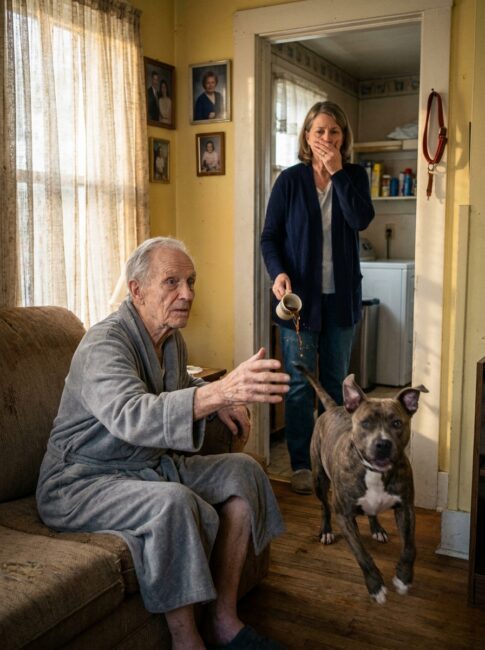
At lunch, he asked when his wife would be home, though Margaret had been gone eight years.
At night, he folded napkins into neat squares and tucked them under his plate the way he must have done for decades.
“Your mother liked a clean table,” he told my husband once.
Then he looked up and asked, “Do you know her?”
My husband, David, turned toward the sink.
“Yes, Dad,” he said.
“I knew her.”
Buddy was the one name Alzheimer’s never touched.
We learned not to correct him.
The doctor told us correction often bruises more than it helps.
So when Walter called into the empty living room, we let the silence answer.
But silence has weight.
It sat on our furniture.
It followed us into the laundry room.
It waited in the hallway at night.
Walter had routines from a life his mind could no longer map.
At 5:45 a.m., he woke and shaved one side of his face better than the other.
At 6:00, he asked for black coffee with one spoon of sugar.
At 6:12, he patted the sofa.
“Buddy, come here.”
At 6:14, his hand dropped.
Every day.
I started writing the times down in a blue notebook because nurses document what they cannot fix.
March 3rd.
6:12.
Called Buddy.
March 4th.
6:12.
Called Buddy.
March 5th.
6:12.
Reached farther today.
That last part bothered me.
Reached farther today.
Like Buddy was standing just out of reach.
David hated the notebook.
“Don’t make a science project out of my dad,” he snapped one morning.
Then he apologized before dinner and sat in his truck for twenty minutes with the engine off.
Grief makes people sharp in small rooms.
I understood that.
Still, I kept writing.
There were other details too.
Walter refused to eat breakfast unless a second plate sat on the floor beside the sofa.
Not a dog bowl.
A plate.
One scrambled egg.
One torn piece of toast.
He never looked down at it.
But if I forgot, he pushed his own plate away.
“Not yet,” he’d say.
“Boy hasn’t had his.”
Sometimes he tapped twice on the sofa arm.
Two soft knocks.
Then he’d smile at nothing.
David told me Buddy used to answer that sound.
When Walter knocked twice, Buddy came running from anywhere in the house.
Kitchen.
Garage.
Backyard.
Even from sleep.
“They were ridiculous together,” David said once, standing by the cedar tree behind the house.
“Dad talked to that dog more than he talked to people.”
I asked what happened to Buddy.
David rubbed his thumb across the rim of his coffee cup.
“Cancer,” he said.
“Dad slept beside him on the laundry room floor the last week.”
Then he walked away.
That was all he could say.
By spring, Walter’s world got smaller.
He stopped recognizing the hallway bathroom.
He opened closets and stared inside like he had found doorways to other houses.
One afternoon, I found him standing at the back door holding an old leash.
Brown leather.
Cracked.
Soft from years of hands.
“Walk?” he asked.
I looked down at the empty clip.
Then at his face.
He looked ready.
Jacket buttoned wrong.
Cap tilted sideways.
Hope sitting in his eyes like sunrise.
So I said, “Okay.”
We walked two blocks with no dog.
Walter held the leash loose in his right hand.
Every few steps, he glanced down beside his knee and smiled.
“Good boy,” he murmured.
A neighbor watering her flowers saw us and turned away fast.
I don’t blame her.
Some things are too tender to witness directly.
That night, David found me crying in the laundry room, sitting beside the dryer with Buddy’s old leash across my lap.
He didn’t ask why.
He just sat down beside me.
For a long time, only the dryer spoke.
Then David said, “I miss the version of him that knew he loved me.”
I wanted to say he still loved him.
I wanted to say love stays.
But hospice had taught me that easy comfort can sound like a door closing.
So I reached for his hand.
And we sat there.
Under the shelf where Buddy’s old red collar still hung from a nail.
The false ending came on a Thursday morning in June.
Hot already.
Cicadas screaming outside before breakfast.
Walter had a bad night.
He wandered twice.
At 2:18 a.m., we found him in the garage, barefoot, holding a flashlight with dead batteries.
At 4:03, he tried to leave through the front door because he said someone was waiting by the mailbox.
By sunrise, all three of us looked hollowed out.
I made coffee.
David toasted bread.
Walter sat on the sofa with his robe untied and his silver hair sticking up at the crown.
At 6:12, he lifted his hand.
Tapped twice.
“Buddy, come here.”
Nothing moved.
Not the curtains.
Not the air.
Not a floorboard.
Walter waited longer than usual.
Then he leaned forward and patted the cushion beside him.
“Buddy?”
His voice cracked on the second syllable.
It was the first time he sounded unsure.
I watched his hand hover in the air.
His fingers trembled.
Then he looked toward the hallway, toward the kitchen, toward the back door.
Searching.
Not confused.
Searching.
“Buddy?” he called again.
David closed his eyes.
I stepped into the living room with his coffee.
“Walter,” I said gently.
“Here’s your cup.”
He didn’t take it.
He looked at me with the face of a man standing in a field after a storm, counting what was missing.
“Where did he go?”
I froze.
Because he had never asked that before.
He called.
He waited.
But he had never asked.
David moved first.
He knelt in front of his father.
“Dad.”
Walter looked at him blankly.
“Dad, Buddy isn’t here.”
The room tightened.
I wanted to stop him.
But the words had already left.
Walter blinked.
Once.
Twice.
Then something passed across his face.
Not understanding exactly.
Something older than understanding.
His mouth opened a little.
His hand fell to his lap.
And he whispered, “I was supposed to keep him safe.”
David covered his face.
Walter began to cry without sound.
No shaking.
No drama.
Just tears slipping down a face that had forgotten passwords, addresses, birthdays, and the names of children, but had not forgotten one brown dog.
I sat beside him.
He let me hold his hand.
For the first time in months, he didn’t call me ma’am.
He simply said, “I lost him.”
That felt like the end of the story.
It wasn’t.
Two days later, I drove past a rescue adoption event outside a feed store in Franklin.
I wasn’t planning to stop.
We had enough chaos.
Enough medication alarms.
Enough grief walking through our hallway in slippers.
But then I saw the dog.
A young male Pit Bull, maybe three years old, stood behind a folding pen with his head low and his body still.
Brindle coat.
White chest.
Soft brown eyes.
One ear bent forward at the tip.
Not torn like old Buddy’s.
But close enough to make my hands go cold.
A volunteer told me his name was Tank.
Found tied behind an abandoned mechanic shop.
Scars on his shoulders.
Afraid of men.
Gentle with elderly people.
“He doesn’t bark much,” she said.
“Mostly just watches.”
Tank looked at me through the wire.
Then he did something small.
He lifted one paw and placed it against the fence.
Two taps.
Tap.
Tap.
I stepped back like the ground had shifted.
The volunteer smiled.
“He does that when he wants someone to come closer.”
I thought of Walter’s fingers tapping the sofa arm.
Two soft knocks.
The old red collar hanging in our laundry room.
The empty breakfast plate.
The cracked leash.
And the way Walter had whispered, I was supposed to keep him safe.
I signed the foster papers before I called David.
When I brought the dog home, David stood in the driveway with both hands on his head.
“Claire.”
“I know.”
“We can’t just replace Buddy.”
“I know.”
“Dad may not even understand.”
“I know.”
Tank sat in the back seat, quiet as a folded blanket.
Then Walter appeared at the front window.
Not fully dressed.
One suspender hanging loose.
He stared at the dog through the glass.
And for the first time all week, he smiled before anyone told him to.
We agreed not to say Buddy’s name.
That was the plan.
Let Walter meet the dog slowly.
No pressure.
No performance.
No trying to force a miracle onto a sick man.
But plans are fragile around love.
The next morning, I woke before my alarm.
Tank slept on a dog bed beside our bedroom door, though I had left the crate open in the laundry room.
At 6:00, Walter’s bedroom door creaked.
At 6:08, slippers shuffled down the hall.
At 6:12, Walter sat on the sofa.
I stood in the kitchen holding my breath.
David stood behind me.
Tank lifted his head.
Walter tapped the sofa arm twice.
Tap.
Tap.
And said, “Buddy, come here.”
Tank stood.
No hesitation.
No training.
No command he knew.
He walked straight into the living room, climbed his front paws onto Walter’s knees, and pressed his wide head into the old man’s chest.
Walter wrapped both arms around him.
His eyes closed.
His whole face changed.
Not younger.
Not healed.
But found.
“You came back,” he whispered.
Then he laughed once, small and broken.
“Buddy,” he said into the dog’s neck.
“I waited so long.”
David made a sound behind me that I had never heard from him before.
I turned and saw him gripping the counter with both hands.
I didn’t move.
Tank didn’t move.
Walter held that dog like twelve years had folded in half and placed something warm back into his arms.
That was the big twist everyone saw.
An old man’s mind forgot twelve years.
A rescue dog answered a name that wasn’t his.
It would have been enough.
But there was more.
Three weeks after we adopted Tank, I found a box in the attic while searching for extra bed pads.
It was labeled in Margaret’s handwriting.
BUDDY — DO NOT THROW AWAY.
Inside were photographs, vet bills, a cracked tennis ball, and a stack of small envelopes.
Each envelope had a date.
The last one was addressed to David.
He opened it at the kitchen table.
His hands shook before he even unfolded the letter.
Margaret had written it during her cancer treatment.
Her handwriting leaned hard to the right, like she was pushing each word uphill.
“David,” it began.
“If your father ever gets lost inside himself, remember this: he may forget names, but he will follow love if it has a shape.”
David stopped reading.
His jaw locked.
I took his hand under the table.
He kept going.
“Buddy is that shape for him. Not because Buddy was only a dog. Because Buddy was beside him through every thing your father could not say out loud.”
There was another line.
One that explained the second plate.
“Your father fed Buddy from a plate every morning after my surgery because he said no one recovering should eat alone.”
I looked toward the living room.
Walter sat on the sofa with Tank’s head in his lap, stroking the same spot behind the same bent ear.
The old ritual wasn’t confusion.
It was care.
The empty plate.
The tapping.
The leash walks with no dog.
His mind wasn’t inventing nonsense.
It was reaching for the last language it still trusted.
A body remembers some things.
Hands remember where to rest.
Feet remember the way to the back door.
A heart remembers who came when it called.
After that letter, we stopped calling Tank by his old name.
Not because we believed he was the same dog.
Not because Walter needed a trick.
But because Buddy had become more than one animal in our house.
Buddy was a word for come close.
Buddy meant sit with me while I eat.
Buddy meant I am still here somewhere.
So the rescue became Buddy.
And slowly, the house changed.
Walter still forgot us.
He still asked David if he worked for the power company.
He still called me “nurse” on days when I wore jeans and no badge.
But each morning, his face opened when Buddy entered the room.
The dog learned his schedule like prayer.
At 5:45, Buddy waited outside Walter’s door.
At 6:00, he followed him to the sofa.
At 6:12, he placed his head exactly where Walter’s hand would fall.
No command.
No leash.
Just habit becoming mercy.
There were small miracles too quiet to post about.
Walter began eating more.
Only if Buddy had his plate first.
He stopped wandering at night as often because Buddy slept across the bedroom doorway like a living gate.
When Walter got agitated during baths, Buddy sat outside the bathroom and gave two soft taps against the door.
Tap.
Tap.
Walter would turn his head.
“Good boy,” he’d say.
And his shoulders would drop.
One afternoon, Walter looked at David for almost ten seconds.
Longer than usual.
Buddy was between them, tail thumping against the rug.
Walter pointed at David and asked, “Is he ours?”
David crouched slowly.
“Yeah, Dad.”
Walter nodded.
“Good.”
Then he looked down at Buddy.
“Keep him safe.”
David lowered his head into the dog’s neck.
I walked to the hallway because some moments deserve privacy even inside family.
The strangest twist came in October.
We took Buddy to the vet for a limp.
Nothing serious.
Just an old injury from before the rescue, stiffening in cold weather.
The vet scanned his microchip to update the records.
She frowned at the screen.
“This dog was originally registered under another name,” she said.
My stomach tightened.
“What name?”
She turned the monitor slightly.
“Looks like… Henry.”
That was Walter’s middle name.
Henry.
A name he no longer answered to.
I know coincidence when I see it.
I also know some coincidences arrive wearing work boots and sit down at your kitchen table until you admit they matter.
I didn’t tell Walter.
He didn’t need that fact.
But I told David.
He stood under the maple tree for a long time after.
Then he laughed once.
Not because it was funny.
Because some things are too heavy to hold without making a sound.
Now our mornings are different.
Still hard.
Still full of pills, spills, repeated questions, and socks placed in the refrigerator.
But at 6:12, the whole house listens.
Walter taps twice.
Buddy comes running.
His nails click across the hardwood.
His tail hits the coffee table.
Walter opens his arms before the dog reaches him.
Every time.
Some mornings, Walter says, “You’re late.”
Some mornings, “Where’ve you been?”
Some mornings, he just presses his cheek against Buddy’s head and breathes like someone finally unlocked a window.
And every morning, Buddy accepts the story Walter is living in.
No correction.
No argument.
No hurry.
Just weight against his knees.
Warmth under his hand.
A name answered.
I started a ritual of my own.
Every Friday, I drive to the little pet bakery near Nolensville Road and buy two plain peanut butter biscuits.
One goes in Buddy’s jar.
One goes into a small metal tin I keep on the kitchen shelf under the old red collar.
I don’t explain it.
I don’t need to.
After breakfast, Walter sometimes points to the tin and asks, “Is that for the boy?”
“Yes,” I say.
“For the boy.”
He always nods like this is proper.
Like the world, for one tiny second, has arranged itself correctly.
Then Buddy sits beside him.
Walter breaks his toast in half.
One piece for himself.
One piece held low between careful fingers.
Buddy takes it gently.
Always gently.
Twelve years disappeared from Walter’s mind.
But not from his hands.
Not from the way his palm knows the shape of a dog’s skull.
Not from the way his voice finds one name in the dark.
People ask if Walter knows this Buddy is not the first Buddy.
I don’t answer quickly.
Because the question feels too small.
Maybe he knows.
Maybe he doesn’t.
Maybe memory is not one locked room, but a house with many doors.
Some are shut.
Some are gone.
And one, somehow, still opens every morning at 6:12.
Walter taps twice.
Buddy comes.
The sofa creaks.
The old man smiles.
And somewhere inside all that forgetting—
someone is remembered.
“Buddy,” he whispers.
The dog lifts his head.
Still here. Say “Buddy” if you believe love can outlive memory.