Part 2: The German Shepherd Kept Pushing His Owner Toward The Shed — Then The Camera Revealed What He Practiced At Night
The first year after my stroke did not feel like a year. It felt like one long hallway with no doors, just the sound of my wheelchair scraping across the floor and the pill organizer beeping every morning like a tiny machine counting what was left of me.
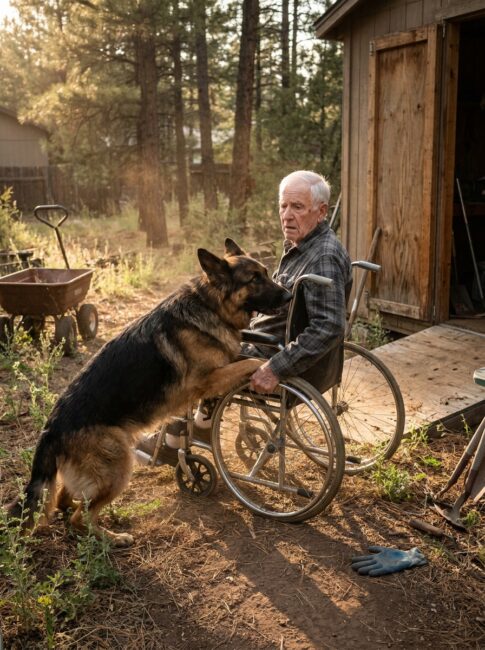
People came by often at first. Neighbors brought casseroles wrapped in foil, church ladies brought banana bread, and my son Mark drove up from Phoenix every other weekend with groceries, tools, and the face of a man trying not to look scared. He would stand in the kitchen, checking the smoke alarm batteries, the pantry shelves, the wheelchair brakes, and I would tell him, “I’m not dead yet.” He would answer, “That’s what I’m trying to keep going.”
Ranger always watched those visits closely. He watched Mark tighten screws on the ramp, watched the nurse check my blood pressure, watched the physical therapist move my right arm as if it belonged to a sleeping stranger. He did not bark or beg for attention. He simply stood there, silent and focused, as if every human movement in that house was being stored somewhere behind his brown eyes.
When I sold Ellen’s blue Subaru because I could no longer drive, Ranger sat in the driveway and watched the young couple pull away. He did not chase it. He did not whine. He only stared down the street long after the car disappeared, then went into the laundry room and came back with Ellen’s old gardening glove. He dropped it on my lap, and I held it until the sun went down.
When my daughter Beth came from Portland, she tried to be cheerful for the first two hours. She folded laundry, filled the freezer with soup, and taped a list of emergency numbers beside the phone. Then I heard her crying in the laundry room, muffling it into a towel so I would not hear. Ranger pushed the door open with his nose, leaned his shoulder against her knees, and stayed there until she sank to the floor and wrapped both arms around his neck.
“He knows what to do better than we do,” Beth said later, wiping dog hair from her black sweater.
I smiled because it sounded like a joke. But it did not feel like one.
There were small days after that, the kind no one would think to remember until they were gone. Ranger brought my socks one at a time from the bedroom, usually one black and one white. He stood between my wheelchair and the porch steps whenever I rolled too close. He carried the newspaper from the driveway so carefully that only the corner was wet, then waited for praise as if he had delivered a government document.
He knew which hand worked. That was the strangest part. If he wanted me to pet him, he put his head under my left hand. If he brought me something, he placed it on my left side. He never pushed his nose under my right hand, the dead hand, the hand that lay in my lap like a forgotten tool.
Once, a home health nurse named Carla watched him open the refrigerator with the towel Ellen had tied to the handle years before, back when arthritis made her fingers stiff. Ranger bit the towel, pulled backward, and the refrigerator door swung open. Carla froze in the kitchen doorway and asked, “Who trained him to do that?”
“Nobody,” I said. “He watches.”
Carla looked at the towel, then at the bottom shelf where I kept bottled water, apples, sandwich meat, and the orange juice Mark insisted I drink when my sugar ran low. Her expression changed for one second, just enough for me to notice and not understand.
“Smart dog,” she said.
By fall, Ranger had taken over the schedule of the house. Breakfast at six. Pills at eight. Porch at ten. Nap at one. Backyard at four. Every afternoon, he rolled his tennis ball to my left wheel, and if I ignored him, he nudged the brake lever with his nose. If I still ignored him, he made a low sound in his chest, not quite a growl and not quite a whine. A command.
So I would unlock the chair and follow him outside.
Our backyard sloped gently from the kitchen door to the shed. Before the stroke, I had built birdhouses out there, planted tomatoes with Ellen, and watched monsoon clouds roll over the mountains like dark curtains. After the stroke, the yard became a picture of a life I could see but no longer enter.
Ranger wanted me back in it.
He would bring me a scrap of cedar. Then a screwdriver. Then the old coffee can full of nails, which he carried by the rim with careful teeth. One afternoon, he brought me Ellen’s pruning shears, the ones wrapped with blue tape around one handle because her grip had gotten weak near the end.
“Where did you find these?” I asked.
He looked toward the shed. Toward the little ramp. Toward that place again.
I rolled close, then stopped at the base. My left hand tightened on the wheel while my right hand sat useless in my lap. “No,” I said.
Ranger walked behind me. I felt his breath on the back of my neck, then the pressure of his chest against the chair handles. Slow. Steady. Careful. The wheels moved forward, and the ramp creaked under me.
“Ranger.”
He pushed again.
The chair climbed one inch, then two. My heart pounded so hard I heard it in my ears. Halfway up, I locked the brake and said, “No,” but my voice sounded smaller that time.
Ranger stepped around and sat in front of me, ears high, eyes on mine. He did not seem to understand fear. Or maybe he understood it better than I did and simply refused to let it make the decisions.
That was the first day he pushed me halfway up the ramp.
Not all the way. Only halfway. But halfway was more than I had done in nine months, and when the sun turned orange behind the pines, Ranger rested his head on my knee as if halfway was worth honoring.
“You’re going to get me killed,” I whispered.
He closed his eyes like he disagreed.
After that, the pushing became our routine, strange and stubborn and private. Every day at four, Ranger guided me to the ramp. Every day, I said no. Every day, he tried anyway. Some days I let him move me six inches. Some days I cursed and rolled back inside. Some days I sat at the kitchen table afterward, ashamed that a dog had more faith in my life than I did.
Then came the afternoon my phone slid off the porch.
It landed screen down in the dirt near the shed. I stared at it from the top of the ramp, annoyed at first, then uneasy. The distance looked small to anyone with two working legs, but to me it might as well have landed across the street.
My chair was angled wrong. My left wheel sat too close to the edge, and the right brake had been loose for days because I had meant to call Mark and never did. Ranger saw the phone, trotted down the ramp, picked it up gently, and started back toward me.
Halfway up, his back paw slipped.
The phone dropped.
He caught himself, but I reached for him without thinking. My dead side did nothing, my left hand missed the brake, and the chair rolled forward with a sudden scrape of metal against wood.
For one thin second, there was no sound.
Then the right wheel slid off the ramp.
“Ranger!”
He lunged, but not at me. He grabbed the front footrest strap in his teeth and dropped his whole body low, claws digging into the wood. The wheelchair tilted, caught between falling and not falling, and I saw his shoulders shake as he pulled backward with everything in him.
“Let go,” I said, because I was afraid he would break his jaw.
He did not let go.
The chair tipped another inch. Ranger made a deep sound I had never heard before, something between pain and promise, and pulled again. The wheel bumped back onto the ramp, and I slammed the brake with my left hand.
For a while, neither of us moved. Ranger was breathing hard, and so was I. The phone lay forgotten in the dirt below us, but Ranger stepped close and pressed his forehead against my knee. I touched his muzzle and saw a thin line of blood where the strap had cut his lip.
“Stupid dog,” I said.
My voice broke on the first word.
That should have been the end of the story. A dog saved an old man from falling. A good ending. A clean ending. The kind people tell at church breakfasts, grocery store lines, and local news segments before moving on with their day.
But the next morning, I found the refrigerator open.
Ranger was standing in front of it, and a bottle of orange juice lay on the floor between his paws. At first, I thought he had made a mess. Then I tried to speak, and nothing came out right.
My tongue felt thick. The kitchen clock had two hands, but I could not make them mean anything. The room narrowed at the edges, and I remember thinking only one thing.
Not again.
Ranger barked once, sharp enough to cut through the fog. He picked up the orange juice bottle and dropped it against my left foot. Then he ran to the counter, grabbed the towel hanging from the drawer, and yanked until the drawer slid open.
Inside was the old medical alert button Beth had bought me, the one I refused to wear because it made me feel like a museum exhibit. Ranger pawed at the drawer until the button slid forward, then took the cord in his teeth and dragged it across the tile.
He put it in my lap.
I could not lift it. My hand would not close.
Ranger climbed his front paws onto the wheelchair, pressed his nose against the button, and held it there until a voice crackled through the speaker.
“Mr. Whitaker? Do you need help?”
Ranger barked.
Once.
Then again.
I remember his face above me, steady and close, not panicked, not confused, just watching me the way Ellen used to watch a pot that was about to boil over. By the time the paramedics arrived, my blood sugar had crashed low enough to make my speech almost useless. The doctor later used careful words about how bad it could have been if I had been alone.
He did not need to finish.
I understood the space between his sentences.
Ranger had not only saved me from the ramp. He had saved me in the kitchen too.
That was when people started calling him a hero. The local paper came first, sending a young woman with a camera who knelt in my living room and asked Ranger to look toward the window. He looked at me instead. Then a radio station called, a pet food company mailed boxes to the house, and a trainer from Tucson left a voicemail saying Ranger had “natural service instincts.”
Mark drove up from Phoenix, hugged me too hard, then crouched in front of Ranger. “You big show-off,” he said, and Ranger licked his chin.
For a few days, the house filled with people. Neighbors brought muffins. Carla told every nurse in the county. Beth cried again, but this time in the kitchen, and this time she did not hide it. I sat in my chair while people told me how lucky I was, and I nodded because they were right.
But one question stayed under my ribs.
How did he know?
Not how he opened the fridge. I had seen him watch. Not how he pushed the chair. I had seen him practice the ramp. But how did Ranger know to pull the medical alert button from that drawer?
I had never used it.
Not once.
Three days after the kitchen incident, Mark installed a backyard camera under the porch roof. “Not for you,” he said, tightening the screws while I complained from the doorway. “For my blood pressure.”
I told him cameras were for banks and rich people with gates. He ignored me and installed another small camera in the kitchen after I yelled at him about the first one.
That night, Ranger would not settle. He paced from my bedroom to the kitchen, from the kitchen to the back door, from the back door to my wheelchair. His nails clicked on the floor in slow, restless patterns.
At 2:13 a.m., according to the camera, he did something no one saw with human eyes.
He dragged my old green garden cart from beside the shed. It was rusted at the corners and small enough to fit between the tomato beds, the same cart I used to haul soil for Ellen before arthritis stole her grip and the stroke stole mine. Ranger took the rope handle in his mouth, backed up the ramp, and pulled.
The empty cart rolled after him.
It bumped sideways. He stopped, adjusted his stance, and tried again. For twenty-six minutes, under a porch light full of moths, Ranger pulled that cart up and down the ramp. Alone. In the dark. Practicing the weight, the slope, the angle, the exact place where wheels slipped.
Then he went inside.
The kitchen camera caught the rest. Ranger opened the refrigerator with the towel, took the orange juice bottle from the lower shelf, carried it to my wheelchair, and dropped it. Then he opened the drawer with the other towel, took the medical alert cord in his teeth, dragged it to the chair, and dropped it in the seat.
Then he sat there.
Waiting.
Practicing.
The next morning, Mark showed me the footage on his phone. I watched it without speaking while Ranger lay beside my chair, chin on his paws, looking like nothing in the world needed explaining.
“Dad,” Mark whispered.
I could not answer.
The dog had not guessed. He had rehearsed.
But that still did not explain the drawer.
So Mark pulled up more footage from the night before my emergency. There I was at the kitchen table, sitting alone after the ramp accident, the medical alert button lying in my left hand. I had taken it from the drawer for the first time in months, turned it over, and stared at it like it was a bill I did not want to pay.
Then, on the video, I said to the empty kitchen, “Ellen would have made me wear this stupid thing.”
I placed it back in the drawer and rolled away.
At first, I thought Ranger was not in the room. But then Mark paused the video and pointed to the microwave door. In its dark reflection, Ranger was standing in the hallway, watching me.
Not asleep.
Not missing it.
Watching.
That was the first twist.
The second came from Carla.
She stopped by two days later with a grocery bag and a face that told me she was carrying something heavier than food. Ranger stood between her and me, not aggressive, just present. Carla sat at the kitchen table, folded her hands, and said, “I need to tell you something about Ellen.”
The room went still.
“About Ellen?” I asked.
Carla nodded. “She called our clinic about a year before she passed. She asked if dogs could learn assistance tasks without formal training. I told her some dogs can pick up routines, but it is not safe to rely on that alone.”
I looked at Ranger. He looked away.
Carla swallowed. “She said, ‘My husband will never accept help from strangers. But he accepts help from the dog.’”
The refrigerator hummed. The old clock clicked above the sink. Carla reached into her bag and took out an envelope with my name written across the front in Ellen’s handwriting, leaning slightly to the right the way it always did when her fingers hurt.
“She asked me to keep this,” Carla said, “until I believed you were ready.”
I wanted to be angry. At Carla. At Ellen. At the whole secret shape of love. But my left hand reached for the envelope before my pride could stop it.
Inside was one page.
No grand goodbye. No long speech. Just Ellen, plain as toast.
Harold,
If you are reading this, it means Ranger has started doing the work I hoped he would learn. Do not be proud. You are terrible at it.
I laughed once, and it hurt.
The letter continued.
I have been showing him small things. Not training, not really. Just letting him watch. The fridge towel. The drawer towel. The ramp. The orange juice. Your stubborn face. He pays attention better than you.
There it was. The seed I had stepped over a hundred times.
Ellen tying towels to handles after her arthritis made gripping painful. Ellen letting Ranger sit in the kitchen while she opened drawers with loops of cloth. Ellen pretending to drop things so Ranger could bring them. Ellen telling me, “That dog understands more than you think,” while I hid behind the newspaper and pretended not to hear.
She had not trained him with commands. She had taught him a language of need.
Then she had left him with me.
The final line was shorter.
When your body forgets you, let him remember.
I read it three times. Then I lowered the page to my lap, and Ranger rose from the floor. He came to me slowly, placed his head under my left hand, and waited.
Not my right hand.
Never my right hand.
Because Ellen must have shown him that too.
That day changed the house, but not loudly. No one fell to the floor. No music swelled. No miracle light came through the window. The refrigerator still hummed, the pill organizer still beeped, and the wheelchair still scraped the floor.
But the air shifted.
The ramp was no longer a hill Ranger wanted me to climb. It was a sentence Ellen had started and trusted him to finish. The towels tied to the refrigerator and drawer were no longer ugly little tricks for a half-broken man. They were handles left by love.
The garden cart was not a toy. It was Ranger’s wheelchair, his practice body, his way of saying, “I will be ready before you need me.”
I began to see every strange habit differently. The way he slept facing the ramp was not because he liked the door; it was because that was the place I feared most. The way he brought me orange juice even when I said I was fine was not because he wanted treats; it was because Ellen had taught him that fine could be a lie.
The way he watched reflections in the microwave, the dark television, and the window at night was not because dogs chase shadows. It was because he had learned that people reveal themselves when they think no one is looking.
The way he brought me Ellen’s pruning shears from the shed. The way he pushed the coffee can of nails toward my chair. The way he placed that blue glove on my lap every afternoon at four.
All of it was a trail.
He had been trying to take me back to the places where I had stopped living.
I had thought I was the abandoned one. Old man. Dead wife. Quiet house. Half a body. One dog. But Ranger had been abandoned too, in his own way. Ellen was his person first. She was the one who brushed him on the porch, slipped him bits of toast, and sang badly to the tomato plants while he watched from the steps.
When she died, he lost the voice that gave the house its map.
Then I had my stroke.
And somehow, instead of breaking, Ranger took the map in his mouth and carried it to me.
That was the part I could never explain to reporters. They wanted a clean miracle. They asked if Ranger was specially gifted, if German Shepherds were smarter than other dogs, if I had used a secret command when he pushed my chair.
I always gave them the same answer.
“No command.”
Because there was none.
Ranger did not obey me into survival.
He watched me into it.
One week after Carla brought the letter, I asked Mark to take me to the shed. He looked nervous. Ranger looked impatient. The ramp waited in the afternoon light, and for the first time in months, I looked at it without pretending it was not there.
I set my left hand on the wheel. Ranger stepped behind me, and I felt his chest touch the handles.
“Slow,” I said.
He pushed.
One inch. Then two. The ramp creaked, and my hand trembled on the wheel. Halfway up, fear rose hot in my throat. I saw the wheel slipping again, the drop, the blood at Ranger’s lip.
“Stop,” I whispered.
Ranger stopped immediately. Then he came around front, sat down, and looked at me.
Behind him, the shed door stood open. Inside, on a shelf, I could see Ellen’s blue gardening gloves, the coffee can, the cedar scraps, and the birdhouse wood I had left untouched for almost a year. They were not tools anymore. They were proof that a life can wait for you without leaving.
I unlocked the brake.
“Okay,” I said.
Ranger went behind me again.
This time, he pushed me all the way up.
At the top, Mark made a sound and turned away. I pretended not to notice. Ranger picked up a small piece of cedar from the shed floor and placed it on my lap, then sat there with his ears high, waiting.
So I built a birdhouse.
Badly.
With one good hand, three crooked nails, and a German Shepherd watching like a building inspector, I built the ugliest birdhouse in northern Arizona. The roof leaned. The hole was not centered. The back panel had a gap wide enough for wind.
But when I hung it on the fence, Ranger sat beneath it with his chest out, proud as if we had raised a barn.
Every Tuesday now, I make toast the way Ellen did. One slice too dark, butter all the way to the corners, and one tiny piece cut off for Ranger. I place it on the porch step, not as a shrine and not as a ceremony, but because he still sits there at sunrise with his nose pointed toward the tomato beds, waiting for a woman who used to sing badly to the plants.
Then I take my coffee outside. Ranger brings the old gardening glove, and I set it across my knee. We sit there together in the morning light, a man, a dog, and a house full of instructions love forgot to label.
At four in the afternoon, we go to the ramp. Every day. Some days I climb it. Some days I only sit at the bottom and look. Ranger never rushes me. He stands behind my chair, patient and warm, ready whenever I am.
Last month, a little brown bird moved into the crooked birdhouse. I saw it fly in with grass in its beak, and Ranger saw it too. He looked at me, then at the birdhouse, then back at me, like he wanted credit.
I gave it to him.
“Good work, partner.”
His tail thumped once against the fence. Not fast. Not wild. Just enough.
People still ask me what Ranger saved. They mean my life, my body, my old stubborn bones, and yes, he saved those. But that is not the whole answer.
He saved the kitchen from becoming a room I only passed through. He saved the ramp from staying a warning. He saved Ellen’s tools from rust. He saved my son from calling every night with fear hidden inside jokes. He saved Tuesday toast.
He saved the word home.
Some mornings, when the light comes over Flagstaff and touches the silver on his muzzle, I swear Ranger still listens for Ellen. I do too.
We do not hear her.
Not exactly.
But the fridge opens. The drawer slides. The ramp creaks.
A dog steps behind my chair.
And love keeps moving.
One inch.
Then two.
Still here.
Still pushing.
Comment “Ranger” if this old dog’s promise stayed with you.