Part 2: He Left His Harley to a Girl — Then She Found the Woman He Loved
Uncle Red was not romantic-looking.
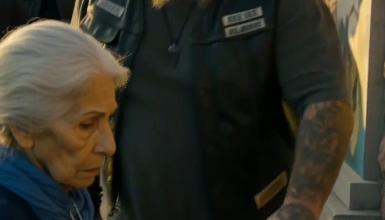
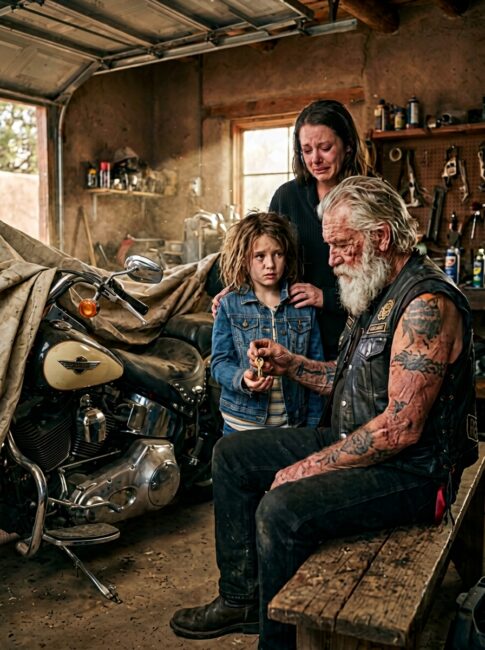
People use words like “mysterious” when they talk about lonely old men, but Red was mostly stubborn, loud, and built from hard weather. He had a face like dried leather, a nose broken twice, one ear slightly folded from an old fight, and tattoos that had faded into blue shadows under the New Mexico sun. One forearm had an eagle. The other had a name covered by a rose and a strip of black ink so old it had turned gray.
I asked about that one when I was eight.
He said, “Don’t read grown men’s skin, kid. It’s usually bad spelling and worse decisions.”
That was Uncle Red. Rough with the world. Careful with me.
His garage sat behind a low adobe house outside Santa Fe, not far from Cerrillos Road. The garage smelled like motor oil, dust, sun-baked leather, and the black coffee he drank even after doctors told him his stomach hated it. A radio played old country through bad speakers. The Harley sat in the center bay like an altar nobody admitted was holy.
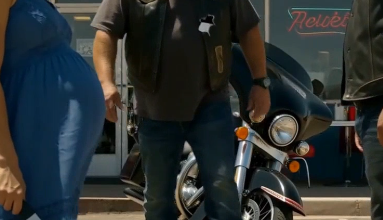
He rode with a small group called the Sangre Roadmen. Not a fancy club. Just twelve men and two women who wore patched leather cuts, met at the Turquoise Trail Diner, and believed a man’s worth could be measured by whether he showed up when somebody’s truck died in the desert.
My mother didn’t like bikers at first.
She liked Red because my father had trusted him, but the rest of them scared her. Big men. Loud engines. Long beards. Boots on our porch. Jokes too rough for church. They looked like the people mothers warn daughters about.
Then my mother’s water heater broke the week before Christmas.
Red came with four Roadmen, two toolboxes, one replacement tank, and a bag of groceries nobody mentioned. They fixed the heater, patched a leak under the sink, and left before my mother could work out how to pay them. The next morning, there was firewood stacked by the side gate.
No note.
Just boot prints in frost.
That was brotherhood. Not talk. Not “ride or die” shouted over beers. A busted water heater. A cold house. Men making sure a widow and her daughter had hot water.
Red had no wife. No children. No siblings who called. His parents had been gone so long their photos had curled at the edges in an old cigar box. He had my father once. Then he had us.
He never said that.
He acted like we were inconvenient errands.
“Get your backpack,” he’d say. “I ain’t waiting all day.”
Then he would drive me to school because my mother worked double shifts at the hospital. He’d park his truck away from the other parents because he knew some of them looked at him wrong. When I got older and embarrassed, he pretended not to notice.
He came to my fifth-grade poetry reading and sat in the back with both tattooed arms crossed, looking like he was guarding a bank vault. When I finished, he clapped once. Loud. Everyone turned. I wanted to disappear.
Afterward he gave me a gas station hot chocolate and said, “Words were good.”
That was a standing ovation from Red.
The cancer came slow, then fast.
At first, he said it was just a cough. Then it was tests. Then hospital bracelets. Then pill bottles on the kitchen counter. Then the Harley stayed under its canvas cover more often. The first time he asked me to start it for him, I knew something had changed.
I stood in the garage while he sat in a folding chair, breathing like each breath had a receipt attached.
“Turn it over,” he said.
“I don’t know how.”
“You got hands.”
He walked me through it. Switch. Choke. Thumb the starter.
The engine caught, deep and uneven, shaking the concrete under my sneakers. The sound filled my chest. Red closed his eyes.
For a second, he looked younger.
That was seed one: every time the engine started, he touched the little red ribbon hidden under the seat.
Seed two: the white flowers.
Once a week, even near the end, somebody left white flowers in a jar by Red’s back door. Not roses. Little desert lilies when they were in season, grocery-store carnations when they weren’t. My mother thought it was one of the Roadmen. Red said nothing.
He always brought them inside.
The will reading felt ridiculous.
I don’t know what I expected. Dark wood room. Serious lawyer. Rain on windows. Instead, we sat in a beige office next to a dentist near St. Michael’s Drive, with bad coffee, a humming air conditioner, and a lawyer named Mr. Penn who kept saying “asset” like Uncle Red would rise from the dead just to correct him.
There weren’t many assets.
The adobe house went to be sold, with the money split between my mother and a veterans’ repair charity Red supported. His tools went to the Roadmen. His old leather cut went to Bishop, the club’s oldest rider, with instructions to “keep the boys from acting stupid at my memorial, if possible.”
Bishop cried then.
He hid it by coughing into his bandana.
Then Mr. Penn cleared his throat.
“To Lily Harper,” he read, “I leave my 1986 Harley-Davidson Heritage Softail, black and cream, along with all riding gear, maintenance records, and the sealed envelope in the left saddlebag.”
My mother said, “Absolutely not.”
I said nothing.
I was twelve. The room had tilted.
The Roadmen looked at the floor like they had known. Maybe they had. Red never did anything without making someone uncomfortable first.
Mr. Penn kept reading.
“She is too young now. Good. The bike can teach patience before it teaches balance. If her mother says no forever, listen to her. If her mother says yes one day, Bishop is to teach her right. No showing off. No shortcuts. No riding angry. No riding to impress boys. Especially no riding to impress boys.”
That made my mother laugh and cry at the same time.
Then came the sentence that stayed under my skin for five years.
“If Lily ever rides it alone, tell her to come see me first.”
The false climax should have been the funeral.
The Sangre Roadmen gave Red a proper send-off. Twelve Harleys and two trucks rolled behind the hearse through Santa Fe, out past low adobe walls, juniper, and dry hills under a hard blue sky. Nobody revved. Nobody made a show. The engines stayed low and steady, like men holding back words.
At the cemetery, Bishop placed Red’s leather gloves on the casket.
My mother held my hand so hard it hurt.
The Harley wasn’t there.
That had been Red’s request. “Don’t bring my bike to the ground unless Lily rides it,” he wrote.
At twelve, I hated him for that.
I hated that he left me something I couldn’t use. Hated that the garage smelled like him but he wasn’t in it. Hated the canvas cover. Hated the hidden ribbon. Hated the sealed envelope because my mother said I couldn’t open it until I was old enough to understand what a machine can take from you if you treat it like a toy.
So the Harley sat.
For five years.
Bishop came every month to start it. He taught me to check oil before I was allowed to sit on it. Then clutch. Then brake. Then balance on a smaller bike. Then road rules. Then patience.
Mostly patience.
At fifteen, I wanted to ride it.
Bishop said no.
At sixteen, I yelled that it was mine.
Bishop said, “Then act like it.”
At seventeen, after safety classes, permit hours, closed-lot drills, and more lectures than any human should survive, my mother stood in the garage with both arms wrapped around herself and said, “Your Uncle Red would haunt me if I rushed this.”
I said, “He’d haunt you anyway.”
She smiled a little.
Then she handed me the key.
It had a red leather tag, cracked and dark from years of his thumb.
The first ride was not beautiful.
It was terrifying.
The Harley felt alive in a way no training bike had. Heavy. Honest. Unforgiving. The engine thumped through my bones. The handlebars vibrated under my gloves. The smell of gas and hot metal wrapped around me. Bishop rode behind me. My mother followed in the car.
We took back roads first.
Then Route 14.
Then the cemetery road.
I parked beside Uncle Red’s grave with my heart beating in my throat.
Bishop and my mother stayed near the gate.
They knew.
I sat on the ground beside the bike and the stone. I talked for an hour. About school. About my mother. About how the clutch scared me less now. About how I had dropped the bike once in practice and cried because I thought he would be mad.
Finally, I said, “I came, Uncle Red. I can ride it now.”
That was when she appeared.
Small. White-haired. Straight-backed. Carrying white flowers.
And looking at his grave like she had just been told the past had died without permission.
The woman’s name was Eleanor Whitcomb.
She was seventy-five, though she stood like she had argued with age and refused most of its terms. She wore a blue cardigan, pearl earrings, and walking shoes dusted with cemetery gravel. Her hair was silver, pinned neatly at the back. Her hands shook just a little around the flowers.
She did not look like the kind of woman who belonged in Uncle Red’s story.
That was my first mistake.
She looked at the Harley, then at me.
“Did you say Raymond left you that bike?”
Nobody called him Raymond.
Not even the lawyer, after the first time Bishop growled.
I stood up.
“He was my uncle,” I said.
“Blood?”
“No.”
Eleanor nodded slowly, like that answer fit better than yes would have.
“I loved him in 1972,” she said.
My mouth opened, but nothing smart came out.
She looked down at the headstone.
“Raymond Cole,” she read softly. “Still using Red, I suppose.”
“You knew him?”
Her laugh broke in the middle.
“Child, I knew him before the beard.”
That made no sense.
Uncle Red had always been old in my mind. He had always had the beard, the boots, the leather vest, the voice like gravel in a coffee can. The idea that he had once been twenty-one, clean-shaven, reckless, and loved by a woman in pearls felt impossible.
Eleanor knelt slowly and placed the white flowers by the stone.
That was when I understood.
The flowers at his back door.
The flowers on his grave.
The quiet weekly proof of someone I had never met.
“You’ve been bringing them,” I said.
She kept her eyes on the stone.
“Not always to the house. Only when I knew he was sick. Before that, I left them here for his parents. Then, after he passed…” She stopped. “I didn’t know. Not until months later. Nobody knew to call me.”
“Why would they?”
She nodded once.
“Fair.”
Then she told me.
In 1972, she was twenty-one, a scholarship girl from Albuquerque with a suitcase, a stubborn father, and plans bigger than New Mexico. Red was twenty-two, working at a gas station near Cerrillos, riding a shovelhead Harley that leaked oil on every clean patch of concrete in the county. He had black hair then. No beard. Same eyes.
They met because Eleanor’s car died on Route 14.
Red fixed it for free because she called him “sir” and he thought that was the funniest thing he’d ever heard.
They dated two years.
Diner coffee. Cheap motels on weekend rides. A county fair where he won her a stuffed coyote. Letters. Fights. Makeup drives. Plans.
“He asked me to marry him behind the old Turquoise Trail Diner,” she said. “He didn’t have a ring. He tied a red ribbon around my finger and said he’d buy a real one when he stopped being poor.”
My hand went to the Harley.
The ribbon under the seat.
Eleanor saw me see it.
Her face changed.
“He kept it?”
I swallowed.
“Under the seat.”
She pressed one hand to her mouth.
That was the twist.
The red ribbon was not some biker superstition. Not a joke. Not decoration.
It was the closest thing he had ever had to a wedding ring.
Eleanor went to Europe for a year to study art restoration. Red told her to go. Said he’d wait. Letters came for a while. Then less. Then one got returned. Her father had intercepted some. Red moved after his mother got sick. Eleanor came home two years later engaged to someone else because hurt people sometimes make permanent choices with temporary pain.
The marriage didn’t last.
Red never married.
“I thought he hated me,” she said.
I thought about all those years. All those white flowers. All those quiet visits. All that love standing outside the door because neither person knew how to knock.
“Did he know?” I asked.
Eleanor looked at the grave.
“I don’t know.”
But I did.
Not fully. Not yet.
The sealed envelope in the saddlebag was still unopened.
We brought Eleanor home.
My mother was angry at first. Not at Eleanor exactly. At the size of the secret. At Red. At herself. At the idea that a man could sit at our kitchen table for years, drink our bad coffee, fix our broken shelves, remember every one of my birthdays, and still hide a whole woman in the silence behind his eyes.
Eleanor stood in our doorway holding her purse in both hands.
“I shouldn’t have come,” she said.
My mother looked at her for a long moment.
Then said, “You loved him?”
Eleanor’s eyes filled.
“Yes.”
“That’s enough to come in.”
They sat at our kitchen table until midnight.
The house smelled like coffee, rain on the porch, and the leather jacket I had hung over a chair. Eleanor told stories none of us had. Red dancing badly at a roadside bar. Red writing poems he would deny under oath. Red saving for a ring in a coffee can. Red getting into fights he should have walked away from. Red crying when his mother died. Red laughing so hard at a gas station dog stealing his sandwich that he bought the dog another one.
My Uncle Red became Raymond that night.
Not smaller.
More whole.
Then my mother brought out the envelope from the saddlebag.
The paper had yellowed at the edges. Red had written my name across it in block letters.
LILY — WHEN YOU RIDE.
My hands shook opening it.
Inside were two things.
A short letter to me.
And a photograph.
In the photo, Red stood beside a younger Eleanor in front of the Turquoise Trail Diner. He was lean, black-haired, no beard, wearing a denim jacket and grinning like the world had not hit him yet. Eleanor held up her left hand. Around one finger was a red ribbon.
On the back, Red had written:
She said maybe. I heard forever.
Eleanor made a sound I will never forget.
Not crying. Not speaking. Something older.
My mother read the letter because I couldn’t.
“Kid,” Red had written, “if you’re reading this, you got the bike to the cemetery in one piece. Good. Don’t get cocky. Bishop was probably behind you sweating through his shirt. Tell him I said that. Under the seat is a red ribbon. Leave it there unless you meet a woman named Eleanor Whitcomb. She used to have my heart before I got too proud to ask for it back. If she is still alive and you find her somehow, tell her I was never mad. Tell her I kept the ribbon because some promises don’t know when to die.”
Eleanor put both hands flat on the table.
My mother covered her mouth.
I kept reading.
“There’s another thing. I left you the Harley because a machine can carry more than a body. It can carry stories nobody knew how to tell. Ride it gentle. Ride it honest. And if you ever feel alone, remember you’re sitting on every mile I survived.”
That was Red.
Even dead, still pretending not to be tender.
Eleanor cried for an hour.
Not loud. Not dramatic. Just steady, like fifty years had finally found a door and walked through it.
The next Sunday, she came for dinner.
Then the Sunday after that.
Then every Sunday.
She taught me to knit because she said hands need work when the heart gets noisy. She taught me to make green chile stew the way her mother did. She taught me how to iron a collar, how to write a thank-you note, how to tell good silver from cheap silver, how to stop apologizing before asking a question.
I taught her where the choke was.
She refused to ride at first.
“I’m too old for that nonsense,” she said.
But the first time I started the Harley in the driveway, she stood on the porch with one hand on her chest.
“That sound,” she whispered.
“What?”
She smiled, but it hurt.
“That was how I knew he was coming.”
By spring, she let me take her around the block in the sidecar Bishop borrowed from another Roadman and mounted just for the day.
She wore a helmet over her silver hair and laughed like a girl who had just been handed 1972 back for ten minutes.
When we got home, she patted my cheek.
“You are the granddaughter I did not have,” she said. “I was supposed to be his wife. Maybe I get to be your grandmother instead.”
I said yes before she could change her mind.
Every Sunday became ours.
Not formal. No big announcement. Just a rhythm.
I would ride the Harley to Eleanor’s little house near Old Pecos Trail. The engine would roll into her quiet neighborhood low and steady, and she would already be waiting by the gate with a cloth bag over one arm. Sometimes flowers. Sometimes cookies. Sometimes yarn. Always something.
We would go to the cemetery first.
I parked beside Red’s grave. Eleanor placed white flowers in the jar. I checked the red ribbon under the seat, not because it needed checking, but because rituals matter. The ribbon had been replaced once with a piece of the original sewn inside the new silk so it wouldn’t crumble away. Eleanor did that with hands more patient than mine.
Then we sat.
Sometimes she talked to him.
Sometimes I did.
Sometimes neither of us said a word, and the desert wind moved through the cemetery grass while the Harley clicked and cooled beside us.
After that, we took the long way to the Turquoise Trail Diner.
Route 14 ran through scrub, low hills, old mining towns, and sky so wide it made every grief feel both enormous and survivable. Eleanor rode in the truck with my mother at first. Later, when I got steadier, she rode behind me on the Harley for short stretches, her gloved hands light at my waist, trusting me with the road Red had once trusted.
The Sangre Roadmen adopted her immediately.
Bishop called her “Miss Eleanor” and acted like she outranked everyone, which she did. She corrected their grammar, scolded them for eating too much fried food, and once told a biker named Tank that his beard looked like “a broom that lost hope.” Tank trimmed it the next day.
At the diner, we sat in the booth where Red had asked her to marry him.
Eleanor always touched the edge of the table before sitting.
One afternoon, she brought a small box.
Inside was the stuffed coyote Red had won her at the county fair in 1973. Its fur was flattened, one eye scratched, blue ribbon around its neck faded almost gray.
“I kept it,” she said.
I laughed.
“You both kept everything except each other.”
She looked at me, then laughed too.
That became a kind of healing. Not fixing. You don’t fix fifty years. You don’t fix death. You don’t fix the empty chair where a stubborn old biker should be drinking coffee and pretending his eyes aren’t wet.
But you can put a hand on the table where he once sat.
You can ride the road he loved.
You can learn the woman he lost.
You can let a Harley carry one story into another until the silence stops feeling like a locked room.
On Red’s birthday, we rode with the Roadmen.
Fourteen bikes. One truck. Eleanor in the truck at first, then on the back of Bishop’s Harley for the final mile because she said, “If Raymond can see this, I want him properly jealous.”
At the cemetery, Bishop placed a black bandana on Red’s headstone.
Eleanor placed white flowers.
I tied a tiny red ribbon around the flower jar.
The engines idled low.
Nobody spoke.
Then Eleanor leaned toward the stone and said, “You fool. I came back.”
The Roadmen looked away.
Mercy again.
Leather creaking. Boots shifting. Grown men staring hard at the horizon.
I am twenty-two now.
The Harley is still mine, though it has never felt only mine. It carries too many hands. Red’s. Bishop’s. My father’s memory. My mother’s fear. Eleanor’s lost years. My own first shaky ride to the cemetery.
I keep the red ribbon under the seat.
I keep Red’s letter in a plastic sleeve inside the left saddlebag.
I keep a pair of white flowers tied to the rear rack every Sunday.
Eleanor is eighty now. Smaller than when I met her, but sharper in the eyes. She still knits faster than anyone I know. She still says my stew needs more salt. She still calls the Harley “Raymond’s noisy confession.”
Every Sunday, I pull up outside her gate.
She comes out with flowers.
Sometimes she rides with me. Sometimes she follows in my mother’s car. Sometimes she is too tired, and I bring the cemetery back to her in a photo: Red’s stone, the Harley beside it, white flowers in the jar, red ribbon moving in the wind.
Last week, she handed me an envelope.
I said, “What’s this?”
She smiled.
“Don’t be dramatic. I’m not dying today.”
Inside was an old black-and-white photo I had never seen. Red at twenty-two, sitting on his Harley, looking over his shoulder at the camera. Young. Wild. Alive. Waiting for someone.
On the back, Eleanor had written:
He was always coming home. Just not always on time.
I rode to the cemetery alone that afternoon.
Parked beside his grave.
The engine shut off.
The sudden silence felt full.
I touched the ribbon under the seat and looked at his name in stone.
“She came back, Uncle Red,” I said.
The Harley clicked softly in the sun.
And for a second, I swear it sounded like an old man laughing.
Follow the page for more biker stories about loud engines, hidden love, and families found after goodbye.