Part 2: Her Father’s Club Raised Her — Then 47 Bikers Walked Into Her Wedding
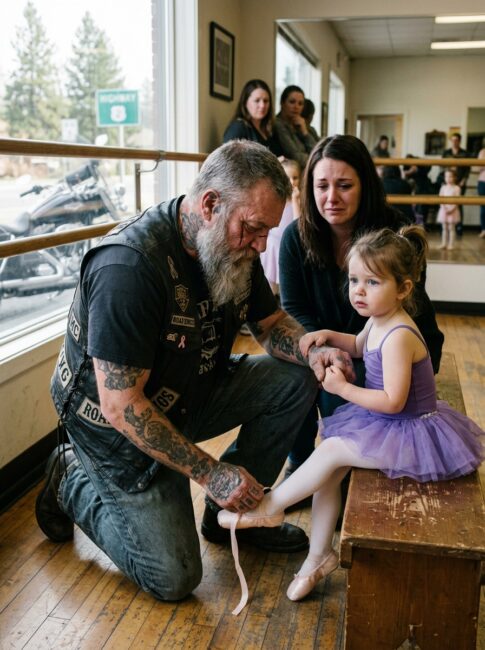
I taught ballet in a narrow studio between a pawn shop and a bakery on Division Street in Spokane.
The studio smelled like floor polish, hairspray, coffee, and tiny shoes that had been worn too long. Every Tuesday at 4:00, mothers arrived with tote bags, daughters arrived with pink tights, and fathers mostly arrived late, looking uncomfortable and proud.
Then there was T-Bone.
The first day he brought Maddie in, the entire waiting room went quiet.
He filled the doorway. Black leather cut. Thick gray beard. Tattoos down both arms. One hand wrapped around a child’s backpack covered in cartoon cats. His boots made the wood floor answer back. His Harley was still cooling outside, ticking in the parking lot, the smell of gasoline and hot metal following him through the door.
Maddie held two fingers of his left hand.
Not his whole hand. Just two fingers. That was all her tiny grip could manage.
She had a little round face, dark blond hair, and the serious eyes children get after adults start whispering around them. She wore a purple dress over her leotard because she refused to enter “a dancing building” without looking fancy.
T-Bone looked down at me and said, “She’s here for twirling.”
Maddie corrected him without looking up.
“Ballet.”
He nodded once.
“Right. Serious twirling.”
That was the first time I saw her smile after Eli’s funeral.
I had known Eli casually. Everybody in that part of town knew the North River Saints. They were not outlaws. They were roofers, tow truck drivers, mechanics, a retired Marine, a barber, and one former paramedic who still carried a first-aid kit bigger than most suitcases. They rode Harleys, argued over diner coffee, raised money for veterans, and looked rough enough to make people lock car doors before realizing they were the ones changing flat tires in the rain.
Eli had been the youngest of them.
Twenty-nine. Loud laugh. Red beard. Loved his wife Laura like it embarrassed him and loved Maddie like she had hung the moon with a plastic spoon.
He died on a wet October night on Highway 2.
No dramatic fault. No villain. Just rain, headlights, bad timing, and a road that gave nobody a second chance.
The club came to the funeral in formation.
Forty-seven Harleys rolled behind the hearse, slow and low, engines sounding like grief with pistons. T-Bone rode in front. He did not cry where people could see. Not then. His jaw stayed locked. His eyes stayed dry. But at the graveside, when Maddie reached up and asked, “Where Daddy go?” T-Bone took one step backward like somebody had hit him in the chest.
After that, he became a fixture.
He had no wife. No kids. No family left except the club. He lived in a small house near Nine Mile Road with a garage full of tools, old helmets, coffee cans of bolts, and one photo of him and Eli taped to the inside of a cabinet where visitors couldn’t make a fuss over it.
T-Bone had a past too.
He had done two years in prison in his twenties after a bar fight went too far. He never polished that story into redemption. He told it plain.
“I was drunk,” he once said to me while waiting for Maddie’s class to end. “I was mean. I hurt a man. Paid what I owed. Some debts don’t end when the door opens.”
After prison, he met Eli through the club. Eli was the one who dragged him back into ordinary life. Gave him work. Made him eat at Christmas. Made him answer texts. Made him laugh at stupid movies. Made him believe a man could be more than the worst thing he had done.
So when Eli died, T-Bone did the only thing he understood.
He stood where his brother could not.
At first, Laura resisted.
She was grieving, broke, furious, and too tired to accept help without feeling like she was failing. T-Bone never argued with her. He fixed the porch step. Changed Maddie’s car seat. Dropped off groceries and said they were “extra.” Sat in the truck outside the pediatrician’s office because Laura said she could handle it alone, then drove them home after she came out crying.
Maddie noticed.
Kids always do.
She started saving him the purple crayons. Then the corner of her peanut butter sandwich. Then the seat beside her at school programs.
By the time she was five, she would run into the studio yelling, “Uncle T, watch my leap!”
And every week, that frightening man sat in the same tiny chair, elbows on tattooed knees, watching like the New York ballet had come to Spokane just for him.
The first real test came when Maddie was eight.
Her school held a father-daughter dance.
Laura found the flyer crumpled at the bottom of Maddie’s backpack. Pink paper. Glitter border. The kind of thing schools print without thinking about who gets cut by the words.
Maddie pretended she didn’t care.
That was how we knew she did.
She told Laura she had homework. Then said dancing was stupid. Then said her dress didn’t fit. Then said nobody needed fathers anyway. The next Tuesday at ballet, she danced angry. Little feet hitting the floor too hard. Jaw tight. Eyes shiny.
T-Bone watched from the pink chair.
After class, he waited until everyone left.
Then he walked over, leather cut creaking, boots soft for once.
“You going to that dance?” he asked.
Maddie shrugged.
“Sounds dumb.”
“Most dances are.”
She looked up.
He cleared his throat.
“I could take you.”
Maddie stared at him like he had offered to fly.
“But it says father-daughter.”
T-Bone’s face did something strange. Not pain exactly. A man like him had learned to hide that. It was more like his whole body had to carry the sentence before he answered.
“I ain’t your dad,” he said.
Maddie looked down.
Then he added, “But I can stand in the spot.”
That was T-Bone. No poetry. No grand talk. Just the spot.
Laura cried in the car when Maddie told her.
The night of the dance, T-Bone showed up in black jeans, polished boots, a clean shirt, and his leather cut because he said a man should be honest about who he is. The other fathers wore khakis and nervous smiles. T-Bone looked like he had taken a wrong turn on the way to a biker funeral.
Some parents stared.
One father moved his daughter to the other side of the gym.
Maddie saw it.
Her shoulders folded inward.
T-Bone saw that.
He knelt down in front of her, right there under the paper streamers, and said, “Eyes on me, kid.”
She looked at him.
“You embarrassed?”
She shook her head too fast.
He nodded toward the room.
“They don’t know me. That’s allowed. You know me. That’s what counts.”
Then he held out his hand.
Maddie took it.
They danced badly.
I mean badly.
T-Bone moved like a refrigerator trying not to scare a bird. Maddie stood on his boots for half the songs. By the third song, the other fathers had stopped staring. By the fifth, one asked T-Bone where he got his boots. By the end, Maddie had eaten two cupcakes, won a plastic crown, and told everyone her Uncle T rode a Harley and “doesn’t know ballet but is learning.”
That should have been the false climax.
The rough biker replaces the missing father for one night. The little girl smiles. Everyone learns not to judge by leather.
But life kept going after the dance.
And grief is not solved by one slow song.
At eleven, Maddie started asking harder questions.
Did Daddy like pancakes?
Did Daddy ever get mad?
Did Daddy want more kids?
Did Daddy know he was going to die?
T-Bone never lied if he could help it. He answered what he could and swallowed what he couldn’t. Sometimes he took her to Frank’s Diner off Highway 2, the last place Eli had eaten breakfast with the club. They sat in the same booth. T-Bone ordered black coffee. Maddie ordered chocolate chip pancakes and asked about a man she could barely remember.
The brotherhood helped too.
Forty-seven uncles, though not all at once. Maddie learned tire pressure from Bishop, the retired Marine. She learned how to throw a softball from Rooster, who had never raised children but had raised three dogs and considered it close enough. She learned basic first aid from Doc. She learned swear words from Tiny, unfortunately, and how to apologize for them from Preacher.
When Laura got pneumonia one winter, the club built a schedule without being asked.
One man took school pickup. One handled groceries. One shoveled snow. One sat in the hospital waiting room with Laura until she woke up. T-Bone took nights. He slept in a recliner by Maddie’s bedroom door because she was scared her mother would vanish like her father.
On the third night, Maddie came out with her blanket and whispered, “Are you leaving too?”
T-Bone opened his eyes.
His beard was crushed on one side. His back hurt. His boots were still on.
“No.”
“When?”
“When what?”
“When are you leaving?”
He sat up slowly.
“When you tell me to.”
She thought about that.
Then she climbed into the recliner with him, too big for his lap and too small for that much fear.
He did not move for two hours.
Maddie was eighteen when she called him from the bridal shop.
I know because I was there.
I had stayed close to Laura over the years, and by then Maddie felt less like a student and more like one of the children our whole town had quietly claimed. She had grown into a woman with her father’s laugh and her mother’s spine. She was marrying a young man named Caleb Whitaker, a twenty-two-year-old nursing student with kind eyes, nervous hands, and the good sense to look slightly terrified whenever the North River Saints were mentioned.
Maddie had tried on six dresses that day.
The seventh one made Laura stop breathing.
Not because it was expensive or dramatic. It was simple. Ivory. Soft sleeves. A skirt that moved when Maddie turned. She looked like herself in it. That is rarer than people think.
The bridal consultant asked, “Who will be walking you down the aisle?”
The room went quiet.
Maddie looked at her reflection.
Laura’s hand tightened around a tissue.
For years, people had stepped around that question. Father’s Day. School forms. Emergency contacts. Wedding traditions nobody thinks about until a missing chair becomes the loudest thing in the room.
Maddie took out her phone.
She called T-Bone.
He answered on the third ring, engine noise in the background.
“What broke?”
That was how he answered most calls.
Maddie smiled at the mirror.
“Nothing broke, Uncle T.”
“Then who needs moving?”
“Nobody.”
“Kid, I’m working with limited categories here.”
She took a breath.
“I need to ask you something.”
The engine noise stopped. Somewhere, in his garage, the old Harley ticked as it cooled.
“I’m listening.”
Maddie looked at herself in the dress.
“Will you walk me down the aisle?”
No sound came through the phone.
Not even breathing.
“Uncle T?”
His voice came back rough.
“You sure?”
Maddie’s eyes filled.
“I’ve been sure since I was eight.”
That was the twist people think is the big one.
It wasn’t.
T-Bone agreeing to walk her down the aisle was beautiful, but predictable to anyone who had watched him show up for fifteen years.
The real twist happened that night at the clubhouse.
T-Bone walked into the North River Saints’ meeting room carrying a garment bag.
The men looked up from coffee, cards, and an argument about whether a certain carburetor problem was electrical or moral.
Bishop squinted.
“What’s that?”
T-Bone hung the bag on the wall.
“A suit.”
The room went silent like someone had pulled a fire alarm in church.
Tiny said, “For court?”
“No.”
“Funeral?”
“No.”
Preacher leaned back.
“Brother, don’t tell me you’re getting married.”
T-Bone looked at all forty-six of them.
“Maddie asked me to walk her down the aisle.”
Nobody joked after that.
Bishop removed his cap.
Rooster looked at the floor.
Doc rubbed both hands over his face.
Then T-Bone said, “I ain’t doing it alone.”
Tiny blinked.
“What’s that mean?”
T-Bone looked at Eli’s photo on the wall. It hung above the coffee maker, because bikers are sentimental in the strangest places.
“She didn’t just have me,” he said. “She had all of you. So buy a suit.”
The rebellion was immediate.
Men who had ridden through hail, slept on gravel, faced surgeries, divorces, and IRS audits suddenly panicked over formalwear.
“I don’t wear ties.”
“My neck don’t do buttons.”
“Last suit I wore was my cousin’s arraignment.”
“Do boots count as dress shoes?”
T-Bone let them complain for almost a minute.
Then he said, “Eli would’ve worn one.”
That ended it.
Brotherhood tested.
Not by danger.
By discomfort.
By pride.
By forty-seven men walking into a tailor shop and admitting they did not know their sizes.
The tailor was a small Vietnamese American man named Mr. Tran who owned a shop near Sprague Avenue and had no fear of bikers whatsoever.
When the North River Saints entered in a group, leather, tattoos, beards, and boots filling the room, Mr. Tran looked over his glasses and said, “No motorcycles inside.”
Bishop muttered, “Wasn’t planning on it.”
Mr. Tran pointed at the first platform.
“You. Big one. Stand.”
Tiny stepped forward.
Mr. Tran measured him, clicked his tongue, and said, “Very difficult shape.”
Tiny looked offended.
The whole club laughed for ten minutes.
Over the next two weeks, Mr. Tran fitted forty-seven bikers for suits. Black suits. White shirts. No matching ties because he said matching ties would make them look like a “sad singing group.” He allowed boots if polished. He threatened to refuse service if anyone wore a skull belt buckle to the ceremony.
T-Bone came last.
He stood on the platform like he was awaiting sentencing.
I was there because Laura had asked me to pick up Maddie’s altered reception dress, and I saw him through the front window. Huge man. Tattooed neck. Scarred hands hanging at his sides. Mr. Tran pinning the sleeves of a black suit that made T-Bone look almost gentle and deeply uncomfortable.
“You wear suit before?” Mr. Tran asked.
T-Bone grunted.
“Thirty years ago.”
“Wedding?”
“Prison hearing.”
Mr. Tran did not pause.
“This one better.”
T-Bone looked at himself in the mirror.
His jaw tightened.
That was when I saw the seed return.
Inside his leather cut, the one he had worn to every ballet class and doctor visit and school pickup, was a tiny patch stitched behind the heart. I had glimpsed it once years earlier when he bent down to tie Maddie’s shoe. Pink thread. A child’s handwriting shape.
Now, in the tailor shop, T-Bone took off the cut and held it folded over his arm. The inside patch showed clearly.
It said: MADDIE’S UNCLE.
The letters were crooked.
Maddie had made it when she was nine at summer camp, sewing each letter with stubborn concentration. She thought he had put it in a drawer. He had stitched it inside his vest instead, where no one could laugh and where it would touch the place he pretended not to have.
Mr. Tran saw it.
He didn’t tease.
He just said, “You want that sewn inside suit jacket too?”
T-Bone looked down.
His voice came out low.
“Can you?”
Mr. Tran nodded.
“Yes. Close to heart.”
On the wedding day, the church sat on a hill above Spokane, not far from the road that eventually fed into Highway 2. The morning smelled like rain, pine, hairspray, and polished leather. Forty-seven Harleys stood in the parking lot in two clean rows, but the engines were off. The silence felt respectful and strange.
Then the church doors opened.
Forty-seven bikers walked in wearing suits.
Some fit better than others.
Tiny’s jacket pulled at the shoulders. Rooster’s tie was crooked. Bishop looked like he might be attending both a wedding and a military inspection. Preacher had polished his boots so hard they reflected stained glass.
People turned.
Some guests looked scared at first. Then confused. Then moved.
Because each man wore a small pink boutonniere.
Maddie had chosen them.
For her forty-seven uncles.
T-Bone stood at the back with her. His suit was black. His boots were polished. His beard was trimmed. His hands shook once, so he curled them into fists and released them before Maddie could see.
But she saw.
She took his arm.
“You okay?” she whispered.
He looked down at her in the white dress.
For a second, he was not fifty, not tattooed, not feared, not the man with the past. He was the man who had tied ballet shoes, checked homework, sat through fevers, stood outside classrooms, and learned how to clap quietly at dance recitals because Maddie once told him he was “too loud with his feelings.”
He swallowed.
“You sure?” he asked again.
Maddie smiled.
“I told you. Since I was eight.”
The music started.
T-Bone walked her down the aisle.
Slow.
Not because he wanted drama. Because if he moved too fast, he was afraid the moment would break.
Every biker stood as she passed.
Forty-seven men who had known her father, protected her mother, carried groceries, fixed cars, attended birthdays, and tried very hard not to cry in public.
At the altar, Caleb waited, pale and smiling.
T-Bone placed Maddie’s hand in his.
Then he leaned close to the groom and spoke softly enough that only the front row heard.
“This girl didn’t grow up with her birth father,” he said. “But she grew up with forty-seven uncles and forty-seven Harleys. You love her right, you got family for life. You hurt her heart, those same Harleys will be in your driveway asking why.”
Caleb went white.
Maddie laughed through tears.
T-Bone held his stare one second longer.
Then he added, “Welcome to the family, son.”
That was the real twist.
It wasn’t a threat.
It was an adoption.
Caleb understood it later. Every man at that altar had once stood in the gap for Maddie. Now they were making room for him there too.
The reception was at Frank’s Diner’s event hall, which sounds strange until you understand Frank had fed the North River Saints for twenty years and would have considered it treason if Maddie celebrated anywhere else.
The parking lot was full of Harleys and rented sedans.
Inside, there were white tablecloths, wildflowers, barbecue, too much coffee, and forty-seven bikers trying to behave around cloth napkins.
They failed gently.
Tiny cried during the toast and blamed allergies. Rooster danced with Laura and stepped on her foot twice. Bishop inspected the buffet line like a military operation. Mr. Tran came as a guest and spent the first hour adjusting ties against people’s will.
Then came Maddie’s dance.
Not father-daughter.
She refused to call it that.
The DJ announced, “The bride will now dance with her uncles.”
People laughed at first.
Then they realized she meant it.
Forty-seven songs had been cut into pieces. One for each biker. Thirty seconds here. Forty-five seconds there. A little country. A little Motown. A little rock. One Elvis song because Doc threatened to boycott otherwise.
Maddie danced with each man.
Bishop held her like she was still three and had fallen asleep on his shoulder after a barbecue. Rooster spun her too fast and apologized to Laura. Marcus, one of the newer members, cried openly because he had lost a daughter years before and never gotten this dance. Preacher whispered something that made Maddie laugh. Tiny kept saying, “You look so grown, kid,” like he couldn’t believe time had done this without asking permission.
With each dance, a piece of the past came forward.
The uncle who taught her to ride a bike.
The uncle who scared off a boy who kept texting after she said stop.
The uncle who taught her to change oil.
The uncle who took her and Laura to the ER at 3 a.m.
The uncle who brought soup.
The uncle who never knew what to say, so he sent birthday cards with cash and one sentence: Don’t spend it dumb.
T-Bone went last.
By then, the room had changed.
No one was whispering about bikers anymore. No one was wondering why they were there. They were watching a woman dance with the village that had raised her, even if that village wore leather most days and smelled like gas stations and road coffee.
The final song was slow.
T-Bone stepped onto the dance floor like a man approaching a cliff. Maddie took his hand.
His suit jacket shifted, and for one second I saw the inside lining near his heart.
Mr. Tran had sewn the patch there.
MADDIE’S UNCLE.
Pink thread.
Crooked letters.
T-Bone saw me notice.
He gave me the smallest nod.
Maddie rested her head against his chest, right over the patch.
They moved badly. Like the father-daughter dance years before. A refrigerator trying not to scare a bird. But Maddie knew the steps now, and T-Bone followed.
Halfway through the song, he leaned down.
“You good, kid?”
Maddie closed her eyes.
“I’m good.”
He nodded.
Then, rough and low, he asked the question he had been asking in different ways for fifteen years.
“You sure?”
Maddie lifted her head and looked at him.
“With you here,” she said, “I’ve been good for a long time.”
T-Bone’s eyes went wet.
He looked away fast.
Biker culture has rules about crying. Most of them are nonsense, but men still obey them until something stronger breaks through.
Maddie put both arms around him.
This time, he did cry.
Quiet. No shaking. No performance.
Just one hand on her back, one hand pressed to his eyes, while forty-six men in suits looked everywhere except directly at him because mercy takes many forms.
Outside, the Harleys waited under string lights.
Silent.
For once, the thunder had come inside.
After the reception, Maddie and Caleb left through a tunnel of sparklers.
T-Bone hated sparklers. Said they were tiny fireworks with bad attitudes. He held one anyway because Maddie told him to stop being dramatic.
The club stood in two lines outside the diner hall. Forty-seven bikers in wrinkled suits, polished boots, pink boutonnieres, and faces that looked softer than they wanted them to.
Maddie hugged each one before she got into the car.
It took twenty minutes.
No one complained.
When she reached T-Bone, she stopped.
For a second, neither of them moved. The old Road King sat behind him, black and chrome under the parking lot lights, the same bike that had carried him to ballet class, school pickups, doctor visits, graduations, and now this.
Maddie touched the lapel of his suit.
“You can go back to leather tomorrow,” she said.
T-Bone grunted.
“Thank God.”
She laughed.
Then she hugged him hard.
Caleb waited by the car, smart enough not to interrupt.
T-Bone bent down and whispered something in Maddie’s ear.
I asked her later what he said.
She smiled and told me.
“Call if the world gets heavy.”
When the car pulled away, the club did not start their engines right away.
They stood there in the quiet, watching tail lights disappear toward Division Street, toward the highway, toward whatever comes after the people who raised you let you go.
Then T-Bone walked to his Harley.
His suit jacket lifted as he reached for the handlebars.
Inside, close to his heart, the little pink patch caught the light.
MADDIE’S UNCLE.
The engine turned over.
Forty-six more answered.
And the thunder followed her home.
Follow the page for more biker stories about rough-looking people who show up when family breaks.