Part 2: Homeless Man Thrown Out of a Café — Then a Young Waitress Saw What Was in His Coat Pocket and Burst Into Tears
The manager released the man’s sleeve, but his expression remained guarded.
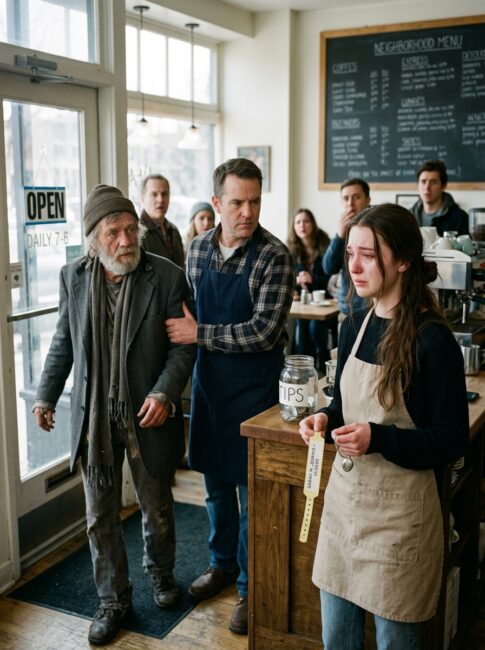
Lily stood behind the counter with the bracelet resting in her palm.
She was nineteen years old, with dark brown hair tied loosely at the back of her neck and the careful smile of someone accustomed to serving strangers before sunrise.
Most customers knew her as the polite college student who worked weekend shifts to help pay tuition.
Few knew anything about her mother.
Lily had been seven months old when Anna Carter died in an apartment fire on the east side of town.
Her aunt June had raised her afterward.
The details were rarely discussed.
Lily knew only that the fire had started in the kitchen sometime after midnight, and that a neighbor had carried her outside before the building collapsed.
She had always imagined that neighbor as a faceless hero who disappeared before anyone could thank him.
Now the man standing in front of her smelled faintly of rain, old wool, and wood smoke.
“Who are you?” Lily asked.
The man lowered his eyes.
“My name is Walter Hale.”
The name meant nothing to her.
Behind Lily, the manager reached into the tip jar and lifted out a small object wedged beneath the folded bills.
It was a silver locket, blackened around the edges.
Walter looked at it with visible relief.
“That is what I dropped,” he said.
The manager opened the locket carefully.
Inside was a tiny photograph of a young woman holding a baby wrapped in a pale blue blanket.
Lily leaned closer.
The woman in the photograph had Lily’s eyes.
On the opposite side of the locket was an engraving.
For Dad. Come home when you are ready. — Anna
Lily looked from the locket to Walter.
“Dad?” she whispered.
Walter’s hands tightened around the edge of the counter.
“She was my daughter.”
The café seemed to grow quieter, although the espresso machine continued to hiss behind them.
Walter Hale was not the neighbor who happened to notice smoke from across the street.
He was Lily’s grandfather.
He had been inside the apartment that night.
Before Lily could ask another question, a man near the window suddenly stood up.
“My wallet is missing,” he said.
He checked his coat, then glanced toward Walter.
“I had it when I sat down.”
The accusation moved through the café without anyone saying the words aloud.
Walter looked exhausted rather than offended.
“Check beneath your chair,” he said.
The man frowned.
“Why?”
“Because it fell when you stood up ten minutes ago. I tried to tell you, but you walked outside to take a phone call.”
The customer bent down.
His wallet was beneath the chair leg.
A few people looked away, embarrassed.
Walter did not wait for an apology.
He reached for the locket, but Lily closed her fingers around it.
“You knew my name before you saw my badge,” she said.
Walter glanced at the name tag pinned to her apron.
It had turned backward while she was carrying a tray.
His eyes softened.
“I knew your name before you had one,” he said.
Lily swallowed hard.
Walter reached into the inside pocket of his coat and removed a bundle of envelopes tied together with an old shoelace.
The envelopes were worn at the corners.
Each one had Lily’s name written across the front.
Some were decorated with faded birthday stickers. Others were plain.
The earliest envelope was addressed to Lily on her first birthday.
The most recent one was dated three weeks earlier.
None had been opened.
“I came to leave these with your aunt,” Walter said. “I heard she sometimes meets you here after your shift.”
Lily stared at the bundle.
“You wrote to me every year?”
Walter nodded.
“Why did I never receive them?”
He looked toward the window.
“Because I asked June to keep them until she believed you were ready.”
Lily felt a flicker of anger.
“You asked her to hide them from me?”
“I asked her to protect your childhood from an old man carrying too much regret.”
Walter’s voice did not rise.
That made the words harder to hear.
He picked up one of the sugar packets that had fallen from his pocket.
“I should not have come inside today,” he said. “I only wanted somewhere warm to sit while I waited for June.”
The manager glanced at the packets.
“You can have coffee,” he said quietly. “And breakfast.”
Walter shook his head.
“I do not have enough money.”
“It is on the house.”
Again, Walter shook his head.
“I did not come for charity.”
Lily studied his coat, his unshaven face, and the careful way he kept his hands folded as though trying not to take up space.
Then she noticed another envelope tucked behind the birthday letters.
This one was larger.
It was addressed to her aunt.
Across the bottom, Walter had written two words.
Final payment.
Before Lily could ask what it meant, the café door opened.
A woman in her late fifties stepped inside, brushing snow from her shoulders.
The moment she saw Walter, she stopped walking.
“Walter,” Aunt June said.
Walter turned slowly.
June pressed one hand to her mouth.
“You promised you would call me before coming here.”
“I lost my phone,” he said.
June looked at the damp coat, the battered boots, and the letters spread across the counter.
Then her eyes moved to the hospital bracelet in Lily’s hand.
The color left her face.
“Oh, Walter,” she whispered. “Not like this.”
Lily looked at her aunt.
“What is the final payment?”
June did not answer immediately.
She pulled out a chair beside the counter.
Then she looked at Lily with tears gathering in her eyes.
“It is time you knew what happened after the fire.”
Anna Carter had been twenty-two when she became pregnant with Lily.
She was unmarried, working evenings at a grocery store, and trying to finish community college classes during the day.
Walter had raised Anna alone after his wife died.
He had spent years believing that strict rules could protect his only child from hardship.
When Anna told him she was pregnant, fear came out of his mouth sounding like anger.
He told her she was throwing away her future.
He said things he could never take back.
Anna packed a suitcase and left his house before sunrise.
For months, Walter did not call her.
Neither did she call him.
Pride is rarely loud when it does the most damage. Sometimes it simply sits beside a silent telephone until too much time has passed.
The night of the fire, Walter had finally decided to visit.
He had purchased a small stuffed rabbit from a drugstore and placed it in a paper bag.
He had rehearsed an apology during the entire drive.
He never got the chance to say it.
When he turned onto Anna’s street, he saw smoke pouring from an upstairs window.
Walter ran inside before the fire trucks arrived.
He found Anna on the floor of the bedroom, barely conscious.
She had wrapped Lily in a blanket and placed her inside the empty bathtub, away from the flames spreading through the hallway.
Walter lifted the baby first.
Anna gripped his arm.
“Take Lily outside,” she gasped.
“I am coming back for you.”
“Promise me she will never think she was unwanted.”
Walter carried Lily down the stairs through thick black smoke.
A neighbor took the baby from his arms.
Then Walter went back inside.
By the time firefighters pulled him from the building, part of the ceiling had collapsed.
Anna died at the hospital two days later.
Walter spent weeks recovering from burns along his back and shoulder.
He blamed himself for every minute he had spent waiting for Anna to call first.
June took Lily home.
She was Anna’s older cousin, though everyone called her Aunt June. She had a steady job, a small house, and a spare bedroom filled with boxes.
Walter wanted to raise Lily himself.
But he could not lift his left arm without pain.
He was grieving, injured, and sleeping only a few hours each night.
“I was afraid I would turn your childhood into a place where grief lived in every room,” Walter told Lily.
He had asked June to take temporary custody while he recovered.
Temporary became permanent after Lily was diagnosed with a heart defect at eighteen months old.
The surgery was successful, but June’s insurance covered only part of the cost.
Walter sold his truck.
Then he mortgaged his house.
When that was not enough, he sold the house itself and moved into a rented room behind a mechanic shop.
Lily looked down at the large envelope marked Final payment.
June opened it and removed a cashier’s check.
“This covers the last of your student loan,” June said.
Lily stared at the amount.
“No,” she whispered. “I cannot take that.”
Walter looked uncomfortable, almost embarrassed.
“It is not much.”
“It is everything you have.”
He did not answer.
June folded the check carefully.
“For years, Walter sent money whenever he could,” she said. “School supplies. Dental bills. Your first winter coat. The summer science program you loved when you were eleven.”
Lily remembered that program.
June had told her she received a scholarship.
Walter had worked nights repairing delivery vans to pay the fee.
When his injured shoulder worsened, he lost the mechanic job.
He cleaned offices after closing time.
Later, he washed dishes at a hospital cafeteria.
He sent birthday cards but never signed them as Grandpa.
He did not believe he had earned the word.
“Why did you never visit me?” Lily asked.
Walter took a long breath.
“I did.”
June looked toward the floor.
Walter had attended Lily’s elementary school concerts from the back row.
He had watched her middle school graduation from across the gymnasium.
He had once stood outside in the rain during a charity walk while Lily passed him cups of water without knowing his name.
When Lily began working at Maple Street Café, Walter occasionally stopped across the street.
He watched through the window for a few minutes and left before she noticed him.
He never entered.
Not until that morning.
“I was not waiting for the perfect moment,” Walter said. “I knew there would never be one.”
“Then why today?”
Walter reached inside his coat and removed a folded document.
It was a letter from a transitional housing program for older adults.
After months in shelters and temporary rooms, Walter finally had a small studio apartment waiting for him in a neighboring town.
He was leaving that afternoon.
“I wanted June to have the letters,” he said. “And the locket. I did not want them lost in another move.”
Lily ran her thumb across the edge of the hospital bracelet.
“You kept this for nineteen years.”
Walter nodded.
“It was still around your wrist when I carried you outside.”
Lily noticed the faint scars climbing above the collar of his shirt.
Until that moment, she had imagined the fire as something that belonged to the past.
Now she could see it written across his skin.
The café manager placed a mug of coffee on the counter.
Beside it, he set a plate with eggs, toast, and potatoes.
Walter reached into his pocket and placed three crumpled dollar bills on the counter.
The manager pushed the money back.
“I said it is on the house.”
Walter looked at the plate but did not touch it.
Lily understood before anyone else did.
He was hungry.
But hunger was not the reason he hesitated.
He had spent years refusing to enter her life because he believed accepting comfort would mean asking for forgiveness.
Lily pulled out the chair beside him.
“Please sit down,” she said.
Walter’s eyes filled, but he remained standing.
“You do not owe me anything,” he said.
“I know.”
“I made mistakes your mother never had the chance to hear me apologize for.”
“I know.”
“I cannot ask you to make those mistakes disappear.”
Lily set the bracelet on the counter between them.
“I am not asking them to disappear.”
Walter looked at her.
Lily’s voice trembled.
“I am asking you to eat breakfast with me.”
For several seconds, he did not move.
Then Walter sat down.
The manager turned away, giving him privacy.
A customer near the door quietly removed a five-dollar bill from his wallet and placed it in the tip jar.
Another customer did the same.
Walter noticed.
He started to rise.
Lily rested her hand over his.
“Let them be kind,” she said.
That was when Walter finally lowered his head and cried.
Not loudly.
Not dramatically.
He cried like a man who had carried something heavy for so long that setting it down felt almost frightening.
Walter did not become a different person that morning.
He was still a sixty-eight-year-old man with a painful shoulder, a thin coat, and years of regret he could not repair with one breakfast.
Lily did not suddenly know how to call him Grandpa.
The word felt too large.
Too tender.
She needed time to grow into it.
But after her shift ended, Lily and June drove Walter to his new apartment.
It was on the second floor of a brick building near a public library.
The room was small, with beige walls, a narrow kitchen, and one window overlooking a parking lot.
Walter carried his belongings in a single duffel bag.
Lily carried the paper bag from the café.
Inside was a turkey sandwich for later, two blueberry muffins, and the sugar packets Walter had taken from the table.
When she unpacked them, Walter looked embarrassed.
“I save them for coffee,” he said. “Shelters do not always have sugar.”
Lily placed the packets inside a kitchen drawer.
“There,” she said. “Now you know where they are.”
Walter smiled for the first time.
It was a careful smile, as though he had almost forgotten how.
June helped hang his coat behind the door.
Lily noticed the lining was torn near the pocket where the locket had fallen.
The next afternoon, she returned with a small sewing kit.
Walter sat beside the window while Lily repaired the pocket with uneven stitches.
He watched her work without speaking.
On the table rested the stack of birthday letters.
Lily had opened only one.
It was the letter Walter wrote when she turned eight years old.
That year, Lily had lost a tooth during school lunch and placed it in a napkin. A cafeteria worker accidentally threw it away.
Lily had cried for hours.
Walter had written:
Dear Lily,
I heard you lost something small today, and I know small things can feel very large when they matter to you. I hope you never let anyone make you feel foolish for caring.
Some things are worth keeping safe, even when other people do not understand why.
Lily read the letter twice.
Then she folded it carefully and returned it to the envelope.
Over the following weeks, Walter began stopping at Maple Street Café every Sunday morning.
He always ordered coffee and toast.
He always tried to pay.
The manager usually accepted one dollar and pretended not to notice when Lily quietly added eggs to the plate.
Walter never sat near the window anymore.
He sat at the counter, where Lily could speak with him between customers.
Some mornings, they talked about Anna.
Other mornings, they discussed ordinary things.
The weather.
Lily’s classes.
A squeaking cabinet door in Walter’s apartment.
The ordinary conversations mattered more than Lily expected.
They gave Walter a place in her life that was not built entirely from tragedy.
One Sunday, a new server noticed the old hospital bracelet framed beside the cash register.
Below it was the scorched silver locket.
“What is the story behind those?” she asked.
Lily looked toward the counter.
Walter was stirring sugar into his coffee, one packet at a time.
His repaired coat hung from the back of the chair.
Lily smiled softly.
“They belong to someone who spent a long time standing outside,” she said.
Walter looked up.
Lily placed a warm blueberry muffin beside his coffee.
Then she sat with him for a moment before the morning rush began.
Sometimes the smallest seat at a crowded counter becomes the place where a family quietly finds its way home.
Follow this page for more heartfelt stories about the people we almost overlook.