I Snatched a Stranger’s Phone and Deleted His Videos in Front of Everyone — Then One Woman Realized Why I Had Been Watching Him
The stranger screamed that I had stolen his phone, the crowd saw a tattooed biker deleting his private videos, and within seconds everyone at the Cincinnati street festival decided I was the criminal.
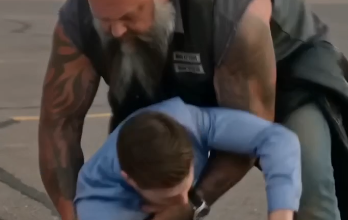
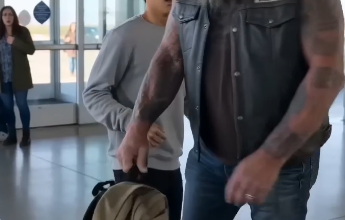
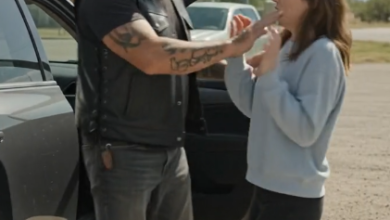
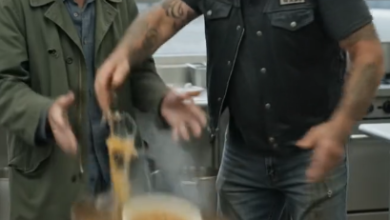
My name is Wade Mercer, though most riders around Ohio call me Gravel. I was fifty-five, six-foot-four, and heavy enough to make an ordinary black leather vest look like body armor.
The gray beard reaching my chest did not soften the picture. Neither did the faded tattoos climbing from my knuckles to my neck, the chain hanging from my jeans, or the twelve Harley-Davidsons parked behind me.
The man whose phone I took was nothing like me.
He was perhaps thirty, clean-shaven, neatly dressed in a pale blue shirt and khaki pants. He looked like an accountant waiting for friends, not someone who deserved to have a stranger’s hand close around his phone.
That was exactly what the crowd saw.
They did not see what I had noticed three minutes earlier.
“Give it back!” he shouted.
He reached toward me, but I stepped away without touching him. Then I turned the phone toward my chest, keeping its screen hidden from the people gathering around us.
A woman called for security. Another man raised his own phone and started filming me. Parents pulled their children closer as my club brother Bear walked over in a leather cut and heavy boots.
“Wade,” Bear said quietly, “what did you see?”
I did not answer him yet.
The stranger’s expression had changed. Anger remained there, but something colder had slipped underneath it.
Fear.
I opened the gallery and deleted several recent recordings from ordinary view. Then I locked the device and held it above my shoulder, beyond the stranger’s reach.
“You can’t do that,” someone shouted.
They were right.
I should have immediately locked the phone and waited for police without changing anything. At that moment, however, I was thinking about the women in those recordings—not about procedure.
One woman stood near a food cart, unaware that she had become part of whatever was hidden on the device. She was thirty-two, Asian American, wearing a green summer dress and carrying a paper bag of peaches against her chest.
Her name was Claire Nguyen.
I did not know it yet.
She watched me with the same fear as everyone else until I quietly asked Bear to stand between her and the stranger. Bear obeyed without demanding an explanation.
That made the scene look worse.
Two enormous bikers had taken a man’s phone, deleted his videos, and blocked his path toward a frightened woman.
Festival security arrived. The stranger immediately pointed at me.
“He attacked me and destroyed my property!”
“I never touched you,” I said.
“You stole my phone.”
“That part’s true.”
The security guard told me to hand it over. I shook my head and looked toward the two police officers moving through the crowd.
“Only to them.”
The stranger suddenly stopped demanding his phone back.
Instead, he ran.
Bear watched him turn between two market tents, then looked at me.
“What was on it?”
I glanced at Claire, whose face had gone pale after she noticed the angle from which the stranger had been holding his camera.
“Something she never agreed to.”
Then Claire looked beneath the edge of the vendor table, found one small object the stranger had dropped, and finally understood why I had risked becoming the villain.
Want to know what Claire found and what police recovered from the stranger’s phone? Drop PHONE in the comments — I’ll share more soon.
PART 2 — THE MAN EVERYONE WATCHED
People notice a man like me before I notice them.
I learned that years ago. Mothers tighten their grip on shopping carts, store employees glance toward security cameras, and polite men suddenly stand straighter when my boots enter a quiet room.
Sometimes the reaction amuses me. Sometimes it saves time.
That Saturday, it nearly allowed a predator to disappear.
The Iron Lanterns had ridden from Dayton to Cincinnati for a charity breakfast benefiting a women’s shelter. We never advertised those rides because the shelter’s residents deserved privacy, not a row of motorcycles turned into social media content.
My younger sister, Mara, had spent six months in a shelter twenty-three years earlier. Her former boyfriend had controlled her money, monitored her calls, and photographed her without permission.
I had offered to “solve” the problem the way an angry twenty-nine-year-old mechanic imagined problems were solved.
Mara stopped me.
“If you make this about your anger,” she said, “you take my choice away again.”
I never forgot it.
The club knew only part of that history. Bear knew all of it.
Raymond “Bear” Donnelly was fifty-seven, broad as a refrigerator and far calmer than his braided white beard suggested. Before retiring, he had worked twenty-two years as a Cincinnati paramedic.
Luis Alvarez, our Latino road captain, was forty-eight and owned a small electronics repair shop. He understood phones, cloud backups, and digital evidence better than any of us.
That became important later.
Before we left the shelter breakfast, the director reminded us not to post photographs that might identify residents. Every rider placed his phone inside a saddlebag.
The lesson was simple.
Privacy was not a courtesy.
It was dignity.
Twenty minutes later, I saw a stranger stealing it from women who did not even know he was there.
At first, I doubted myself. The man carried himself with the quiet confidence of someone accustomed to being overlooked. He studied produce, checked prices, and occasionally raised his phone as though photographing festival decorations.
Then he drifted behind a red-haired woman in a white skirt.
His wrist rotated downward.
A passing family blocked my view, and when they moved, the man was already walking away.
I followed at a distance.
The second woman was older, perhaps sixty, wearing a loose blue dress. He stood behind her near the bakery stall, lowered the phone beside a canvas tote, and pretended to adjust his shoe.
I felt my jaw tighten.
Bear noticed.
“What’s wrong?”
“Blue shirt.”
Bear looked but did not stare. “What about him?”
“Watch his hand.”
We separated. I stayed near the fruit stands while Bear moved toward the coffee truck. Luis remained beside the motorcycles.
We did not confront the man immediately because suspicion was not proof, and I had learned what damage a furious assumption could cause.
Then Claire entered the aisle.
She was thirty-two, with dark hair gathered in a loose bun and a green dress falling below her knees. One hand held a bag of peaches while the other adjusted the earbud through which she spoke with her mother.
The stranger saw her.
His entire direction changed.
He followed Claire past two stalls, slowed when she slowed, and stopped when she examined a tray of silver bracelets. Then he lowered himself behind the vendor table.
The phone tilted upward.
I moved.
The distance between us was perhaps thirty feet.
It felt shorter.
My coffee hit the pavement. Boots struck concrete. Leather creaked across my shoulders as people moved aside and the stranger looked up.
His eyes met mine.
He knew.
I reached him as he rose. My right hand closed around the phone while my left remained open at my side.
“Let go,” he whispered.
I pulled once.
He released it.
The movement looked violent because of our size difference. He was slender and barely five-foot-ten; I outweighed him by nearly a hundred pounds.
Claire spun around.
“What are you doing?”
“Stay near the vendor,” I told her.
That was the wrong thing to say. It sounded like an order from a man who had no right to give one.
The stranger recovered quickly.
“He stole my phone!”
Every face turned toward me.
Crowds do not wait for context. They choose the clearest picture available, and the clearest picture was a massive tattooed biker holding property that belonged to a frightened stranger.
A young father stepped forward.
“Give it back.”
“Police can have it.”
“You’re not the police.”
“No.”
The stranger reached for the device. I stepped back and raised it beyond his reach.
“Unlock it,” I said.
“Go to hell.”
“I saw where you aimed it.”
For the first time, his expression slipped.
Only for a second.
Claire saw anger between us but still did not understand why she stood at the center of it. She backed toward the jewelry vendor, holding the peaches against her chest.
I tapped the screen. The phone had not locked yet.
The open camera showed the last frozen frame.
I wish I had not seen it.
I will not describe it beyond this: Claire had been recorded from an intimate angle without her knowledge or consent.
My thumb opened the recent gallery. There were other clips.
Other women.
I deleted the visible copies in a rush, driven by the thought that those recordings could be shared before police arrived. I did not empty the recovery folder, alter the account, or damage the device.
Still, it was a mistake.
Evidence should be preserved untouched.
At that moment, I was not thinking like an investigator. I was thinking like Mara’s brother.
Bear arrived and looked at my face.
“What is it?”
“Get Luis. Call police.”
The stranger tried to move toward Claire.
Bear stepped into the space between them. His palms remained visible, and his voice stayed level.
“Wait here, brother.”
“I’m not your brother.”
“Fair enough. Wait anyway.”
Two festival security guards pushed through the crowd. One was a Black American woman in her forties named Officer Denise Carter, an off-duty school safety coordinator working the event.
She studied the stranger, then me.
“Whose phone?”
“His,” I said.
“Give it to me.”
“When the police arrive.”
“I am event security.”
“I know. But this needs an evidence bag and somebody trained to preserve digital files.”
Luis had reached us by then. He heard that sentence and glanced at the phone.
“Wade, don’t touch anything else.”
“I won’t.”
The stranger pointed toward the riverwalk.
“He attacked me. Arrest him.”
Denise looked at my empty left hand, the untouched clothing on both men, and the witnesses surrounding us.
“Did he strike you?”
“No, but he ripped it away.”
“Why?”
“He’s crazy.”
Denise turned to me.
“Why?”
I looked toward Claire. She was listening now, but she did not deserve to have the truth announced before hundreds of strangers.
“Ask him where his camera was pointing.”
The market noise seemed to recede.
Claire’s eyes moved from my face to the stranger’s lowered hand.
Then she understood enough to go pale.
The first Cincinnati police officer arrived two minutes later.
His name was Marcus Reed, a Black American patrol officer in his early forties. His partner, Officer Elena Ruiz, followed him through the crowd while Luis calmly explained that the device might contain evidence of nonconsensual intimate recordings.
Officer Reed asked me to place the phone on an empty vendor table.
I complied.
The stranger began speaking rapidly.
He said I had mistaken an ordinary market video for something obscene. He claimed he was a travel creator. He claimed the angle was accidental.
Then he said the phone was locked and nobody had permission to search it.
That was his right to say.
Officer Ruiz separated us and asked witnesses what they had seen. Most could describe only the moment I grabbed the phone.
Bear had seen more.
“I watched him follow two women,” he said. “Then Wade saw the third recording happen.”
Claire wrapped both arms around herself.
“Was I the third?”
Nobody answered immediately.
I hated that silence.
She looked at me. “Did you see the video?”
“Yes.”
“How much?”
“Enough to stop him.”
“Did anyone else see it?”
“Not from my hands.”
Her next question came quietly.
“Did you delete it?”
“I removed the visible clips. I didn’t wipe the phone.”
Officer Reed’s expression hardened.
“You should not have changed anything.”
“I know.”
“Do you?”
“Yes.”
I handed him my identification and offered to give a full statement. If interfering with the evidence meant I faced consequences, I would accept them.
Claire surprised everyone.
“He was trying to stop it from spreading.”
Officer Reed nodded without agreeing. “Intent matters, but preserving evidence matters too.”
Luis stepped forward only after being invited. He explained that deleted phone files often remained recoverable, especially when the recovery folder and cloud account had not been cleared.
He did not touch the device.
The officers secured it.
Meanwhile, Denise had found a tiny detachable camera lens near the jewelry table. It appeared to have fallen from a phone accessory when I grabbed the device.
Claire stared at it.
That small object ended the argument inside her.
The stranger saw it too.
He ran.
Not far.
Two uniformed officers near the festival entrance stopped him without a public struggle. He was returned in handcuffs and seated away from the crowd.
I did not celebrate.
Neither did Bear.
A frightened woman still stood beside a bag of bruised peaches, realizing that a stranger had turned an ordinary morning into something she might question for years.
That was the real damage.
Officer Ruiz asked Claire whether she wanted to make a formal report. She said yes, but requested somewhere private.
Denise opened the festival office.
Before Claire left, she looked at me.
“You said there were other women.”
“Yes.”
“Can they be identified?”
“Maybe.”
“Then deleting those videos could hurt them.”
The words landed hard because she was right.
“I made the wrong call,” I said. “I’m sorry.”
She studied me for a long moment, perhaps expecting an excuse.
I gave none.
Then she entered the office with Officer Ruiz.
The phone was taken for forensic examination after officers obtained the proper legal authority.
Investigators recovered the recordings from the device and associated storage. The suspect had collected more than the clips I had seen at the market, and several appeared to have been made in other public places.
Police identified multiple victims.
I will not name them.
Claire later told me that the hardest part was not knowing strangers had seen the recordings. It was imagining how many people might have noticed something unusual and decided it was none of their business.
The man was arrested and charged under applicable Ohio laws based on the recovered material and other evidence. The final case depended on the victims, investigators, prosecutors, and digital records—not on a biker delivering a dramatic confession.
My role was simpler.
I saw something.
I stopped it.
Then I made part of the evidence harder to handle because anger outran judgment.
Officer Reed did not arrest me for taking the phone. The circumstances, witness accounts, and my immediate cooperation mattered. Still, he gave me a warning I repeated to every rider in our club.
“Stop the immediate conduct if you safely can. Call us. Preserve the device. Don’t investigate it yourself.”
That sentence belonged in the story as much as the arrest did.
Heroes in viral posts never make procedural mistakes. Real people do.
Three days later, Claire visited Mercer Custom Repair.
The garage smelled of oil, hot rubber, and the terrible coffee Bear brewed in a dented steel pot. A V-twin engine sat open on my workbench, and old blues played through a radio beneath the tool cabinet.
Claire entered holding a fresh bag of peaches.
Bear noticed first.
“Wade,” he called, “company.”
I wiped my hands and walked toward her. She seemed steadier than she had at the market, though her eyes still checked the room before she stepped farther inside.
“I came to return something,” she said.
From her handbag, she removed the sunglasses I had dropped while crossing the market.
The left lens was cracked.
“Keep them,” I said.
“They look expensive.”
“Gas station. Twelve dollars.”
She almost smiled.
Then she placed the peaches on my desk.
“My mother says food is how we thank people.”
“You don’t owe me thanks.”
“I know.”
That answer sounded familiar.
Claire worked as a high-school librarian in Covington. She had spent the week assisting investigators and speaking with two other women identified from the recordings.
“They blamed themselves,” she said.
“For what?”
“For wearing dresses. For not noticing. For standing where they stood.”
My hands tightened around the rag I was holding.
“Mara did that too.”
“Who’s Mara?”
“My sister.”
I told Claire only what Mara had given me permission to share over the years. I explained why seeing that camera angle had turned suspicion into something personal.
“So you deleted the videos because of her?”
“Partly.”
“And partly because you thought you were protecting us.”
“Yes.”
“You should have preserved them.”
“Yes.”
She folded her arms.
“You’re very difficult to argue with when you agree.”
Bear laughed from across the garage.
“He’s difficult all the time.”
Claire looked toward the motorcycles parked near the bay door. Their chrome caught the afternoon light in hard white lines.
“Why did the others believe you before they knew what was happening?”
“They didn’t.”
“They followed your directions.”
“That’s different.”
“How?”
Bear answered before I could.
“We trusted him enough to hold the space. We waited for the truth.”
That was brotherhood at its best. Not blind loyalty. Not automatic violence.
Space.
Time.
Enough restraint for the truth to arrive.
The case continued for months.
Claire did not disappear into its paperwork. She became involved with a local organization that taught bystander awareness and digital privacy, while carefully avoiding messages that placed responsibility on potential victims.
She invited the Iron Lanterns to attend a workshop.
Half the club complained.
Luis attended first because he understood the technology. Bear attended because retired paramedics are incapable of ignoring useful training. I attended because Claire asked.
The rest arrived because no Lantern rides alone.
We learned how to recognize suspicious positioning without assuming guilt, how to create a distraction that gives a targeted person room to move, and how to contact security without escalating the scene.
Most importantly, we learned not to search, share, or alter a suspected offender’s device.
Claire looked directly at me during that part.
I raised one hand.
“Understood.”
The workshop leader asked why twelve intimidating bikers wanted training on an issue many people avoided discussing.
Bear shrugged.
“We stand out.”
The woman waited.
Luis translated.
“People watch us. We can use that.”
Afterward, two survivors asked whether the club would provide escorts from evening community meetings to the parking structure. We agreed, under rules set by the organization.
No roaring engines at the doors.
No photographs.
No names posted online.
No treating frightened women like helpless passengers inside someone else’s heroic story.
We simply waited beside the curb, walked at whatever pace they chose, and left when they were safely inside their vehicles.
Claire called it the Quiet Ride.
I hated the name.
It stayed.
One autumn evening, Mara joined us. She had not ridden on my Harley for nearly twenty years, but she arrived wearing an old denim jacket and carrying a helmet beneath one arm.
Claire knew who she was before I introduced them.
“You’re the sister,” she said.
Mara looked at me.
“What has he told you?”
“That you taught him protection without permission is another form of control.”
Mara smiled.
“He listened eventually.”
She rode behind me that night.
Her hands rested lightly against the sides of my vest as the Harley moved through Cincinnati. At each red light, the engine’s low pulse traveled through the frame and into my boots.
We did not speak.
We did not need to.
A year after the festival, Claire returned to the market.
She wore another green dress.
That choice was deliberate.
Bear and I were near the same fruit stand, drinking coffee that tasted as if someone had filtered river water through a burnt boot.
Claire bought peaches. Then she stood beside the jewelry table where the recording had happened.
For a moment, she did nothing.
Nobody watched her except us.
Then she turned, found me near the curb, and raised one peach above her head.
I nodded.
No speech.
No rescue.
Only a woman reclaiming an ordinary Saturday.
The police later returned the suspect’s phone as part of the completed legal process, but it never came to us. That was where it belonged—with evidence handlers, attorneys, and the people whose rights had been violated.
At the garage, Luis mounted an old broken phone on a small wooden stand near the workbench. Its screen was black. Its battery had been removed.
Beneath it, he placed a metal plate carrying four words:
SEE. INTERRUPT. CALL. PRESERVE.
I objected to having my mistake turned into club furniture.
The brothers voted.
I lost eleven to one.
Every new prospect now hears the story. I tell them exactly what happened, including the part that makes me look reckless.
“I grabbed his phone,” I say. “He was secretly recording women. I removed the visible files because I wanted to protect them, then gave the device to police—but preserving the evidence untouched would have protected them better.”
Nobody applauds.
That is not why I tell it.
Outside the garage, twelve Harley engines start in uneven sequence. Leather creaks, chains rattle, and boots lift from oil-stained concrete.
I take one final look at the dead phone on the workbench.
Then I ride.
Follow this page for more powerful biker stories about misunderstood courage, hard-earned dignity, and rough-looking riders who choose to protect strangers when everyone else looks away.