Part 2: The Father Who Never Missed His Son’s Games — Until the Final One, When His Empty Bleacher Seat Silenced Everyone
Coach Daniel Price did not open the envelope right away.
He stood beside the dugout with it in his hand while the crowd clapped for the senior players. The applause was bright and uneven, full of camera flashes and proud mothers calling names too loudly.
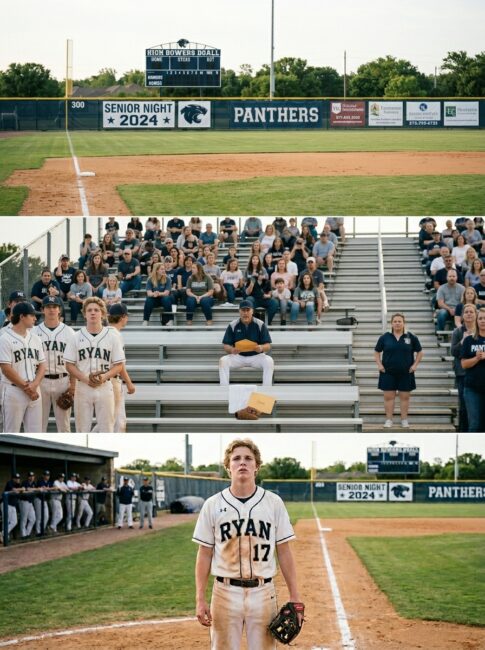
Ryan stood near home plate with the other seniors, holding a framed photo of himself in uniform.
Every boy had someone walking beside him.
Mothers with flowers. Fathers with arms around shoulders. Grandparents leaning on canes. Little sisters carrying balloons.
Ryan stood alone.
He kept his chin up because he had learned early that people looked away faster when you did not ask them to feel sorry for you.
From the top row, Tom’s usual seat looked like a small wound in the crowd.
The folded white towel rested where Tom always sat. The glove lay on top of it, old and darkened by years of oil and weather. The envelope waited beneath the glove, tucked carefully so the wind could not steal it.
Coach Price looked toward the parking lot.
No sign of Tom.
Only rows of trucks, minivans, and one ambulance parked far beyond the outfield fence near the service gate.
The coach frowned.
He had seen the ambulance earlier and assumed it was there for game coverage, the way emergency crews sometimes attended big school events. But now two paramedics stood near it, speaking quietly to a woman in a hospital badge.
Something about their faces bothered him.
Ryan did not see them.
He was staring at the dirt near home plate while the announcer read his name.
“Number seventeen, Ryan Whitaker. Four-year varsity starter. Team captain. Batting average, .342. Planning to attend Western Kentucky Community College in the fall.”
The crowd cheered.
Ryan smiled because he was supposed to.
But his eyes moved once, quickly, to the empty seat.
His mother had died when he was eight. Since then, Tom had become the man everyone recognized at ball fields. He was the father who arrived before the chalk dried. The father who kept score in a spiral notebook. The father who shouted, “Good eye, Ry,” even on pitches everyone else thought should have been swings.
He was also the father who never talked much to other parents.
Some called him cold.
Some called him proud.
One mother once said Tom acted like he owned the bleachers because he always sat in the same place. Another parent joked that the red cooler probably held beer, though no one had ever seen him drink from it.
Ryan had heard those comments too.
He hated them.
But lately, even he had not known what to think.
Tom had been late to two practices. He had forgotten to pick Ryan up once after batting cages. Three weeks earlier, Ryan had found him sitting in the kitchen at 2 a.m., staring at an unpaid electric bill with his hand pressed against his chest.
When Ryan asked if he was okay, Tom folded the bill and said, “Go to bed, son.”
No explanation.
That was Tom’s way.
Quiet until silence became a wall.
During warm-ups that night, Ryan had looked up and seen his father in the familiar top-row seat. For a second, everything in him had settled.
Then Tom stood.
Ryan paused with a ball in his throwing hand.
Tom looked down toward the field. His mouth moved as if he wanted to say something.
But he did not wave.
He lifted the cooler, turned away, and walked down the bleacher steps.
Ryan missed the next throw so badly it rolled to the fence.
Now, standing alone on senior night, Ryan told himself not to look again.
Coach Price slipped the envelope into his back pocket, intending to wait until after the game.
Then he noticed something else.
The red cooler was not with Tom.
It sat beneath the bleachers, half-hidden behind the support rail.
Coach Price walked toward it.
The cooler was old, scratched, and marked with Ryan’s initials in black marker. Inside, there were no drinks.
Only ice packs.
A small orange pill bottle.
A folded towel stained faintly pink.
And beneath everything, twelve years of baseball ticket stubs sealed inside a plastic bag.
Coach Price closed the lid slowly.
On the field, Ryan stepped into the batter’s box for his first at-bat.
The pitcher wound up.
Ryan swung late and missed by a foot.
A few parents murmured.
Coach Price looked again toward the parking lot.
The ambulance doors were open now.
And someone was sitting inside wearing Tom’s faded denim jacket.
Coach Price left the cooler beneath the bleachers and walked fast toward the service gate.
He did not run. Running would make people stare, and he could not explain what he did not yet understand.
Behind him, the game continued.
Strike two.
The crowd groaned.
Ryan stepped out of the batter’s box, tightened his gloves, and looked once toward the top row.
Still empty.
Coach Price reached the ambulance just as one of the paramedics pulled the door halfway closed.
“Is that Tom Whitaker?” he asked.
The woman in the hospital badge turned.
She was Dr. Melissa Grant, whose son played second base.
Her expression told him enough before she spoke.
“He wouldn’t let us take him until senior introductions were done,” she said quietly.
Coach Price looked into the ambulance.
Tom sat on the stretcher, pale and sweating, oxygen tubing beneath his nose. One hand gripped the side rail. The other held a small notebook against his chest.
His eyes found Coach Price.
“Don’t tell Ryan,” Tom said.
The coach stared at him.
“Tom.”
“Not during the game.”
The paramedic checked a monitor and exchanged a look with Dr. Grant.
Tom tried to sit straighter.
“He needs this night.”
That was when Coach Price understood the first piece.
Tom had not left because he did not care.
He had left because he could not stay upright.
Dr. Grant stepped closer to the coach.
“He’s been having chest pain for weeks,” she said. “Maybe longer. He told me it was indigestion when I saw him at the pharmacy.”
Tom closed his eyes.
Coach Price remembered the red cooler full of ice packs. The pink-stained towel. The pill bottle.
He remembered how Tom had sat alone all season, one hand inside his jacket, face tight whenever he climbed the bleachers.
“You should’ve gone to the hospital,” the coach said.
Tom gave a tired laugh without humor.
“And miss his last season?”
The words were not heroic when he said them. They were rough, stubborn, and full of fear.
Coach Price wanted to be angry, but anger could not find a place to stand.
Tom opened the notebook.
Inside were score sheets.
Not just from that season.
Years of them.
Ryan’s first little league hit. His first strikeout. His first game after his mother’s funeral. Every inning was written in Tom’s careful block letters, with small notes in the margins.
“Too hard on himself today.”
“Smiled after double.”
“Looked for me after catch.”
“Tell him Mom would have loved that swing.”
Coach Price looked away.
Tom saw him reading and pressed the notebook closed.
“That’s for him later,” he said.
On the field, the crack of a bat split the night.
The crowd shouted.
Coach Price turned.
Ryan had fouled one straight back. Still alive.
Tom heard it and tried to look past the ambulance door.
“What count?” he asked.
“Still two strikes.”
Tom nodded, breathing carefully.
“He drops his back shoulder when he wants it too much.”
Coach Price almost smiled through the ache in his throat.
Even half-collapsed in an ambulance, Tom was coaching from the parking lot.
The paramedic said, “Sir, we need to go.”
Tom tightened his grip on the notebook.
“After this at-bat.”
“Mr. Whitaker.”
“After this at-bat,” Tom repeated, softer this time.
No one spoke.
Across the field, Ryan stepped back in.
The pitcher threw.
Ryan did not swing.
“Ball one!”
Tom exhaled like a man spared.
Coach Price looked at him and suddenly remembered another night, three years earlier, when Ryan’s cleats had fallen apart before a tournament game. New cleats had appeared in Ryan’s locker the next morning. Ryan thought the booster club bought them.
The booster club had not.
Tom had repaired fences at the field for two weekends and asked Coach Price to keep his name out of it.
Then there was the batting cage rental fee Ryan never knew had been covered.
The gas cards slipped quietly to two teammates whose parents could not drive them to away games.
The extra glove donated anonymously after a freshman left his on a bus.
All those little acts had circled the team like wind, felt but rarely seen.
And Tom had let people call him distant.
He had let them think he sat alone because he believed himself better than everyone else.
The truth was simpler and heavier.
Tom sat alone because the top row was where his wife used to sit.
After she died, he kept the seat beside him empty.
Not for attention.
For memory.
The white towel on the seat tonight had been hers. She used it at Ryan’s first T-ball game, when he was five and more interested in dandelions than baseball.
The glove on top of it was not Ryan’s.
It was hers too.
She had played softball in high school and taught Ryan how to catch with both hands. When cancer took her quickly, Tom placed her glove in the hall closet and never moved it.
Until tonight.
Coach Price swallowed.
“Why put those on the seat?”
Tom’s eyes filled, though no tears fell.
“In case I didn’t make it back.”
The pitcher threw again.
Ryan swung.
A sharp line drive flew over second base.
The stands erupted.
Ryan rounded first, then stopped with a clean single.
From the ambulance, Tom lifted one trembling fist.
No one in the bleachers saw it.
But Ryan did.
Somehow, across the lights, the noise, and the distance, he looked toward the service gate at the exact moment his father raised his hand.
Their eyes met.
Ryan’s face changed.
The boy who had tried not to cry at home plate now stood frozen on first base, staring beyond the outfield fence.
The first base coach clapped.
“Ryan! Stay with us!”
But Ryan was not looking at the game anymore.
He was looking at the ambulance.
Tom lowered his fist quickly, as if he had been caught.
Ryan took one step off the base.
Then another.
The crowd noise thinned.
Coach Price could see the thought forming in him. The son understood before the crowd did. He understood that his father had not abandoned him.
He had been hiding pain so Ryan could have one clean night.
Tom shook his head.
From the ambulance doorway, he mouthed one word.
Play.
Ryan stood in the dirt, torn between the field and the man who had never missed a game.
The pitcher glanced over, confused.
The umpire called time.
Then Ryan did something that made the stadium fall quiet.
He removed his batting helmet, set it on first base, and walked toward the outfield fence.
His teammates called his name.
Coach Price did not stop him.
Ryan crossed the foul line, passed the bullpen, and reached the service gate while everyone watched. He came to the ambulance breathless, face pale with fear.
Tom tried to speak first.
“Get back out there.”
Ryan shook his head.
“You left.”
Tom’s face broke.
“I tried not to.”
That was the twist no one on the bleachers could hear yet, but they could see enough. They saw the ambulance. They saw the oxygen. They saw the father in the denim jacket, smaller than they remembered.
Ryan stepped inside the ambulance.
For one second, he looked like the little boy who used to run to Tom after games with dirt on his knees.
“You promised you’d never miss one,” Ryan said.
Tom touched the notebook.
“I didn’t.”
Ryan looked toward the empty bleacher seat.
The towel.
The glove.
The envelope.
Tom followed his gaze.
“I saved your mom’s seat,” he whispered. “Every game. Every year. I thought if I kept sitting beside it, maybe you’d still feel both of us there.”
Ryan covered his mouth with his hand.
Tom’s voice turned thin.
“I wanted to tell you tonight. After the game. I didn’t want your last memory of this field to be me being carried out.”
Ryan bent forward and pressed his forehead to his father’s hand.
Around them, the stadium had become so quiet that the lights seemed to hum louder.
Coach Price finally opened the envelope.
Inside was a letter addressed to Ryan.
The first line read:
“Son, if my seat is empty tonight, look beside it before you decide I left you.”
Coach Price could not read further.
He handed the letter to Ryan.
Ryan unfolded it with shaking hands while Tom was loaded fully into the ambulance.
The paramedic stepped back, giving them a few seconds that medical rules probably did not allow.
Ryan read only one paragraph aloud, his voice breaking.
“I was never watching the game by myself. Your mother was in every foul ball, every dirty uniform, every time you looked up and smiled. I kept that seat for her, but I kept showing up for you.”
The crowd could not hear the words.
But they saw Ryan climb down from the ambulance and run to the bleachers.
He climbed to the top row.
He picked up the glove.
Then he held it against his chest.
One by one, the people who had whispered about Tom stood without being asked.
The mother who had mocked the red cooler cried into both hands.
The father who had said Tom loved being seen took off his cap.
The players lined the fence.
And Ryan, standing beside the empty seat, lifted his mother’s glove toward the ambulance.
Tom saw it through the closing doors.
He smiled once.
Then the ambulance pulled away.
The game did not resume for several minutes.
No one seemed to know how to return to ordinary things after watching a boy learn the shape of his father’s love in front of an entire town.
Ryan stayed on the top row until Coach Price climbed the bleachers and sat two seats away.
Not beside him.
Not in Tom’s place.
Just close enough.
“You want me to call the game?” the coach asked quietly.
Ryan looked down at the field.
His teammates were waiting. The other team was waiting too, caps in hand, their faces solemn beneath the lights.
For a moment, Ryan looked like he might leave.
Then he placed his mother’s glove back on the towel.
He tucked the envelope beneath it.
And he touched the empty seat with two fingers.
“No,” he said. “He told me to play.”
Coach Price nodded.
Ryan returned to first base to a silence deeper than applause.
Then someone began clapping.
It was not loud at first. It came from the visiting dugout, one player tapping his hands together with his head bowed. Then another joined. Then the home crowd. Then every person along the fence.
Ryan did not smile.
He only lowered his head, adjusted his gloves, and waited for the next pitch.
He stole second on the first throw.
In the seventh inning, with two outs and the game tied, Ryan came up again. The top-row seat remained empty, but it no longer looked abandoned.
It looked occupied by everything people had failed to see.
The towel. The glove. The letter.
A father’s stubbornness.
A mother’s memory.
A boy’s whole childhood sitting quietly under stadium lights.
Ryan took the first pitch.
Ball one.
He took the second.
Strike one.
On the third pitch, he hit a clean drive into right field. The runner from second came home. The crowd rose as the winning run crossed the plate.
His teammates rushed him, but Ryan did not stay long in the pile.
He ran first to the fence and looked toward the road where the ambulance had disappeared.
Then he climbed the bleachers one more time.
He sat in his father’s seat.
Not beside it.
In it.
He placed the glove on his lap and finally cried with the whole town pretending not to watch too closely.
Later that night, at the hospital, Tom woke to find Ryan asleep in a chair beside his bed, still wearing his dusty uniform. The letter lay folded on the blanket between them.
Tom’s surgery had been urgent, the doctors said.
But he was alive.
When Ryan opened his eyes, neither of them spoke at first.
Tom reached weakly toward his son’s hand.
Ryan held it.
After a long silence, Tom whispered, “Did you win?”
Ryan laughed once, though tears slid down his face.
“Yeah, Dad.”
Tom closed his eyes with a tired smile.
“Good eye, Ry.”
The next spring, Miller County High replaced the old bleachers.
Before they tore them down, Ryan walked to the top row with a screwdriver and removed the small metal number from his father’s seat.
He kept it in his glove.
Years later, when people asked why a grown man still carried an old softball glove to every game he coached, Ryan never gave a long answer.
He would simply look toward the top row, where sunlight touched the aluminum seats, and say, “Some people never leave where they loved you best.”
And if this story stayed with you, follow this page for more heartfelt stories about the quiet love we often overlook.