The Girl Who Wrote an Apology Letter to the Whole School — And Her Confession Left the Auditorium Silent
Lily did not look like a girl ready to defend herself.
She looked like a child walking into weather she had already accepted.
Her letter trembled in both hands as the microphone caught the soft scrape of paper. The first row of students leaned forward, hungry for an apology that would make the rumors feel true.
Principal Howard stayed beside her, close enough to take the microphone if she froze.
Mrs. Carter watched from the wall.
She had taught for thirty-one years and had learned that guilt often had a posture. Avoiding eye contact. Tight shoulders. Hands hidden from view.
Lily had all of it.
But something else was there too.
Not defiance.
Fear.
“I know everyone thinks I ruined the donation boxes,” Lily read. “I know because I heard people say it before the first bell.”
A few heads turned.
A boy in the second row looked down at his shoes.
Lily swallowed.
“I did touch the boxes.”
Whispers lifted instantly.
Principal Howard raised one hand, and the sound faded.
Lily kept reading.
“I touched them because one of the cans had rolled under the radiator, and I thought it would get hot. I put it back.”
Mrs. Carter blinked.
That was not what she expected.
“I also took blue paper from the art room,” Lily continued. “But I did not put it over the camera.”
A teacher near the aisle shifted.
The blue paper had been the strongest piece of evidence.
Lily glanced toward the back of the auditorium, then quickly returned to the letter.
Mrs. Carter followed her eyes.
In the last row, three eighth-grade boys sat stiffly, their faces too carefully blank. One of them, Austin Reed, wore a new varsity jacket though he did not play varsity anything. His father owned Reed Auto Sales and sponsored half the school banners hanging in the gym.
Austin leaned back and smirked.
Lily’s voice grew smaller.
“I took the blue paper because I needed to make a sign.”
She unfolded a second page.
“I was going to write, ‘Please leave one box for families who cannot ask.’”
The auditorium became quieter in a different way.
Mrs. Carter felt a cold thread move through her chest.
Lily Parker had never taken a field trip without a scholarship form. Her lunch account had been negative twice that semester, though the balance was always mysteriously paid before anyone could speak to her mother.
Mrs. Carter had assumed the office handled it.
Now she wondered.
Lily continued.
“My mom said we were fine. She always says that. But on Friday, I saw my little brother hiding crackers in his sock drawer.”
A girl in the third row stopped whispering.
“He said he was saving them for Christmas morning.”
Lily’s mouth pressed shut for a moment.
She turned the page with fingers that had gone white.
“I wanted to ask for help, but I didn’t know how to do it without making my mom feel ashamed.”
Principal Howard lowered his eyes.
Mrs. Carter remembered seeing Lily’s mother at conferences last year, still wearing a grocery store name tag, apologizing twice for being seven minutes late.
Then Lily read something that made Mrs. Carter’s stomach drop.
“When I came back to the hallway, the boxes were already broken.”
A ripple moved across the room.
“I saw who did it.”
Austin Reed’s smirk disappeared.
Lily did not say his name.
Not yet.
“I saw three boys laughing. One of them said nobody would believe me anyway.”
Mrs. Carter looked toward the back row again.
Austin stared straight ahead.
His two friends no longer looked blank. They looked trapped.
Lily took a breath.
“I picked up the cards first because Mrs. Morton’s second graders made them, and they had little stickers on them. Some were torn.”
Mrs. Morton covered her mouth.
“I put the envelopes under my coat because money was falling out, and people were coming around the corner.”
The room shifted again.
That was what Mrs. Carter had seen.
Lily carrying something under her coat.
Not stealing.
Protecting.
But the girl still had not reached the part that made her ask to apologize to the entire school.
The principal leaned closer, his face pale.
“Lily,” he whispered, “you don’t have to finish.”
She shook her head once.
“I do.”
Then she looked up from the paper for the first time.
Her eyes found Austin Reed in the last row.
And the auditorium felt smaller than it had a minute before.
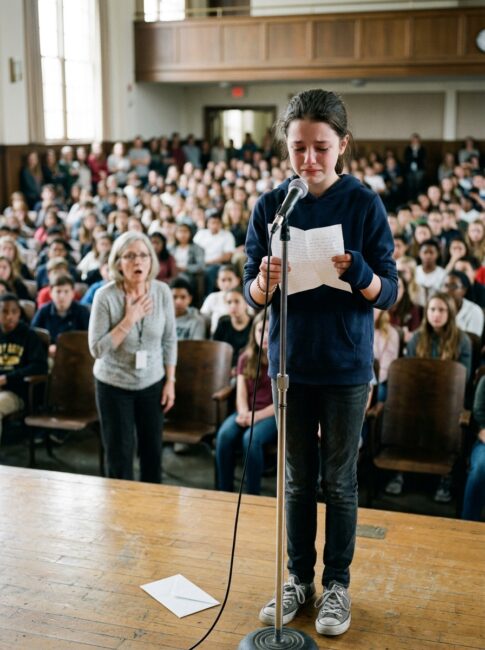
Lily’s next words did not come quickly.
They came like someone opening a locked door from the inside.
“I did not tell the truth on Friday,” she read. “When Principal Howard asked me if I knew anything, I said no.”
That admission landed hard.
Some students nodded as if this proved what they had believed.
Mrs. Carter did not move.
She was remembering something else now.
Friday afternoon, outside the office, Lily had stood with both hands in her sleeves while Principal Howard asked about the hallway. Austin Reed had walked past with his friends, slow enough to be seen.
Lily had watched them.
Then she had said, “No, sir.”
At the time, Mrs. Carter thought it was guilt.
Now she remembered the way Austin had tapped two fingers against his phone.
A warning.
Lily read on.
“I said no because one of the boys recorded my brother crying in the cafeteria last month.”
A sound passed through the teachers.
Not loud.
Just the shared breath of adults realizing they had missed something important.
“He dropped his tray,” Lily continued. “He was embarrassed because he had no money on his account. They told him if I talked about the donation boxes, they would send the video to everyone.”
Principal Howard turned slowly toward the back row.
Austin Reed’s face had gone red.
His friend Mason looked as if he might be sick.
Lily folded the top page over.
“I was scared. I thought if everybody saw my brother crying, he would never want to come back to school.”
Mrs. Carter’s eyes burned.
Lily’s brother, Noah, was seven years old. He had big glasses and a backpack shaped like a dinosaur. Every morning, Lily walked him to the elementary wing before crossing over to the middle school entrance.
Mrs. Carter had seen that.
Everyone had.
They had called Lily quiet.
They had not called her responsible.
“I also thought if I told why I was near the boxes, people would know we needed help,” Lily said.
Her voice did not break, but something about that made it worse.
“My mom works at night now. She thinks I’m asleep when she comes home, but I hear her counting tips at the kitchen table.”
The auditorium did not move.
Not one cough.
Not one whisper.
“She sold her wedding ring in October,” Lily read. “She said she lost it washing dishes, but I found the pawn shop paper in the trash.”
Mrs. Carter pressed one hand against the wall.
The story was no longer about donation boxes.
It was about all the small ways a family could disappear in plain sight.
Lily turned another page.
“I put the envelopes in my locker because I was afraid the boys would come back. I was going to give them to Mrs. Carter after school.”
Mrs. Carter closed her eyes.
She had left early Friday for a dental appointment.
By the time Lily tried to find her, the rumors had already started.
“One envelope opened,” Lily said. “I did that. I wanted to see whose name was on it, so I could give it back.”
Her fingers tightened on the letter.
“It was blank.”
Principal Howard whispered, “Blank?”
Lily nodded.
“It had two hundred dollars inside and a note that said, ‘For the family too proud to ask.’”
A murmur broke through the auditorium and died just as fast.
Mrs. Carter knew that handwriting.
Her own.
She had placed that envelope in the basket Friday morning after noticing Lily save half her lunch twice in one week.
She had not written a name because kindness felt safer when it did not embarrass anyone.
Lily looked directly at Mrs. Carter.
“I knew it was for us.”
Mrs. Carter could not speak.
“I was going to put it back,” Lily said. “But then I thought about Noah’s Christmas morning crackers.”
This was the moment the crowd expected the confession to turn simple.
She had taken the money.
She had lied.
She had been caught.
But Lily kept reading, and the story bent again.
“I brought the envelope home.”
A few students gasped.
“My mom found it in my backpack. She cried because she thought I stole it.”
Lily’s voice finally shook.
“I told her I did.”
Mrs. Carter’s tears slipped free.
Lily had taken the blame at home too.
“She made me bring it back Monday. She said being poor does not give us the right to take what is not ours.”
In the second row, a teacher began to cry silently.
“But this morning, before school, I put the envelope back in Principal Howard’s office.”
Principal Howard turned toward his secretary, who nodded through tears from the side aisle.
“It was all there,” the secretary whispered.
Lily lowered the letter.
For the first time, she spoke without reading.
“I’m sorry I lied. I’m sorry I let people think I ruined everything. I’m sorry the little kids’ cards got torn, and I’m sorry I was too scared to say who did it.”
Then she looked toward the back row.
“But I’m not sorry for trying to keep my brother from being laughed at.”
Austin Reed stood abruptly.
“I didn’t even do anything,” he said.
His voice cracked across the auditorium.
Nobody answered.
Then Mason, the smaller boy beside him, began crying.
“I told him not to,” Mason said.
Austin spun toward him.
“Shut up.”
But it was too late.
Mason covered his face.
“Austin put the paper on the camera. We knocked the boxes over because he said the whole kindness thing was fake anyway.”
The room turned toward Austin.
For the first time all morning, Lily was not the one being stared at.
Principal Howard’s face had changed from stern to something colder.
“Austin,” he said quietly, “come with me.”
Austin looked toward the teachers, then toward the students who had laughed with him all year because laughing with him was easier than being his next target.
No one moved to protect him.
As he walked down the aisle, Lily stepped back from the microphone.
Her shoulders were still small.
Her dress was still faded.
Her shoes were still worn thin at the toes.
But the room no longer saw a strange girl with a guilty face.
They saw a sister who had swallowed shame to shield a little boy.
They saw a daughter trying to protect her mother’s pride.
They saw a child who had carried adult weight without knowing where to set it down.
Mrs. Carter walked to the stage.
She did not ask permission.
She simply climbed the steps and stood beside Lily.
Then, in front of the whole school, she took the microphone.
“The blank envelope was mine,” she said.
A soft sound moved through the room.
“I wrote that note because I saw a student saving food and told myself I was being respectful by not asking questions.”
She looked at Lily.
“I should have asked.”
Lily looked down.
Mrs. Carter turned back to the students.
“This assembly began because we thought one person owed the school an apology.”
Her voice wavered.
“I think more than one person does.”
Nobody clapped.
It would have been too easy.
Instead, the auditorium sat in a silence that felt earned.
Then a little boy appeared at the side entrance.
Noah Parker stood there with his dinosaur backpack, holding the hand of the elementary school counselor. His glasses were crooked, and he looked frightened by the crowd.
Lily saw him and froze.
Noah looked at his sister, then at the microphone, then at all the faces watching her.
He did not understand everything.
But he understood enough.
He let go of the counselor’s hand and ran to the stage.
Lily dropped the letter as he wrapped both arms around her waist.
The apology pages scattered across the floor.
Nobody picked them up right away.
They watched a girl hold her little brother in the middle of a school that had nearly mistaken her love for guilt.
The auditorium did not empty the way it usually did.
There was no rush of sneakers, no shouting, no teachers waving students toward the exits. Everyone seemed to move carefully, as if the room had become a place where noise might break something.
Principal Howard took Austin and the two boys to the office.
No announcement was made about punishment.
No public speech followed.
That was not what stayed with people.
What stayed was Lily kneeling on the stage, gathering the fallen pages of her apology letter while Noah helped smooth the wrinkles with his small hands.
Mrs. Carter knelt too.
When Lily reached for the page with the first line, Mrs. Carter gently covered it with her palm.
“You don’t have to keep apologizing for everything,” she said.
Lily stared at her.
It was clear nobody had said those exact words to her before.
In the hallway afterward, students passed the donation table one by one. The boxes had been replaced with new ones. The torn cards from Mrs. Morton’s second graders had been taped carefully along the wall.
Some students dropped in cans.
Some placed dollar bills.
Some only slowed down and read the sign Mrs. Carter had made from a piece of blue construction paper.
It said:
“For families who cannot ask.”
No names.
No questions.
Just a table by the office and a blue box with a slot cut into the lid.
At lunch, Noah sat with Lily instead of his usual class table. He opened his lunch tray and found an extra carton of milk beside it.
He looked around, confused.
Across the cafeteria, a girl who had whispered about Lily that morning quickly looked away.
Lily noticed.
She did not smile.
But she did not move the milk either.
That afternoon, Mrs. Parker came to the school wearing her grocery store uniform and a winter coat with one missing button. Her face was tired in a way makeup could not hide.
She walked into the office prepared to apologize.
Instead, Mrs. Carter met her at the door.
For a moment, both women stood without speaking.
Then Mrs. Parker said, “She told me she stole it.”
Mrs. Carter nodded.
“She was trying to protect everyone.”
Mrs. Parker’s hand rose to her mouth.
Not dramatically.
Just enough to hold herself together.
Through the office window, they watched Lily sitting beside Noah on a bench. He leaned against her shoulder, and she fixed the strap on his dinosaur backpack with careful fingers.
Mrs. Parker whispered, “She’s twelve.”
Mrs. Carter had no answer big enough for that.
A week later, the Winter Kindness Drive ended with more donations than Brookside Middle had ever collected.
But Lily did not stand onstage again.
She did not receive an award.
Mrs. Carter offered one, quietly, but Lily shook her head.
“No, thank you,” she said. “Noah doesn’t like when people stare.”
So the school found smaller ways.
A counselor began keeping grocery cards in plain envelopes. Teachers checked lunch accounts before balances became humiliating. A few students learned to stop laughing just because someone powerful started first.
And Lily kept walking Noah to the elementary wing every morning.
Only now, when she passed the front hallway, people made room without making a show of it.
One Friday, Mrs. Carter found a folded paper on her desk.
There was no name on the outside.
Inside, in Lily’s careful handwriting, were only two sentences.
“Thank you for the blue sign. My mom said it helped her ask without feeling small.”
Mrs. Carter sat with the note in her hand while winter light stretched across the empty classroom.
Outside, Lily and Noah crossed the sidewalk together. Noah talked with both hands, his dinosaur backpack bouncing behind him. Lily listened, one sleeve pulled over her fingers, walking slower so his shorter legs could keep up.
At the front doors, Noah reached up and fixed a strand of his sister’s hair the way she always fixed his backpack.
Lily laughed softly.
Not loudly enough for the whole school to hear.
Just enough for one person to notice.
And if this story stayed with you, follow this page for more heartfelt stories about the quiet lives we often overlook.