Part 2: The Student Banned From Band for Breaking the Rules — Until the Final Concert Made the Whole School Stand
Mrs. Miller did not move at first.
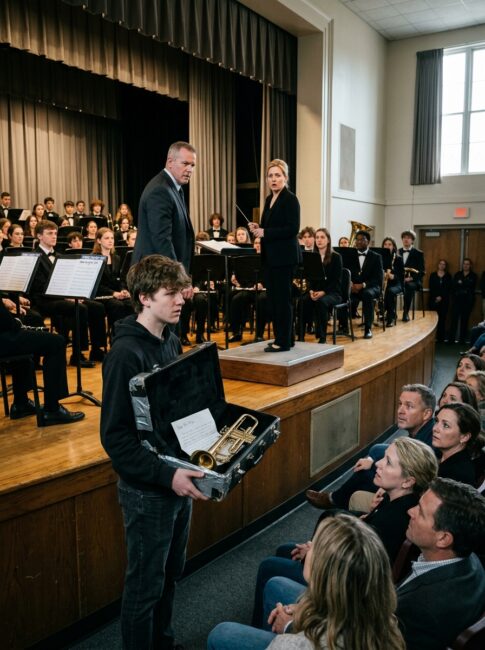
She stood on the conductor’s platform with her baton hovering above the air, the way it always did one second before music began. But this time, nothing began.
The audience shifted in their seats.
The students in the wind ensemble stared at Caleb as if he had walked in from another life. He looked thinner under the stage lights, his brown hair falling into his eyes, his black hoodie too warm for the auditorium.
Assistant Principal Vaughn stepped from the wing.
“Caleb,” he said quietly, but the microphone near the piano caught enough of his voice to make the front rows lean forward. “You need to leave the stage.”
Caleb did not argue.
That was the first thing Mrs. Miller noticed.
He did not raise his voice. He did not glare. He did not act like the angry boy everyone had described after the break-in.
He only held the old trumpet case with both hands.
“Please,” he said. “Just let me give it back.”
Give it back?
Mrs. Miller’s eyes moved to the case.
It was not school property. At least, not exactly. The school trumpet Caleb usually played was already locked in the storage room. After the incident, she had personally taken it from him.
This case was older, brown at the corners, patched with silver tape. One latch was missing. A faded sticker on the side read: Ridgemont Marching Band, 1998.
A murmur moved through the students.
In the second row, Marcus Lee, the senior first chair, sat frozen with his trumpet halfway to his mouth. Beside him, Jenna Ortiz covered her lips with two fingers.
Mrs. Miller looked at them.
They knew something.
“Caleb,” she said, trying to keep her voice steady, “what is in the case?”
His hands tightened around the handle.
The knuckles were raw.
Not dirty.
Raw.
As if he had spent days scrubbing, sanding, or working with tools too long for a boy who should have been studying for finals.
“I fixed it,” he said.
The words were almost swallowed by the room.
Mr. Vaughn frowned.
“Fixed what?”
Caleb slowly lowered the case onto the stage floor. The metal latch clicked open, loud in the auditorium silence.
Inside lay a trumpet.
But not the bright gold instrument everyone expected.
This one was old, worn, and carefully polished. Its bell had a small crease near the rim. The valves shone like they had been cleaned by someone patient enough to save what most people would throw away.
Mrs. Miller’s breath caught.
She knew that trumpet.
It had belonged to Mr. Raymond Ellis, Ridgemont’s former band director, who had taught for thirty-four years before passing away in February. His memorial program still sat pinned to the bulletin board outside the music room.
The trumpet had disappeared the week after his funeral.
Teachers assumed it had been moved during the storage cleanout.
Students whispered it had been stolen.
Caleb had been found in the music room two months later, holding a screwdriver beside a broken cabinet.
Now he stood in front of the whole school with Mr. Ellis’s trumpet resting in an old case.
Mrs. Miller felt heat rise in her face.
“Where did you get that?” she asked.
Caleb looked toward the floor.
No answer.
That silence made the audience restless again.
Mr. Vaughn stepped closer.
“Caleb, this is serious.”
“I know.”
“Then explain.”
Caleb swallowed.
His eyes moved past the band, past the parents, toward the back of the auditorium.
Mrs. Miller followed his gaze.
Near the last row, an elderly Black woman sat alone in a blue church dress with a cane folded across her lap. Her hands gripped a small white envelope.
Mrs. Miller did not recognize her at first.
Then she did.
Mrs. Ellis.
Raymond Ellis’s widow.
She had not attended a school event since the memorial.
Why was she here?
Caleb saw Mrs. Miller looking and shook his head once, almost begging her not to speak.
Another small twist of unease turned in Mrs. Miller’s chest.
On the stage, the band students remained silent.
Marcus finally leaned forward and whispered, “He didn’t steal it.”
Mrs. Miller turned sharply.
“What?”
Marcus’s face went pale.
Jenna whispered, “We thought he was just fixing cases at first.”
“Cases?”
Jenna looked at Caleb, then down at her clarinet.
“After school. For kids who couldn’t afford repairs.”
Mrs. Miller felt the first crack run through what she thought she knew.
Caleb reached into the case and lifted a folded piece of paper.
“I only came to return this,” he said.
He held it out to her.
Mrs. Miller stepped down from the podium and took it.
The paper was old, yellowed at the edges, and written in Raymond Ellis’s hand.
At the top, it said:
For the student who needs music more than permission.
Mrs. Miller looked up.
Caleb’s eyes were full of fear.
And suddenly, the broken cabinet, the screwdriver, and the missing trumpet no longer fit the story everyone had been telling.
Mrs. Miller unfolded the letter with hands that did not feel like hers.
The auditorium remained still behind her. Parents held programs midair. Students sat with instruments ready but forgotten. Even Mr. Vaughn seemed uncertain now, caught between school policy and something much harder to name.
The letter was short.
Raymond Ellis had written it in the careful cursive Mrs. Miller remembered from old rehearsal notes.
Andrea,
If this trumpet finds its way back to the room, do not polish the dent out of the bell. That dent is part of its voice.
I have kept it for years because students kept needing it more than I did.
If a child comes to you with more hunger than money, more silence than confidence, and more music than explanation, let the trumpet choose him.
Mrs. Miller stopped reading.
She looked at Caleb.
His face had gone red with shame, as if being seen kindly was worse than being accused.
Raymond had been her mentor. He had hired her as assistant director fifteen years earlier and taught her how to hear children before correcting them. After he died, she had promised herself she would protect his program.
Instead, she had protected the rules.
“What happened?” she asked, but softer this time.
Caleb pressed one thumb against the broken latch of the case.
Mrs. Ellis stood slowly from the back row.
Every head turned as she made her way down the aisle, leaning on her cane. No one spoke. The band students watched her like she carried the missing measure of the song.
When she reached the stage, Mr. Vaughn hurried to help her up the side steps, but she waved him away.
“I can climb three steps,” she said.
Her voice was gentle, but it carried.
Caleb backed away as though he had done something wrong.
Mrs. Ellis looked at him.
“You told me not to come.”
Caleb stared at the floor.
“You shouldn’t have to explain anything.”
She smiled sadly.
“Neither should you.”
Mrs. Miller felt that sentence settle over the stage.
Mrs. Ellis turned to the audience.
“My husband gave that trumpet to Caleb in January.”
A murmur broke open.
Mrs. Miller whispered, “January?”
Caleb shut his eyes.
Mrs. Ellis continued, “Raymond heard him practicing outside the school one evening. It was freezing. The boy was standing by the dumpster because he thought nobody could hear him miss notes out there.”
Several students glanced at Caleb.
He did not lift his head.
“My husband asked why he was outside,” Mrs. Ellis said. “Caleb told him the practice rooms were full.”
She paused.
“That was not the whole truth.”
Mrs. Miller remembered January. Caleb had started arriving early, leaving late, and playing with a mute that made his sound thin and strained.
She had praised his discipline.
She had not asked why he never took the trumpet home.
Mrs. Ellis looked at the old instrument.
“His apartment building had a noise complaint policy. His mother works nights and sleeps afternoons. His little sister has sensory issues and cries when sounds are too sharp. So Caleb practiced where he could.”
Caleb whispered, “Mrs. Ellis.”
She ignored him gently.
“My husband liked stubborn children. He said they became good musicians if someone was patient.”
A few quiet laughs moved through the auditorium, tender and brief.
“Before he passed, Raymond told Caleb that trumpet was his until he no longer needed it.”
Mrs. Miller looked at the dented bell.
“Then why was it in the school cabinet?”
Caleb finally spoke.
“I brought it back after the funeral.”
His voice was rough.
“I thought it should stay with the school.”
Mrs. Ellis shook her head.
“He brought it to my porch first. At six in the morning. He left it with a note saying he was sorry he couldn’t make it sound like Mr. Ellis did.”
Mrs. Miller’s throat tightened.
Caleb had not attended the memorial. Some students called him disrespectful for that too.
“He was working,” Mrs. Ellis said, answering the thought nobody had voiced. “Stocking shelves before school to help his mother.”
That was the second reversal, and it hit differently.
The old shoes. The sleeping in study hall. The missed fundraiser payments.
Not laziness.
Not attitude.
Weight.
Mrs. Ellis continued, “I returned the trumpet to him. But the valves were sticking, and the leadpipe was damaged. He could not afford a repair shop.”
Caleb looked at Mrs. Miller for the first time.
“I was fixing it myself.”
“The night you were found in the music room?” she asked.
He nodded.
“The cabinet wasn’t locked right. I didn’t break it open.”
Mr. Vaughn frowned.
“The janitor said the door was damaged.”
Caleb looked toward the trumpet case.
“It was already split near the hinge. I pulled too hard.”
“Why not tell us?”
The question left Mrs. Miller before she could soften it.
Caleb’s answer came quietly.
“Because Marcus’s trumpet was missing too.”
Marcus flinched.
Every student turned.
Caleb glanced at him with no anger.
“I borrowed it for a sectional while mine was apart. He didn’t know. I was going to put it back before anyone noticed.”
Marcus whispered, “I told people you stole it.”
Caleb did not respond.
Mrs. Miller’s chest tightened.
There it was. The mistake inside the mistake. Caleb had broken a rule. He had taken a trumpet without asking. That part was true.
But he had not done it to steal.
He had done it because the final concert had a solo written for Mr. Ellis, and he believed he had one chance to play the old man’s trumpet back to the room that loved him.
Mrs. Ellis held up the white envelope.
“Raymond wrote one more note,” she said.
She handed it to Mrs. Miller.
This one had Caleb’s name on it.
Mrs. Miller did not open it.
Caleb shook his head.
“I can’t.”
Mrs. Ellis touched his sleeve.
“You can.”
The boy’s hands trembled as he took the envelope. He opened it slowly, careful not to tear the paper.
Inside was a small card.
He read it silently.
His mouth tightened. His eyes shone under the stage lights.
Mrs. Ellis nodded once.
“Out loud, baby.”
Caleb swallowed.
Then he read:
“Caleb, if they ever mistake your silence for guilt, play the part I taught you. Some truths are too shy for speeches.”
The entire auditorium changed.
Parents who had whispered leaned back as if struck by the gentleness of the words. Band students lowered their eyes. Mr. Vaughn looked toward the discipline folder tucked beneath his arm and seemed ashamed of its weight.
Mrs. Miller remembered the meeting after the incident.
Caleb standing beside his mother, saying almost nothing.
His mother, exhausted in a grocery store uniform, asking if there was any way he could still attend rehearsals. Mrs. Miller had said no. The policy was clear.
Caleb had accepted it.
He had not defended himself because defending himself would have exposed his poverty, his mother’s struggle, Marcus’s embarrassment, and Mrs. Ellis’s private gift.
He let the school call him a thief rather than turn someone else’s pain into evidence.
Mrs. Miller turned to the band.
On their stands lay the final piece of the night: “Homeward Light,” written by Raymond Ellis years ago and arranged for a trumpet solo.
Caleb had been assigned that solo before the suspension.
Afterward, Marcus had taken it.
Marcus stood suddenly.
His chair scraped against the stage.
“I can’t play it,” he said.
Mrs. Miller looked at him.
Marcus’s eyes were wet.
“I mean, I practiced it. But it’s not mine.”
He walked to the front, carrying his polished trumpet.
Then he held it out to Caleb.
“I’m sorry,” he said.
Caleb stared at the instrument.
He did not take it.
Instead, he looked at the old trumpet in the case.
Mrs. Miller understood.
She turned to Mr. Vaughn.
There were rules.
There were consequences.
There were audiences watching.
But there was also a boy who had carried a dead teacher’s faith in a dented case.
Mrs. Miller stepped back onto the podium.
“Caleb,” she said, her voice breaking, “would you play Mr. Ellis’s solo tonight?”
A sound moved through the room, not applause yet, but breath returning.
Caleb looked terrified.
“I’m not in uniform.”
Mrs. Ellis laughed softly through tears.
“Music does not care what you’re wearing.”
Mrs. Miller lifted her baton.
Caleb picked up the old trumpet.
His hands still shook when he raised it, but the first note came out warm, worn, and human. It was not perfect. It had a slight crack at the edge, like a voice trying not to cry.
Then the band joined him.
The melody moved through the auditorium slowly, like sunrise over an empty street. Caleb stood beside the conductor’s podium in his black hoodie, playing a trumpet with a dented bell while every rumor about him fell away note by note.
Mrs. Miller conducted with tears on her face.
Marcus played harmony behind him, softer than he had ever played in his life.
Mrs. Ellis sat in the front row, one hand over her heart.
By the final measure, Caleb’s sound rose above the band, not loud, not proud, just clear enough to reach the last seat in the auditorium.
When the last note faded, nobody clapped at first.
The silence held the shape of an apology.
Then Mrs. Ellis stood.
With her cane in one hand and tears on her cheeks, she stood for the boy her husband had chosen.
One student stood next.
Then Marcus.
Then the whole band.
Then the audience rose row by row, until the entire school was standing for a student they had nearly reduced to a rumor.
Caleb lowered the trumpet.
He looked smaller than the applause.
But not broken.
After the concert, people gathered in the lobby beneath framed photos of old marching bands and dusty award plaques.
Usually, the final spring concert ended with flowers, cupcakes, and proud parents asking children to pose with instruments they wanted to put away. That night, the lobby felt quieter.
Not sad.
Careful.
Mrs. Miller found Caleb near the trophy case, holding the old trumpet case against his chest. His mother stood beside him in a grocery store polo, her name tag still pinned crookedly near her collar.
She looked tired.
She also looked proud in a way that did not ask permission.
Mrs. Miller approached slowly.
“Mrs. Turner,” she said. “Caleb.”
Caleb’s mother nodded, guarded but polite.
Mrs. Miller held the discipline form in her hand.
For two weeks, that paper had decided who Caleb was allowed to be.
She folded it once.
Then again.
Then she tore it in half.
Caleb stared at the pieces.
“I cannot erase that I should have listened sooner,” Mrs. Miller said. “But I can make sure this does not follow you as a lie.”
His mother covered her mouth.
Caleb looked down at the trumpet case.
“I did borrow Marcus’s trumpet without asking.”
“I know,” Mrs. Miller said. “And we’ll talk about that. But we’ll talk about all of it this time.”
That was as close to justice as the night could manage.
Not clean.
But honest.
Mrs. Ellis joined them a few minutes later. She carried the program from the concert, folded neatly around the page where “Homeward Light” was listed.
She handed it to Caleb.
“Raymond would have hated all that standing,” she said.
Caleb almost smiled.
“He would’ve said we rushed the middle section.”
Mrs. Ellis laughed, and the sound softened everyone nearby.
Then she placed one hand on the trumpet case.
“You keep it,” she said.
Caleb shook his head.
“I can’t.”
“You can.”
“It was his.”
Mrs. Ellis looked toward the auditorium doors, where students were still leaving in clusters.
“No,” she said gently. “It was his gift.”
Caleb ran his thumb over the duct tape on the handle.
Mrs. Miller noticed the raw places on his fingers again. They no longer looked like evidence of guilt. They looked like proof of care.
Marcus walked over with his parents behind him.
His father looked uncomfortable, holding a bouquet meant for a celebration that had turned into something else.
Marcus stood in front of Caleb.
“I should’ve asked you first,” he said.
Caleb looked at him.
“I should’ve asked before borrowing it.”
They both stood there, awkward and young, learning that apologies sometimes needed room to breathe.
Marcus held out his hand.
Caleb took it.
No speech followed.
That made it better.
The next week, the music room cabinet was repaired. Not replaced. Repaired.
Mrs. Miller asked Caleb if he wanted to help, and he came after school with a small toolbox borrowed from the maintenance closet. Together they tightened hinges, sanded rough edges, and labeled shelves that had been messy for years.
On the inside of the cabinet door, Mrs. Miller taped a copy of Raymond Ellis’s line.
Some truths are too shy for speeches.
Students saw it every time they checked out an instrument.
By fall, Caleb was back in band.
He still wore old shoes. He still spoke softly. He still practiced outside sometimes when the weather was kind. But no one called him a thief again.
At the winter concert, Mrs. Ellis sat in the front row.
Caleb played second trumpet that night, not a solo. Most people barely noticed him during the first three songs.
Then, during warm-ups, Mrs. Miller saw him turn toward a nervous freshman whose clarinet would not play.
Caleb knelt beside the boy’s chair, opened a small repair kit, and fixed the loose reed guard without making anyone stare.
The freshman whispered, “Thanks.”
Caleb only nodded.
From the podium, Mrs. Miller watched him return to his seat with the old dented trumpet resting across his knees.
The bell still had its crease.
The sound still carried.
And if this story stayed with you, follow this page for more heartfelt stories about the quiet lives we often overlook.