Part 2: The Student Who Kept Falling Asleep in Class Was Called Last at the Ceremony — And the Reason Left His Teacher Speechless
For a few seconds, the gym held its breath.
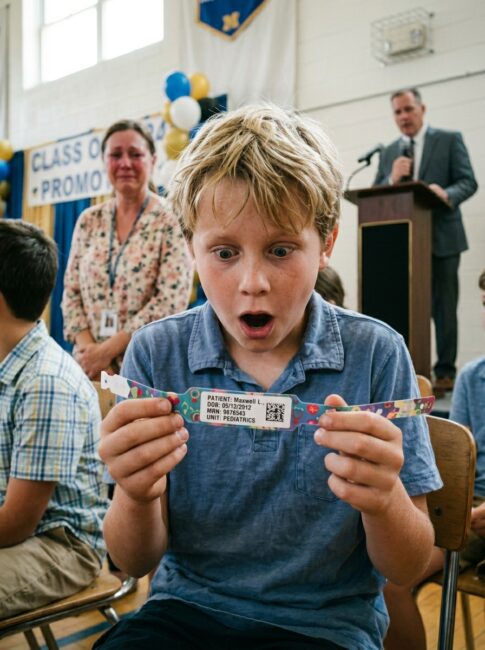
Ethan blinked hard, confused by the light, the faces, and the sound of his own name echoing through the speakers. He looked smaller than he had all year, though he was one of the tallest boys in the class. His blond hair stuck up on one side. His shirt collar was bent beneath his sweater.
A few parents smiled politely.
Some did not bother.
Mrs. Brooks heard someone behind her whisper, “That poor principal. The boy can’t even stay awake for an award.”
Ethan stood too quickly and nearly stumbled over the program on the floor. A boy beside him snickered. Ethan bent to pick it up, but his hand hesitated.
There was something written on the back of the program.
Mrs. Brooks could not read it from the stage, but she saw Ethan trace the words with his thumb before folding it carefully and slipping it into his pocket.
Principal Harris waited with the patience of a man who had known children long enough not to embarrass them when life already had.
“Come on up, Ethan,” he said gently.
Ethan walked down the center aisle with his eyes lowered.
The applause was thin at first. A few teachers clapped harder, trying to fill the spaces. Mrs. Brooks clapped too, though her heart had started to beat strangely.
Something was wrong.
She had spent months frustrated with Ethan. She had written notes home. She had asked him to stay after class. She had spoken in that careful teacher voice adults use when they believe they are being kind but are really tired.
“Ethan, you have so much potential.”
“Ethan, you cannot sleep your way through fifth grade.”
“Ethan, I need you to try.”
He always gave the same answer.
“Yes, ma’am.”
No excuse. No complaint. No tears.
Just that quiet, worn-out nod.
Now he climbed the stage steps and stood beside the principal with both hands shoved into his pockets. His shoulders curved inward, as if he expected the room to throw something at him.
Principal Harris smiled.
“This year’s Quiet Courage Recognition goes to a student who has shown unusual responsibility, compassion, and strength.”
A ripple passed through the gym.
Mrs. Brooks looked toward the other teachers. Mrs. Lane from fourth grade raised her eyebrows. Coach Dennis stopped leaning against the wall.
Ethan stared at the floor.
Responsibility?
Compassion?
Mrs. Brooks knew Ethan as the boy who turned in blank worksheets with pencil smudges across the top. She knew him as the boy who slept during science videos and dropped his milk carton in the cafeteria because he was too exhausted to hold it.
But then she noticed his hands.
They were rough.
Not dirty, exactly, but red around the knuckles, with small cuts near the fingers. A child’s hands should have held video game controllers, baseball gloves, or crayons. Ethan’s looked like hands that had scrubbed floors.
The principal continued.
“Sometimes courage does not arrive with a speech. Sometimes it sits in the back of a classroom, hoping nobody notices how tired it is.”
The gym grew quieter.
Ethan swallowed.
Mrs. Brooks felt a cold pressure behind her ribs.
A memory returned to her.
Three weeks earlier, during recess, she had found Ethan sitting alone behind the portable classrooms. His lunch tray was untouched beside him. He had been wrapping half his sandwich in a napkin.
She had assumed he was hiding food because he did not like what the cafeteria served.
“Ethan,” she had said, sharper than she meant to, “food belongs in the cafeteria.”
He had looked up, startled.
Then he had put the wrapped sandwich back on the tray.
“Yes, ma’am.”
That was all.
But later that same day, she had seen him near the kindergarten wing, kneeling beside a little girl with dark curls. The girl had been crying, and Ethan had pressed the wrapped sandwich into her hands.
Mrs. Brooks had not asked.
She had been late for a staff meeting.
Now she remembered the girl’s face.
She remembered the way Ethan looked over his shoulder first, as if being kind was something he might get in trouble for.
Principal Harris unfolded another paper.
“This recognition was not recommended by a teacher,” he said.
Mrs. Brooks felt that sentence land like a stone.
“It was recommended by our night custodian, Mr. Alvarez.”
A murmur moved through the room.
At the back wall, near the double doors, old Mr. Alvarez stood in his navy uniform. He held his cap against his chest. His gray mustache trembled slightly.
Ethan looked at him once, then looked away fast.
Mrs. Brooks had seen Mr. Alvarez in the evenings only a few times, usually when she stayed late grading essays. He was the kind of man people greeted without stopping, the kind who kept buildings running and disappeared before applause ever began.
Why would he know Ethan?
Principal Harris turned toward the crowd.
“Mr. Alvarez asked if he could say a few words.”
The custodian looked almost frightened as he walked forward.
Mrs. Brooks watched Ethan’s face change.
Not embarrassment.
Not guilt.
Something closer to pleading.
Mr. Alvarez reached the microphone and adjusted it with a shaking hand.
“I am not good at speeches,” he said, his accent soft and warm. “But I know a good boy when I see one.”
Ethan shut his eyes.
And for the first time all year, Mrs. Brooks wondered whether Ethan had been sleeping in class because school was the only place quiet enough to close his eyes.
Mr. Alvarez did not begin with a grand story.
He began with a mop bucket.
“Back in October,” he said, “I came to clean the cafeteria after a school board meeting. It was almost nine o’clock. The halls were dark. I thought everyone was gone.”
He paused and looked at Ethan.
“But there was a boy sitting by the vending machine with a backpack on his lap.”
Mrs. Brooks gripped the edge of the stage curtain.
Nine o’clock.
Ethan should have been home. He should have been eating dinner, brushing his teeth, arguing about bedtime, asking for five more minutes of television.
“He told me he was waiting for his ride,” Mr. Alvarez said. “I asked who was coming. He said his mother.”
A woman in the second row shifted uncomfortably.
Everyone knew Ethan’s mother, or thought they did.
They knew she missed conferences. They knew she never volunteered for field trips. They knew her voicemail was full and her signature rarely appeared on permission slips.
What they did not know was that Linda Miller had been working two jobs since February.
What they did not know was that she cleaned rooms at the motel by the highway until midnight, then stocked shelves at the grocery store from four until seven in the morning.
What they did not know was that she cried in her car before walking into either place because there was never enough gas, enough time, or enough of herself left over.
But Mr. Alvarez did not say all of that yet.
He only said, “His mother did not come until very late.”
Ethan’s face tightened.
“He asked me not to tell anyone,” Mr. Alvarez continued. “He said she would be embarrassed.”
Mrs. Brooks felt her throat close.
A small sound came from somewhere in the audience, maybe a mother realizing too late how easy judgment had been.
Mr. Alvarez went on.
“After that, I saw him many nights. Sometimes outside the library. Sometimes near the cafeteria. Sometimes walking his little sister from the after-school program because his mother could not leave work.”
The little girl with dark curls.
The sandwich.
Mrs. Brooks looked toward the side aisle and saw a child standing beside a woman in a faded black dress. The girl held a stuffed rabbit with one missing ear.
Linda Miller stood behind her daughter, pale and still.
She looked like a woman who had spent years apologizing for things she could not control.
Principal Harris placed a hand gently on Ethan’s shoulder. Ethan did not pull away, but he did not look up.
Mr. Alvarez cleared his throat.
“One night in January, the boiler broke near the kindergarten rooms. Water was leaking everywhere. I was alone and my back is not good.” He gave a small, nervous smile. “This boy saw me trying to move boxes before they got wet.”
Mrs. Brooks remembered January.
Ethan had slept through nearly an entire spelling test the next morning. She had tapped his desk with a ruler, not hard, but enough to wake him in front of everyone.
“Ethan, this is not a hotel,” she had said.
The class had laughed.
He had not.
He had simply picked up his pencil and written his name crookedly on the test.
Mr. Alvarez’s voice softened.
“He helped me carry every box. Then he went home and came back before school with his sister.”
Mrs. Brooks closed her eyes.
The gym had become painfully quiet.
No coughs. No rustling programs. No whispers.
Only Mr. Alvarez, a custodian in polished work shoes, telling everyone what teachers had missed in plain sight.
“Then in March,” he said, “his mother got sick.”
Linda Miller lowered her head.
“She had pneumonia,” Principal Harris added quietly. “She asked us not to share that publicly. But she gave permission today.”
Ethan’s eyes opened sharply.
He looked at his mother, and his face carried the wounded panic of a child who had tried so hard to protect her dignity that hearing the truth aloud felt like a kind of betrayal.
Linda put one hand over her mouth.
She was crying silently.
Mr. Alvarez looked at Ethan, as though asking permission to continue. Ethan gave the smallest nod.
“His mother was in the hospital for three days,” Mr. Alvarez said. “His aunt came when she could, but she has her own children. Ethan made sure his sister got to school. He helped her with homework in the hallway. He saved food from lunch. He called the hospital from the office phone and told his mother everything was fine.”
A tear slipped down Mrs. Brooks’s cheek before she knew it was there.
Everything was not fine.
He had been eleven.
Eleven years old, wearing untied sneakers because nobody had reminded him. Eleven years old, sleeping in fractions. Eleven years old, carrying secrets too heavy for his backpack.
And everyone had called him lazy.
Mr. Alvarez reached into his jacket pocket and pulled out a folded sheet of notebook paper.
“He left this for me last week,” he said. “He did not know I kept it.”
Ethan whispered, “Please don’t.”
The microphone caught it.
The room heard.
That small plea did something no speech could have done. It made every adult in the gym understand that this was not a performance. This was a boy being seen against his will.
Mr. Alvarez unfolded the paper.
“I will not read all of it,” he said. “Only one line.”
He looked down.
“Thank you for letting me sleep in the library when Mom was at the hospital. I promise I cleaned the table after.”
Mrs. Brooks pressed her fingers to her lips.
The library.
That explained the mornings he arrived before the first bell and sat in the corner with his hood up. She had thought he was avoiding classmates.
He had been trying to get ten more minutes of sleep.
Principal Harris leaned toward the microphone.
“There is more,” he said.
Mrs. Brooks turned toward him.
“In April, we discovered Ethan had been leaving anonymous notes in the cafeteria payment box. Some had coins taped inside. Some had just a dollar. They were marked for students who needed lunch money.”
A few children turned around, wide-eyed.
One boy in the front row stared at Ethan as though seeing him for the first time.
Principal Harris continued, his voice uneven.
“When we asked where the money came from, Ethan said he found it. Later, Mr. Alvarez told us Ethan had been helping stack chairs after evening events and refused payment. So Mr. Alvarez would leave a few dollars near the exit, pretending he dropped them.”
Mr. Alvarez looked guilty.
“I did not know he was giving it away,” he said.
For the first time, Ethan almost smiled.
Almost.
Mrs. Brooks remembered another day, one that now burned inside her.
She had found Ethan in the classroom during lunch, digging through the lost-and-found bin. A pink sweater lay on his desk, folded neatly.
“Ethan, that is not yours,” she had said.
He had gone red.
“I know.”
“Then why are you taking it?”
He had looked toward the door.
“I wasn’t taking it.”
She had written a behavior note anyway.
Now, from the side aisle, his little sister lifted one arm. She was wearing that same pink sweater, the sleeves rolled three times.
Mrs. Brooks could not look away.
The note she had sent home had never been signed.
Of course it had not.
There had been no one awake long enough to read it.
Principal Harris turned to Ethan.
“This award is not for perfect attendance,” he said. “It is not for perfect grades. It is not for looking put together when life has pulled at every thread.”
Ethan’s lips trembled.
“It is for showing up anyway.”
The applause began slowly.
This time, it did not remain polite.
It grew from the teachers first, then the parents, then the children. It filled the gym and shook the paper stars taped to the walls. People stood, one by one, not because anyone told them to, but because sitting felt wrong.
Ethan looked terrified.
He clutched the hospital bracelet in his pocket and turned toward his mother.
Linda Miller was standing too.
So was his sister.
Mrs. Brooks wanted to go to him, to say she was sorry, to undo every sharp word and every tired assumption. But she stayed where she was because the moment did not belong to her guilt.
It belonged to the boy who had been sleeping through school because he had been awake for everyone else.
Principal Harris handed Ethan a small wooden plaque.
Ethan accepted it with both hands.
Then, without planning to, he stepped toward the microphone.
The applause faded.
He looked out at the crowd.
His voice was barely more than a whisper, but the microphone carried it.
“I didn’t want anybody to know,” he said.
No one moved.
“My mom tries really hard.”
Linda broke then. She covered her face and bent forward as if the sentence had opened a door she had been holding shut for months.
Ethan looked at Mrs. Brooks.
Not accusing.
That was what hurt most.
He looked at her with the same tired kindness he had shown all year, as if he had already forgiven people who had never asked.
“I’m sorry I fell asleep in class,” he said. “I was trying to listen.”
Mrs. Brooks could not breathe.
Across twenty-eight years of teaching, she had received drawings, mugs, letters, and apples from children who loved her. But no sentence had ever humbled her like that one.
I was trying to listen.
Not I did not care.
Not I hated school.
Not leave me alone.
I was trying.
The applause did not return right away.
The silence was too full.
Then one child began clapping.
It was the boy who had snickered earlier.
His face was red, and he clapped hard, staring down at his shoes.
Soon the whole room joined him.
Ethan stepped away from the microphone and walked down from the stage. But instead of returning to his seat, he went to the side aisle.
He knelt in front of his little sister and handed her the plaque.
She hugged it like it was a doll.
Then he turned to his mother.
Linda reached for him with both arms, and for a moment, Ethan resisted. Maybe he was too embarrassed. Maybe he had been strong for so long that being held felt unfamiliar.
Then he folded into her.
The gym watched a mother hold the boy everyone had misread.
And Mrs. Brooks, who had thought she knew the difference between carelessness and exhaustion, stood behind the curtain with tears on her face and no defense left.
After the ceremony, families spilled into the hallway for photographs.
Children posed with certificates. Parents adjusted collars. Balloons bumped against ceiling tiles. The ordinary sounds of celebration returned, but they seemed softer now, as if the whole school had learned to speak more gently.
Mrs. Brooks stayed near the classroom door until most of the crowd had passed.
She saw Ethan standing by the trophy case with his mother and sister. His little sister still held the plaque. Linda kept smoothing Ethan’s hair, though it would not stay down.
Mrs. Brooks walked over slowly.
She had rehearsed a dozen sentences in her mind.
None of them sounded big enough.
Ethan noticed her first. His body stiffened, but he did not step back.
“Hi, Mrs. Brooks,” he said.
That almost undid her.
She knelt so she would not tower over him.
“Ethan,” she said, and her voice cracked on his name. “I owe you an apology.”
He looked confused.
Children were used to apologizing to adults.
They were not always prepared for adults to apologize to them.
“I saw you sleeping,” she continued. “But I did not see how hard you were staying awake.”
Linda turned her face away, crying again.
Mrs. Brooks looked at her too.
“I should have asked better questions.”
For a moment, Ethan said nothing.
Then he shrugged, but not carelessly. It was the shrug of someone who had learned not to ask too much from other people.
“It’s okay,” he said.
Mrs. Brooks shook her head.
“It wasn’t.”
That was all she could manage.
The hallway quieted around them. Somewhere, a janitor’s cart rolled across tile. Somewhere else, a father laughed too loudly at a blurry photo. Life kept moving in its small, stubborn ways.
Mrs. Brooks reached into her folder and pulled out a stack of papers.
“I found these in my desk,” she said.
Ethan looked down.
They were his unfinished assignments from the year. Reading responses with one sentence written. Math pages with half the problems done. A science worksheet with a droplet stain in the corner, maybe water, maybe something else.
His face darkened with shame.
But Mrs. Brooks turned the top page around.
At the bottom, where she had once written “Incomplete,” she had crossed it out.
Beside it, in blue pen, she had written, “Still trying.”
Ethan stared at the words.
His fingers touched the paper the same way he had touched the program earlier, like words could bruise or heal depending on how they were placed.
“You can finish them over the summer,” she said. “Only the ones you want. And when school starts next year, I’ll make sure your teachers know the right things.”
Ethan glanced at his mother.
Linda nodded, wiping her cheeks.
Then Ethan looked back at Mrs. Brooks.
“Can I still come to the library early?” he asked.
“Of course,” she said.
He hesitated.
“For sleep?”
Mrs. Brooks smiled through tears.
“For sleep. For books. For quiet. For whatever you need.”
Mr. Alvarez appeared at the end of the hallway, pushing his cart. He pretended not to see them at first, but Ethan’s sister ran to him with the plaque lifted high.
“Look!” she said.
Mr. Alvarez bent down as if he had never seen anything so wonderful.
Ethan walked over too. The old custodian opened his arms, and this time Ethan did not hesitate. He hugged him in the middle of the hallway, surrounded by mop buckets, paper programs, and fading applause.
Mrs. Brooks watched the boy rest his forehead briefly against Mr. Alvarez’s shoulder.
Just one second.
But in that second, he looked like a child again.
Not a problem to be corrected.
Not a lesson to be managed.
Just a tired boy who had carried too much and finally found a place to put some of it down.
On Monday morning, Mrs. Brooks entered her classroom and found something on Ethan’s old desk.
A folded ceremony program.
On the back, in careful pencil, were the words she had seen him tracing before he walked to the stage.
“Stay awake until they call your name.”
Beneath it, in smaller letters, he had added:
“They did.”
Mrs. Brooks sat at the desk for a long time, holding that paper while sunlight moved slowly across the empty classroom floor.
And if this story stayed with you, follow this page for more heartfelt stories about the quiet lives we often overlook.