My Biker Husband Kept a Secret Journal for Thirty Years—After His Funeral, I Learned Why Every Page Began With the Color of My Shirt
My husband looked like a man who kept a list of enemies, but after his funeral I opened the locked cabinet in our garage and found thirty journals filled with me.
Gabriel “Grinder” Maddox had frightened strangers for most of his adult life. He was six-foot-five, nearly three hundred pounds, with a shaved head, a gray beard reaching his chest, and tattoos covering his neck, forearms, and scarred knuckles. He wore heavy boots inside grocery stores, a chain wallet to church, and a black leather cut whose old patches made polite people cross parking lots to avoid him.
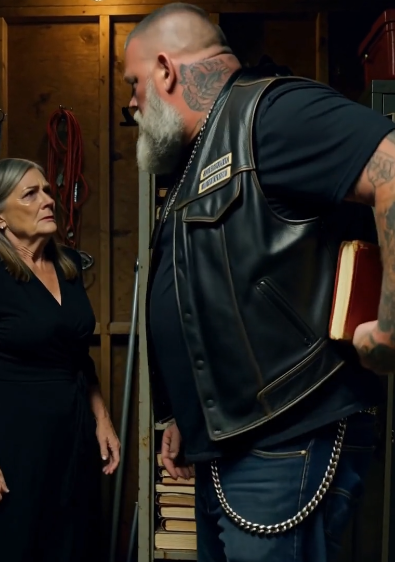
But Gabe had never written me a love letter.
Not once in thirty-two years.
He fixed whatever I broke, warmed my car before winter shifts at the hospital, and appeared outside the kitchen whenever a jar refused to open. When my mother died, he drove six hours through sleet, entered her empty house alone, and packed everything because I could not make myself cross the doorway.
That was how Gabe loved—through weight, distance, and work.
Words were different.
If I asked what he felt, he would rub his beard and say, “Plenty.” If I asked what he was thinking, he answered, “Stuff.” On our thirtieth anniversary, I gave him a handwritten letter six pages long. He gave me a new water heater and spent the afternoon installing it.
I laughed then.
Some nights, I did not.
Gabe died on a Wednesday morning at Miller’s Diner outside Beckley, West Virginia. He had ordered black coffee, complained about the eggs, and slid from the booth before anyone understood what was happening. His club brothers tried to save him until the ambulance arrived.
They could not.
Four days later, seventy-one motorcycles followed his coffin beneath a cold Appalachian sky. Men who rarely removed their sunglasses stood beside his grave with their heads bowed. Women from town whispered about the violent biker past they believed he had carried. A deputy remained near the cemetery gate, expecting trouble that never came.
After everyone left our house that evening, I entered Gabe’s garage searching for his insurance papers. Motor oil still scented the concrete. His gloves rested on the workbench. One coffee mug waited beside a wrench as if he might return and complain that I had moved it.
Behind his riding jackets stood a narrow steel cabinet.
It was locked.
I found the key sewn inside the lining of his leather cut. Inside were thirty black journals, one for each year of our marriage, arranged by date. A final red notebook rested on top with my name scratched across its cover.
My hands began shaking before I opened the first book.
June 14, 1994.
Today Maggie wore a yellow shirt. Beautiful.
The next page began the same way.
Today Maggie wore blue. Beautiful.
Page after page, year after year, every entry opened with what I had worn and the same three words. Some dates came from ordinary Tuesdays. Others came from hospital rooms, funerals, arguments, and nights I remembered sleeping with my back turned toward him.
Then I reached the year Gabe had almost left me.
The first sentence still described my shirt.
The words beneath it revealed where he had actually gone every Thursday night, why his club brothers had lied for him, and what my husband had been preparing for the day I would be wearing black.
I met Gabe in the summer of 1991, when I was twenty-six and working the late shift at a roadside diner off Route 19. He arrived with four other bikers ten minutes before closing, bringing rainwater, engine noise, and the smell of gasoline through the front door. Every waitress except me suddenly found something important to do in the kitchen.
Gabe was thirty-one then. His beard was black, his arms were enormous, and a fresh scar crossed his left eyebrow. He removed his wet leather jacket, folded it instead of throwing it into the booth, and asked whether ordering coffee would keep me too late.
That question changed my opinion before I wanted it changed.
The men ate quickly. Gabe stacked their plates, wiped spilled sugar into a pile, and left enough cash to cover the meal twice. When I ran outside to return part of it, I found him kneeling beside my Ford Escort with a flashlight between his teeth.
“You got a belt going bad,” he said.
I stepped backward. “Were you looking under my hood?”
“Listening.”
He pointed toward the engine. “That squeal follows you home, it won’t bring you back.”
It sounded like a threat until I saw the replacement belt in his hand. He had carried one in his saddlebag because, according to him, “Everybody drove junk back then.”
He fixed the car beneath a leaking awning while his friends waited. I tried to give him the money he had left on the table. He refused.
“Use it for a better belt.”
“You just put in a new one.”
“Then use it for pie.”
That was our first conversation.
Our second happened three weeks later when he returned alone, ordered coffee, and sat at the counter until closing. He did not flirt. He barely looked at me. When I asked why he had come back, he studied the napkin holder as if it contained instructions.
“Pie,” he said.
The diner had never served pie at midnight.
I married him two years later.
My mother cried when I announced the engagement. She had heard about Gabe’s past: fights in bars, eighteen months in county jail, years of drinking, and a motorcycle club that local newspapers mentioned only when police were involved. She believed I was repeating the mistakes of every woman in our family.
My father had been charming in public and cruel at home. He remembered strangers’ birthdays but never mine. He could compliment a cashier’s hair while failing to notice when my mother had been sick for a week. His greatest talent was making the people closest to him feel invisible.
Gabe knew that history.
He never promised he was different. He simply behaved differently.
He stopped drinking before our first date because I told him I would not build a home around a bottle. He attended recovery meetings without asking me to praise him. When anger rose in him, he walked to the garage and repaired something until his hands became steady.
Still, he had a hard edge. Gabe could reduce a room to silence by entering it. He disliked police, banks, neckties, and anyone who abused a weaker person. He spoke in short sentences because long ones seemed to trap him.
During our first year of marriage, I assumed he was simply private. Then I discovered he struggled to read.
The discovery came at a pharmacy. He handed me a bottle and asked which instruction meant “twice a day.” When I answered, embarrassment hardened his face.
“Print’s too small.”
It was not.
Later, his sister told me Gabe had left school at fourteen. Their father made him work in a tire shop and beat him whenever he brought home poor grades. Nobody had realized the boy reversed letters, lost his place on a page, and needed more time to understand written instructions.
Gabe learned to hide it.
He memorized road signs by shape. He recognized tools by weight and placement. At restaurants, he ordered whatever the person beside him ordered. When forms appeared, he claimed he had forgotten his glasses.
Writing was worse.
His signature looked like wire dragged through mud. He could spell mechanical terms because he had repeated them for decades, but ordinary words defeated him. The few notes he left on our refrigerator contained no more than three words: Back soon. Need milk. Love you.
I once found a birthday card in the trash because he had ruined it while trying to write my name.
I pretended not to see.
Gabe’s club, the Iron Lanterns, knew about his difficulty, although nobody said it aloud. Their president, Walter “Preacher” Boone, read meeting notices to everyone instead of handing out papers. A quiet road captain named Luis completed Gabe’s registration forms. In return, Gabe repaired their motorcycles, roofs, furnaces, and marriages whenever repairs were possible.
They protected his dignity without turning it into charity.
That was brotherhood as I came to understand it: not dramatic rescues beneath thunderclouds, but a man sliding a form across a table already completed so another man never had to ask.
Our first years together were not easy. Money remained thin. I worked nights at the county hospital while Gabe repaired trucks during the day and motorcycles after dinner. We lost our first child during the fifth month of pregnancy, and grief entered our house like a tenant who refused to pay rent or leave.
I blamed myself.
Gabe blamed silence.
One evening, three weeks after the hospital, I wore a yellow blouse my mother had given me. I cooked dinner and waited for Gabe to say something—about the baby, about me, about anything. He ate quietly, washed his plate, and went to the garage.
I followed him.
“You don’t even see me,” I said.
He turned from the workbench.
I remember his face because those words struck him harder than anything I ever threw. I told him that I could disappear inside our home and he would only notice when dinner stopped appearing. I said I had married a wall wearing boots.
Gabe listened.
Then he left.
His Harley started in the driveway, the V-twin shaking our windows before the sound disappeared toward Route 19. He returned after midnight carrying no flowers, explanation, or apology.
The next morning, a black composition notebook lay beneath his work gloves.
He did not show it to me.
On its first page, in letters pressed so hard that they scarred the paper beneath, he had written:
Today Maggie wore yellow. Beautiful.
For twelve years, I never knew the journals existed. Gabe wrote before dawn, usually at the workbench while I slept. He kept each completed notebook inside a locked ammunition box beneath a stack of old motorcycle magazines, then moved the collection into the steel cabinet when the box became too small.
I noticed other habits instead.
He watched me dress without appearing to watch. If I entered the kitchen wearing something different, his eyes lifted for one second, then returned to his coffee. Whenever I bought a new blouse, he touched the fabric at my shoulder as if testing its durability.
“What color?” he would sometimes ask.
At first I thought he was teasing.
“Green.”
He nodded. “Good one.”
There were mornings when his description was wrong. He called burgundy brown, lavender blue, and coral orange. I corrected him, and he repeated the proper word beneath his breath.
We had two children by then, a daughter named June and a son named Matthew. Gabe was no better at speaking to them than he was at speaking to me, but he attended everything. He arrived at school plays in a leather cut, folding his broad body into chairs built for elementary students. He never understood the rules of soccer yet shouted encouragement whenever either team moved quickly.
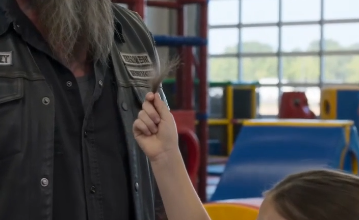
When June was bullied because of her thrift-store clothes, Gabe did not confront the other child. He learned to sew.
I came home after a night shift and found him at the kitchen table, tattooed fingers pushing a needle through denim while an instructional videotape played on our television. The stitches were ugly. The embroidered sunflower he attempted looked like a fried egg.
June wore the jacket until the sleeves became too short.
Matthew went through a period when he refused to be seen with us. At fourteen, he called his father an ignorant grease monkey during an argument. Gabe said nothing. The following morning, Matthew discovered a rebuilt dirt bike behind the garage and a helmet on the seat.
He apologized before starting it.
That was our family’s language. Machines. Meals. Things repaired before sunrise.
But language can become a prison even when love lives inside it.
In 2006, I began working as a nurse supervisor. My schedule stabilized, the children needed us less, and for the first time I had enough quiet to notice the spaces in my marriage. Gabe had started leaving every Thursday evening at six. He showered first, trimmed his beard, and replaced his work shirt with a clean one.
“Club business,” he said.
The Iron Lanterns usually met on Wednesdays.
When I asked Preacher, he looked away.
“Just something Grinder handles.”
Luis gave me the same answer. Other club members suddenly became fascinated by their coffee whenever I mentioned Thursdays.
Then I found the name Lena.
It was written on a folded slip of paper in Gabe’s pocket beside an address in Charleston and the words seven o’clock. Beneath it, someone had drawn a heart in red ink.
My hands went cold.
I waited until he came home that night. The Harley entered our driveway shortly before ten. Gabe removed his helmet, saw me sitting on the porch, and stopped.
“Who is Lena?”
His expression answered too many questions and none of them.
“Where’d you find that?”
“In your pocket.”
“Shouldn’t go through my cut.”
“Shouldn’t make me need to.”
He climbed the porch steps slowly. The leather creaked around his shoulders. His beard remained damp from fog, and a red streak marked the side of his hand.
“Lena helps me with something.”
“What?”
“Private.”
I laughed because the alternative was crying. “You leave every Thursday after cleaning yourself up. Your club lies for you. Another woman’s name is in your pocket, and you want privacy?”
“Yes.”
That one word nearly ended us.
I told him to leave. Gabe did not argue. He walked to the garage, returned carrying a small duffel bag, and rode away while I stood behind the curtain refusing to watch.
For six nights, he slept at the clubhouse.
The Iron Lanterns split over what happened. Preacher insisted Gabe had made him promise not to reveal the truth. Luis believed keeping that promise was destroying the very marriage it was meant to honor. Two members accused me of abandoning Gabe without evidence. June heard them and banned every motorcycle from our driveway.
Brotherhood cracked.
On the seventh day, Lena came to my house.
She was sixty-two, Black, soft-spoken, and married to a retired postal worker waiting in the car. The red heart on her note had been drawn by her six-year-old granddaughter, who decorated every scrap of paper she touched.
Lena taught adult literacy at a community center in Charleston.
Gabe had attended her Thursday class for nine months.
“He asked us not to tell you,” she said. “He wanted to write something before your anniversary.”
My anger shifted but did not disappear. “Why couldn’t he tell me that?”
“Shame grows strange roots.”
She explained that Gabe had arrived unable to write a complete paragraph. He sat at the back, refused to read aloud, and almost quit when another student laughed at his spelling. The following week, six Iron Lanterns entered the classroom and occupied every empty chair.
They enrolled.
Preacher, Luis, Boone, Ellis, and two men who read perfectly well spent months pretending they needed lessons so Gabe would not be the only leather-clad biker struggling through children’s workbooks.
That was why the club had lied.
It was not the whole reason.
Lena opened her satchel and removed a sheet of lined paper. Gabe had written a short letter in careful block print. Words were crossed out. Several sentences leaned downhill.
Maggie,
I know how to fix things that make noise. I don’t know how to fix quiet. I heard what you said years ago. I see you. I always did. I am learning how to say it where you can keep it.
Gabe
I read it twice.
Then Lena took the page back.
“He isn’t finished.”
That evening, I drove to the clubhouse. Forty motorcycles stood outside, but the building was silent. Inside, Gabe sat alone at the bar with a glass of cola between his hands.
I placed my wedding ring beside it.
His face emptied.
Then I pushed it toward him.
“Put it back on me.”
His hands shook as he lifted the ring. The same hands that could rebuild an engine in darkness struggled to guide a narrow band over my knuckle.
“I thought you had another woman,” I said.
“Only got enough trouble for one.”
It was not romantic.
It saved us anyway.
Before we left, I asked what he had been writing for so long.
Gabe looked toward Preacher. Preacher looked toward Luis. Neither man spoke.
“Not ready,” Gabe said.
I should have demanded the answer.
Instead, I let him keep one secret.
I did not know it already occupied twelve journals.
After the Thursday-night truth surfaced, Gabe began leaving notes in places where I would find them. They remained short, but each one cost him effort. Beautiful today appeared on my bathroom mirror. Red good became stuck to the refrigerator. A card inside my lunch bag said You are tired. Come home safe.
I kept every note.
What I did not know was that the private journals continued. Adult classes had taught Gabe to build sentences, but the notebooks had become something larger than an exercise. They were a record of our ordinary life from the single angle he understood best: what he noticed when I believed nobody was looking.
Every entry began with my clothes.
Today Maggie wore her blue hospital shirt. Beautiful.
Today Maggie wore the green sweater with the loose cuff. Beautiful.
Today Maggie wore my black T-shirt because she is angry and won’t admit she likes it. Beautiful.
Only after his death would I read what came next: the groceries we could barely afford, the sound of June crying behind her bedroom door, the way Matthew tried to hide a poor report card, the names of neighbors who needed repairs, and small admissions Gabe could never make aloud.
I wanted a drink today.
I drove past the bar twice.
I came home because her porch light was on.
Some entries were only four lines. Others covered several pages. His spelling improved, then worsened whenever his hands hurt. He recorded our worst arguments without making himself innocent.
Maggie was right. I was cruel because I was scared.
I slept in the garage and made her apologize first.
Coward.
In 2013, Gabe began describing colors incorrectly more often. He mistook my red scarf for brown. He called a purple dress blue and then became angry when June corrected him.
We assumed age was changing his eyes.
The diagnosis was diabetic retinopathy complicated by a medication reaction. He could still see, but colors had begun losing their distinction. Reds darkened first. Greens and browns blended. Night riding became difficult.
The doctor told him to stop riding after sunset.
Gabe asked whether doctors received training in ruining perfectly good afternoons.
He obeyed, though he complained.
The first person he told was not me. It was Luis.
I learned why years later from the journals. Gabe believed that if I knew colors were disappearing, I would understand what the opening sentence meant. He had guarded the notebooks for twenty years and feared pity more than blindness.
So the Iron Lanterns helped him.
Every morning when I left for work, Gabe took a quick photograph on an old flip phone. Not a secret photograph of my body, but an ordinary image from a distance: me carrying coffee, searching for keys, scraping frost from the windshield. He sent it to a group of club brothers with a single question.
Color?
Replies returned within minutes.
Blue, brother.
Green with little white things.
Red. Definitely red. Don’t write brown again.
The same men who could argue for an hour over oil brands held daily discussions about the difference between teal and turquoise. Preacher bought a color chart. Luis labeled the inside seams of my clothes with tiny fabric tags whenever Gabe secretly brought them to the clubhouse.
June nearly caught them once. She walked into the garage and found six enormous bikers leaning over my floral blouse beneath an inspection lamp.
They claimed they were repairing a button.
There was no missing button.
By then, the club had learned about the journals, although none had read them. Gabe needed help buying notebooks without my noticing and storing them when our garage flooded. His brothers handled both. They understood the books mattered because he guarded them more carefully than his motorcycles.
Then the secret became a burden.
In 2018, Preacher’s wife, Carol, was diagnosed with cancer. During treatment, Preacher stopped attending club rides and spent every day beside her. Gabe visited their house, repaired a porch railing, and sat silently while Carol slept.
After she died, Preacher asked whether he could read one page from Gabe’s journal.
“Why?”
“I forgot what ordinary felt like.”
Gabe refused.
The answer wounded him. Preacher had protected the notebooks for decades, attended literacy classes, and helped identify colors, yet Gabe would not share even a harmless entry. Their friendship cooled. At meetings, they spoke only about routes and club business.
Months passed.
Then Gabe arrived at Preacher’s house carrying a blank black notebook.
He placed it on the kitchen table.
“Write what she wore,” Gabe said.
Preacher stared at him. “She’s gone.”
“Then start yesterday.”
Preacher wrote one sentence that night. Carol wore a white robe. She complained it made her look like a hospital curtain.
The next night, he wrote another memory.
By spring, Preacher had filled eighty pages.
That repaired the brotherhood.
It also changed the Iron Lanterns. Members began keeping small records of things they feared forgetting: a child’s joke, a wife’s coffee order, the sound of a father’s voice, the dog waiting beside the garage. The club still organized rides and charity work, but once a month they met without motorcycles and read one sentence aloud.
Gabe never read his.
“Mine belong to Maggie,” he said.
The men respected that.
I remained unaware of everything.
I saw only an aging husband whose vision worsened and whose Thursday nights had become crowded with strange errands. When I caught him photographing me one morning, I accused him of sending an unflattering picture to the club.
“Need to remember the shirt,” he said.
“It’s teal.”
“Looks blue.”
“It has always been teal.”
He smiled. “Then you’ve always looked good in blue.”
I rolled my eyes and went to work.
That evening, his journal began:
Today Maggie wore teal. Beautiful.
Luis says teal is not blue.
Luis talks too much.
Gabe’s final year began with small changes. He sat longer before standing. He rubbed the center of his chest when he believed I was not looking. His boots remained beside the door on cold mornings because bending to lace them exhausted him.
I noticed.
He denied.
“Old engine,” he said. “Still starts.”
The cardiologist disagreed. Decades of hard labor, diabetes, and damage from his drinking years had weakened his heart. Surgery might help, but Gabe resisted it for months because hospitals frightened him more than highways.
That surprised everyone except me.
He could face men twice as angry as he was, yet the smell of antiseptic returned him to childhood, when his mother entered a hospital and never came home. He remembered waiting beside a vending machine while adults avoided his eyes.
I finally convinced him to schedule the operation.
“If you die because you’re stubborn,” I said, “I’ll bring you back and kill you properly.”
He nodded. “Fair.”
The surgery was set for November. Gabe responded by preparing for death while pretending he was preparing for winter. He serviced the furnace, replaced the weak battery in my car, labeled every valve in the basement, and placed account information inside a yellow envelope.
He updated his will.
He also bought a red journal.
The previous thirty books had black covers. This one was different, with thick paper and a leather tie. He carried it inside his vest instead of locking it away.
I assumed it contained motorcycle records.
The truth appeared after his funeral. Gabe had used the red notebook to prepare entries for days he feared he would never see. They were not predictions about my clothes. They were instructions inviting me to choose colors again.
The first unused page began:
Tomorrow, wear yellow. The one from our first bad year if you still have it. Beautiful.
Another said:
Wear green when June takes you to lunch. Let her pretend she isn’t checking whether you eat.
Another:
Wear Matthew’s old blue sweatshirt when the house gets cold. He will complain, but he likes that you kept it.
Those pages waited at the end.
Before them, however, came the record of his last months.
Gabe wrote about pain, fear, and a promise he did not know how to make. He worried I had spent so many years caring for other people that widowhood would become another duty. He knew I would organize the funeral, thank the riders, return borrowed dishes, pay bills, and tell everyone I was fine.
He wanted to interrupt me.
The club helped.
One Saturday, Gabe summoned the Iron Lanterns to our garage while I worked at the hospital. He placed the steel cabinet key on the workbench and told them where I would find it.
Nobody spoke.
Finally, Preacher asked, “What if you come through surgery fine?”
“Then you all forget this conversation.”
“And if you don’t?”
“Make sure she opens the red one last.”
Luis turned away. Boone cursed. A young prospect began crying and pretended oil had entered his eye.
Preacher closed his fist around the key. “Tell her yourself.”
“Been trying thirty years.”
“That ain’t an answer.”
“It’s the one I got.”
The argument became loud enough for our neighbor to hear. Several members accused Gabe of surrendering before the fight. Gabe accused them of confusing preparation with cowardice. Preacher threatened to resign as executor of his instructions.
Brotherhood bent again.
Then Luis asked the question nobody wanted spoken.
“What are you scared she’ll find?”
Gabe looked toward the locked cabinet.
“Proof I knew she was lonely.”
That silenced them.
The journals contained love, but love did not erase failure. Gabe had watched me work double shifts and recorded that I looked tired without always asking what I needed. He had described the color of my blouse on mornings when he later ignored me at dinner. He had seen me.
Sometimes he had still failed to reach me.
“I wrote it down because saying it was hard,” he told them. “That don’t mean writing was enough.”
Preacher returned the key.
“Then give her one sentence while you’re breathing.”
That evening, I found Gabe sitting at our kitchen table without coffee, tools, or television noise. He wore a clean dark shirt. His beard had been combed. The deliberate arrangement frightened me.
“What happened?”
“Sit.”
I sat across from him.
For several seconds, he studied my clothes. I had changed after work into an old rust-colored sweater, one he always called brown.
“Orange,” he said.
“Rust.”
“Close enough.”
He rubbed both hands over his thighs. His knuckles had become swollen with age, and the letters tattooed there no longer formed clean shapes.
“You know I see you.”
It was not a question.
I tried to lighten the moment. “Hard to miss me in this sweater.”
He did not smile.
“You know?”
The fear in his voice removed every joke from mine.
“Yes, Gabe. I know.”
He nodded, but his shoulders did not relax. “Even when I don’t say it?”
“Yes.”
“Especially then?”
I reached across the table and took his hands.
“Especially then.”
He looked down at our fingers. For one brief second, I thought he might tell me about the journals. Instead, he stood, kissed the top of my head, and carried his coffee mug to the sink.
That was Gabe. He approached the door, touched the handle, and trusted action to cross the threshold for him.
Three weeks before surgery, we rode together one last time. His vision made handling the motorcycle unsafe, so he sat behind Luis while I rode in Preacher’s sidecar. Gabe complained the entire way.
We followed Route 19 to the overlook where he had proposed to me in 1993. Back then, he had not knelt. His knee was injured, and he feared he would not rise gracefully. He had simply held out a ring and said, “You want to keep doing this?”
At the overlook, thirty years later, he asked the same question.
“You want to keep doing this?”
“What, freezing beside a road?”
“Living with me.”
I told him I would consider it.
He touched my rust-colored sleeve.
“Good shirt,” he said.
The next morning, he wrote:
Today Maggie wore rust. Beautiful.
She said yes again without saying it.
I understood her perfectly.
Gabe never reached the scheduled surgery.
On a Wednesday morning, he rode in Preacher’s truck to Miller’s Diner for breakfast. He had stopped riding alone months earlier, although he allowed most people to believe his motorcycle needed work.
The waitress, Kayla, remembered everything. Gabe ordered eggs, toast, and black coffee. He complained that the eggs were too soft, then ate all of them. He asked Kayla what color her apron was.
“Purple,” she said.
He repeated it once.
Preacher recognized the habit and laughed. “Maggie doesn’t own that apron, brother.”
“Might buy her one.”
Gabe took the red journal from his vest and wrote a sentence. Then he closed it, slid it toward Preacher, and said, “Not first.”
“What?”
“The red one. Not first.”
His coffee cup slipped.
Preacher reached across the table, but Gabe was already falling sideways. Luis called emergency services. Boone cleared the aisle. Two club members began CPR while Kayla moved customers away.
They worked until paramedics took over.
Gabe died before reaching the hospital.
When I arrived, seven Iron Lanterns stood in the emergency corridor. These were men who had faced prison cells, roadside wrecks, war, addiction, divorce, and graves. None could look at me.
Preacher held the red notebook against his chest.
He did not give it to me.
Not yet.
The funeral brought riders from five states. Seventy-one motorcycles filled the road outside the chapel, their engines rumbling beneath a low November sky. Neighbors who had feared the club brought coffee. Nurses from my hospital lined the sidewalk. Lena, the literacy teacher, attended with her husband and now-grown granddaughter.
I did not recognize her at first.
She embraced me and whispered, “He worked very hard.”
I assumed she meant at life.
During the service, Preacher spoke for less than two minutes.
“Grinder could fix anything except his own opinion,” he said. “He believed words made a man weak because words had been used to hurt him. Then Maggie taught him some words are shelter.”
He stepped away before emotion broke his voice.
At the cemetery, the Iron Lanterns formed a wall behind me. Rain darkened their leather. When the coffin began descending, seventy-one gloved hands touched seventy-one chests.
No engines revved.
The silence belonged to Gabe.
Afterward, our house filled with food and people. Club members stood in corners as if guarding the walls. June organized casseroles. Matthew handled phone calls. I washed clean cups because stopping felt dangerous.
Preacher waited until midnight.
When everyone else had left, he placed the steel cabinet key on the table.
“Garage,” he said.
“What does it open?”
“Thirty years.”
I almost became angry. Grief turns mystery into insult. I had buried my husband that morning, and now his closest friend was offering riddles.
“Tell me plainly.”
Preacher rubbed both hands over his face. “Gabe kept journals. They’re yours. Read the red one last.”
“Journals?”
“Yes.”
“My Gabe?”
A tired smile moved beneath his beard. “Your Gabe.”
We entered the garage together. The room smelled of oil, leather, cold concrete, and the coffee he had abandoned two days earlier. Preacher showed me the cabinet behind the jackets, then turned toward the door.
“You knew?”
“All of us did.”
“For how long?”
“Some longer than others.”
“Why didn’t anyone tell me?”
“Because he asked us not to.”
The old wound from those Thursday nights opened again. I remembered club members lying, Gabe sleeping away from home, and Lena carrying that first letter.
“Were the journals why he learned to write?”
Preacher looked at the cabinet.
“They were why he kept learning.”
He left me alone.
Thirty black notebooks waited inside, each marked with a year. Some covers were stained by oil. One bore water damage from the garage flood. Several were held together with tape. On top rested the red journal.
I took down the first book.
The opening sentence described my yellow blouse. I remembered it immediately: cheap cotton, pearl buttons, one cuff always coming loose. I had worn it on the night I accused Gabe of not seeing me.
He had started writing the following morning.
I read until sunrise.
The next notebook began with the blue dress I wore to June’s baptism. The third documented a green sweater from the winter our furnace failed. Every page started with color and beauty, followed by a life I recognized only after seeing it through his eyes.
Gabe had noticed everything.
He remembered the day I cut my hair and pretended not to care that nobody mentioned it. He recorded the exact night Matthew stopped calling us Mom and Dad in public. He wrote about June leaving for college, Preacher losing Carol, Luis becoming a grandfather, and the stray dog that slept beneath our porch.
He also recorded himself.
The truth was not polished.
He wrote about cravings. Shame. Jealousy. He admitted fearing that my education would eventually make me embarrassed by him. He confessed that whenever I used a word he did not understand, he stored it in memory and asked Lena later.
He described standing outside the hospital after our miscarriage, unable to enter because he believed his grief would burden mine.
I read the line again and struck the cabinet with my fist.
“You fool,” I said to an empty garage. “You absolute fool.”
Love filled those books.
So did wasted time.
Near noon, June found me on the floor surrounded by journals. I showed her a page from 1998.
Today Maggie wore green. Beautiful.
June covered her mouth.
“He wrote every day?”
“Almost.”
We searched for gaps. There were entries from birthdays, Christmas mornings, storms, hospital shifts, and club rides. On days Gabe traveled, he wrote what I had worn when he left or what he imagined I might be wearing at home.
Only three dates were blank.
The day of our miscarriage.
The week he slept at the clubhouse.
The day his mother died.
Even then, the next entry always began with my clothes.
Color became the road back.
By evening, Matthew, June, and I had arranged the notebooks chronologically across the garage floor. Preacher returned with Luis and Boone. They stood at the threshold, uncertain whether they were welcome.
I held up an entry from 2014.
Today Maggie wore purple. Beautiful.
I am told it is purple. Looks brown to me. Luis says trust him. Hard decision.
Luis laughed through tears.
That was when they told me about Gabe’s vision, the photographs, the group messages, and the fabric labels. They described six bikers debating teal beneath an inspection lamp.
For the first time since Gabe died, I laughed.
The sound startled all of us.
Then Preacher pointed toward the unopened red journal.
“He said that one came last.”
I lifted it.
A dried yellow flower slipped from between the pages.
It came from the overlook where Gabe had proposed.
The red journal began six months before Gabe’s death. Its early entries followed the familiar pattern, though his handwriting had grown larger and less steady.
Today Maggie wore blue hospital scrubs. Beautiful.
Today Maggie wore the red coat she says is burgundy. Beautiful.
Today Maggie wore gray and looked tired. Still beautiful. Tell her tomorrow.
Beneath that sentence, he had added another line.
I did not tell her.
The remaining pages became more direct. Gabe knew his heart was failing. He knew surgery carried risks. He wrote because death frightened him, but my life afterward frightened him more.
Maggie will wear black when they put me in the ground.
She will look beautiful.
She will hate anyone who says it.
I pressed my hand against my mouth.
The next pages contained no instructions about money, motorcycles, or property. Those matters waited in the yellow envelope. The red journal dealt only with color.
After black, he wanted yellow.
He wanted me to wear the blouse from our first terrible year, the one with the repaired cuff. Gabe had found it in a storage box, washed it, and hung it inside the guest-room closet without telling me.
June retrieved it.
The cotton had faded. A small repair appeared near the wrist, sewn with the same uneven stitches Gabe had once used on our daughter’s denim jacket.
I wore it the following morning.
The next red page read:
Today I hope Maggie wears yellow.
If she does, she got out of bed.
Good.
The following entry asked for green. Another suggested blue. Gabe had written thirty future pages—one for each year he had kept the journals. He did not pretend to know what I would choose, so each page offered a color and a reason.
Wear white when you are ready to be angry with me. White shows coffee stains and truth.
Wear red the first time you laugh without apologizing.
Wear blue when you go back to Miller’s Diner. Kayla will make the eggs wrong. Eat them anyway.
Wear green when the club asks you to lead the spring charity ride. Yes, they will ask. No, you cannot refuse because I already told them you said yes.
I shouted toward the ceiling when I read that one.
Preacher, waiting in the kitchen, called back, “He made us promise.”
“Of course he did.”
The final prepared entry was not attached to a date. Gabe had written it for a day he could not name.
Today Maggie wore whatever she wanted. Beautiful.
She did not dress for work, a funeral, a child, a husband, or anybody watching.
That is the day I know she is all right.
Below it, the page held a longer letter.
Maggie,
You once said I did not see you. You were right that night. I saw your yellow shirt. I saw your face. I did not know how to cross the room.
I started these books because writing one sentence was all I could do. Then one became two. Then years happened.
I should have told you more while you could answer. Paper is useful, but it cannot hold your hand. Do not make me kinder in death than I was alive. Remember the nights I failed. Remember I came home. Both are true.
You gave a man who hated words a reason to learn them.
If you are reading this in black, turn the page.
There was one final page.
At the top, Gabe had written:
Tomorrow, wear yellow.
Beautiful.
I closed the journal and sat in his garage until darkness covered the windows. The Iron Lanterns waited inside the house, speaking quietly. Nobody tried to hurry me.
Before leaving, I placed the red book on Gabe’s workbench beside his gloves and unfinished coffee mug. For thirty years, he had recorded the soundless details of our marriage. Now the silence in the room belonged to me.
The next spring, the club asked me to lead their charity ride for the adult literacy center where Gabe had learned to write. I told them I did not own a motorcycle.
Preacher showed me the sidecar.
Gabe’s final joke.
We raised enough money to fund evening classes for three years. Lena placed one of Gabe’s early practice pages in a frame near the classroom entrance. Not the journals. Those remained mine.
The displayed page carried only one sentence:
I see my wife.
Every June, on our anniversary, I read one black notebook from beginning to end. I do not skip his ugly admissions. I do not soften the arguments or pretend thirty years were perfect.
They were ours.
Sometimes the club gathers in my kitchen afterward. Preacher reads one memory of Carol. Luis describes the shirt his late brother wore on their final ride. Younger members have begun carrying notebooks in their saddlebags, though they tease one another about it.
Nobody laughs very hard.
Gabe’s Harley still stands in the garage. Once a month, Matthew starts it and lets the V-twin shake the windows. The sound rattles tools against the pegboard and vibrates through the cabinet where the journals remain arranged by year.
On those mornings, I wear yellow.
If this story touched you, follow our page for more powerful biker stories about hidden tenderness, enduring love, brotherhood, and the truths people sometimes leave behind.
Tomorrow, I will choose my own color.
Beautiful.