Part 2: My Niece Asked For A Princess Party — So Twelve Bikers Put On Paper Crowns
My real name is Raymond Harlow, but nobody called me Raymond after 1983 except judges, nurses, and my late mother when she was mad enough to pray.
The road name came later.
Wolf.
I got it because I used to ride alone, eat alone, sleep light, and show my teeth before anybody got too close. I liked the name when I was young. It made people back up. At twenty-six, that felt like winning. At sixty, it just felt like a man paying rent on an old mistake.
I rode with the Copper Kings MC, a small club out of Kingman. We were not saints. I won’t sell you that lie. We had men with records, men with divorces, men with scars, men who had done things they did not brag about after they got old enough to understand memory has teeth. But most of us worked jobs. Paid taxes badly but paid them. Buried parents. Fixed neighbors’ fences. Sat with brothers through chemo. Showed up when called.
The world saw our cuts first.
Maisie saw our hands.
That little girl came into my house with one backpack, two stuffed animals, and a social worker who said, “Temporary placement,” like temporary was a kind word. Her mother, my daughter Jenna, had been arrested outside a motel in Lake Havasu. Pills. Bad checks. A boyfriend with a record longer than his patience. I had seen the wreck coming and still missed the crash.
That is a particular kind of shame.
The kind that makes coffee taste like rust.
Jenna had been my only child. Her mother died when Jenna was nine, and I raised her the way I had been raised by my own father: keep food on the table, keep the roof patched, say less than you feel because words can be used against you later. I thought I was being strong. Turns out silence makes a poor blanket for a grieving kid.
Jenna started slipping away at fourteen.
By twenty-five, she had Maisie.
By twenty-eight, she was gone behind a steel door.
So I became a father again after my hands had already started aching.
Maisie changed the house first.
Not in dramatic ways. Small ones. Crayons in the silverware drawer. Pink socks stuck to motorcycle rags in the dryer. A plastic unicorn on my workbench beside spark plugs. Apple juice in the fridge where beer used to sit. A tiny toothbrush in the bathroom cup next to my denture brush and razor.
She changed the club too.
The first time I brought her to the Copper Kings clubhouse, the place smelled like leather, motor oil, old smoke trapped in wood, and coffee burnt down to punishment. Twelve men froze like I had walked in with a live grenade.
Tank was the first to move.
His real name was Howard Briggs, but nobody used it. He was fifty-four, Black American, six-foot-four, shoulders like a barn door, bald head, thick beard, tattoos down both arms, and a stare that could make a drunk man sober. He had been a bouncer, a tow truck driver, and for eight years, a man nobody wanted standing on the other side of a problem.
Maisie looked up at him and asked, “Are you a giant?”
Tank stared at her.
Then he said, “Part-time.”
She handed him a purple crayon.
“Draw giant.”
He sat down.
That was the first crack in him.
From then on, the Copper Kings kept things for Maisie. Fruit snacks in saddlebags. Wipes in the clubhouse bathroom. A booster seat in Preacher’s truck. A tiny pink helmet hanging from a peg between black leather cuts. Men who had once argued over territory now argued about whether a four-year-old should be allowed to have soda.
Inside my own cut, behind the left panel, I had sewn a small patch Maisie picked out from a roadside tourist shop.
It was a yellow star with crooked eyes.
She told me, “Put it inside so nobody steals your sunshine.”
I acted annoyed.
I stitched it in that night.
Bad job. Bent needle. Blood on one finger.
But the star stayed.
That was the first seed.
The second came two weeks before her birthday, when Maisie asked why her mother couldn’t come.
I told her, “Mommy is away right now.”
She said, “Because she did bad choices?”
I swallowed hard. “Yeah, baby.”
“Do bad choices mean no party?”
That question broke something in me.
“No,” I said. “Bad choices don’t cancel birthdays.”
She nodded like she had just needed the law clarified.
Then she asked for princesses.
And I realized I had no idea how to give a little girl a world soft enough to make up for the one she had inherited.
I tried first by myself.
That was my mistake.
I went to Walmart on Stockton Hill Road at 7:15 on a Thursday morning because I figured fewer people would be there to watch an old biker fail at girl things. I wore a plain shirt. No cut. Still, people looked. They always did. Tattoos don’t clock out. Neither does a face that has spent too many years daring the world to swing first.
The party aisle was a war zone.
Pink plates. Purple napkins. Plastic tiaras. Balloons shaped like castles. A banner that said something sparkly I could not bring myself to buy because it looked like it would take four college degrees to hang straight.
I stood there holding a pack of paper crowns while a young mother beside me loaded her cart like she had trained for this her whole life.
She glanced at me.
“You need help?”
“No.”
Five seconds passed.
“Yes.”
She helped.
Her name was Denise. White woman, early thirties, two kids, tired eyes, kind mouth. She told me what cupcakes children actually eat, which juice boxes don’t explode, and why glitter should be considered a felony. When I told her the party was for my niece, she smiled.
“That’s sweet.”
When I said twelve bikers might come, she stopped smiling for a half second.
Then she recovered.
That half second stayed with me.
By Friday night, my kitchen table looked like a discount fairy tale had thrown up. Crowns, streamers, plastic cups, frosting, candles, blue shirts, pink shirts, a paper cape kit, and a cake I had bought from the bakery because the one I made came out shaped like a tire.
Maisie watched me tape streamers to the wall.
“Princesses need music,” she said.
“What kind?”
“Pretty.”
That did not narrow it down.
I called Preacher, our president. He was sixty-three, white, gray ponytail, retired line cook, Bible verses tattooed on one arm and old regrets on the other.
“I need the brothers here by noon tomorrow,” I said.
“For what?”
“Princess party.”
Silence.
Then: “Say that again.”
“Maisie wants princesses. I got no princesses. I got you.”
He breathed through his nose.
“Wolf.”
“Don’t make me ask twice.”
Another silence.
Then his voice got lower.
“Dress code?”
“Walmart shirts. Pink or blue. Paper crowns mandatory.”
“Hell.”
“And somebody has to be Prince Charming.”
“You out of your mind.”
“Probably.”
He showed up the next morning with twelve men and fourteen complaints.
The sound came first. It rolled down the street like thunder in boots. Harley after Harley turning onto my block, pipes low, engines hot, chrome flashing under the Arizona sun. Curtains moved in every house. Mrs. Granger across the street stepped onto her porch with her phone in her hand.
Maisie ran to the window.
Her eyes went wide.
“Are those my princesses?”
I looked outside at twelve huge men dismounting motorcycles. Beards. Tattoos. heavy boots. Leather cuts over their arms because I had told them not inside the party. Tank carried a Walmart bag like it contained evidence. Preacher held a pack of paper plates. Mickey, a redheaded Irish American welder with skulls tattooed on both hands, had blue frosting on his shirt and no idea how it got there.
“Something like that,” I said.
Maisie hid behind my leg when they walked in.
That was the false climax.
Because the whole room suddenly felt wrong.
Twelve bikers in a small house made the air heavy. Boots on linoleum. Leather creaking. Chain wallets tapping. The smell of gas, road dust, sweat, and aftershave pushing against the sugar smell of cupcakes. These men had come for love, but love does not automatically make a man less frightening to a child.
Maisie’s fingers dug into my jeans.
Tank saw it first.
He stopped in the doorway.
Then he slowly took off his sunglasses.
His eyes softened.
“We too loud, princess?”
Maisie nodded without coming out.
Every man in that room went still.
Preacher looked at me, then at the others.
“Engines off,” he said, though the bikes were already silent.
He meant something else.
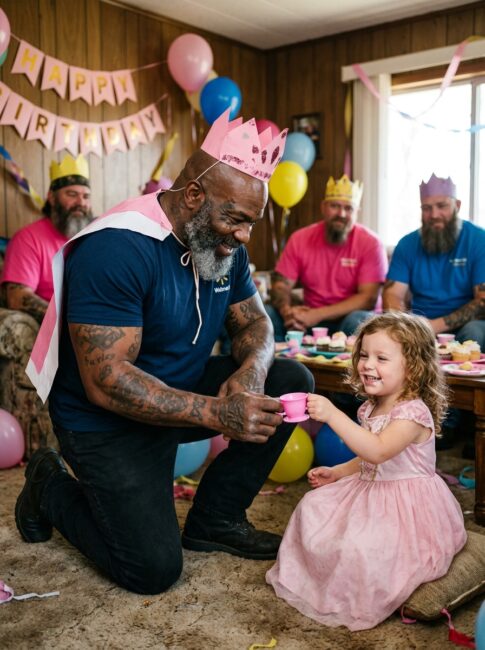
The men lowered their voices. Took off boots or wiped them. Set down bags. Moved slowly. Tank crouched, which for a man his size was practically a construction project, and pulled a paper crown from his bag.
It was pink.
Too small.
He placed it on his bald head.
It snapped immediately.
Maisie gasped.
Tank froze.
Then Mickey whispered, “The prince has fallen.”
Maisie peeked around my leg.
Tank held the broken crown in both hands like a wounded bird.
“I may require royal repairs,” he said.
That was the first time she smiled.
Then she ran to get tape.
The party should have been funny.
And it was.
You have not seen confusion until you have watched twelve bikers try to understand the rules of “princess freeze dance.” Preacher moved like a refrigerator trying to be polite. Mickey spun once, got dizzy, and sat down in a laundry basket. Angel, a Mexican American HVAC repairman with tattoos up his neck, let Maisie paint a blue star on his cheek and then told everyone it improved his face.
Tank was Prince Charming.
Not because he volunteered.
Because every other man stepped backward at once.
He wore his black jeans, a blue Walmart shirt stretched tight across his chest, and a paper cape that barely reached his elbows. He refused to remove his leather wrist cuffs, so Maisie declared them “royal armor.” She gave him a cardboard sword, then took it back because, according to her, princes do not poke balloons.
For three hours, my house became something I had never seen before.
Safe.
Not quiet. Not calm. Safe.
There were cupcakes smashed into napkins, juice spilled on the rug, frosting in Tank’s beard, paper crowns taped and re-taped, and men who had been feared in bars bowing before a four-year-old in a thrift store princess dress.
At one point, Maisie sat on Tank’s knee while he held a plastic teacup between two fingers the size of sausages.
“More tea, Prince Tank?”
“Yes, ma’am.”
“It’s pretend.”
“Still thirsty.”
She laughed so hard she hiccuped.
I stood in the hallway, watching, with my hand pressed against the little yellow star patch hidden inside my vest. The patch felt warm under my palm. Or maybe that was just my chest hurting in a good way.
Then my phone rang.
Jenna.
From prison.
The party noise dropped out of me.
I stepped into the back bedroom and answered.
“Dad?”
Her voice sounded smaller through the facility phone line. Tinny. Tired. Still my child.
“Yeah.”
“Is it happening?”
I looked through the doorway. Maisie was placing a crooked crown on Preacher’s gray head while he sat obediently on the couch.
“It’s happening.”
“Is she happy?”
I closed my eyes.
“Yeah, Jen. She’s happy.”
There was a little sound on the line. Not quite crying. Not quite breathing.
“I’m sorry,” she said.
Those two words had been said before, but that day they landed different.
I did not know what to do with them. Anger is easier when it stays hot. Mine had cooled into something heavy.
“She knows you love her,” I said.
“Does she?”
I watched Maisie take Tank by the hand and lead him to the center of the room.
“She will.”
That was the twist nobody at the party knew.
The princess party had not just been for Maisie.
It was also the first birthday Jenna had ever missed sober.
In prison, she had joined a recovery program. She had written Maisie a letter every week for three months. I kept them in a shoebox because Maisie could not read much yet, and because I was afraid if I handed them over too soon, Jenna would disappear again and leave paper promises behind.
That morning, a letter had arrived.
Pink envelope. Prison stamp. Maisie’s name written carefully.
Inside was a birthday card Jenna had made from notebook paper.
A hand-drawn crown.
A sentence that made my hands shake.
Tell my baby she was born royal, even if I forgot how to be her mother.
I had hidden the card inside my vest, behind the yellow star patch.
I was waiting for the right moment.
But as I stood in the bedroom listening to my daughter cry softly through a monitored prison phone, I realized there was no right moment. There was only a child in the next room being loved by twelve men wearing paper crowns because one mother could not be there and one old man could not do it alone.
Jenna whispered, “Can I hear her?”
I almost said no.
Not to be cruel. To protect Maisie. To protect myself. To avoid the look on that little girl’s face when the call ended and her mother was still gone.
Then I heard Maisie laugh.
A full laugh. Bright. Unafraid.
I said, “Hold on.”
I walked back into the living room.
The room went quiet when they saw my face.
Maisie looked up.
“Uncle Ray?”
I knelt in front of her. My knees cracked. My vest creaked. My hand shook when I pulled out the pink envelope.
“Your mama sent something.”
The party froze.
Twelve paper-crowned bikers went silent around a four-year-old girl holding a prison birthday card.
Maisie touched the drawing of the crown.
“Mommy made this?”
“Yeah, baby.”
“Is she a princess too?”
My throat closed.
Before I could answer, Tank spoke from behind me, voice low and careful.
“Sometimes princesses get lost.”
Maisie looked at him.
“Do they come back?”
Tank’s eyes flicked to me.
Then he said, “If they keep walking the right way.”
I put the phone on speaker.
Jenna’s voice came through thin and shaking.
“Happy birthday, baby.”
Maisie stared at the phone like it was magic.
Then she smiled.
“Mommy, the princes came.”
After that, the party changed again.
Not sad exactly.
Deeper.
Maisie sat on the couch with the phone in both hands while twelve bikers pretended not to listen and listened to every word. Jenna asked about the cake. Maisie told her it had too much pink, which was “almost enough.” Jenna asked about presents. Maisie described each one, including the stuffed dragon Preacher bought because he said princesses needed security.
Then Maisie said, “Uncle Ray made princes.”
Jenna laughed and cried at the same time.
I had not heard that sound from my daughter since she was sixteen.
When the call ended, Maisie did not fall apart the way I feared. She pressed the phone to her cheek, then handed it back to me.
“Mommy is walking right,” she said.
I nodded because I did not trust my voice.
Then she climbed onto a kitchen chair with her juice cup.
That tiny girl in a thrift store princess dress, curls falling out of her ribbon, frosting on her chin, stood above twelve bikers who had seen bar fights, hospital rooms, divorce courts, funerals, prison visits, and highways at 3 a.m.
She lifted the cup with both hands.
“Thank you, crown uncles.”
Nobody moved.
Maisie frowned.
“You have to cheers.”
Twelve men lifted plastic cups of fruit punch, sweet tea, water, and one black coffee Tank had refused to surrender.
“To the princess,” Preacher said.
Maisie shook her head.
“To the princes.”
That hit the room hard.
She pointed at them one by one. “Prince Tank. Prince Mickey. Prince Angel. Prince Preacher. Prince everybody.”
Mickey’s eyes got wet first, which he denied later with offensive language.
Then Maisie said the line I will carry until I die.
“You are my real princes.”
The room went silent.
Not awkward. Not empty.
Full.
Every biker bowed.
Some did it badly. Some stiffly. Tank’s paper cape slipped over his shoulder. Preacher’s crown fell into his eyes. Angel put one tattooed hand over his heart. I bowed last because I was crying and did not want Maisie to see.
She saw.
Children always do.
She climbed down and hugged my neck.
“Don’t be sad, Uncle Ray. You’re king.”
I almost laughed. Almost.
After the party, when the balloons had sagged and the cupcakes were gone and Maisie had fallen asleep on the couch with her crown still on, the brothers helped clean.
That was another revelation.
These men, who had once left beer cans wherever gravity allowed, washed plates, folded chairs, wiped frosting from the floor, and carried trash to the curb. Tank stood at the sink, still wearing his broken crown, washing tiny plastic cups with the focus of a surgeon.
I joined him.
For a while, we worked without talking.
That is how bikers say most things.
Then Tank said, “I never been a prince before.”
I looked at him.
He kept his eyes on the sink.
His voice was low.
“Not in nobody’s story.”
The water ran over his huge hands.
“My old man called me monster. Teachers called me trouble. Cops called me suspect. Women called me mistake. Club called me Tank, and that was fine. A tank don’t feel nothing.”
He rinsed a pink cup and set it in the rack.
“Today that little girl called me prince.”
His jaw tightened.
“I didn’t know I needed that.”
I did not answer right away.
The yellow star patch inside my vest pressed against my chest. I thought about Jenna’s card. About Maisie asking whether bad choices canceled birthdays. About every man in that house wearing a paper crown not because it was funny, but because one child had asked them to become something softer than their names.
“She saw you,” I said.
Tank nodded once.
“Yeah.”
Then he dried his hands on a dish towel covered in cartoon flowers.
“Scared the hell out of me.”
That was Tank.
Five words of truth, then back to dishes.
Before he left, he walked to the couch where Maisie slept. He did not touch her. Just stood there a second, looking down at the little girl who had renamed him.
Then he took off his broken pink crown and placed it gently on the coffee table beside her birthday card.
“Night, princess,” he whispered.
After that birthday, the Copper Kings started doing something we never voted on.
We kept crowns.
Not in a ceremonial way. Nothing written in bylaws. No patches made. No speeches. Bikers ruin things when they over-explain them.
But crowns started showing up.
A paper crown tucked above the clubhouse bar. A blue plastic one hanging from Tank’s rearview mirror. A tiny glitter crown glued to Preacher’s toolbox. Mickey got a crown tattooed on his ankle and told everyone it was because he lost a bet. Nobody believed him.
Maisie noticed all of them.
She became the unofficial royal inspector.
At the clubhouse, she would walk past men twice her size and point.
“Where’s your crown?”
If a brother did not have one, she made him a sticker crown from whatever paper was nearby. Old receipts. Napkins. A flyer for a tire sale. Once she made one from a parking ticket, and Preacher said it was the most expensive crown in the kingdom.
Every year after that, on her birthday, the brothers came.
The second year, Jenna was still inside, but sober. She called again. Maisie read three words from one of her letters by herself. Tank cried in the bathroom and blamed allergies.
The third year, Jenna came home.
That was not clean or easy. Real life does not wrap a bow around a prison release and call it healing. Jenna was thin. Nervous. Ashamed. Maisie hid behind me when she first walked in. I saw my daughter’s face break and rebuild in the same breath.
The Copper Kings were in the yard that day, all wearing crowns again.
Not crowding.
Guarding space.
Jenna knelt on the porch.
“Hi, baby.”
Maisie stared at her.
Then she turned to Tank. “Is she walking right?”
Tank looked at Jenna.
Jenna looked like she might collapse under the question.
Tank nodded once.
“So far.”
Maisie walked to her mother slowly.
No movie music. No running hug.
Just one small hand reaching out.
Jenna took it like it was the last rope on earth.
Since then, the princess party became our yearly ritual. Not big. Not public. Just family, club, cake, and men wearing colors they once would have mocked. The Harleys still rumble up the street, but softer somehow. Or maybe the neighbors learned the sound differently.
Mrs. Granger from across the street brings cookies now.
Denise from Walmart came the next year with her kids and a glitter warning label she made herself.
And Tank?
Tank became the best Prince Charming we had.
He bought a real cape online. Purple. Ridiculous. Too short by a foot. He wears it over his leather cut in the backyard after the bikes are parked and the engines are off.
He says it is for Maisie.
Maybe.
But every time she says, “Prince Tank,” that giant man stands a little straighter.
Some names repair what others ruined.
Maisie is eight now.
Jenna has been clean three years. I do not say that lightly. I count it the way bikers count miles in bad weather. Carefully. With respect. Knowing one wrong turn can still cost you.
Last Saturday, Maisie asked me to take her down Route 66 for pancakes.
She wore a denim jacket, pink boots, and a plastic crown faded from too many summers. I rode slow with her in the sidecar, the morning air cold enough to bite but not hard enough to hurt. The Harley’s engine thumped steady beneath us. Not loud. Just there.
At Hank’s Diner, Tank was already waiting.
He sat in the corner booth wearing a black shirt, heavy boots, tattoos showing, and a tiny paper crown folded from a napkin. People stared. He let them.
Maisie slid into the booth across from him.
“Morning, Prince Tank.”
“Morning, Princess.”
I poured coffee. Jenna arrived ten minutes later, hair still wet from work, eyes tired but clear. Maisie waved her into the booth like a queen returning from war.
For a while, we just ate.
Pancakes. Burnt coffee. Syrup on the table. Boots under the booth. The old neon sign buzzing in the window.
When we left, twelve Harleys were parked outside.
The brothers had come without being called.
Maisie stood on the curb and looked at all of us. Old men. Scarred men. Men with records, regrets, jobs, bad knees, soft spots, and paper crowns tucked in saddlebags.
Then she bowed.
Every biker bowed back.
Leather creaked.
Boots shifted.
Engines waited.
Maisie climbed into the sidecar and held Jenna’s birthday card against her chest, the old one with the hand-drawn crown.
I started the Harley.
The V-twin woke up low and steady.
Tank lifted two fingers.
Maisie shouted over the rumble, “Real princes!”
The taillights rolled toward Route 66.
Crowns in the wind.
Follow the page for more biker stories about the gentle hearts hidden under leather.