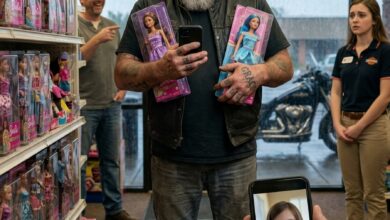
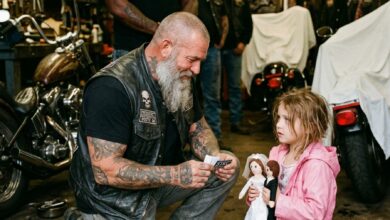
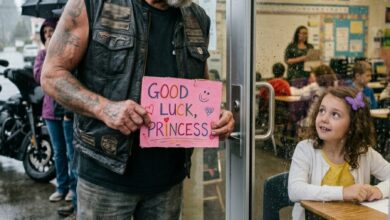
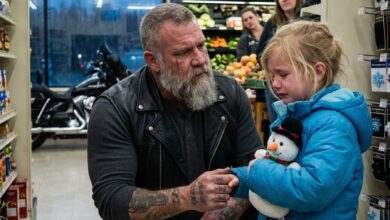
Part 2: They Laughed at the Biker’s Teddy Bear — Until They Learned Who Was Waiting
My name is Claire Whitman, and at the time I was a case aide for Lane County Family Services. Not a social worker yet. Not the person who made the big decisions. I drove forms between offices, supervised visits when the licensed staff were overloaded, and wrote down what I saw in language nobody outside the system would ever read.
“Child appeared comfortable.”
“Adult arrived on time.”
“Interaction was appropriate.”
Cold words for hot little rooms.
The biker’s name was Thomas Rourke, but nobody called him Thomas. Everyone called him Tank. He rode with a small veterans’ motorcycle club out of Newport called the Gray Harbor Riders. Mostly older men. A few women. Retired welders, mechanics, two former Marines, one Black American woman named Denise who could rebuild a carburetor and silence a room with one raised eyebrow. They did toy runs every December and funeral escorts for veterans whose families had gotten too small.
Tank had been one of those men people warned you about before you met him.
“He has a record,” one supervisor said.
“Old charges,” another added.
“Anger issues.”
“Club ties.”
“Looks unstable.”
That last one always bothered me, even before I knew him. Looks unstable. What does stable look like? Khakis? A quiet voice? A house with matching towels?
Tank did not look stable by county standards.
He wore a black leather cut with faded patches, heavy boots, jeans that smelled faintly of rain and motor oil, and rings that clicked against every coffee cup he held. His beard covered most of his face. His eyes were pale blue and tired. Across his left hand was a tattoo of a wrench. Across his right was the word HOME, one letter on each knuckle.
That tattoo looked almost like a threat until you saw him with Maddie.
Maddie was seven. White American girl. Thin wrists. Honey-blond hair that would not stay brushed. She had been in care for thirteen months when Tank’s name appeared in the file as a possible kinship placement. He was not her father. Not by blood. He was her mother’s older half-brother, the uncle who had disappeared from family pictures after a bad stretch in his twenties.
Maddie called him “almost Dad.”
The first time I supervised their visit, she sat at a plastic table in the children’s home with a coloring book, pretending not to care if he came. That was how foster kids protect themselves. They build a small wall and call it being fine.
At exactly 3:00 p.m., we heard the Harley outside.
Not loud. Just deep. A throat of thunder under the window.
Maddie’s crayon stopped moving.
She did not run to the door.
She did not smile.
But her shoulders dropped.
Tank walked in holding a paper bag from a diner off Route 126. He had rain on his beard and grease under one thumbnail. He looked at me first, because he had learned rules matter in rooms like that.
“Ma’am,” he said. “I’m Thomas Rourke.”
Then he looked at Maddie.
“Hey, bug.”
She kept coloring.
“You brought pie?”
“Apple.”
“With the crumb top?”
“Didn’t ride through sideways rain for the wrong pie.”
She tried not to smile and failed.
That visit lasted one hour. He spent twenty minutes eating pie with her, ten minutes fixing a broken wheel on a toy truck for a little boy who was not his, and the rest of the time listening while Maddie explained a cartoon with the seriousness of a lawyer in court.
He did not interrupt.
He did not check his phone.
He did not talk about himself.
When the hour ended, Maddie asked, “Can I go home with you today?”
Tank’s jaw tightened.
Not anger. Pain held in both hands.
“Not today,” he said.
“Tomorrow?”
“Not tomorrow.”
“Then when?”
“When the people with clipboards stop being scared of me.”
I wrote that down, then crossed it out before submitting the note.
Instead, I wrote: “Adult acknowledged child’s disappointment calmly.”
That was the system.
Tank kept showing up. Every Tuesday and Friday. Same time. Sometimes on the Harley, sometimes in an old Ford pickup when the rain got ugly. He brought books, cheap hair clips, grocery-store cupcakes, and once a pair of purple rain boots Maddie wore indoors for the entire visit.
The Gray Harbor Riders started helping too. Not loudly. Bikers rarely help loudly unless there is a fundraiser involved.
Denise found him a bunk bed. A prospect named Leo painted Maddie’s room pale yellow. Two brothers repaired the porch steps because the home study report said “exterior safety concern.” Tank quit smoking because Maddie told him his jacket smelled like sad campfire.
The detail nobody noticed was the peppermint gum.
Every visit, he chewed it before walking in.
Not to hide smoke anymore.
To show her he had listened.
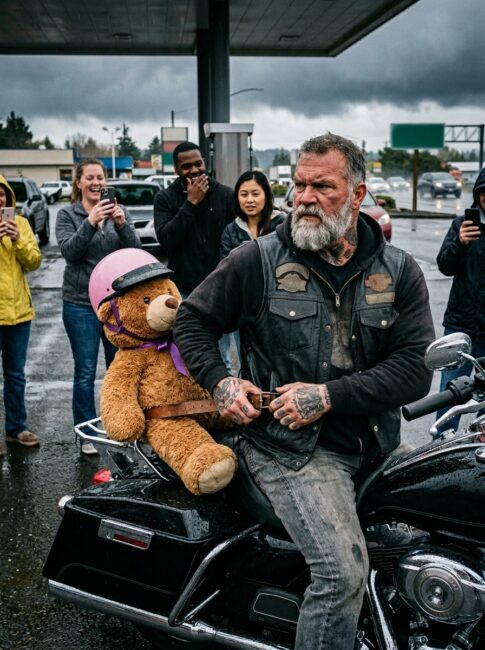
The teddy bear started as a mistake.
Maddie had seen it in the front window of a coastal gift shop in Yachats during a supervised community visit. The bear was too big for the display chair, with one arm flopped over the side and a stitched smile that looked like it knew secrets.
She stopped walking.
Tank stopped with her.
“You like him?” he asked.
Maddie shrugged. Too big a want was dangerous. Children in care learn to make their wishes small so disappointment has less room to swing.
“He’s dumb,” she said.
Tank looked at the bear.
“Real dumb.”
“He wouldn’t fit in my bed anyway.”
“Nope.”
“Probably costs a million dollars.”
“Probably two.”
She pressed one finger to the glass.
The visit moved on.
But Tank remembered.
Two weeks later, the adoption review was delayed again. Not denied. Delayed. That word can cut worse because it gives you nothing to fight. A background form from another county had not arrived. A reference needed clarification. His old assault charge required additional review, even though it was more than twenty years old. The home study worker wanted another conversation about “support systems.”
Tank sat across from my supervisor with his hands flat on his knees.
Big hands. Knuckles scarred. Nails clean.
“I did what you asked,” he said.
“We know, Mr. Rourke.”
“I fixed the steps.”
“Yes.”
“I put locks on the medicine cabinet.”
“Yes.”
“I got the room ready.”
“Yes.”
“I did the parenting class with the lady who kept calling me Todd.”
My supervisor sighed.
“We know.”
Tank leaned forward.
The chair made a small sound under him.
“That little girl asks every visit if today’s the day. I gotta keep telling her no. You ever done that?”
Nobody answered.
His eyes went wet but did not spill. He looked angry if you did not know what grief looks like on a man trained to hide it.
The visit that week was cut from an hour to fifteen minutes because of staffing.
That was the rule.
Tank got the call while he was at work at a small repair shop near Waldport. Fifteen minutes. Take it or reschedule.
He took it.
Then he bought the bear.
The gift shop owner told me later she had watched him try to figure out how to transport it. He had gone in wearing his cut, rain dripping off his shoulders, and pointed at the window.
“How much for the big idiot?”
The owner told him.
He paid cash.
Then he asked if she had a helmet.
“A helmet?”
“For the bear.”
She thought he was joking.
He was not.
She found a child’s pink bicycle helmet from a back shelf, discounted because the box was torn. Tank bought that too. He buckled it under the bear’s chin right there in the shop, tested the strap with two fingers, and asked for extra cord.
The owner laughed once, kindly.
Tank did not.
“Precious cargo,” he said.
That is how he ended up riding thirty miles down Highway 101 with a giant teddy bear strapped behind him, helmet on, purple ribbon tied around its paw. Rain moved in sheets off the Pacific. Trucks passed and sprayed water across his boots. People honked. A college kid filmed from a Subaru and shouted, “Do it for the content, grandpa!”
Tank kept riding.
At the Shell station, I saw him for the first time that day and almost did what everyone else did.
I almost reduced him to a joke.
The bear made him look absurd. A huge tattooed biker checking a stuffed animal’s safety strap like he was carrying a senator. His cut was soaked. His beard dripped onto his shirt. His hands trembled when he tightened the buckle, not from fear, I thought, but from cold.
Then I saw him buy the cupcake.
One gas-station cupcake with rainbow sprinkles.
He asked the cashier if they had a candle.
They did not.
He nodded.
“Worth asking.”
When he left, the teenage boy at the pump laughed again, quieter this time.
Tank heard him.
He turned, one hand on the handlebar, the other resting lightly on the bear’s paw.
“Kid,” he said, “best thing you can carry is something somebody needs.”
Then he rode away.
I sat in my county car for a full minute before I started the engine.
By the time I reached the children’s home, the rain had turned hard and silver. The visit was scheduled for 4:00 p.m. Tank arrived at 3:37.
He was early.
Too early.
Rules said visitors waited outside until staff were ready.
So he waited.
In the rain.
Beside the Harley.
With the teddy bear still strapped behind him.
I thought someone would bring him in.
Nobody did.
The front desk was short-staffed. One child had a meltdown in the hallway. Another needed medication. A foster parent was late. Phones rang until they sounded like alarms. The kind of afternoon where good intentions get buried under policy.
I looked out the window at 3:52.
Tank was still there.
He had taken off his leather cut and draped it over the teddy bear to keep it dry. Rain soaked through his thermal shirt. His gray beard clung to his chest. He stood with his arms folded, not in a tough way. In a cold way.
At 4:05, I said to my supervisor, “Mr. Rourke is outside.”
She looked at the clock.
“We’re running behind.”
“He’s in the rain.”
“He can wait in his truck.”
“He came on the bike.”
She rubbed her forehead.
“Claire, I have three crises right now.”
So he waited.
At 4:20, Maddie began crying in the playroom because she thought he had not come.
That was the part that still makes my stomach hurt.
She had been watching the small clock above the bookshelf. Seven-year-olds in care know time better than bankers. They know five minutes late can become a no-show. They know adults have reasons and excuses and emergencies. They know promises can die in traffic.
“He forgot,” she whispered.
I looked out the window.
Tank stood in the rain, two hands resting on the teddy bear’s covered shoulders, looking at the building like he could hold it up by staring hard enough.
“No,” I told her. “He’s here.”
“Then why doesn’t he come in?”
I had no good answer.
At 4:34, my supervisor finally nodded.
“Fifteen minutes.”
I went outside myself.
The rain hit my face cold and sharp. Tank turned when he heard the door. His skin was pale under the beard. His lips had a faint blue edge.
“You’re up,” I said.
He did not complain.
Not one word.
He just removed the leather cut from the bear, shook water off it once, and put it back on. The cut made a heavy wet sound across his shoulders.
Then he unbuckled the teddy bear.
Slowly.
Carefully.
Like waking a child.
That was when I saw the laminated tag clearly.
It did not say “For Maddie.”
It said:
For Maddie Rourke. For when you come home.
I stopped breathing for a second.
“Mr. Rourke,” I said, “her last name isn’t—”
“I know,” he said.
His voice was low.
“She asked what it would be if the judge says yes.”
He lifted the bear in both arms. It was so large its feet dragged near his boots.
The scary biker walked through the rain carrying that ridiculous bear like a newborn.
Inside, Maddie saw him.
She did not run to him first.
She ran to the bear.
Her small body hit the stuffed animal so hard Tank had to brace his boots against the floor. She wrapped both arms around its belly and buried her face in the fur.
For one second, I saw something flash across Tank’s face.
Pain.
Not jealousy. Not disappointment.
Recognition.
He understood exactly why she hugged the bear first.
The bear was safe to want.
The bear could not be taken away by paperwork.
The bear did not have a background check.
Then Maddie reached out one hand without looking up.
Tank took it.
His huge tattooed fingers closed around hers.
“Hey, bug,” he said.
“You came.”
“Yep.”
“You’re wet.”
“Rain does that.”
“You waited?”
“Yep.”
“How long?”
He glanced at me.
“Little bit.”
I could have protected him with a vague note.
Instead, for once, I wrote the truth.
“Mr. Rourke arrived twenty-three minutes early and waited outdoors in heavy rain for approximately two hours to preserve the child’s scheduled visitation opportunity. Child displayed immediate emotional relief upon seeing him.”
That note changed the file.
But not for the reason people think.
The next morning, my supervisor asked me to expand my observation.
County language again.
Expand.
Document.
Clarify.
So I wrote everything.
I wrote about the bear’s helmet. The safety strap. The cupcake in the saddlebag. The fact that he never raised his voice when the visit was shortened. The fact that he waited outside because a staff member told him to wait, even though no one checked on him. The fact that Maddie believed he had forgotten, and that his presence stopped her crying faster than any staff intervention had that day.
Then I wrote what I was not sure I was allowed to write.
“Child appears to experience Mr. Rourke as a reliable attachment figure.”
Reliable.
That word carries weight in family court.
It means more than nice. More than loving. More than related. Reliable means the child looks for you when scared and expects you to be there. It means the nervous system has started building a road toward you.
Tank did not know any of that.
He just knew Maddie needed him.
Later that week, I drove out to his house for an addendum visit with the licensed social worker. It sat outside Waldport, off a narrow road where fir trees leaned over the ditches and mailboxes wore moss like old hats. The house was small. White paint. Blue trim. Porch steps newly repaired. A wind chime made of old wrenches hung near the door.
Inside, everything smelled faintly of coffee, sawdust, and peppermint.
Maddie’s room was ready.
Not perfect. Better than perfect.
A yellow bedspread. A bookshelf made from sanded crate wood. A night-light shaped like a moon. Purple rain boots lined up by the closet. On the pillow sat a smaller stuffed bear wearing a tiny leather vest.
I looked at Tank.
He shrugged.
“Denise made it.”
On the wall, he had framed a piece of paper.
At first, I thought it was a drawing.
Then I stepped closer.
It was a checklist written in block letters.
MADDIE’S ROOM
Bed
Books
Night light
Window lock
Snack drawer
No yelling
Always knock
That last line got me.
Always knock.
I asked about it.
Tank looked at the doorway instead of at us.
“Kids in homes like that,” he said, “they don’t get much that’s theirs. Figured a door could be a start.”
The licensed social worker, Mrs. Alvarez, not the same as the teacher from the other story, took notes. She was a sharp Black American woman in her forties with calm eyes and no patience for performance. She had been skeptical about Tank from the beginning, mostly because his file was thick and his support system looked unconventional on paper.
Then the Gray Harbor Riders showed up.
Not planned. At least, not by us.
Three bikes rolled into the gravel driveway. Engines cut one by one. The sudden silence was almost funny. Denise stepped off first, a Black American woman in her late fifties, tall, silver braids tucked under a bandana, leather cut dark with rain. Behind her came Leo, the Latino American prospect, carrying a box of children’s books. Last was a White American man named Frank with a casserole dish wrapped in towels.
Tank opened the door and frowned.
“What are you doing?”
Denise looked at him like he was slow.
“Support system.”
Mrs. Alvarez’s pen stopped moving.
Denise stepped inside, wiped her boots, and introduced herself properly. She had paperwork. Copies of her nursing license. A letter stating she would provide emergency childcare. Frank had proof he lived twelve minutes away. Leo had a schedule showing he could help with school pickup twice a week.
Tank stared at them.
“You didn’t have to.”
Denise snorted.
“Brother, you taught my grandson to ride a bicycle after his daddy left. Sit down.”
That was twist number two.
The club was not a risk factor.
The club was the net.
All those patches people worried about were attached to people who had been quietly building a village around a child they barely knew because Tank loved her.
Then came the third twist.
Mrs. Alvarez asked about his old assault charge. Tank did not flinch.
“I put a man in the hospital,” he said. “Bar fight. I was twenty-seven. Drunk. Mean. Stupid.”
The room went quiet.
He kept his hands open on the table.
“He lived. I did time. Got sober. Paid restitution. Apologized. He didn’t forgive me. Didn’t owe me that.”
No excuses.
No speech.
Then he added, “That’s why I don’t drink. That’s why there’s no alcohol in the house. That’s why my brothers know if I bring a kid home, they don’t show up loud or sideways.”
Mrs. Alvarez looked at the checklist again.
No yelling.
Always knock.
I watched her face change.
Not soften completely. Good social workers do not get swept away by one touching scene. But she saw the same thing I had started to see.
Tank had not erased his past.
He had built guardrails around it.
Before we left, I noticed something hanging inside his leather cut on a small hidden patch. Not skulls. Not flames. Not club colors.
A tiny stitched teddy bear.
Under it, one word.
WAITING.
I asked him about it.
He touched the patch once with two fingers.
“Maddie said bears wait good,” he said.
Then he closed the vest.
That was all.
The file was not approved overnight. Nothing in the system moves like it does in stories. There were still forms. References. Court dates. A judge with tired eyes. A licensing worker who measured bedroom windows and checked smoke detectors. Another delay because somebody typed Tank’s birth year wrong and the background system flagged a mismatch.
But after the rain visit, the case moved differently.
People called back faster.
Emails got answered.
The phrase “child’s attachment” appeared in meetings.
Tank still rode every Friday when weather allowed. Same route. Waldport to Florence. Highway 101 bending along the coast, fog caught in the trees, gulls cutting over gray water, his Harley making that low V-twin sound that you feel in your ribs before your ears catch it.
Sometimes strangers still stared.
Sometimes kids still pointed at the huge biker with the stuffed animal strapped behind him.
Because the bear kept riding.
Not the giant one every time. After Maddie received it, Tank bought a smaller brown bear and buckled it behind him on visit days. Helmet. Strap. Purple ribbon. Same ritual.
At first I thought it was for Maddie.
Then I realized it was for him too.
A promise you could see.
A way to tell the road, the county, the weather, and his own old fear: I am still coming.
When visits expanded to two hours, he arrived early.
When visits moved to unsupervised afternoons, he still signed every paper carefully.
When Maddie was allowed to visit his house, he stood on the porch pretending not to shake while she walked into her yellow bedroom for the first time.
She did not say much.
She ran her fingers over the bookshelf, touched the moon night-light, opened the snack drawer, then turned back to him.
“You knock?”
“Every time.”
“Even if it’s your house?”
He shook his head.
“Our house.”
She looked at that word for a while.
Our.
Then she climbed onto the bed, pulled the giant teddy bear beside her, and said, “He fits.”
Tank looked out the window until his eyes dried.
After placement began, he kept the Friday ritual. Not to the children’s home anymore. Just down the road to the same Shell station where people had laughed. He would buy coffee, peppermint gum, and one cupcake with rainbow sprinkles. Then he would ride home slow because cupcakes do not like potholes.
Maddie would meet him on the porch.
Always with the bear.
Always pretending she had not been waiting.
The adoption finalized on a wet Thursday in Lincoln County courthouse.
No big crowd. Just Tank, Maddie, Mrs. Alvarez, me, Denise, two Gray Harbor Riders trying to look respectable in button-down shirts, and a judge who had clearly seen enough broken families to recognize a repaired one when it stood in front of him.
Maddie wore a purple dress.
Tank wore his leather cut over a clean black shirt.
The judge asked Maddie if she understood what adoption meant.
She nodded.
“It means he can’t just be almost Dad anymore.”
The judge smiled.
“That’s one way to say it.”
After the papers were signed, Maddie asked if she could change the bear’s tag.
Tank handed her a marker.
Right there in the hallway, sitting on a wooden bench outside the courtroom, she crossed out the old line.
For Maddie Rourke. For when you come home.
Under it, she wrote:
I’m home now.
Tank read it once.
His jaw tightened. His eyes went red. He did not cry in the way people expect. No big sobbing. No speech. He just pressed his rough thumb to the tag and breathed like the air had finally reached the bottom of his lungs.
Outside, the rain had stopped.
The Harley waited at the curb with the small bear strapped behind it, pink helmet shining under the courthouse lights. The giant bear rode home in Denise’s SUV because even Tank admitted some passengers deserved a seatbelt and a roof.
Maddie climbed behind him on the Road King, her little boots resting on the pegs, her arms wrapped tight around his waist.
I stood on the courthouse steps and watched them pull away.
The V-twin rolled low through the wet street. His taillight glowed red. Her purple ribbon flickered once in the wind.
No one laughed this time.
Follow the page for more biker stories that prove the roughest-looking hearts sometimes carry the softest cargo.