Part 2: The Biker Club Played Doll Wedding — Then One Question Broke the Garage
The Iron Pines clubhouse sat behind an old tire shop outside Kingman, Arizona, where Route 66 runs through town like a memory people keep repainting so it does not disappear. Tourists drove by taking pictures of neon signs and rusted gas pumps. They never turned down our gravel lane unless they were lost or brave.
The clubhouse was nothing special. Two garage bays, one office, a bathroom that always needed a handle jiggled just right, and a back room with a poker table nobody admitted was warped. The roof clicked when the sun went down. The swamp cooler rattled like loose bones. Harleys came and went all week, low V-twin rumble rolling across the dirt, boots hitting concrete, leather cuts creaking as men climbed off their bikes and shook road dust from their sleeves.
To most people, we looked like a warning.
Maybe we were, once.
Not the kind people make movies about. We were not outlaws pretending to be legends. We were mechanics, truckers, roofers, veterans, ex-drunks, one barber, and a woman named Carla who could weld cleaner than any man I knew and did not let us forget it. We carried our mistakes in plain view. Old scars. Bad knees. Names tattooed for people we had lost or failed.
Brick had done twelve years in the Army and came home with a limp, a divorce, and a way of standing near exits. He did not talk about Iraq unless he was warning younger men not to confuse noise with courage. Moose owned a landscaping business and sent half his paycheck to two daughters in Phoenix. Razor, our road captain, had been sober nine years and still counted the days when stress got ugly. Carla had buried a son and kept his tiny toy motorcycle on the shelf above her welder.
Brotherhood was not a slogan to us.
It was who showed up when the engine died, when the court date came, when the doctor said the word nobody wanted, when the phone rang at 2:00 a.m. and somebody on the other end said, “Brother, I need a ride.”
When Ellie came to live with me, I did not know how to ask for help.
I had raised one daughter badly enough that she married a man who argued like winning mattered more than love. That is a hard thing to admit. My daughter, Jenna, was not bad. Her ex, Caleb, was not a monster. But their marriage turned into a house fire no one could see from the street. Doors slammed. Voices cracked. Apologies came in the morning and vanished by dinner.
Ellie learned to read weather in adult faces.
She was six years old and already knew which tone meant get small.
The night Jenna brought her to me, Ellie carried one purple backpack, three dolls, and a plastic lunchbox full of rocks she called “family stones.” She did not cry. That scared me more than crying.
“She just needs a few days,” Jenna said.
A few days became a week. A week became three months.
I turned the small spare room into Ellie’s room. Pink curtains from Walmart. A night-light shaped like the moon. A shelf for her dolls. I fixed the squeak in the closet door because she asked if closets were supposed to make noises at night. I learned to buy cereal with marshmallows. I learned that six-year-olds ask questions while you are making coffee and expect answers that can hold the world together.
“Grandpa, when Mommy says Daddy ruined everything, does that mean me too?”
“No, baby.”
“Then what did he ruin?”
I burned my hand on the coffee pot and did not answer fast enough.
She stopped asking.
That was worse.
The club noticed before I told them. Brotherhood hears what men try not to say. I started missing rides. I left meetings early. I kept checking my phone during runs. One Thursday, Brick followed me into the garage while I was pretending to adjust a chain that did not need adjusting.
“You in trouble?” he asked.
“No.”
“She is?”
I looked at him.
He nodded once, like that answered plenty.
Next Friday, I brought Ellie to the clubhouse because my babysitter canceled and the custody lawyer called it an “important hearing.” I expected rough comments. Not mean ones, just awkward ones. Men like us knew how to rebuild carburetors in the dark but could freeze around a child holding a juice box.
Ellie walked in behind me clutching her doll.
Sixteen bikers went silent.
Moose turned off the grinder so fast the wheel whined down like an animal.
Brick crouched carefully, his bad knee popping.
“What’s her name?” he asked.
Ellie held up the doll.
“Mrs. Pickle.”
Brick nodded like he had met generals less important.
“Ma’am.”
That was the first seed.
The president of the Iron Pines did not laugh at a little girl’s world.
He entered it.
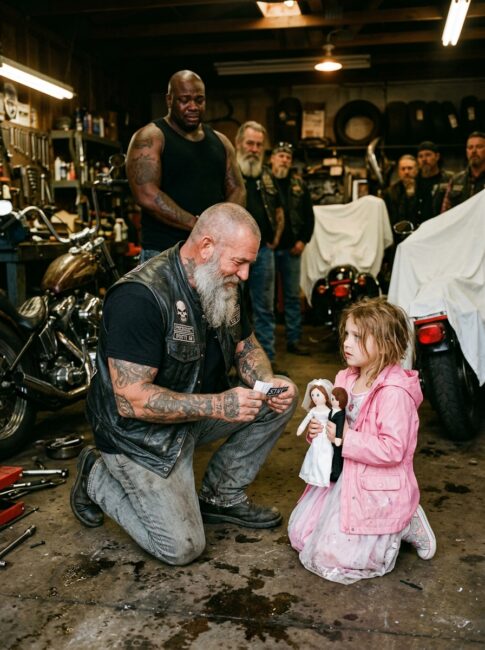
The doll wedding happened three weeks later, after a family court hearing that left all of us carrying invisible bruises.
Jenna and Caleb had fought in the hallway outside the courtroom. Not screaming. They were too smart for that in front of a judge. But their whispers had teeth. Ellie sat beside me on a wooden bench, swinging her little legs, pretending to read a picture book upside down.
She heard every word.
“She uses Ellie against me.”
“You don’t even show up on time.”
“You left first.”
“You made me.”
“You always do this.”
Ellie turned one page.
Then another.
Her face stayed blank.
A child’s blank face is not peace. It is a door closing.
Afterward, the judge extended temporary custody with me while the parents completed mediation and counseling. That sounded clean on paper. It did not feel clean in the parking lot, where Jenna cried behind sunglasses and Caleb punched the air beside his truck hard enough to make Ellie flinch from twenty feet away.
I took her to the clubhouse because I had nowhere else to put my hands.
The ride there was only six miles. She sat in her car seat in my old pickup, holding Mrs. Pickle and a second doll she had named Mr. Sunday. Out on Route 66, afternoon heat shimmered off the asphalt. A line of Harleys passed us going the other way, pipes low, chrome flashing. Ellie watched them through the window.
“Do bikers get divorced?” she asked.
I kept both hands on the wheel.
“Sometimes.”
“Does everybody?”
“No.”
“Why not?”
Because some people stay. Because some people learn. Because some people stop hurting each other before the house burns down.
I did not say any of that.
I said, “It depends.”
She looked back at her dolls.
“That’s a grown-up answer.”
She was right.
When we reached the clubhouse, the guys were setting up for a charity ride meeting. Folding chairs. Coffee urn. A whiteboard with route notes. Brick was at the front, big hands on his hips, explaining road formation to two new prospects. Moose was taping down an extension cord. Carla was welding a bracket in the side bay, sparks falling like tiny orange rain.
Ellie walked into the middle of it all and announced, “There’s going to be a wedding.”
Nobody moved.
Brick looked at me.
I shrugged.
“Whose?” he asked.
“Mrs. Pickle and Mr. Sunday.”
Razor coughed into his coffee.
Ellie pointed at Brick. “You’re the minister because you’re in charge.”
Brick looked at the whiteboard. Looked at the prospects. Looked at the child.
“Meeting’s postponed,” he said.
That was the false climax people would have loved if they had seen it.
Sixteen grown bikers transformed a garage into a child’s chapel.
Moose found a clean white shop towel and draped it over two Harleys because Ellie said guests needed to look fancy. Razor lined up socket wrenches like pews until Carla told him pews did not need to be sorted by size. A prospect named Danny ran to the gas station and came back with cupcakes, plastic flowers, and a bottle of apple juice he called champagne until Brick looked at him.
“Juice,” Brick said.
“Juice,” Danny corrected.
Ellie assigned roles with the severity of a judge.
Brick was minister. Moose was best man. Carla was maid of honor. Razor ran music from a phone but was warned not to play anything “too motorcycle.” I was father of the bride, which made my throat close because I had not done so well at being father of anything lately.
Ellie walked Mrs. Pickle down the aisle of shop rags while the Harleys stood under white sheets like strange metal angels. The garage smelled like engine oil and vanilla cupcakes. Leather creaked as men shifted in their chairs. Boots scraped concrete. Someone sniffed and blamed dust.
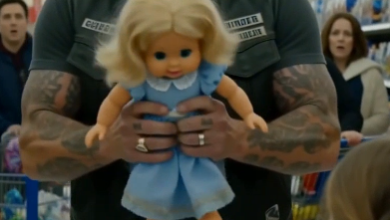
Brick held the dolls gently in his tattooed hands.
“Dearly beloved,” he said, voice rough as gravel, “we are gathered here because Miss Ellie said so.”
The room laughed softly.
Ellie did not.
She watched him like this mattered.
Brick noticed. His face changed. Just a little.
He continued more carefully.
“Love ain’t just saying words,” he said. “It’s showing up. It’s fixing what you break. It’s not leaving somebody scared when you can help it.”
I looked at him then, wondering where those words came from.
Ellie stepped forward.
Her small hands clenched around the dandelion-and-zip-tie bouquet.
“Do they have to promise?”
Brick nodded.
“Usually.”
“What if they promise and still leave?”
The garage went quiet.
The air compressor clicked once in the corner.
Nobody laughed now.
Brick lowered the dolls.
Moose looked at the floor. Carla turned off the welding torch. Razor stopped the music.
Ellie looked at all of us. Six years old. Pink raincoat. Princess dress. Eyes too careful for her age.
Then she asked the real question.
“Can people love each other and not leave?”
That was the moment the game ended.
And the real ceremony began.
Brick did not answer right away.
That surprised me.
Brick had words for everything. Flat tire on Route 93? Brick had words. Prospect making excuses? Brick had words. Some drunk at a diner trying to start something? Brick had three words, and somehow the room got safer.
But that question took his voice.
He looked at Ellie, then at me, then at the covered Harleys and the dolls in his hands.
His jaw worked once.
I saw the old soldier in him step back. The president stepped back too. What was left was a man with a daughter he had not spoken to in eleven years because pride had sat in his mouth like a stone.
That was the twist under the twist.
Ellie had not just exposed her own fear.
She had exposed ours.
Every man in that garage knew something about leaving.
Some had been left by fathers. Some had left women they loved because drinking was easier than apologizing. Some had buried friends and called it life. Some had mistaken silence for strength until their children stopped calling.
We looked like men who rode together because we were tough.
A lot of us rode together because we had failed somewhere else.
Brick set the dolls down on the toolbox altar with care. Then he lowered himself to one knee in front of Ellie. His leather cut creaked. His bad knee cracked loud enough that Moose winced for him.
Brick did not wince.
He took off his sunglasses and hooked them on his collar. His eyes were pale, tired, and wet in a way he would have denied if anyone pointed it out.
“Yes,” he said.
Just one word.
Ellie stared at him.
“Even if they fight?”
“Yes.”
“Even if they don’t live in the same house?”
Brick swallowed.
“Yes.”
“Even if they stop being married?”
The garage held its breath.
Brick looked at me again, and for the first time in all the years I had known him, I saw him ask permission without saying a word.
I nodded because I did not have anything better.
He turned back to Ellie.
“Sometimes grown-ups mess up the house they built,” he said. “Sometimes they can’t live in it together anymore. But love ain’t supposed to make a kid wonder who’s staying.”
Ellie’s lower lip trembled.
“Mommy says Daddy left.”
“I know.”
“Daddy says Mommy pushed him.”
“I know.”
“Who’s right?”
Brick’s big hands rested on his knees. Tattooed hands. Scarred hands. Hands that had held handlebars through storms and folded flags at funerals.
He said, “That ain’t yours to carry.”
Ellie blinked.
“What is mine?”
Brick reached into the inside pocket of his cut and pulled out a small patch. Pink thread. Crooked letters. It had been sewn badly onto black cloth, then cut loose like someone saved it from another life.
It said STAY.
I had never seen it before.
Neither had most of the club.
Brick held it in his palm.
“My girl made me this when she was about your age,” he said. “I didn’t understand it then.”
His voice got rougher.
“I do now.”
That was the hidden patch.
Not a club secret. Not a weapon. Not some dramatic biker symbol.
A child’s crooked little plea, carried inside a leather cut for more than thirty years.
Ellie touched the patch with one finger.
“Did you stay?”
Brick closed his eyes once.
“No,” he said.
The room took that hit with him.
Then he opened his eyes.
“But I can today.”
And that is when he made the promise.
Not as club president.
As a man who had left once and finally knew what it cost.
Brick stayed on one knee and looked over his shoulder at us.
“Brothers,” he said.
Every man in the garage straightened.
Carla folded her arms.
“And sister,” he added.
“Smart,” Carla said, but her voice was soft.
Brick looked back at Ellie.
“You asked if people can love each other and not leave. I can’t promise what your mom and dad do. That’s their road. But I can promise what we do.”
Ellie held Mrs. Pickle against her chest.
“What do you do?”
Brick placed the STAY patch on the toolbox between the bride doll and groom doll.
“We show up.”
Moose stepped forward first.
He did not do delicate well. His boots sounded like bricks hitting concrete. He crouched beside Brick, huge hands dangling between his knees, eyes fixed on Ellie.
“I got two girls,” he said. “I don’t see ’em every day. But I call. I pay. I show up to every recital they let me into. Love don’t always live in one house, short stack. But it better keep its boots by the door.”
Ellie studied him.
“Are you the best man?”
Moose nodded.
“Then you have to promise too.”
He put one hand over his heart.
“I promise.”
Carla came next. She knelt even though her back hated it.
“My boy died when he was nineteen,” she said, and the room got very still because Carla never said that out loud. “I couldn’t stay with him in the way I wanted. But I keep loving him. Every day. Leaving and losing ain’t the same thing, baby.”
Ellie did not fully understand. But she heard the truth in it.
Razor cleared his throat.
“I left my son when I was drinking,” he said. “Thought sending money counted. It didn’t. Been making amends nine years. He talks to me now on Sundays.”
He looked at Ellie.
“If a grown-up says sorry but don’t change, that’s just noise.”
Ellie nodded like she was filing it somewhere important.
One by one, the Iron Pines stepped forward. Not with speeches. Bikers do not do speeches unless somebody dies or a grill catches fire at a fundraiser.
They gave small promises.
“I can pick you up from school if Grandpa’s truck quits.”
“I’ll teach you how to patch a bicycle tire.”
“I’ll sit outside the courtroom if you need.”
“I’ll bring cupcakes that ain’t from the gas station.”
“I’ll knock before coming into your room.”
That last one came from Danny, the prospect, and I saw Ellie’s eyes lift.
Children hear the promises that matter.
Then she looked at me.
The garage disappeared for a second. Just me and my granddaughter. Me with my old mistakes. Her with her little bouquet and the weight of two adults’ broken marriage sitting on shoulders that should have carried nothing heavier than a backpack.
“Grandpa,” she said, “are you staying?”
I wanted to say yes fast.
Too fast would have sounded like fear.
So I walked over, slowly, boots scraping concrete, and got down in front of her. My knees complained. My chest hurt. My hands shook, and I hated that everyone could see.
“I should’ve stayed better for your mama,” I said.
Ellie tilted her head.
“When she was little?”
“Yeah.”
“Did you leave?”
“Not the house.” I rubbed my face. “But sometimes a man can be in the room and still not be there.”
Brick looked down.
Moose looked away.
There are truths that make a whole brotherhood uncomfortable because too many men recognize themselves in them.
“I can’t fix back then,” I said. “But I can stay now.”
Ellie looked at me for a long time.
Then she took the zip-tie bouquet and pressed it into my hands.
“You have to hold flowers if you promise.”
So I did.
A sixty-one-year-old biker with oil under his nails and a cracked heart, kneeling in a garage off Route 66, holding dandelions tied with zip ties while my granddaughter decided whether the world was safe enough to believe in again.
Brick picked up the dolls.
“Ceremony ain’t done,” he said.
Ellie wiped her nose on her sleeve.
“Okay.”
Brick stood with effort. Moose reached to help, but Brick waved him off. The president had one more thing to do on his own.
He cleared his throat.
“Mrs. Pickle and Mr. Sunday,” he said, “you don’t gotta be perfect. You gotta be kind. You gotta tell the truth. You gotta not make little folks carry big folks’ hurt.”
Ellie whispered, “And stay.”
Brick looked at the STAY patch on the toolbox.
“And stay the best way you can.”
He lifted the dolls.
“By the power temporarily given to me by a six-year-old in a pink raincoat, I pronounce you married.”
The garage exhaled.
Someone clapped.
Then everyone clapped.
Not loud. Not mocking.
Careful.
Like applause could break something if handled wrong.
Ellie made the dolls kiss. Then she turned and looked at the two Harleys under white sheets.
“The guests can honk now.”
Razor said, “Motorcycles don’t honk at weddings.”
Carla said, “They do today.”
Brick nodded once.
Outside, engines turned over one by one.
Not roaring.
Low. Gentle. A rolling thunder held on a leash.
Ellie smiled for the first time all day.
After that Saturday, the doll wedding became a thing, though nobody called it therapy because that would have made half the club run for the desert.
Every other weekend, Ellie brought Mrs. Pickle and Mr. Sunday to the clubhouse. Sometimes they renewed their vows. Sometimes they argued because Mrs. Pickle “needed space” or Mr. Sunday “forgot to listen.” Ellie acted out small dramas with plastic faces and yarn hair, and we learned to listen for the real question hiding underneath.
“Why does Mr. Sunday sleep in the toolbox?”
“Do people stop being family if they move?”
“Can you be mad and still make pancakes?”
Brick never missed a wedding if he could help it. If he was out on a run, he called in on speakerphone and gave the blessing from a gas station parking lot somewhere between Kingman and Needles, Harley ticking hot behind him.
His daughter called him two months after the first ceremony.
I do not know what he said to her. That was not my business. I only know he walked outside when the phone rang and came back twenty minutes later with his sunglasses on even though the garage door was closed.
Carla started keeping a small box labeled Wedding Supplies in the office. Inside were paper flowers, twist ties, doll shoes, a plastic ring from a cupcake, and Brick’s old STAY patch wrapped in a clean rag. Ellie was allowed to take it out only for ceremonies.
Moose became serious about his role as best man. He bought a tiny black bow tie for Mr. Sunday and once drove thirty-five miles because Ellie said the groom needed “better shoes.” He came back with doll boots and a receipt he refused to show anyone.
The two Harleys stayed honored guests.
Mine and Brick’s.
Every wedding, Ellie covered them with white sheets and placed paper cups of apple juice near their front tires. Nobody moved those bikes once the ceremony started. Not even when Razor needed a wrench trapped under my sheet. He waited.
That was the new rule.
You wait when a child is building a safe place.
Jenna and Caleb eventually learned about the garage weddings. At first, Jenna cried when I told her. Caleb got angry, then quiet. The next mediation session went differently. Not magically. Nothing healed in one afternoon. But they stopped saying certain things near Ellie.
That was something.
On Ellie’s seventh birthday, both of them came to the clubhouse.
Separate cars.
Separate cakes.
But they came.
Ellie made them sit on opposite sides of the garage, beside the covered Harleys. Brick stood minister again, paper collar tucked into his cut, and performed a birthday ceremony for Mrs. Pickle and Mr. Sunday’s “family meeting.”
At the end, Ellie handed her parents each a zip-tie flower.
“You don’t have to be married,” she said. “But you have to not make me hold the mad.”
Jenna broke first.
Caleb covered his face.
Brick stared at the floor like he was giving them privacy the only way a garage full of bikers could.
That night, after everyone left, I found Ellie asleep on the office couch under Brick’s spare riding jacket. The jacket looked too rough for a child. Heavy leather. Road dust. Old patches. But she had pulled it up to her chin like a blanket.
On the back was the Iron Pines patch.
On the inside, where only she could see, was STAY.
Years have passed since that first doll wedding.
Ellie is twelve now. Too tall for princess dresses. Too cool for dandelion bouquets. She pretends not to care about the old games, but once a year, usually in April, she still brings Mrs. Pickle and Mr. Sunday to the clubhouse.
The dolls look rough now. One eye scratched. One arm loose. The lace napkin yellowed. The tiny boots Moose bought are still on the groom.
Brick is older. His limp is worse. His beard has gone white. But when Ellie hands him the paper collar, he puts it on without a joke.
The Harleys still get covered in white sheets.
The garage still smells like oil, leather, hot dust, and coffee burned down to the bottom of the pot. Boots still scrape concrete. The air compressor still clicks at the worst emotional moments like it has comic timing.
And every year, Brick reads the same vow.
“Love ain’t making a kid carry what adults broke.”
Then the club answers, rough voices under a tin roof.
“We stay.”
Last spring, after the ceremony, Ellie walked over to Brick and tucked something into the inside pocket of his cut. He pulled it out after she left.
A new patch.
Better stitching this time.
Same word.
STAY.
Brick held it in his palm for a long while. Then he folded it into the leather, right beside the old one.
Outside, the sun dropped behind Route 66. The Harleys fired up, one after another, low thunder rolling into the desert evening.
Ellie stood beside me in the doorway.
“You good, kid?” I asked.
She watched the taillights fade.
“Yeah,” she said. “They came back.”
Follow the page for more biker stories where the roughest rooms become the safest places.