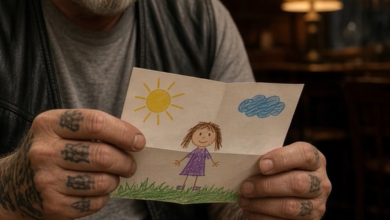
Part 2: The Scariest Dad Stayed Outside — Until One Word Saved His Little Girl
His name was Raymond Cole, though no one called him Raymond unless they worked for the county or wanted trouble. Everybody else called him Ray. At the diner off Highway 101, the one with the cracked red booths and coffee that tasted like it had been brewed through a shop rag, the waitresses called him “Mr. Cole” because he always tipped cash and fixed the back door without being asked.
The club called him Preacher.
Not because he was holy.
Because when men got loud, he got quiet, and somehow that was worse.
He had spent most of his life on roads that smelled like wet asphalt, gasoline, pine trees, and bad decisions. He rode with a small veterans’ motorcycle club out of North Bend called the Harbor Saints. Nothing fancy. No outlaw theater. Mostly old Marines, welders, tow-truck drivers, one retired nurse, and a prospect named Danny who was thirty-two but still got treated like a kid because he once put diesel in a gas generator and nobody had let him forget it.
Ray’s Road King had a dent on the left saddlebag from a night he never talked about. His cut had patches from memorial rides, toy runs, veterans’ funerals, and one small patch stitched low on the inside lining where most people would never see it.
A tiny purple butterfly.
Under it, in careful thread, was one word.
Lily.
That was the first thing about him that did not match.
The second was his hands.
They looked rough enough to break boards. Thick fingers. Scars over the knuckles. A crescent-shaped burn on his right wrist from a garage fire back in 1998. But his nails were always clipped clean. Always. I noticed because he came into the school office three times before the spelling bee, each time holding paperwork like it might explode.
Foster placement forms.
Emergency contact updates.
A letter from Lily’s therapist.
He signed everything slowly because his right hand cramped if he wrote too long. He never complained about it. He just flexed his fingers once, waited, then kept going.
The first day he brought Lily in, she stood half behind his leg. Not hiding exactly. More like anchoring. Her small fingers hooked into the seam of his jeans. He did not move her hand away. He did not tell her to be brave. He just stood there in the office smelling faintly of rain, leather, engine oil, and peppermint gum.
“Morning,” he said.
His voice sounded like gravel in a coffee can.
Lily did not speak.
I gave her a visitor sticker because I had nothing else to give.
Ray took it, bent down with a soft grunt, and stuck it carefully to the front of her sweater.
“There,” he said. “Official.”
She looked at it, then at him.
“Do I have to talk today?”
“Nope.”
“Do I have to stay?”
“Only till lunch. Then we get pie.”
“What kind?”
“Your kind.”
She nodded like that settled the constitution.
Later, her teacher told me Lily had come from three homes in two years. Before Ray, she had been placed with a family who used a quiet child as proof of good parenting, then complained when quiet turned into nightmares. Before that, an aunt who loved her but could not keep her. Before that, a house with too many people and not enough doors that locked.
Ray was not her blood. He was her mother’s older cousin, a man the county found after everyone else had been called and most had stopped answering.
He answered on the first ring.
The social worker warned him that Lily had panic episodes, food hoarding, trouble sleeping, and no tolerance for shouting.
Ray said, “Then I won’t shout.”
She warned him that eight-year-old girls needed stability.
Ray said, “So do sixty-two-year-old men.”
That was the third thing that did not match.
The Harbor Saints did not love the idea at first. Not because they disliked Lily, but because Ray had been their fixed point for years. He opened the clubhouse. He closed it. He led the charity rides. He collected dues from men who always “forgot.” He was the one you called at 2:00 a.m. when your truck slid off Route 42 or your marriage broke in half.
Brotherhood sounds pretty until one brother suddenly belongs to someone else first.
The first Saturday after Lily arrived, Ray missed a club ride for the first time in nine years. Not a big ride. Just a coastal run down toward Bandon, breakfast at a diner, back by noon. Still, the boys noticed.
“Preacher gone soft?” one of them joked.
Ray looked at him over his coffee.
“No,” he said. “Just needed.”
Nobody joked again.
But I heard from Danny that Ray still showed up at the clubhouse that night, after Lily was asleep at a neighbor’s, carrying a pink backpack in one hand and a toolbox in the other. He fixed a leaking sink, replaced two bulbs, and left before anyone could thank him.
On the backpack, written in black marker, were spelling words.
Ocean.
Lantern.
Thunder.
Breathe.
That last one mattered.
I did not know it yet.
The spelling bee was held in Mrs. Alvarez’s classroom because the gym roof had started leaking again, and the district had spent the repair money on “technology upgrades,” which meant six tablets that never charged right and a projector that hummed like a sick refrigerator.
By 9:00 a.m., the room smelled like pencil shavings, damp coats, floor wax, and nervous children. Folding chairs lined the back wall. Parents stood behind them with phones ready. Mrs. Alvarez had taped paper bees to the board, and somebody had brought grocery-store cupcakes with yellow frosting.
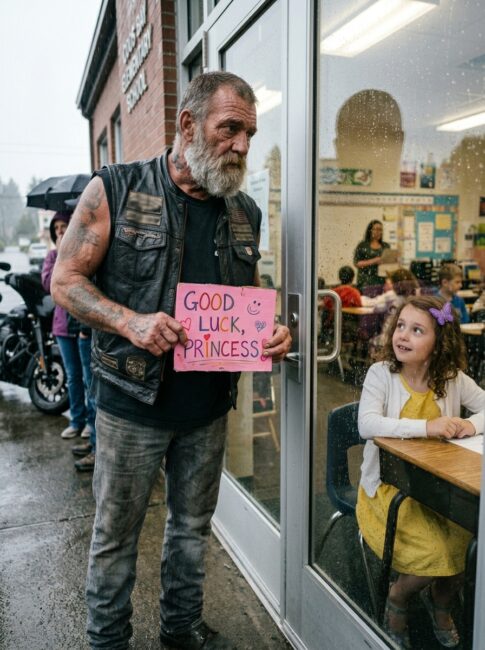
Lily sat in the second row, yellow dress folded neatly under her knees, white cardigan buttoned all the way up. Her curls were clipped to one side with a purple barrette. She kept touching it.
Ray had bought it at the Dollar Tree by the gas station after Lily whispered that the other girls wore “pretty things” on special days. He had walked into that store with oil under his sleeves and asked a teenage cashier where they kept hair clips. The kid pointed without making eye contact.
Ray came back with six options.
Lily chose the butterfly.
Now she touched it every few seconds, like checking that she still existed.
Ray stood outside the window near the hallway door. Not inside. Not hovering. Outside, exactly where he promised. Rain tapped the glass behind him. He held the pink sign low enough that only Lily could see it unless someone turned around.
Good luck, princess.
The first few rounds went easy.
Cat.
River.
Button.
Lily spelled them in a voice so small Mrs. Alvarez had to lean forward, but she spelled them right.
Each time, she looked out the window afterward.
Each time, Ray gave one slow nod.
Not a cheer. Not a thumbs-up. Just that nod.
You’re still here. I’m still here. Keep going.
The other children started falling away one by one. A boy named Mason missed “ladder.” A girl in red boots missed “blanket.” Another child cried after “machine,” and her mother rushed up like the floor had opened.
Lily stayed.
By the final three, the room had changed. Adults who had been whispering about Ray were now watching Lily. Not with pity. With surprise.
That can hurt too, by the way.
Some children learn early that being underestimated is safer than being seen. Lily had been invisible in ways no child should know. Now every eye in that room was on her yellow dress and shaking hands.
The next word was “courage.”
She closed her eyes.
“Courage,” she whispered.
Then louder, “C-O-U-R-A-G-E. Courage.”
Correct.
One boy left.
His name was Tyler Whitcomb. Clean shirt, combed hair, parents who brought a tripod. He was a sweet kid, honestly, but his mother was not sweet that morning. She had been one of the whisperers.
When Tyler spelled “harbor” right, his mother clapped too loudly.
When Lily stepped up again, the room got tight.
Mrs. Alvarez looked at the card.
“Lily, your word is ‘lantern.’”
Lily’s face changed.
Not much. Most people would have missed it.
Ray did not.
Her eyes went glassy. Her fingers went to the butterfly clip, missed it, and caught a strand of hair instead. She pulled until her scalp must have hurt.
I knew that look. I had seen it in children who forgot lunches, forgot homework, forgot which adult was picking them up. It was not fear of losing.
It was fear of disappearing.
She knew the word. I could see it. Her lips shaped the first letters.
“L,” she said.
Then nothing.
The silence stretched.
A chair creaked.
Someone coughed.
Tyler’s mother whispered, “Poor thing.”
Lily heard it.
Of course she did.
Her shoulders rose toward her ears. Her mouth trembled. She looked out the window.
Ray’s pink sign was gone.
For half a second, panic crossed her face so fast it made my stomach drop.
He had promised.
Then Ray reached inside his vest.
His hands shook once. Just once. A big man’s hands, scarred and tattooed, struggling with a folded piece of cardboard tucked against his chest.
He opened the second sign and pressed it to the glass.
One word.
Breathe.
No glitter. No decoration. Just black marker on plain cardboard.
Lily stared at it.
Ray did not smile. He did not mouth the answer. He did not give her letters. He just stood there, rain on his beard, leather creaking when his shoulders lifted with his own breath.
In.
Out.
Lily copied him.
One breath.
Then another.
The whole classroom went quiet in a different way.
Not waiting-to-see-her-fail quiet.
Holding-the-door-open quiet.
She turned back to Mrs. Alvarez.
“Lantern,” she said. “L-A-N-T-E-R-N. Lantern.”
Correct.
The room erupted.
Even Tyler clapped.
Ray lowered the sign, stepped back from the window, and looked down at his boots like the linoleum had suddenly become very interesting.
But the bee was not over.
Tyler missed the next word.
Lily got the final one.
“Shelter.”
She spelled it without looking at the window.
S-H-E-L-T-E-R.
Shelter.
That was the false ending.
Everyone thought the story was about a shy foster child winning a spelling bee.
It was not.
Not yet.
When the applause started, Ray did not come inside.
That was the first thing I noticed.
Parents stood. Kids turned around. Mrs. Alvarez wiped her eyes with the back of her hand and called Lily to the front to hand her the little gold plastic trophy that probably cost $8.99 but looked, in Lily’s hands, like the Nobel Prize.
Lily looked toward the hallway window.
Ray was gone.
Her face fell so hard I nearly left the office desk and ran to her myself.
Then I heard it.
Boots in the hallway.
Slow. Heavy. Not leaving.
Coming closer.
Ray stepped through the main office door because he had gone around to sign in properly.
That detail wrecked me later.
He could have walked straight into that classroom after his daughter won. Everybody would have understood. But Ray Cole, who looked like he had ignored every rule ever written, stopped at the office to put his name on the visitor sheet.
His handwriting leaned hard to the right.
Raymond Cole.
Purpose of visit: Lily.
He took the visitor sticker I gave him and held it in his big hand.
“Where do I put this?” he asked.
“On your vest is fine,” I said.
He looked down at the patches, the road grime, the frayed leather, the old scars of a life people judged in three seconds.
Then he stuck the school sticker right over his heart.
When he entered the classroom, nobody spoke.
Lily ran to him.
Not gracefully. Not like in movies. She hit him at full speed, trophy in one fist, and wrapped both arms around his waist because that was as high as she could reach.
Ray froze.
Both hands lifted slightly, like a man who did not trust himself to touch something breakable.
Then he placed one palm gently on the back of her head.
“You did it,” he said.
“You helped.”
“No,” he said. “You breathed.”
Mrs. Alvarez came over smiling through tears.
“Lily,” she said, “that was wonderful. Can I ask who taught you to calm yourself like that?”
Lily pulled back just enough to look at Ray.
Then she pointed at him in front of the whole room.
“My dad,” she said. “He looks scary, but he’s the safest place I know.”
There are sentences that enter a room and rearrange the furniture inside every adult heart there.
That was one.
Tyler’s mother lowered her phone.
The principal stopped pretending he was not crying.
I looked at Ray because I wanted to see pride on his face.
I did not.
I saw pain.
Not bad pain. Old pain. The kind that wakes up when someone finally says the thing you spent your whole life thinking you did not deserve.
Ray swallowed once.
His jaw worked.
Then he crouched down, knees popping loud enough that a few kids giggled, and looked Lily in the eye.
“Princess,” he said, his voice rougher than before, “you don’t gotta tell people I’m safe.”
“Yes I do,” she said.
He shook his head.
“Why?”
“Because nobody told me before.”
That was the twist nobody saw coming.
Lily was not only being protected by Ray.
She was protecting him back.
From every look.
Every whisper.
Every locked door.
Every person who saw the skull patch before the purple butterfly.
After the classroom emptied, Mrs. Alvarez asked if she could take a picture of Lily and Ray for the school page. Ray said no before she finished the sentence.
Lily looked up at him.
“Because of me?” she asked.
“No,” he said. “Because of them.”
He nodded toward the hallway, where parents were still drifting out with phones in their hands.
I understood. A photo of a little girl was never just a photo anymore. Not online. Not after foster care. Not after people who should have protected her had failed to.
So Mrs. Alvarez put the phone away.
That was when Lily opened Ray’s vest.
Just like that.
Small hands on black leather.
He did not flinch. He just stood still while she reached inside and pulled at the lining.
“Show them,” she said.
Ray closed his eyes.
“Lil.”
“Please.”
A biker does not usually let people look inside his cut. The outside tells the world what he belongs to. The inside tells the truth he may not be ready to share.
But Ray turned slightly and held the vest open.
There it was.
The purple butterfly patch.
Lily.
The room went silent again.
Under the patch, tucked in a clear plastic sleeve sewn carefully into the lining, was a folded piece of notebook paper. I did not read all of it then. I would not have dared. But Lily touched it with one finger.
“My breathing list,” she said.
Ray looked at the floor.
Mrs. Alvarez whispered, “Breathing list?”
Lily nodded.
“When I get scared, Dad says my brain is trying to save me but it’s using old maps.”
Old maps.
That sounded like Ray. Simple words. Heavy cargo.
“He says we make new roads.”
Ray cleared his throat.
“It ain’t magic,” he muttered.
“No,” Lily said. “It’s practice.”
Later, over coffee at the front desk while Lily ate a cupcake with yellow frosting and got most of it on her cardigan, Ray told me a little. Not much. Men like him give you pieces, not chapters.
He had learned breathing in prison.
That was twist number two.
Not yoga. Not therapy in a clean office with a plant in the corner. Prison. Twenty-six years old, locked up for aggravated assault after a bar fight that nearly killed a man. Ray did not excuse it. Did not soften it. Did not say he was young and dumb like that made blood disappear.
“I hurt somebody,” he said. “I paid what they told me to pay. Still paying some.”
In county jail, an old veteran in the next cell taught him how to breathe through panic without letting other men see fear.
“In for four. Hold. Out for six,” Ray said. “Kept me from becoming worse.”
When he got out, he joined a veterans’ riding group because his older brother was in it. His brother died of liver failure twelve years later. The Harbor Saints became what was left.
He did not become good overnight.
That is not how people work.
He became useful first.
He fixed things. Engines. Sinks. Porches. Broken fences. Flat tires. Then, slowly, people.
Lily’s mother, Ray’s cousin, used to call him when she was trying to stay clean. Sometimes he answered. Sometimes he did not. That was the old guilt sitting behind his eyes.
The night Lily was taken into emergency care, Ray had been riding home from a memorial run, rain coming sideways across the McCullough Bridge. His phone kept buzzing in his saddlebag. He ignored it for thirteen miles because the weather was ugly and the road was slick.
When he finally pulled into a gas station and checked, he had nine missed calls.
By the time he reached the hospital, Lily was asleep in a chair under a donated blanket, both shoes still on, one hand gripping a paper cup of apple juice.
The social worker said, “Are you Raymond Cole?”
Ray said, “Depends who’s asking.”
The woman said, “A little girl needs family.”
He looked through the glass at Lily.
She was eight, but sleep had made her look four.
Ray said, “Then stop talking.”
That was twist number three.
He had not planned to become a father.
He had planned to keep moving just enough that grief never caught him.
Lily caught him anyway.
The spelling words started because she would not sleep. She woke from nightmares and forgot where she was. Ray tried night-lights. Warm milk. A radio left low on old country stations. Nothing worked until one night he sat outside her bedroom door and read from her spelling list because he did not know any bedtime stories.
“Lantern,” he read.
Silence.
“L-A-N-T-E-R-N.”
More silence.
“Means a little light you carry.”
From inside the room, Lily whispered, “Again.”
So he read every word.
Every night.
Ocean. Thunder. Shelter. Breathe.
A little light you carry.
That was why the second sign mattered.
Not because it helped her spell.
Because it reminded her she had survived nights worse than a classroom.
It reminded Ray too.
After Lily won, things changed at Oak Ridge Elementary, but not in a dramatic way. Real change usually comes wearing work boots, not marching bands.
Ray started parking farther from the entrance so the Harley would not scare the kindergarteners when he picked her up. Then the kindergarteners started asking him to rev it. He refused every time.
“School zone,” he said.
But he would let them touch the cold chrome after the engine had been off long enough.
Every Thursday, he came early and sat on the bench outside the office with a paper cup of diner coffee. He smelled like leather, rain, and the peppermint gum he chewed because Lily said cigarettes made his beard stink. The chain on his wallet still clicked. His boots still sounded like someone knocking on wood.
People still stared.
But less.
Tyler’s mother apologized two weeks later in the parking lot. I did not hear all of it, only saw her standing near Ray’s bike with her arms folded tight across herself, saying words that looked difficult. Ray listened. Then he nodded once.
That was all she got.
That was enough.
The Harbor Saints changed too. One Friday afternoon, twelve Harleys rolled slowly into the school lot, engines low, all of them wearing yellow ribbons tied to their handlebars because Lily’s class was doing a fundraiser for foster kids. They did not block traffic. They did not act big. They stood in a line beside a folding table and bought every stale brownie the fourth graders had baked.
Danny, the prospect, wore a plastic bee antenna headband because Lily asked him to.
Nobody in the club laughed where she could see.
Every year after that, on the morning of the county spelling bee, Ray and Lily rode in his old pickup instead of on the Harley because she said helmet hair was bad luck. The Road King stayed in the garage, wiped clean, facing the door like a horse waiting for weather to clear.
But Ray still carried a sign.
Not always pink. Not always glitter.
Always folded inside his vest.
Breathe.
Even when Lily got older and pretended she did not need it, she checked.
A quick glance.
A small nod.
A road between them nobody else could see.
I retired from Oak Ridge Elementary last spring. Twenty-three years of lunch slips, scraped knees, lost library books, and children growing taller when you were not looking.
On my last day, Lily came back.
Sixteen years old. Tall now. Still brown curls, though she had dyed the ends purple. She wore boots, a denim jacket, and a little butterfly pin on the collar. Ray came with her, moving slower, beard whiter, hands stiffer around the cane he hated using.
The Harley was parked outside.
Same dented saddlebag. Same old thunder sleeping in the engine.
Lily brought me a card. Inside, in handwriting much steadier than it used to be, she had written one word.
Shelter.
Ray pretended to be interested in the bulletin board while I cried.
Before they left, Lily helped him into his leather cut. I saw the inside lining for just a second.
The purple butterfly was still there.
So was the folded cardboard sign.
Ray climbed onto the Road King with a careful breath. Lily got on behind him, helmet clipped under her chin, arms around the old man who once stood outside a classroom because love meant keeping a promise even when it hurt.
The engine turned over.
That deep V-twin sound rolled across the parking lot, bounced off the brick school walls, and settled into my chest like an old hymn sung through broken speakers.
Ray looked back at Lily.
“You good, princess?”
She leaned her helmet against his shoulder.
“I’m safe.”
He nodded once.
Then the bike eased onto Highway 101, taillight glowing red in the coastal fog.
One little light, still moving.
Follow the page for more biker stories that look rough on the outside and stay with you long after the engine fades.