Part 2: Single Mother Working Two Jobs Was Told to Stand Outside Graduation — Then Her Son Said Her Name First
The first thing people noticed was that Marianne did not cry.
That bothered them more than if she had caused a scene.
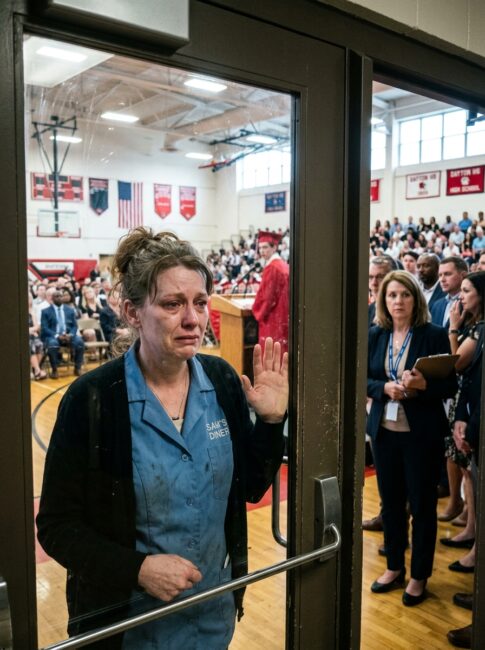
She stood just beyond the double doors, under the overhang where the late May sun hit the concrete in bright white strips. The gym doors were propped open for air, and every few seconds, applause rolled out like waves.
Marianne kept her body turned slightly sideways, as if making herself thinner might make her less visible.
A security guard named Mr. Wallace stood nearby, uncomfortable in his navy blazer. He had worked basketball games, school dances, and two homecoming fights. He knew trouble when it came through a door.
But Marianne did not look like trouble.
She looked tired in a way that did not ask for sympathy.
“You got a ticket?” he asked gently.
Marianne opened her palm. The ticket had been folded so tightly it looked like a prayer note.
Mr. Wallace frowned. “Then why are you out here?”
She gave a small shrug. “They said there wasn’t room.”
He glanced through the glass. There were empty chairs along the wall.
Not many.
But enough.
Before he could say anything, Marianne shook her head.
“Please don’t make it harder,” she whispered.
That was the first small thing that did not make sense.
A woman who had been humiliated in front of a crowd should have been angry. She should have demanded names, called someone, made somebody explain. But Marianne stood there like she was protecting the people who had just pushed her out.
Inside the gym, Evan Cole sat in the first row with the other honor graduates.
He was tall and narrow-shouldered, with hair too neatly combed and a cap that kept sliding slightly to the left. His gown was pressed so cleanly it looked borrowed from a photograph.
Every few minutes, he turned his head.
He was looking for someone.
When he did not find her, his mouth tightened.
Marianne saw him turn the first time.
Her hand lifted toward the glass, then stopped halfway.
She stepped back into the shadow.
“Don’t see me yet,” she murmured.
Mr. Wallace heard her.
Again, it did not make sense.
A mother kept outside her son’s graduation should want him to see her. She should want him to stand up, walk out, make a scene on her behalf.
But Marianne seemed afraid of that exact thing.
Then the second odd detail appeared.
A boy in a wheelchair rolled up beside the open doorway, pushed by his grandmother. He was maybe seventeen, dressed in a red graduation gown like Evan’s, with a silver cord around his neck.
“Miss Marianne?” he said.
Marianne turned.
Her face softened instantly.
“Darius,” she said. “You made it.”
The boy grinned. “You said I would.”
His grandmother looked at Marianne with both hands clasped on the wheelchair handles.
“I tried to save you a seat,” the old woman whispered. “They said the front section was full.”
Marianne smiled as if that explained everything.
“It’s all right, Miss Alma. Today is for them.”
Darius reached into his lap and lifted a small plastic sandwich bag. Inside was a folded index card, worn at the edges.
“You forgot this in the cafeteria last month,” he said.
Marianne’s eyes moved to the bag, and for the first time, her composure cracked.
It was not a dramatic break. Just one breath caught in the wrong place.
She took the card carefully.
On it, in blue pen, were three lines:
Stand straight.
Speak slow.
Look at the back wall if your voice shakes.
Darius said, “You wrote that for me before my scholarship interview.”
Marianne gave a little laugh, but it was thin. “You did the hard part.”
“No,” he said, looking toward the stage. “You did the part nobody saw.”
His grandmother touched Marianne’s arm.
Some of the parents nearby heard that.
They looked at Marianne again, but differently this time.
The cafeteria lady.
The woman who smelled like grease.
The mother standing outside.
A woman from the committee passed by the doorway holding a clipboard. Her name tag read Linda Park — Parent Volunteer Chair. She saw Marianne speaking with Darius and stiffened.
“Marianne,” Linda said, her voice low, “please don’t block the entrance.”
Marianne stepped aside immediately.
Darius’s grandmother stared at Linda.
“She is Evan Cole’s mother,” the old woman said.
Linda’s expression flickered. “I know who she is.”
The words landed strangely.
Not, “I didn’t know.”
Not, “There’s been a mistake.”
I know who she is.
Marianne lowered her eyes, as if that sentence carried a history no one else had been invited to understand.
Inside, the principal began reading names for academic honors. Evan’s name was called twice. First for the state scholarship. Then for top graduate.
Applause filled the gym.
Marianne pressed the folded index card against her chest.
She watched through a gap between two parents.
Her son stood, bowed his head politely, and sat back down.
He still had not seen her.
A younger mother near the door whispered to her husband, “Why doesn’t she just go in?”
Her husband whispered back, “Maybe she did something.”
That was how people filled silence.
With stories that made judgment easier.
But then a janitor came around the side of the building carrying a trash bag. He stopped when he saw Marianne.
“Marianne?” he said. “Aren’t you supposed to be inside?”
She lifted one finger to her lips.
He stared at her uniform, then at the gym, then at Linda Park near the aisle.
His jaw tightened.
“You worked the breakfast shift today?” he asked.
“And cleaned third floor west,” Marianne said.
“And came straight here?”
She gave him the same tired smile. “Wouldn’t miss it.”
He looked like he wanted to say more, but she shook her head once.
Not here.
Not today.
The third detail came when Marianne’s phone buzzed.
The screen was cracked at the top. A message appeared from a contact saved simply as Mr. Hale.
He doesn’t know, does he?
Marianne stared at it for a long moment.
Then she typed:
Not today. Let him have today.
She put the phone away before anyone could read the rest.
But Mr. Wallace had seen enough to understand one thing.
This was not a woman trying to get attention.
This was a woman trying desperately to keep a secret from ruining her son’s proudest hour.
Then the principal walked to the microphone and said, “And now, our valedictorian, Evan Cole.”
The gym rose with applause.
Marianne moved closer to the glass.
For one second, she forgot to hide.
Evan stepped onto the stage with a folded speech in his hand.
He looked across the audience.
Front row.
Left side.
Right side.
Back wall.
His smile faded.
Marianne’s fingers tightened against the doorframe.
Then Evan leaned toward the microphone and said, “Before I begin, I need to ask one question.”
The gym went quiet.
“Where is my mother?”
Nobody moved at first.
It was a strange kind of silence, thick and embarrassed, the kind that makes people suddenly aware of their hands, their faces, and the things they whispered five minutes earlier.
Evan stood behind the podium in his red gown, eyes moving over the crowd.
“My mother had one ticket,” he said. “I watched her put it in her purse this morning before she went to work. She has not missed one important day in my life, even when she had to stand in the back.”
Linda Park moved quickly toward the stage steps.
The principal leaned toward the microphone, smiling the stiff smile adults use when they want a young person to stop being honest in public.
“Evan,” he said softly, “we can discuss that after the ceremony.”
Evan did not look at him.
“I’m not discussing it after,” he said. “My whole speech starts with her.”
A murmur went through the gym.
Outside, Marianne closed her eyes.
“No,” she whispered. “Baby, please.”
But Evan had already seen her.
Through the open doorway, beyond the line of parents, past the glare of daylight on the glass, his eyes found the woman in the blue uniform.
His face changed.
It was not anger first.
It was hurt.
Then he understood enough to become angry.
“Mom,” he said into the microphone.
Every head turned.
Marianne stood frozen in the entrance, one hand still holding the folded ticket.
For a moment, she looked smaller than any person in the gym. Not because she was weak, but because the room had finally made enough space to see how much she had been carrying.
Evan stepped away from the podium.
The principal reached for his elbow, but Evan pulled free.
“I was told,” Linda Park said loudly, “that she agreed to wait outside because of seating.”
Marianne’s eyes opened.
She shook her head once, not at Linda, but at Evan.
Don’t do this.
He saw it.
And that was when his voice broke.
“My mother is asking me not to embarrass anyone,” he said, turning back to the crowd. “That is exactly why I need to say this.”
He unfolded the speech with shaking hands.
“Most of you know me as the kid with the scholarship,” he began. “Some of you know me as the boy who stayed after school, cleaned whiteboards, and studied in the library until the lights turned off.”
A few teachers smiled.
“But my mother knows me as the kid who used to sleep under the diner counter when babysitters cost more than she made in tips.”
Marianne covered her mouth.
Evan continued.
“She worked breakfast at Miller’s Diner from five in the morning until noon. Then she cleaned rooms at St. Agnes Hospital from three until midnight. On weekends, she did laundry for a nursing home. She told me she liked staying busy.”
A small laugh moved through the gym, but it hurt.
“She lied,” Evan said. “She was exhausted.”
He looked down at the paper, then folded it closed.
“I wrote a clean speech. A polite one. The kind people expect from a kid like me. I was going to thank the school, the district, my teachers, and the scholarship board.”
He glanced toward Marianne.
“But I cannot stand here in this gown and pretend my mother’s life was a footnote.”
The twist did not arrive all at once.
It came in pieces, each one heavier than the last.
Evan told them about the winter he was eleven, when the heat was shut off and Marianne heated water on the stove so he could wash before school. He told them how she sold her wedding ring, not for rent, but for his first laptop.
Then he stopped.
His eyes moved to Darius in the wheelchair.
“And she did not just help me.”
Darius lowered his head.
“She packed extra breakfast sandwiches for students who came to school hungry. She called them mistakes from the diner. She pretended the cook made too many.”
A teacher in the second row began crying quietly.
“She washed graduation gowns for kids whose families could not afford dry cleaning. She hemmed pants. She wrote practice interview questions on index cards. She sat with kids after school while they filled out forms their parents did not know how to read.”
The principal’s face had gone pale.
Marianne looked as if every sentence was a door she had tried to keep closed.
Evan’s voice slowed.
“Last year, I almost did not apply to Stanford.”
The room shifted.
“That is the part my mother really does not want me to say.”
Marianne shook her head again, tears on her cheeks now.
Evan looked at her with an apology in his eyes.
“I found the letter by accident,” he said. “Not from Stanford. From the scholarship office. It said my application fee, transcript fees, testing fees, and travel cost for the interview had been paid by an anonymous school sponsor.”
He swallowed.
“I thought some donor believed in me.”
A woman near the aisle whispered, “Wasn’t it?”
Evan heard her.
“No,” he said. “It was my mother.”
Marianne’s shoulders dropped.
“She paid it by cleaning the school after hours for no overtime, because the old contractor quit and the district had no emergency budget. She made a private arrangement with Mr. Hale, the night supervisor. The money went directly to my application costs.”
Mr. Hale, the janitor who had been standing outside, slowly removed his cap.
Evan pointed toward him.
“He told her it was illegal to work off the clock. She said, ‘Then don’t pay me. Pay my son’s future.’”
The gym was utterly still.
Mr. Hale wiped his face with the back of his hand.
“She made me promise not to tell,” he said from the doorway, his voice rough.
Linda Park’s clipboard was pressed against her chest now like a shield.
Evan looked at the volunteer chair.
“And this morning, when my mother came here straight from two jobs, someone told her she did not look appropriate enough to sit with the other parents.”
Linda opened her mouth, but no sound came.
Evan did not raise his voice.
That made it worse.
“My mother has stood in every kind of doorway,” he said. “Apartment doors when landlords wanted rent. Hospital doors when her feet hurt too badly to keep walking. School doors when she waited for me to finish studying. Today, she was asked to stand outside the one door she earned more than anyone.”
A sound came from the back row.
Someone sobbing.
Not loudly.
Just enough to break the air.
Evan turned toward the audience again.
“So before I thank anyone else, I want my first words as valedictorian to be the only words that matter.”
He faced the open doors.
“Marianne Cole,” he said, his voice trembling, “please come inside and sit where my mother belongs.”
No one clapped immediately.
It was too honest for applause.
Then Darius lifted his hands and began clapping from his wheelchair.
His grandmother joined.
Mr. Wallace joined.
One teacher stood.
Then another.
The sound grew slowly, not like celebration, but like confession.
Parents rose from their seats. Students turned around. The whole gym stood while Marianne remained outside, crying silently in her diner shoes.
She did not move.
Evan stepped down from the stage.
The principal did not stop him this time.
He walked the length of the gym in his red gown, past the honor cords, past the cameras, past the rows of people who now had nothing to say.
When he reached his mother, he did not hug her first.
He bent down.
In front of the whole school, Evan Cole untied his mother’s wet work shoes.
Marianne gasped. “Evan, no.”
“They’re hurting you,” he whispered.
She tried to pull away, but he took the folded ticket from her hand and placed it inside his graduation program.
Then he slipped off his own polished dress shoes.
“Wear mine,” he said.
“They won’t fit.”
“They got me here,” he said. “So did yours.”
That was the moment the room changed completely.
Not because a speech had been made.
Because every person there could see the truth no speech could fully hold.
A boy in a graduation gown kneeling before a mother in a diner uniform.
A mother who had accepted shame so her son’s day would not be interrupted.
A son who refused to let her disappear.
Marianne finally stepped inside.
Not proudly.
Not dramatically.
She walked like someone entering a place she still did not believe would welcome her.
Evan held her hand all the way to the front row.
The empty chair was still there.
Reserved.
Waiting.
Marianne sat in the front row with Evan’s dress shoes loose on her feet and her wet work shoes tucked beneath the chair.
No one mentioned the smell of grease again.
No one complained about limited seating.
Linda Park stood near the wall, her clipboard hanging at her side. She looked smaller now, not because anyone had punished her, but because the room had seen the shape of what she had done.
The principal returned to the microphone.
For once, his polished voice failed him.
“Evan,” he said quietly, “you may continue when ready.”
Evan walked back to the stage barefoot in his socks.
A few students laughed softly, but not cruelly. It was the kind of laughter that comes when people are trying not to cry.
He unfolded his speech again.
This time, he did not read much of it.
He thanked his teachers, but he named the ones who had stayed late. He thanked the librarian who let him keep books past the limit. He thanked Mr. Hale for unlocking classrooms when he needed a quiet place to study.
Then he thanked Darius.
“My mother always told me that success is not climbing higher than people,” Evan said. “It is reaching back without making them feel low.”
Marianne stared at her hands.
They were red from soap and cracked around the knuckles.
For years, she had hidden those hands in photographs.
That afternoon, the school photographer captured them resting on her son’s graduation program.
After the ceremony, people approached her carefully.
Some apologized. Some only touched her shoulder and moved on. A few parents looked at her as if seeing a person where they had previously seen a uniform.
Linda Park came last.
Her face was pale, and her voice had lost its committee polish.
“Marianne,” she said, “I was wrong.”
Marianne looked at her for a long moment.
There were many things she could have said.
She could have listed every humiliation from the doorway. She could have mentioned the whispers, the empty seats, the way Linda had said she knew who Marianne was.
Instead, Marianne glanced toward Evan, who was taking pictures with Darius.
Then she said, “Don’t do it to the next mother.”
Linda nodded, crying now.
Marianne did not hug her.
She did not need to.
Outside the gym, the late sunlight had softened. The same sidewalk where Marianne had been told to wait was now crowded with families taking pictures beneath the school sign.
Evan insisted on one photograph there.
“Here?” Marianne asked.
“Here,” he said.
She stood awkwardly beside him, still wearing his shoes. He held his diploma in one hand and her work shoes in the other.
The photographer smiled. “Ready?”
Marianne tried to fix her hair.
Evan stopped her.
“Leave it,” he said. “You look like you.”
The picture was not perfect.
Her cardigan was wrinkled. His gown was crooked. The sun hit the lens at the wrong angle, leaving a pale flare across the bottom of the frame.
But years later, when Evan kept that photo on his desk, people always asked why his mother was wearing men’s dress shoes.
He would smile and say, “Because she gave me every step before I knew how to take one.”
That evening, Marianne returned to Miller’s Diner for the closing shift.
She placed Evan’s graduation program beside the register, careful not to let coffee splash it.
Near midnight, when the last customer left, she opened it again.
Inside was the folded ticket.
Beside it, Evan had written one sentence in the margin.
You were never outside to me.
Marianne read it twice.
Then she slipped the program into her bag, tied her apron, and turned off the lights over the empty booths.
At the door, she paused, looked back at the place where she had worked so many mornings before sunrise, and smiled like someone finally hearing her own name without shame.
Follow the page for more emotional stories about the quiet people life teaches us to see.