Teenagers Humiliated an Old Biker Delivering Pizza in the Rain — Then They Learned Who Was Waiting for That Final Meal
The kid slapped the pizza from my hands while his friends filmed and laughed, but none of them knew who had ordered it—or why I had ridden through forty miles of rain to deliver it.
The box struck the wet sidewalk upside down.
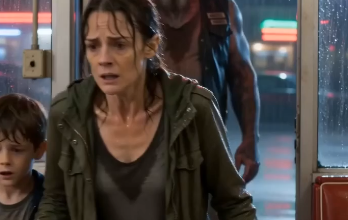
Cardboard split at one corner, melted cheese slid beneath the lid, and rainwater rushed around my boots while six teenagers stood beneath the awning of Brookfield High School laughing as if they had just witnessed the funniest thing in Ohio.
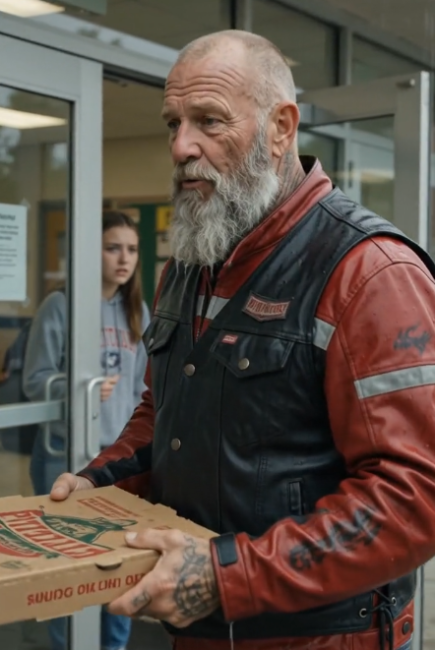
The boy holding the phone pointed its camera at my gray beard, soaked leather vest, and the red delivery bag strapped behind my seat.
“Look at Grandpa Pizza,” he said. “Dude thinks he’s in a motorcycle movie.”
His friends laughed harder.
My name is Walter “Gravel” Mercer. I was sixty-three that November, six-foot-four when my back allowed it, and heavy enough to make most people step aside when they heard my boots coming. My arms carried old tattoos, my face carried older mistakes, and my Harley had outlived two marriages, three jobs, and nearly every foolish version of me.
That afternoon, however, I was wearing a red pizza-shop rain jacket over my leather cut.
It made me look ridiculous.
I knew that.
The boy filming me knew it too.
“Say something tough,” he demanded, moving closer. “Come on, biker man. Tell us you’re gonna beat us up over a pepperoni pizza.”
I looked down at the ruined box.
On its rain-spotted lid, written in black marker, were four words:
For Emily — from Dad.
The boy had not noticed them.
Neither had his friends.
I bent down slowly, slid both calloused hands beneath the soggy cardboard, and lifted it from the pavement as carefully as if there were still something inside worth protecting.
Maybe there was.
The laughter weakened when I did not shout.
Cruel people understand anger. Silence makes them nervous.
“You gonna cry?” the boy asked.
“No,” I said. “But somebody might.”
He grinned at the phone, believing he had won whatever contest was taking place inside his head.
Then a woman’s voice came through the school’s open side door.
“Mr. Mercer?”
I recognized Principal Laura Bennett immediately. Her face was pale, and one hand covered her mouth as she stared at the crushed box in my arms.
Behind her stood a thin seventeen-year-old girl wearing a navy sweater.
She had her father’s eyes.
The teenager lowered his phone.
The girl looked at the writing on the lid, then at me.
“Is that the one?” she whispered.
I could not lie to her.
So I nodded.
And that was when every laugh beneath that awning died.
Three years earlier, I had been sitting in a roadside diner outside Dayton when my brother Daniel “Patch” Carter made me promise to deliver a pizza.
Patch and I were not related by blood. Some men become brothers through family, while others earn it mile by mile, breakdown by breakdown, and night by ugly night.
We had met twenty-seven years earlier at a recovery meeting in the basement of Saint Matthew’s Church.
I was there because a judge suggested it.
Patch was there because his six-year-old daughter had asked him why he loved a bottle more than he loved coming home.
That question had broken something open in him.
Patch had once served as an Army mechanic. After coming home, he repaired motorcycles, drank too much, and slept too little. He could rebuild a transmission by sound, but he could not repair the things the war had rearranged inside his head.
We became sober during the same winter.
It was not heroic.
It was coffee in paper cups, shaking hands, sleepless nights, apologies people did not accept, and phone calls beginning with, “Brother, talk to me until this passes.”
Sometimes he called me.
Sometimes I called him.
We kept each other alive.
Patch eventually opened a two-bay motorcycle shop beside Route 4. He married a quiet nurse named Rebecca, and when their daughter Emily was born, the roughest man in our club began carrying pink hair ties around his wrist.
Every Friday night, father and daughter ate the same meal.
A large pepperoni pizza with mushrooms on one half, extra cheese on the other, and no olives anywhere near the box.
Patch hated mushrooms.
Emily hated pepperoni.
Neither would agree to order separate pizzas because, according to Patch, “Family means sharing the parts you don’t understand.”
He was not a poetic man.
That was about as poetic as he ever got.
On Emily’s first day of kindergarten, he delivered their Friday pizza to the school parking lot because he had to work late. On her tenth birthday, he delivered it to a bowling alley. When she was thirteen and furious with him for missing a choir performance, he appeared outside rehearsal carrying the same pizza and a handwritten apology.
The meal became their language.
Then Patch got sick.
By the time the doctors found the cancer, it had already spread. He underwent treatment, lost his beard, regained part of it, and continued opening the shop because staying home made him feel like a patient.
He told almost nobody how bad it was.
I knew because I drove him to appointments when Rebecca worked.
One rainy afternoon, after the doctor told him there would be no more treatment, we stopped at Mancino’s Pizza. Patch ordered the usual Friday meal even though he could barely swallow.
Emily was fourteen then.
Her father watched her eat through the restaurant window while we stood outside beneath the awning.
“I’m not going to see her graduate,” he said.
I told him not to talk that way.
He grabbed the front of my vest.
“Don’t give me hope you don’t own, Gravel.”
Those words shut me up.
He removed a folded envelope from his jacket and pressed it into my hand.
Inside were instructions, a letter, and enough cash to buy one pizza every year until Emily finished high school.
“You deliver them,” he said.
“I’m not wearing a pizza hat.”
“Wear the vest. It’s uglier.”
He managed half a smile.
Then his eyes returned to his daughter.
“Last one goes to school on the day before Thanksgiving break during senior year. Same order. Write ‘For Emily—from Dad’ on the lid.”
I looked at the money.
“Why that day?”
“Because that’s the day she’ll receive her college decision.”
I did not understand.
Patch explained that Emily dreamed of becoming a nurse like her mother, but tuition frightened her. He had secretly arranged a small scholarship through our riding club, his shop, and a veterans’ organization.
The final letter contained the account information.
The pizza was only supposed to bring her to the table.
“She’ll remember to eat if she sees the box,” he said. “Kid forgets when she’s scared.”
That was Patch.
Dying, and worried his daughter might skip lunch.
I closed my fingers around the envelope.
“You’ll do it yourself,” I said.
“No.”
His voice did not shake.
Mine nearly did.
“You will.”
Patch died eleven weeks later.
I made the first delivery on Emily’s fifteenth birthday. Then her sixteenth. Then her seventeenth.
The school delivery would be the last.
I had protected that promise for three years.
Then a teenager knocked it from my hands for a video.
The boy’s name was Tyler Dawson.
I learned that after Principal Bennett ordered everyone into her office.
Tyler sat across from me with wet blond hair hanging over his forehead. His expensive sneakers squeaked whenever he moved his feet, and he kept glancing at the phone Principal Bennett had placed facedown on her desk.
His five friends waited outside.
Emily sat beside her mother near the window, holding the damaged pizza box against her sweater.
She had not opened it.
“Mr. Mercer,” Principal Bennett said, “I have contacted Tyler’s parents. The video has been deleted from his phone.”
“No, it hasn’t,” Tyler muttered.
Everyone turned toward him.
He swallowed.
“It livestreamed.”
Principal Bennett’s shoulders sank.
Within minutes, dozens of students had shared clips. The opening seconds showed Tyler striking the box and mocking an old biker. The final seconds showed Emily emerging through the door and asking whether it was “the one.”
Nobody watching knew what those words meant yet.
That did not stop them from guessing.
I looked at Tyler.
“Call your friends in.”
Principal Bennett hesitated, but I repeated the request.
The six teenagers entered. Their earlier swagger had disappeared, leaving only damp clothes, lowered eyes, and the sour fear young people wear when a joke stops being funny.
I placed the damaged box on the desk.
“You boys know how to ride?”
Nobody answered.
“Bicycles?”
A few nodded.
“Then you understand balance. Push too hard in one direction, and something hits the pavement.”
Tyler stared at his knees.
I told them about Patch.
Not everything. Some parts belonged only to his family and the brothers who had answered his midnight calls.
I told them about the Friday pizzas.
I told them about the final delivery.
Then I pointed toward Emily.
“That box was her father keeping a promise after death.”
Tyler’s face changed.
There are moments when shame enters a room like cold air. You cannot see it, but everybody feels it.
“I didn’t know,” he whispered.
“That’s the trouble,” I said. “You didn’t ask.”
Emily had remained silent until then.
Now she stood and placed the box in front of Tyler.
“Open it.”
His fingers trembled as he lifted the wet lid.
The pizza was ruined. Cheese had folded over itself, mushrooms clung to the cardboard, and rainwater had soaked the crust.
But beneath the wax paper lining was a sealed plastic envelope.
Patch had made me promise to protect it from the weather.
Tyler looked from the envelope to Emily.
“I’m sorry.”
She took it from him.
“You weren’t sorry when you thought he was just an old delivery man.”
That sentence landed harder than anything I could have said.
Tyler looked at me again, but I had no punishment to offer him.
Pain is not a debt that becomes useful simply because you pass it forward.
I stood.
“I need another pizza.”
Principal Bennett said the school would pay.
Tyler rose so quickly that his chair scraped backward.
“I’ll pay.”
“No,” I said.
His face dropped.
Then I handed him my spare helmet.
“You’ll help deliver it.”
Tyler’s mother arrived fifteen minutes later in a silver SUV.
She entered Principal Bennett’s office already angry, carrying the sharp posture of someone prepared to defend her child before hearing what he had done.
Then she saw the box.
She watched the livestream.
She read Patch’s name on the lid.
Her anger collapsed into something quieter.
When Tyler told her he wanted to ride with me to replace the pizza, she objected immediately. I did not blame her. I looked like the sort of man mothers warned their children about, and my Harley sounded like thunder trapped inside an oil drum.
But Emily spoke.
“Please let him go.”
Tyler’s mother studied her son for a long moment.
Then she nodded.
The rain had softened, but the road still shone black beneath the afternoon sky. Tyler climbed onto the passenger seat wearing my spare helmet and an oversized waterproof jacket borrowed from the school custodian.
Before starting the engine, I looked back at him.
“Hold the rail. Not me.”
“Okay.”
“And if you drop the next pizza, you’re walking home.”
For the first time since entering that office, he almost smiled.
The V-twin turned over beneath us, deep and steady. Students crowded near the windows as we left the school, but Tyler did not wave.
He kept his head down.
At Mancino’s, a cashier named Janice recognized me before I removed my gloves. She had prepared Patch’s Friday pizzas for almost a decade and knew exactly what the final delivery meant.
When I explained what had happened, she did not charge us.
Tyler insisted.
He emptied his wallet onto the counter—twenty-three dollars, several coins, and a movie ticket stub. It was not enough, so he offered his expensive watch as collateral.
Janice pushed it back.
“Keep it,” she said. “But you carry the box.”
While we waited, Tyler asked me whether Patch had been afraid to die.
I considered giving him a comforting answer.
Instead, I gave him the truth.
“Yes.”
Tyler seemed surprised.
“I thought bikers weren’t scared of anything.”
“Only fools aren’t scared.”
“Then what made him brave?”
“He kept his promises while he was scared.”
The new pizza arrived in a clean white box. Janice handed me the marker, but I passed it to Tyler.
He looked at me uncertainly.
“Write exactly what was on the first one.”
Slowly, carefully, he printed:
For Emily — from Dad.
His handwriting was uneven.
Patch would have liked it.
We secured the box in the insulated bag and rode back through the rain. This time Tyler held the bag with both arms, protecting it at every turn as though it contained something alive.
In a way, it did.
When we returned, Emily, Rebecca, Principal Bennett, and Tyler’s mother were waiting in the school cafeteria.
The other five teenagers stood near a table.
They had pooled their lunch money and bought drinks, napkins, paper plates, and a small bouquet from the grocery store across the street.
No one had told them to.
That mattered.
Tyler removed the pizza from the bag and carried it to Emily.
“I can’t undo the first one,” he said. “But I brought this one all the way back.”
Emily accepted it.
Then she surprised us.
She invited everyone to sit down.
The pizza was divided exactly as Patch had always ordered it: mushrooms on one half, extra cheese on the other, pepperoni everywhere, and no olives.
Emily opened the waterproof envelope before taking a slice.
The first item was a letter in her father’s crooked handwriting.
She read silently at first, but halfway down the page her breath caught. Rebecca placed an arm around her, yet Emily shook her head and continued alone.
When she finished, she handed the letter to me.
At the bottom, Patch had written:
If Gravel arrived wet, feed him first. He gets mean when he’s hungry.
I laughed before I could stop myself.
So did Rebecca.
Even Emily laughed through her tears.
That was Patch’s final gift: he had found a way to break the silence in a room he would never enter.
The second item was confirmation of the Daniel Carter Memorial Scholarship. Patch’s motorcycle shop had been sold after his death, and part of the proceeds had funded it. Our club added money from charity rides. A veterans’ association matched the amount.
There was enough for Emily’s first two years of nursing school.
What Patch did not know was that she had been accepted that morning.
She had received the email at 10:17 a.m. and had told no one because she wanted to open her father’s letter first.
The last piece inside the envelope was a small metal patch from his old vest.
It carried no club name.
Only one word:
HOME.
Emily turned it over.
On the back, Patch had scratched a message with a shop tool:
Wherever you help someone, I’ll know you made it.
Tyler pushed his untouched slice away and covered his face.
His mother moved toward him, but I quietly shook my head.
Some realizations need room.
After a while, Tyler looked at Emily.
“My dad’s alive,” he said. “He lives twenty minutes away, and I ignore his calls because I’m mad he left my mom.”
Nobody offered advice.
Tyler took out his phone, ended the livestream that was still attracting comments, and called his father.
The man answered after the first ring.
“Hey, Dad,” Tyler said. “Can we eat pizza Friday?”
The video spread farther than any of us expected.
Millions of people saw the first clip: an old biker in a delivery jacket, a pizza falling into the rain, and teenagers laughing beneath a school awning.
But another recording appeared the next morning.
A security camera from Mancino’s had captured Tyler emptying his wallet onto the counter. It showed him writing Patch’s message on the replacement box and carrying it against his chest through the rain.
Principal Bennett released that portion only after Tyler, Emily, and both families agreed.
The internet wanted a villain.
Emily refused to give it one.
She posted a short statement explaining that humiliating Tyler would only repeat what he had done to me. She asked people to donate to local meal programs instead of sending angry messages.
Within a week, more than thirty thousand dollars had been donated in Patch’s name.
Tyler deleted his prank account.
Then he did something harder.
Every Friday after school, he began working at Mancino’s. He washed pans, folded boxes, swept floors, and delivered food to elderly residents with Janice driving beside him.
His five friends joined him once a month.
At first, I suspected they were doing it to repair their reputations.
Maybe they were.
Good motives are rarely pure when they begin.
What matters is whether the work continues after people stop watching.
They continued.
That winter, Tyler asked me to teach him basic motorcycle repair. I gave him the dirtiest jobs in the garage and waited for him to quit.
He did not.
He cleaned chains, changed oil, sorted rusted bolts, and listened when older men spoke. He also learned that leather vests did not make men loyal, tattoos did not make them cruel, and a delivery uniform did not make anyone small.
One evening, he found Patch’s old red tool chest in the back of my garage.
“Was this his?”
I nodded.
Tyler ran his fingers across the faded name painted on the top drawer.
“Do you think he would hate me?”
“No.”
“How do you know?”
“Patch wasted too many years hating himself. He wouldn’t waste another minute hating a kid who finally understood.”
Tyler swallowed and returned to work.
That was enough.
Emily left for nursing school the following fall.
Before she went, our club gathered outside the Carter family home. No roaring entrance. No long speeches. Just twelve old Harleys idling beneath the maple trees while Rebecca pinned Patch’s small HOME patch inside Emily’s backpack.
Tyler arrived carrying a pizza.
Same order.
No olives.
He had bought it with money from his first real paycheck.
Emily hugged him, then walked over to me. She was no longer the thin girl standing beneath the school awning, but when she looked up, I still saw Patch in her eyes.
“Dad said you’d make the final delivery,” she told me. “He never said it had to be the last Friday.”
So it was not.
On the first Friday of every month, Tyler and I delivered pizzas to families at the veterans’ hospital. Sometimes Emily joined us when she came home. Sometimes Rebecca rode behind me wearing Patch’s old helmet.
Nobody filmed those deliveries.
That made them better.
Three years after the rainstorm, Emily completed her nursing program. Tyler sat beside his father at the graduation ceremony. Their relationship was not magically repaired, but they had stopped pretending anger was the same thing as absence.
Afterward, we gathered in the parking lot.
I opened the insulated bag on my Harley and removed one final box.
Emily smiled when she read the lid.
For Nurse Emily — from Dad.
She traced the words with one finger.
Then she handed me the first slice because Patch had predicted correctly.
I still got mean when I was hungry.
Rain began tapping against the chrome, light at first, then steady enough to send families running toward their cars. Emily stayed beside the motorcycle, eating pizza while water darkened the shoulders of my leather vest.
Tyler stood beneath the awning, watching us.
He did not raise his phone.
He picked up the box and kept it dry.
Follow our page for more unforgettable biker stories about loyalty, redemption, and the quiet promises that keep traveling long after the people who made them are gone.