Part 2: The Biker Heard A Little Girl Ask Why — And Answered For The Son Who Hated Him
I had lived on Juniper Street for twelve years, and Wade Mercer had been there for three of them.
In Seligman, people know what time you leave for work, what brand of beer you hide in your garage fridge, and whether your trash cans have more takeout boxes than grocery bags. A small town watches you even when it pretends not to.
So we watched Wade.
Not close. Not kindly.
Just enough to make stories.
He had come in with one moving truck, one Harley, one old dog named Preacher, and three cardboard boxes marked with black tape. No wife. No kids. No visitors except bikers who rolled in two or three times a month and parked along the curb like thunder lining up for church.
They wore leather cuts. Big beards. Sunburned faces. Old scars. Their boots sounded hard on Wade’s porch. They spoke low and laughed like men who had buried more friends than they admitted.
Most people called them dangerous.
Wade called them brothers.
But the thing about those men was this: they never left beer cans in the street. They never revved engines after ten. And every December, they filled the back of Wade’s pickup with toy boxes for the children’s center in Kingman.
Nobody knew who paid.
Nobody asked.
Wade worked at a repair shop near the old Route 66 diner, the one with the cracked neon sign and coffee strong enough to peel paint. He opened early, closed late, and never charged single mothers for brake checks. He kept a jar of peppermints on the counter for kids, though he acted annoyed when they took two.
“Don’t get greedy,” he’d growl.
Then he’d slide a third one across the counter when their parents weren’t looking.
That was Wade.
A man made of sharp edges who kept leaving soft things behind.
I first saw the lunchbox two summers before Lily’s question.
It was blue, faded, with a cartoon rocket peeling off the front. Too small for Wade. Too childish for a man who smoked on his back steps at 2 a.m. and stared at the highway like he expected his past to come walking up it.
Every Friday, he washed it.
Every Friday, he dried it with a towel.
Every Friday, he placed it on the kitchen table and sat across from it with two cups of coffee. One full. One empty.
That detail got under my skin.
Mrs. Alvarez knew more than I did.
She was seventy-one, Mexican American, five feet tall, Catholic, stubborn, and stronger than most men I had met. She had worked thirty-four years in a laundry behind a roadside motel, raising her own children, then raising Lily when her daughter and son-in-law disappeared into addiction like people walking into fog.
She never said they were bad.
She said, “They are lost.”
That bothered some neighbors. They wanted simpler words. Junkie. Trash. Deadbeat. Words that make children easier to explain away.
Mrs. Alvarez refused.
But refusal did not give her an answer when Lily asked why.
Lily’s parents missed kindergarten orientation. Missed Christmas morning. Missed the little dance recital at the community center where Lily stood in a silver tutu, scanning every face every time the door opened.
Mrs. Alvarez clapped hard enough for three people.
Wade stood in the back by the soda machine, pretending he had only come inside to fix a loose plug.
He left before the lights came up.
But the next morning, there was a pink ribbon tied around Lily’s mailbox.
No note.
Just a ribbon.
Wade denied it when Mrs. Alvarez asked.
His ears turned red.
That was the second thing that didn’t fit.
The first was the lunchbox.
The second was the way he always looked away when Lily laughed.
Like joy hurt him worse than noise.

The night Lily asked the question, the desert air had gone cold fast.
That happens in northern Arizona. Daylight burns you. Night reminds you the ground remembers winter.
I was halfway up Mrs. Alvarez’s steps with a casserole wrapped in foil when Lily’s voice came through the screen window.
“Grandma, why don’t Mommy and Daddy love me?”
The words were small.
That made them worse.
Big grief from a child should be loud. It should break dishes and slam doors. But Lily said it like she was asking why birds fly south.
Mrs. Alvarez was at the stove stirring soup.
The spoon stopped.
For a long moment, all I heard was the refrigerator hum and the faraway rush of a semi passing on Route 66.
Then Mrs. Alvarez said, “Oh, mi niña…”
But she did not finish.
How do you explain addiction to a six-year-old without making her parents monsters?
How do you tell the truth without handing a child a wound shaped like herself?
Lily sat at the table coloring a picture of three stick figures under a sun. The two taller figures had empty circles for faces. She had not drawn mouths.
That detail stayed with me.
Across the fence, Wade’s garage light burned yellow. He was working on his bike, like he did most nights. Metal clinked. A wrench hit concrete. Then nothing.
He had heard.
I knew he had.
I stood on the porch too long, holding that casserole like an idiot, because part of me wanted Mrs. Alvarez to find the right words and part of me knew there were none.
Mrs. Alvarez sat beside Lily and pulled her close.
“Your parents love you,” she said.
“Then why don’t they come?”
There it was.
The question under the question.
Mrs. Alvarez closed her eyes.
Before she could answer, a motorcycle engine turned over next door. Just once. A low cough of thunder. Then it cut off. Like Wade had started it out of habit and killed it because even the Harley knew better than to speak.
A few minutes later, boots crossed gravel.
Heavy. Slow.
The porch boards groaned under him.
Knock. Knock. Knock.
Mrs. Alvarez stiffened.
I stepped inside without being invited, because fear makes rude people of us.
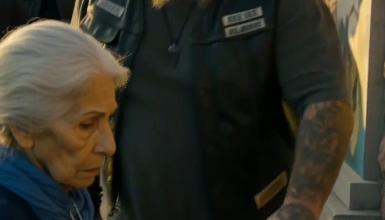
Wade stood outside the screen door. He had washed his hands but not well enough. Oil still sat in the lines of his knuckles. His leather vest creaked when he shifted. A patch on the front said ROAD SAINTS MC. Another said SOBER 12.
That one surprised me.
Not because men like Wade cannot be sober.
Because men like Wade do not usually wear their survival where strangers can read it.
Mrs. Alvarez kept one hand on Lily’s shoulder.
“What do you need, Mr. Mercer?”
Wade removed his cap.
That small act changed the room.
“Ma’am,” he said, “I heard the little girl.”
Mrs. Alvarez’s face hardened.
“This is family business.”
“Yes, ma’am.”
“Then you should not be listening.”
“No, ma’am.”
He accepted the shame without defending himself.
Then he looked past her, not directly at Lily, careful not to scare her.
“I got twelve years clean,” he said. “Before that, I was the kind of sick folks lock doors against. I know what that sickness does to love.”
Mrs. Alvarez’s hand tightened.
Wade swallowed.
“I ain’t here to excuse anybody. Just… maybe I can say it in a way she won’t think it’s her fault.”
The room went so quiet I could hear the soup bubbling on the stove.
Lily slid down from her chair and came to the door.
She looked him over with the brutal honesty of children.
“You’re the loud motorcycle man.”
Wade nodded.
“Yes.”
“You made Grandma’s picture frame fall.”
“I fixed it.”
“You look mean.”
“I know.”
“Are you?”
Wade looked at Mrs. Alvarez before answering.
“I have been.”
That was the false climax.
We thought the danger was letting him in.
We thought the question was whether a frightening biker should sit with a child already carrying too much pain.
But the real danger was what would happen to Wade if Lily believed him.
Because some men can survive being hated.
They cannot survive being trusted.
Mrs. Alvarez opened the screen door.
Wade stepped inside like he was entering a church.
Wade did not sit at first.
He stood near the wall, huge and uncomfortable, as if his body did not know how to be gentle in a grandmother’s kitchen.
Lily returned to her chair.
Her broken crayon lay beside the drawing.
Wade looked at the paper.
Three stick figures. No mouths.
He pulled out the chair across from her, but before sitting, he asked Mrs. Alvarez, “This okay?”
She nodded once.
He lowered himself slowly. The chair complained under him.
His knees hit the underside of the little table. His boots stuck out too far. He folded his hands and rested them where Lily could see them.
No sudden movement.
No big voice.
No pretending.
“You asked why your mom and dad don’t love you,” he said.
Lily watched him.
Wade’s throat moved.
“I think they do.”
Lily’s face changed.
Not hope.
Suspicion.
“Then why don’t they come?”
Wade looked down at his hands.
“Because they’re sick in a way that makes love get trapped.”
That was the sentence.
Mrs. Alvarez covered her mouth.
Wade kept going.
“You ever try to run with a hurt foot?”
Lily nodded.
“Could you run fast?”
“No.”
“Did that mean you didn’t want to?”
“No.”
Wade tapped one finger on the table.
“That’s what addiction does. Except it ain’t the foot. It gets in the body and the brain and the wanting. A person can love you and still be too sick to show up right.”
Lily stared at him.
“That’s stupid.”
Wade almost smiled.
“Yeah.”
“Why don’t they go to the doctor?”
“Sometimes sick people are scared of getting better. Sometimes they don’t believe they can. Sometimes they try and fall down again.”
“Did you?”
The kitchen went still.
There it was.
The question that cut through leather, beard, tattoos, and twelve clean years.
Wade closed his eyes.
“Yes.”
Lily tilted her head.
“Did you have a kid?”
Wade’s face tightened so hard I thought he might stand up and leave.
Instead, he reached into the inside pocket of his vest.
He pulled out a small photograph, creased at the corners and soft from being handled too much.
A boy about eight years old stood beside a blue lunchbox, missing one front tooth, grinning at whoever held the camera.
Wade placed it on the table.
“My son,” he said.
Lily leaned closer.
“What’s his name?”
“Evan.”
“Where is he?”
Wade rubbed both palms against his jeans.
“Eighteen now. Lives in Utah with his mother.”
“Does he come see you?”
“No.”
“Why?”
Wade’s voice dropped.
“Because I didn’t come see him.”
That was the twist.
Wade was not speaking from pity.
He was not some neighbor with a soft spot for a sad child.
He was a father who had once disappeared into the same kind of sickness that took Lily’s parents, and the boy he left behind had spent ten years refusing his calls, his letters, his birthday cards, and every apology Wade had tried to send down the road.
He knew what to say to Lily because he had spent a decade practicing it for a son who would not listen.
The blue lunchbox was Evan’s.
The Friday ritual was not strange.
It was grief with a handle.
Wade looked at Lily and said the words like they cost him something.
“I wish somebody had told my boy this when he was little. So I’m telling you.”
Lily whispered, “What?”
Wade’s eyes shone, but no tears fell.
“That their sickness is not your name.”
Nobody moved after he said it.
Not me.
Not Mrs. Alvarez.
Not even Lily, who usually tapped her shoes when she thought.
Wade pushed the photograph closer, not forcing her to take it.
“My boy was six when I missed his birthday,” he said. “Seven when I sold the bike his grandpa left me. Eight when his mama stopped letting me promise things I couldn’t keep.”
His voice stayed flat.
That made it hurt more.
Biker men do not dress pain up. They set it on the table and let you decide if you can look at it.
“I used to tell myself I loved him,” Wade said. “And I did. But love that don’t show up feels like a lie to a kid.”
Mrs. Alvarez sat down then.
Slowly.
Like her legs had been holding more years than she admitted.
Lily touched the edge of the photo.
“Was he mad?”
“He was quiet first.”
“That’s worse?”
Wade nodded.
“Yeah.”
“What did you do?”
“I got clean too late for him to believe it.”
The refrigerator kicked on with a dull hum.
Outside, Preacher scratched once at Wade’s back gate.
Wade kept his eyes on the table.
“Twelve years ago, I woke up in a motel outside Gallup with no wallet, no bike, no phone, and no idea how many days I’d lost. My brother Moses from the club found me. He didn’t hug me. He didn’t preach. He threw a bottle of water at my chest and said, ‘You can die, or you can become somebody your kid doesn’t have to be ashamed came from.’”
That was the first time I heard the name Moses.
Later, I learned he was the one who brought Wade into the Road Saints. Not because Wade was noble. Because Wade was drowning and mean enough to bite the hand trying to save him.
The club did not fix him.
No brotherhood can do the work for a man.
But they guarded the door while he tried.
One brother drove him to meetings when Wade’s hands shook too badly for handlebars. Another slept on his porch for three nights when Wade wanted to leave town and ruin what was left of himself. Moses kept Wade’s son’s lunchbox in his truck and handed it back every Friday.
“Clean it,” Moses would say.
“Why?”
“So you remember who ate alone.”
That explained the lunchbox.
Every Friday, Wade washed it because Friday was the day he used to pick Evan up from school.
The day he stopped coming.
The empty coffee cup across from him was not for a ghost.
It was for a living boy who wanted nothing to do with him.
Wade reached into his vest again and pulled out a folded envelope. The paper was worn at the creases.
Lily looked at it.
“That for Evan?”
“Yeah.”
“Did you send it?”
Wade shook his head.
“Why?”
“Because sometimes an apology is for the person you hurt. Sometimes it’s just you trying to feel better. I ain’t sure which one this is yet.”
That was the third twist, small but sharp.
Wade had not been rejected because he never tried.
He was holding back because he had finally learned his pain was not the only pain in the story.
Mrs. Alvarez wiped her eyes with the heel of her hand.
“My daughter loves Lily,” she whispered. “But Lily still waits at the window.”
Wade nodded.
“Yes, ma’am.”
“I don’t know what to tell her.”
Wade looked at Lily again.
“You tell her the truth small enough to carry.”
Lily frowned.
“What does that mean?”
“It means your parents are sick. It means it is not your job to fix them. It means missing them does not make you weak. Being angry does not make you bad. And if they don’t come, that does not mean you weren’t worth coming for.”
Lily’s bottom lip trembled.
Wade’s hands curled, then opened.
He did not reach for her.
That mattered.
He let her choose.
After a moment, Lily climbed down from her chair, walked around the table, and leaned against his arm.
Not a hug.
Not exactly.
Just a small body resting against a man the whole street was afraid of.
Wade stared at the wall.
His eyes went wet.
But he did not cry.
He placed one hand, careful as a falling leaf, on the back of her head.
“Your name ain’t what hurt you,” he said.
Lily whispered, “What’s my name?”
Wade looked at Mrs. Alvarez.
She nodded.
“Lily,” he said. “And Lily is enough.”
After that night, Wade became part of Lily’s life in a way nobody announced.
There was no adoption. No miracle phone call from her parents. No clean ending tied with a ribbon.
Real life does not respect timing.
Her mother came back twice, both times thin and nervous, both times crying in Mrs. Alvarez’s driveway, both times leaving before dinner because staying sober for an afternoon is not the same as being ready to be a mother again.
Her father sent one postcard from a treatment center outside Phoenix.
Lily taped it above her bed.
Then took it down.
Then taped it back up.
Wade never told her what to feel.
He just showed up.
On Wednesdays, he fixed the loose hinge on Mrs. Alvarez’s gate. On Fridays, he brought groceries he claimed were “extra from the club,” though everyone knew men like him did not accidentally buy strawberry yogurt, glitter stickers, and dinosaur-shaped chicken nuggets.
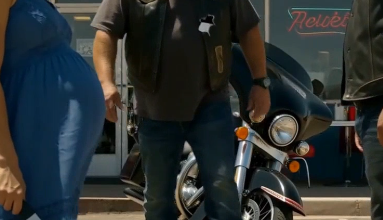
On Sundays, Lily sat on Mrs. Alvarez’s porch while Wade worked on his Harley across the fence. The V-twin would cough, rumble, then settle. Wade would explain tools in simple words.
Socket.
Torque.
Patience.
“Engines don’t like panic,” he told her once.
“Kids don’t either,” she said.
He looked at her over the gas tank.
“No, ma’am, they don’t.”
The Road Saints came around too.
At first Lily hid behind Mrs. Alvarez when six bikers pulled up in a line, engines shaking dust off the curb. Big men. Leather cuts. Tattooed necks. One had a beard down to his chest. Another wore a patch over one eye.
Then the one-eyed man opened his saddlebag and pulled out a stuffed rabbit with one crooked ear.
“My old lady made this,” he said. “Rabbit’s ugly, but loyal.”
Lily accepted it like a queen accepting tribute.
The club started calling her Little Spark.
Wade pretended to hate it.
He didn’t.
Every month, Wade still wrote Evan a letter.
Most stayed unsent.
A few went out.
None came back.
On Evan’s eighteenth birthday, Wade rode north before sunrise. Not to knock on his door. Not to force forgiveness.
He parked three blocks away from the auto shop where Evan worked in Cedar City, Utah, and left a small box at the front desk.
Inside was the blue lunchbox.
Clean.
Empty.
With a note that said only:
You don’t owe me a thing.
I’m still here.
Then Wade rode home through sleet, hands stiff on the chrome, face raw from cold, saying nothing when the brothers asked how it went.
Moses would have understood.
Some roads do not bring you back with what you wanted.
They just bring you back alive.
The last time I saw Wade and Lily together, it was spring.
The desert was warming up again. The kind of evening when the sky over Seligman turns copper and every passing truck on Route 66 sounds farther away than it is.
Lily was seven by then.
She had lost both front teeth and gained a little more noise in her laugh.
Wade sat on Mrs. Alvarez’s porch steps, still huge, still scarred, still frightening to people who only looked once. His leather vest hung open. The SOBER 12 patch had been replaced.
SOBER 13.
Lily sat beside him with the ugly rabbit under one arm.
She asked, “Do you think Evan loves you?”
Wade did not answer fast.
That was one of the things I respected about him. He never gave children cheap words just because adults wanted the room to feel better.
Finally, he said, “I think he’s hurt.”
“That’s not the same.”
“No.”
“Do you love him?”
“Yes.”
“Even if he doesn’t come?”
Wade looked toward the road.
A semi rolled past, low and heavy, shaking the loose screen door behind them.
“Especially then,” he said.
Lily leaned her head against his shoulder.
A minute later, Wade’s phone buzzed.
He looked at it.
His whole body went still.
Not dramatic. Worse.
Quiet.
The screen showed one text from an unknown Utah number.
I saw only four words before he turned the phone against his chest.
I got the lunchbox.
Wade closed his eyes.
His hand shook once.
Then Lily reached over and put her small palm on his scarred knuckles.
The Harley sat by the curb, cooling in the dusk.
Metal ticking.
Leather creaking.
A little girl breathing steady beside a man learning how to stay.
He did not start the engine right away.
This time, he stayed.
Follow this page for more biker stories that hit hard, heal slow, and stay with you.