Part 2: The Fifth Grade Graduate Chosen to Speak About His “Silent Hero” Had Everyone Expecting a Superhero — Until His Final Sentence
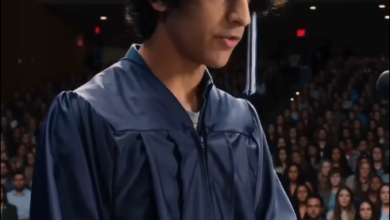
Principal Howard did not move at first.
He was a kind man most days, with silver glasses and a habit of clapping too early. But now he stared at Noah as if trying to decide whether the child had made a mistake or uncovered one.
Mrs. Langley rose halfway from her chair.
“Noah,” she whispered, too softly for most people to hear.
The boy heard her anyway.
He kept both hands on the paper.
The paper was not white like the copy she had approved. It was yellow notebook paper, creased down the middle and smoothed flat with careful fingers. The handwriting was neat at the top, then crooked near the bottom, as if Noah had written while crying or while trying not to.
That was the first small thing people noticed.
A boy who changed his speech to make trouble usually looked proud of himself. Noah looked terrified.
His mother, Rachel Bennett, sat in the third row wearing a navy dress and her best pearl earrings. She looked pale, with one hand pressed to her chest. Beside her, Noah’s grandmother kept whispering, “What is he doing?”
At the back of the cafeteria, the man in the gray work shirt stepped behind a pillar.
His name was Thomas Bennett.
Most people knew him as Tom from the night crew.
Some did not know him at all.
He was thirty-nine, thin from long hours, with tired brown eyes and hands marked by tiny cuts from cardboard boxes and cleaning supplies. His work shirt had the school district logo on one pocket and a coffee stain near the buttons.
He was Noah’s father.
But not many parents knew that.
Noah looked toward him again.
“People think heroes are loud,” Noah said. “They think heroes stand in front of everybody and get medals.”
A few heads turned slowly toward Tom.
Tom shook his head once, barely visible.
Noah saw it.
For a second, he almost folded the paper.
Then he looked at his shoes, breathed in, and kept going.
“My hero is not loud,” he said. “He leaves before I get up, and sometimes he comes home when I am already asleep.”
Rachel closed her eyes.
There was a tightness in her face that did not look like simple embarrassment. It looked like someone bracing for a door to open.
Noah continued.
“My hero smells like floor wax, rain, and the peanut butter crackers he eats for dinner when nobody is watching.”
A few parents stopped smiling.
That was the second small thing.
The speech no longer sounded like a child’s imagination. It sounded like a list of things he had seen and carried quietly.
Mrs. Langley sat down slowly.
Her approved speech remained folded in her lap.
Noah’s voice trembled, but he stayed at the microphone.
“My hero used to build houses,” he said. “He had a red truck, a yellow hard hat, and boots that made the porch shake when he came home.”
Tom lowered his head.
Rachel wiped one tear before it could reach her chin.
“Then one day, the truck stopped coming home,” Noah said. “And people started speaking quieter around him.”
The room changed.
Parents who had leaned back now leaned forward. Teachers near the wall exchanged looks. Even the fifth graders behind Noah stopped whispering.
Noah turned the page.
“My hero told me he got a new job because he liked schools better than construction sites,” he said. “But I found the hospital papers in the laundry basket.”
Rachel’s eyes opened.
Tom’s face tightened.
That was the third small thing.
This was not a story Noah had been given permission to tell.
Principal Howard stepped toward the podium, then stopped when Mrs. Langley raised one hand.
Let him finish.
She did not say it out loud.
She did not need to.
Noah swallowed.
“I learned a word I was not supposed to know,” he said. “Spinal.”
A woman in the second row put her hand to her mouth.
Tom closed his eyes.
“He fell from a roof,” Noah continued. “Not in a movie way. Not with fire or music. Just a rainy Tuesday, a broken ladder, and everybody saying we were lucky he lived.”
The cafeteria stayed silent.
Noah looked at his paper, but the next words came from memory.
“My hero came home different. He walked slower. He hurt more. He stopped laughing in the kitchen.”
Rachel began crying quietly now.
“And then people started asking my mom why he didn’t have a real job anymore.”
At that, Tom looked up.
Shame crossed his face before anger could.
Noah’s small hands tightened around the paper.
“That is why I changed my speech,” he said. “Because today everybody is talking about moving up. But somebody helped me stand up all year, and nobody called his name.”
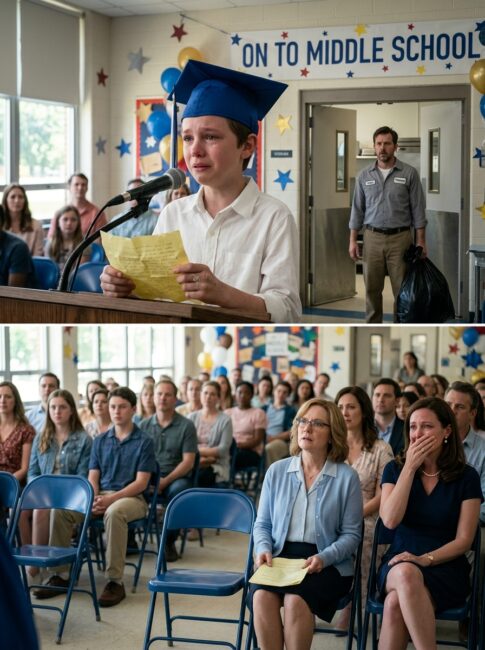
The cafeteria felt smaller than it had a minute before.
All the decorations remained. The paper stars still hung from fishing line. The banner still promised middle school like a bright, simple future.
But every adult in the room seemed to have grown quieter inside themselves.
Noah lifted the yellow paper again.
“When Dad started working nights here,” he said, “he told me it was because he wanted to be near me.”
A few children smiled, but the adults heard the ache beneath it.
“He said cleaning classrooms was important because kids deserve clean places to learn.”
Tom stood near the kitchen doors, gripping the trash bag with one hand. He looked as if he wanted to disappear into the hallway.
Noah saw him and spoke faster, as if afraid his courage would leave.
“But I heard two parents in the parking lot say he was just the janitor.”
The word just landed hard.
Rachel’s face crumpled.
Tom looked down at his work shoes.
That was the fourth twist. The boy had not been ashamed of his father’s work. He had been hurt by the shame other people placed on it.
Noah continued.
“I wanted to tell them he used to build houses taller than our school. I wanted to tell them he could fix anything with a pencil, a level, and one of those little square tools.”
He glanced toward his father.
“But Dad said not to.”
Tom shook his head again, pleading silently.
Noah’s voice softened.
“He said people do not need your whole story to deserve your kindness.”
Mrs. Langley began wiping her eyes.
Noah turned another page.
“After his accident, Dad could not run with me at field day. He could not carry me on his shoulders like before. Sometimes he had to sit on the stairs and breathe until the pain went away.”
A few parents looked down.
“But he still got up at three every morning to make my lunch before his shift ended.”
Rachel looked startled.
“You didn’t know that?” Noah asked, turning toward her.
His mother shook her head through tears.
The room absorbed the fifth twist.
Tom had been doing more than anyone knew, even in his own house.
“He wrote jokes on my napkin,” Noah said. “Bad jokes. Like, really bad.”
A soft laugh moved through the cafeteria, fragile and grateful.
“One day I asked why he always gave me the bigger sandwich,” Noah said. “He told me grown-ups don’t need lunch as much.”
Several mothers in the room began crying.
Noah looked toward his father.
“But I saw him eating crackers in the supply closet.”
Tom pressed his hand over his eyes.
The boy kept going.
“My hero checks every chair in my classroom before school events because he knows I hate wobbly chairs. He fixes the squeaky door near Mrs. Langley’s room because it scared me during tests. He cleans the cafeteria last because he likes to look at my art on the wall when nobody is around.”
Mrs. Langley whispered, “Oh, Tom.”
Noah turned to her.
“And when I got picked to give this speech, I wrote one about superheroes because I thought people would listen better.”
He looked at the approved copy in her lap.
“Mrs. Langley liked it.”
The teacher nodded, crying.
“But then I heard Dad tell Mom he should not come today.”
Rachel turned sharply toward Tom.
Tom looked trapped.
Noah’s voice broke.
“He said people would see his uniform and think less of me.”
The entire room seemed to stop breathing.
Tom finally spoke from the back.
“Noah, buddy, that’s enough.”
His voice was gentle, but heavy with pain.
Noah shook his head.
“No, Dad.”
He was still only ten. His dress shirt was still too big. His feet barely reached the floor when he sat in class. But in that moment, he stood with the stubborn courage of someone protecting a person who had protected him first.
“You told me heroes do the hard thing even when nobody claps,” Noah said.
Tom’s face folded.
“So I am doing the hard thing.”
Rachel covered her mouth, crying openly.
Noah turned back to the audience.
“My dad was not invited like the other parents because he was working tonight’s shift. He took the break schedule nobody wanted so he could stand by the kitchen doors and hear my speech.”
Principal Howard closed his eyes.
The shame in the room now had names and faces.
Noah’s paper shook.
“But he is my parent. He is my hero. And he should not have to hide by the trash cans to watch me graduate from fifth grade.”
For a moment, nobody moved.
Then Mrs. Langley stood.
She walked to the back of the cafeteria, slow and steady, past the rows of stunned parents and students.
When she reached Tom, she did not say anything.
She simply took the trash bag from his hand and set it on the floor.
Then she turned toward the room and began clapping.
One clap.
Then another.
Then Rachel stood.
Then Noah’s grandmother.
Then the fifth grade teachers.
Soon the entire cafeteria rose, chairs scraping, programs falling, parents wiping their faces as applause filled the room.
Tom did not bow.
He did not wave.
He looked at his son across the room, tears running down his face, and pressed one hand over the school district logo on his shirt.
Noah smiled a little.
Then he looked at the last line of his speech.
The line everyone would remember.
“My silent hero is not a superhero,” he said. “He is the man who cleans this room after everyone leaves, then comes home and still has enough love left for me.”
The applause lasted longer than anyone expected.
Not because people were trying to make up for everything with noise, though some probably were. It lasted because no one knew how to stop honoring a man they had spent a year barely seeing.
Tom Bennett stood by the kitchen doors with Mrs. Langley beside him and the trash bag at his feet.
For the first time all morning, he did not look like a staff member waiting for the room to empty.
He looked like a father.
Principal Howard walked to the microphone after Noah stepped back.
He cleared his throat twice before words came.
“Mr. Bennett,” he said, “would you please join your son onstage?”
Tom shook his head quickly.
Noah did not.
He held out his hand from the stage.
That small hand, reaching across the cafeteria, did what applause could not. It gave Tom a place to go.
Slowly, painfully, Tom crossed the floor.
People moved chairs out of his way. A father in the aisle offered an arm, but Tom smiled and kept walking on his own. Not out of pride. Out of the quiet need to meet his son standing.
When he reached the stage steps, Noah ran down instead.
He threw both arms around his father’s waist, careful not to hit the place that still hurt.
Tom bent over him and held on.
The microphone picked up only one sentence.
“I didn’t want you to be ashamed of me,” Tom whispered.
Noah answered into his shirt.
“I was never ashamed.”
That was when Rachel stood beside them, one hand on her husband’s back, one hand in her son’s hair. Their family made a small circle near the stage steps, surrounded by paper stars and a room full of people who had finally gone quiet for the right reason.
The ceremony continued, but differently.
When Noah received his certificate, he handed it first to his father. Tom held it with both hands as if it were made of glass.
Afterward, parents approached him one by one.
Some apologized directly.
Some thanked him for fixing things they had never noticed were broken.
One mother admitted she had been the person in the parking lot. She could barely look at him when she said it.
Tom only nodded.
Noah watched, unsure whether to feel proud or tired. Maybe both.
Near the end, Mrs. Langley brought over the approved superhero speech.
“I kept this,” she said.
Noah looked embarrassed. “It wasn’t true enough.”
She smiled through tears. “No. But it helped you find the one that was.”
That evening, after the cafeteria emptied, Tom stayed to finish his shift.
Rachel offered to wait with him. Noah did too.
Tom started to say no, then stopped.
Together, they folded chairs under the fading light from the high windows. Noah carried programs to the recycling bin. Rachel took down a few paper stars and placed them carefully in her purse.
Before leaving, Noah taped one star to the handle of his father’s cleaning cart.
Tom noticed it near the kitchen doors.
Written in blue marker were five words.
My hero works here.
Tom touched the paper star with one finger, then looked down the quiet cafeteria where the applause had already faded into memory.
Noah stood beside him, holding his fifth grade certificate.
“Ready to go home, Dad?” he asked.
Tom nodded, picked up the trash bag, and this time, he did not hide it behind his back.
Follow the page for more emotional stories that stay with you long after the last line.