Part 2: The Foster Care Student Was Separated From the Honor Group — Then the Principal Told Her Story Before the Entire School
At first, nobody clapped.
People were too confused.
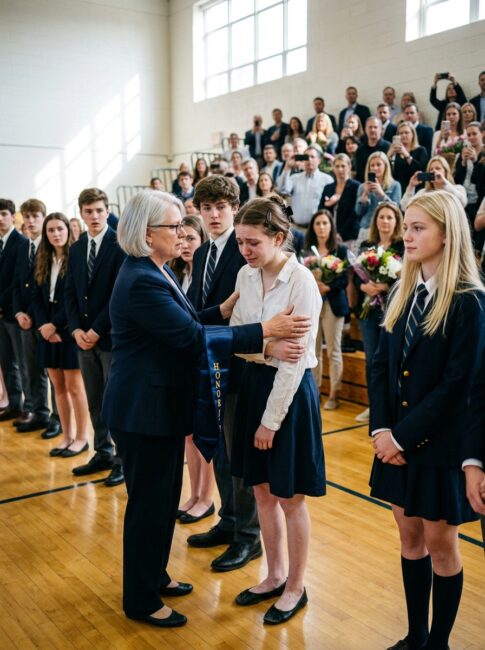
Lily stood beside the principal with her eyes fixed on the floor, still holding the sash in her hands. Her fingers moved over the gold stitching again and again, like she was trying to rub herself out of the moment.
Principal Ellis did not rush.
She was a woman in her late fifties with silver hair, sharp glasses, and the kind of calm voice that made students stop running in the hallway without being yelled at. That morning, though, her voice was different.
It carried something heavier than discipline.
“Many of you know Lily as the girl who missed senior breakfast,” she said. “Some of you know her as the girl who came late to three exams. A few of you know her as the student who was not wearing the right shoes during the district honors photo.”
A ripple moved through the bleachers.
Lily swallowed hard.
Near the first row, a mother leaned toward another and whispered something behind her program. The second woman lifted her eyebrows and looked at Lily’s scuffed flats.
Everyone had seen those shoes.
They were black, cracked near the toes, and polished so carefully they almost looked new from a distance.
Principal Ellis glanced down at them for half a second, then back at the crowd.
“What most of you do not know,” she continued, “is why those things happened.”
Lily’s head lifted just a little.
Not enough to look brave.
Just enough to show she was still there.
The principal reached into the pocket of her blazer and took out a folded sheet of notebook paper. It had been opened and refolded so many times that the creases were nearly white.
“This letter was left on my desk at 6:14 this morning,” she said.
A murmur swept across the gym again.
Lily’s hand tightened around the sash.
The principal did not read it yet.
Instead, she turned slightly toward the honor students still standing in their line below the stage. Most of them looked uncomfortable now. Some stared at the floor. One girl named Madison Pike, class president and daughter of a school board member, kept her arms folded.
Madison had been the one who complained last week.
Everyone knew it.
She had told the counselor that the honor program needed “standards,” and that Lily had missed too many events to deserve the same recognition.
Madison had not said it loudly.
But schools have thin walls.
By Friday morning, half the senior class knew.
Lily Harper, foster kid, scholarship case, always late, always tired, was being questioned for a place she had earned.
Principal Ellis looked at the paper in her hand.
“Lily did not ask me to say this,” she said. “In fact, she begged me not to.”
Lily closed her eyes.
That was the first moment the mood changed.
Not because the crowd understood.
Because they suddenly realized they had been allowed to watch something private.
The principal unfolded the paper.
Her hands were steady, but her mouth pressed into a line before she spoke.
“Mrs. Ellis,” she read, “please do not take my name off the honors list because of yesterday. I know I left practice early, and I know I missed the group picture. I promise I was not being disrespectful.”
The gym went still.
The word practice hung in the air.
Lily was not an athlete. She was in the academic honor society, the volunteer committee, and the state debate team. Practice meant the graduation speech rehearsal.
She had left before her turn.
That was the rumor.
That was why Madison complained.
The principal kept reading.
“I was trying to get back before anyone noticed, but the bus was late, and I could not ask my foster mom for a ride because she had already left for her night shift.”
Lily’s mouth trembled.
A boy in the second row stopped smirking.
The principal paused long enough for the words to settle.
Then she folded the letter again, but did not put it away.
“That is one piece,” she said. “Only one.”
She walked to the edge of the stage and nodded to the large screen behind her.
A photograph appeared.
It was not a school photo.
It showed a grocery store parking lot at dusk. Lily stood beside a row of shopping carts, wearing the same white blouse and cracked black flats. In one hand she held a backpack. In the other, she held the hand of a little boy with a Spider-Man lunchbox.
Gasps moved through the room.
Lily looked at the screen and went completely still.
Principal Ellis said, “That boy is not her brother by blood. He is five years old. His name is Noah. He lives in the same foster home.”
The screen changed.
Now it showed a handwritten bus schedule with circles around three routes. Beside it was a receipt for peanut butter, bread, apples, and children’s cough medicine.
The receipt total was eleven dollars and thirty-six cents.
“She missed the district honors photo,” the principal said, “because Noah’s daycare called the foster home and no adult could get there before closing.”
No one moved.
“She left speech rehearsal because she had to take two buses across town, pick him up, buy food with the money she had saved for graduation shoes, and get him home before his breathing treatment.”
Lily stared down at the sash.
A teacher in the back covered her mouth.
Madison’s folded arms dropped slowly to her sides.
But the principal was not finished.
“And that still is not the whole story.”
Principal Ellis turned off the screen.
The gym lights seemed brighter after the images disappeared, almost too bright for what everyone had just seen.
Lily whispered something, but the microphone did not catch it.
The principal leaned toward her.
Lily shook her head.
“No,” Principal Ellis said softly, but this time the microphone caught every word. “Not today, Lily.”
The room heard the gentleness in it.
And for the first time, people began to understand that the girl had not been pulled from the honor line to be punished.
She had been pulled from it because something larger was about to happen.
Principal Ellis faced the crowd again.
“Lily Harper has been in seven homes since she was nine years old,” she said.
No dramatic music played. No one gasped loudly. The words were too plain for that.
They landed harder because they were plain.
“She came to Franklin Ridge in October of her sophomore year with two garbage bags of clothes and a transcript so broken our registrar had to call three districts to confirm her credits.”
Lily’s eyes filled, but she did not wipe them.
“She never told her teachers that. She only asked which assignments she had missed.”
A few students shifted in their seats.
Some of them remembered.
The girl who always sat by the window. The girl who never joined lunch tables unless invited twice. The girl who said “I’m fine” so often it stopped sounding like an answer.
Principal Ellis lifted the old notebook paper again.
“This letter was not the first thing Lily left on my desk.”
She nodded to a counselor seated near the front.
The counselor stood and carried a small cardboard box to the stage. It was the kind used for printer paper, dented at the corners, with a strip of masking tape on one side.
The principal took out a stack of envelopes.
Not fancy envelopes.
Plain white school envelopes with names written in small, careful handwriting.
“These are tutoring notes,” Principal Ellis said. “Lily wrote them for students who were failing algebra, biology, English, and U.S. history.”
The honor students stared at the stack.
“She did not sign up through the volunteer program because that required a parent permission form, and she did not want to explain why getting one was complicated.”
A few parents lowered their phones.
“She met students before school in the library. She corrected essays during lunch. She helped one freshman pass geometry while sitting in the back of a city bus.”
The principal looked toward the freshman section.
A boy with round glasses suddenly dropped his face into his hands.
His mother, sitting beside him, reached for his shoulder.
That was the first small twist.
Lily had not just survived quietly.
She had been holding other students up while everyone thought she was barely holding herself together.
Principal Ellis took another envelope from the box.
“This one was returned by a teacher who thought it was an anonymous complaint.”
She opened it and read, “Marcus understands the work, but he is embarrassed to ask questions in class. Please do not call on him in front of everyone. He freezes, then pretends he does not care.”
A tall boy near the back stared at Lily.
His face changed in a way that made his friends stop laughing.
Principal Ellis placed the note back in the box.
“She noticed what adults missed,” she said.
Then she reached for something at the bottom.
A black leather wallet, old and worn thin at the corners.
Lily’s breath caught.
The principal held it gently.
“This belonged to Mr. Raymond Ellis,” she said.
The gym went completely silent at the name.
Everyone in Franklin Ridge knew Mr. Ellis.
He had been the principal’s husband, a retired firefighter who volunteered at school events, fixed broken stage lights, and dressed as Santa at the winter drive. He had died the previous spring after a heart attack in the school parking lot.
Principal Ellis looked at Lily.
Her voice almost broke.
“Most of you heard that my husband died before the ambulance arrived. That is not true.”
A chill seemed to move through the gym.
“He died at the hospital. And the reason he got there at all was because a student found him beside his truck, called 911, started chest compressions from instructions over the phone, and stayed with him until help came.”
The principal lifted the wallet.
“That student was Lily Harper.”
Lily began to cry then.
Not loudly.
Just one tear, then another, as if her body had finally run out of places to hide them.
Principal Ellis continued, but slower now.
“My husband carried this wallet for thirty-one years. When paramedics arrived, it was on the pavement beside him. Lily picked it up and gave it to me at the hospital.”
She opened the wallet.
Inside was a small school photo of the principal and her husband from some old charity event.
“There was also a folded note in it,” she said. “Something Raymond had written for a foster youth scholarship fundraiser he never got to attend.”
She looked at the paper tucked inside the wallet.
“He wrote, ‘A child should not have to prove they are worth keeping.’”
The words did something to the room.
They moved through the bleachers and settled into faces one by one.
A grandmother in the front row wiped her cheeks.
A father who had been recording lowered his phone to his lap.
Madison Pike turned away from the stage, crying silently.
Lily had saved the principal’s husband.
And then, after he died, she had never told anyone.
That was the second twist.
The girl people accused of not respecting the honor program had protected the family of the woman now standing beside her.
Principal Ellis placed the wallet back in the box.
“When I asked Lily why she never said anything, she told me, ‘It was not my story to use.’”
That sentence broke something.
Not loudly.
Quietly.
In the teachers.
In the students.
In the parents who had judged her shoes, her absences, her silence.
Principal Ellis turned to the honor students.
“Last week, I received a formal concern that Lily had not represented this program properly.”
Madison lowered her head.
The principal did not name her.
That kindness made the room hurt more.
“I reviewed every absence, every late arrival, every missed ceremony. I found daycare calls, court dates, emergency placement changes, bus transfers, and one night where Lily slept in the school nurse’s office because her new placement was not ready until morning.”
A low sound moved through the audience.
Not anger.
Recognition.
Shame has a sound when it spreads through a crowd.
Principal Ellis stepped closer to Lily.
“This morning, I asked her to step out of the honor line because I refused to let her stand in a row where her story would be measured by the same narrow ribbon as everyone else’s.”
She took the sash from Lily’s hands.
For one terrible second, people thought she was going to take it away.
Instead, she folded it carefully and placed it over Lily’s shoulders again.
Then she removed her own principal’s medal, the silver one she wore at every graduation and award ceremony, and fastened it beneath Lily’s sash.
Lily looked at her, stunned.
“This medal is not an award,” Principal Ellis said. “It is a promise. As long as I am principal here, no student in this building will be reduced to what people can see from a distance.”
No one clapped yet.
They were afraid to ruin the moment.
Then Noah appeared.
The little boy from the photo stepped out from the side door, holding the counselor’s hand and wearing a tiny button-up shirt with sneakers that lit up when he walked.
He carried something folded against his chest.
Lily saw him and pressed both hands over her mouth.
“Noah,” she whispered.
The counselor guided him onto the stage.
He looked frightened by the crowd, but when he reached Lily, he held up the folded object.
It was not flowers.
It was a drawing.
A stick figure girl with brown hair stood beside a smaller stick figure boy. Above them, in crooked blue crayon, he had written:
“LILY CAME BACK.”
That was the third twist.
To the school, Lily had missed a picture.
To Noah, she had kept a promise.
Lily knelt in front of him.
The whole gym watched the foster care student they had judged wrap her arms around a five-year-old boy who had no idea how many adults had just learned the meaning of loyalty.
Noah patted her shoulder with one tiny hand.
“Don’t cry,” he said into the microphone clipped near the principal’s collar. “You found me.”
That was when the applause finally came.
Not the polite kind used for certificates and speeches.
It rose slowly at first, then built until the gym floor seemed to vibrate.
The honor students began clapping.
Teachers stood.
Parents stood.
Then the freshmen.
Then the seniors.
Within seconds, the whole gym was on its feet.
Madison Pike walked out of the honor line.
For a moment, people thought she was leaving.
Instead, she climbed the stage steps, took the flowers from her own mother’s hands, and stood awkwardly in front of Lily.
“I’m sorry,” she said.
The microphone barely caught it.
Lily looked at the flowers.
Then at Madison.
Then at the honor line below, where students who had never missed a meal, a ride, or a permission slip watched her with faces changed by something they could not undo.
Lily did not give a speech.
She did not make anyone feel worse than they already did.
She only took one flower from the bouquet, broke the stem shorter, and tucked it into Noah’s shirt pocket.
“For him,” she said.
And somehow, that was enough.
By Monday morning, the story had already moved beyond Franklin Ridge.
A parent had posted a short video of the assembly, but not the whole thing. Only the part where Noah held up his drawing and Lily knelt in front of him.
The caption said, “We almost missed who she was.”
Thousands of people shared it.
Some called the school to donate shoes, clothes, gift cards, and graduation supplies. A local mechanic offered Lily a used car after hearing about her bus routes. A retired teacher mailed a check with a note that said, “For the student who kept showing up.”
But Lily did not become a different person overnight.
That was the part people outside the school never saw.
She still sat by the window in English class. She still carried the same backpack with the torn zipper. She still spoke softly when teachers called on her, and she still looked uncomfortable when too many people said she was inspiring.
The difference was smaller.
And maybe more important.
Students started leaving chairs open at lunch without making a big show of it.
The freshman Marcus began asking questions in class.
The boy with round glasses brought Lily a thank-you card written in pencil, folded twice, and pushed it across the library table without saying anything.
Madison Pike stopped wearing her honor sash around school before ceremonies. Two weeks later, she asked Principal Ellis if the honor society could start a transportation fund for students who missed events because they could not get rides.
Principal Ellis approved it.
She did not smile when Madison asked.
But she did place the form on top of the stack.
Graduation came on a warm evening in June.
The football field was covered with white folding chairs, and families filled the bleachers again. This time, when Lily’s name appeared in the program, there was a small note beneath it.
Valedictorian.
Some people were surprised.
Most were not.
When she walked across the field in her cap and gown, her black flats were still the same pair, cleaned and polished one last time. Around her neck was the navy honor sash. Beneath it, hidden unless the light hit just right, was Principal Ellis’s silver medal.
Noah sat in the front row beside his foster mother.
He wore a tiny clip-on tie and held a sign almost bigger than his chest.
LILY CAME BACK.
When Lily reached the microphone for her speech, she unfolded a paper, looked at it, then folded it again.
For several seconds, she said nothing.
The audience waited.
She looked at Principal Ellis seated behind her. Then she looked at Noah.
Finally, Lily leaned toward the microphone.
“I used to think being seen meant people finding out everything that hurt you,” she said. “But sometimes it means someone noticing you are still here.”
No one moved.
She did not list her hardships.
She did not explain foster care.
She did not tell everyone what they should learn.
She simply thanked her teachers, her counselor, the bus driver who waited thirty seconds longer when he saw her running, and the cafeteria worker who packed extra apples without asking why.
Then she paused.
“And I want to thank Mr. Ellis,” she said, her voice softening, “for writing something he probably did not know I needed.”
Principal Ellis bowed her head.
Lily touched the silver medal lightly through her gown.
“A child should not have to prove they are worth keeping,” she said.
The words drifted across the field with the evening wind.
After graduation, there were photos, hugs, and speeches from people who suddenly wanted to be part of her story. Lily accepted them kindly, but she kept looking toward the edge of the field.
That was where Principal Ellis stood alone near the fence, holding the old black wallet in one hand.
Lily walked over.
For a moment, neither of them spoke.
Then Lily reached into her gown pocket and took out the cracked black hair clip she had worn the day of the assembly.
“I bought a new one,” she said.
Principal Ellis looked at the clip, then at Lily.
It was such a small thing.
Too small for a stage. Too ordinary for a headline.
But Principal Ellis took it like it mattered.
“Where will you go now?” she asked.
Lily looked back at the field, where Noah was chasing the glow from someone’s phone flashlight across the grass.
“College in August,” she said. “Until then, I promised somebody I’d keep coming back.”
Principal Ellis smiled then.
Not proudly.
Tenderly.
Across the field, Noah turned and shouted, “Lily!”
She raised one hand.
The sun had almost disappeared behind the bleachers, leaving a thin gold line over the school roof. For a second, the cracked shoes, the old wallet, the silver medal, and the child’s handmade sign all seemed to belong to the same quiet truth.
Lily Harper walked back across the grass, not toward applause this time, but toward the little boy waiting for her.
And if this story stayed with you, follow this page for more emotional stories about the people we almost misunderstand.